Unit 9 - linear kinetics

0.0(0)
Studied by 1 person
call kaiCall Kai
learnLearn
examPractice Test
spaced repetitionSpaced Repetition
heart puzzleMatch
flashcardsFlashcards
GameKnowt Play
Card Sorting

1/36

encourage image

There's no tags or description

Looks like no tags are added yet.

Last updated 8:01 PM on 10/9/26
Name
Mastery
Learn
Test
Matching
Spaced
Call with Kai
Chat

No analytics yet

Send a link to your students to track their progress

37 Terms

1
New cards

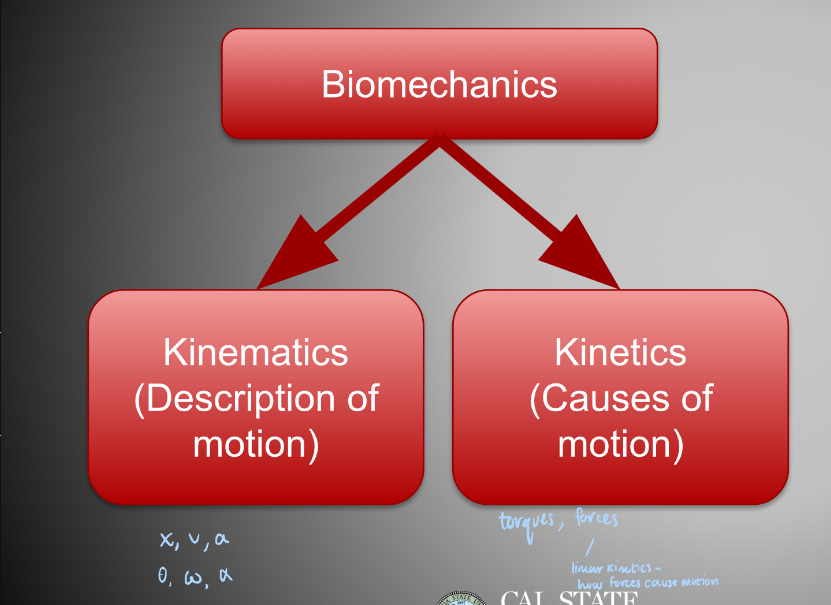
are torques adn force kinematics or kinetics?

kinetics
<p>kinetics </p>
2
New cards

explain Newton’s first law

law of inertia: A body in its state continues at rest or a constant velocity unless and external force (gravity) acts on it

<p>law of inertia: A body in its state continues at rest or a constant velocity unless and external force (gravity) acts on it</p>
3
New cards
  1. What is inertia

  2. Inertia is directly proportional to an object’s ____


  1. resistance to change in motion

  2. mass


4
New cards

Explain why it is easier to push a car rather than a ship

car has less mass so there is less inertia to overcome

<p>car has less mass so there is less inertia to overcome </p>
5
New cards
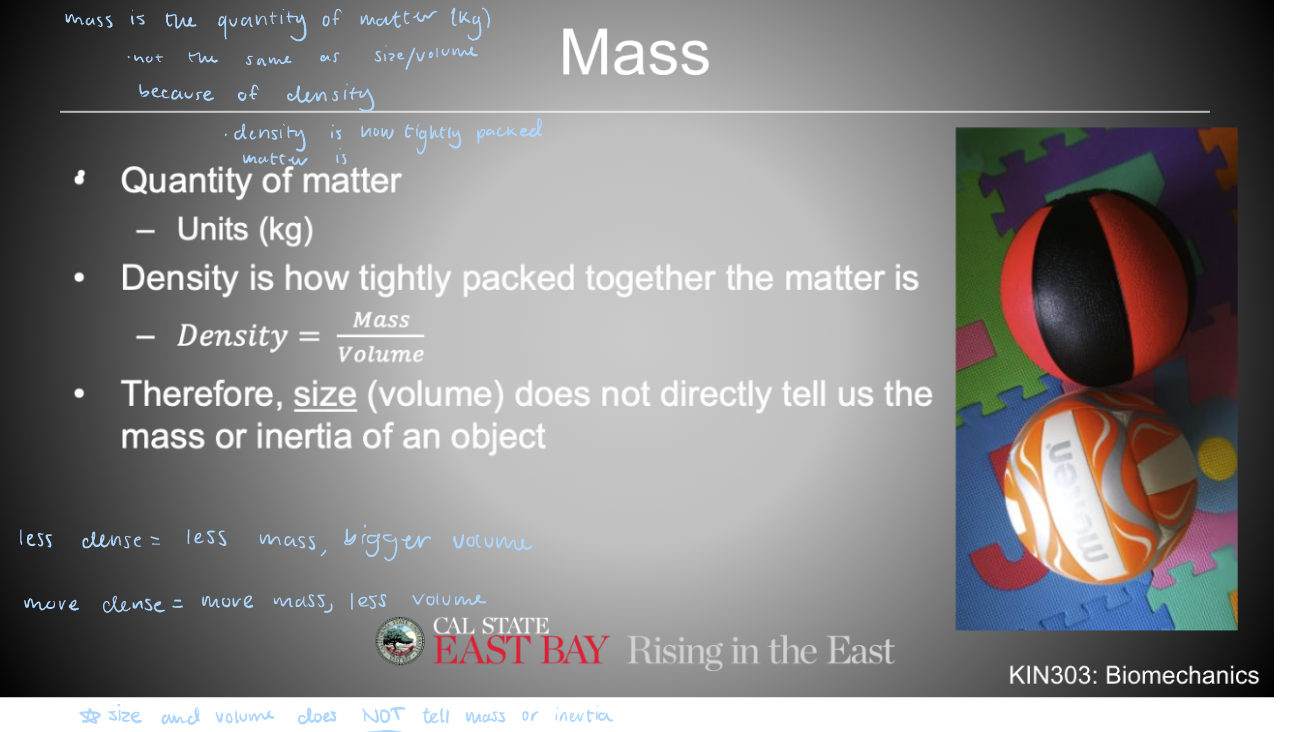
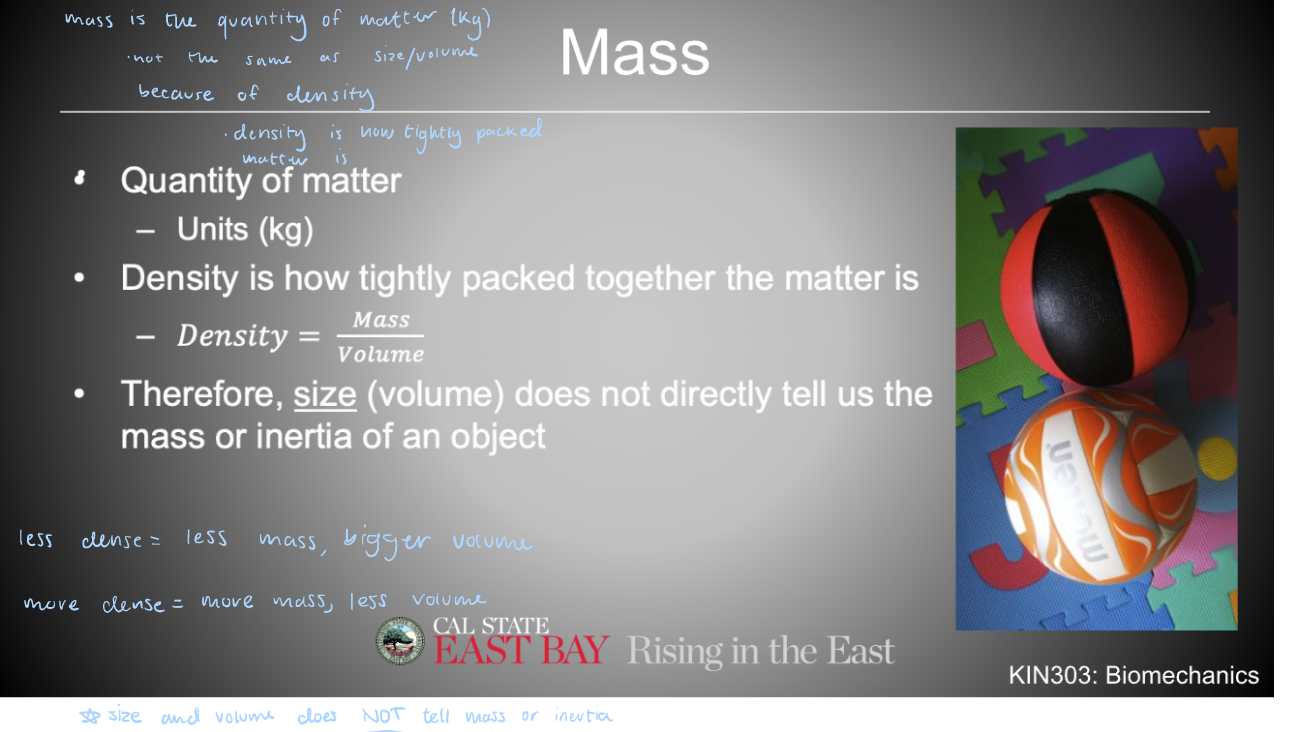
  1. define mass

  2. what are the units for mass?

  3. how is mass different than density?

  4. equation for density


  1. quantity of matter

  2. kg

  3. density is how tightly packed together the matter is

  4. density = mass/volume


<ol><li><p>quantity of matter </p></li><li><p>kg </p></li><li><p>density is how tightly packed together the matter is </p></li><li><p>density = mass/volume </p></li></ol><p></p>
6
New cards
  1. explain the difference between a volleyball and a medicine ball

  2. less dense means…

  3. more dense means…


  1. a medicine ball and a volleyball are the same size (volume) but the volleyball is less dense so it has less mass and the medicine ball is more dense so it more mass

<ol><li><p>a medicine ball and a volleyball are the same <u>size</u> (volume) but the volleyball is less dense so it has less mass and the medicine ball is more dense so it more mass </p></li></ol><p></p>
7
New cards

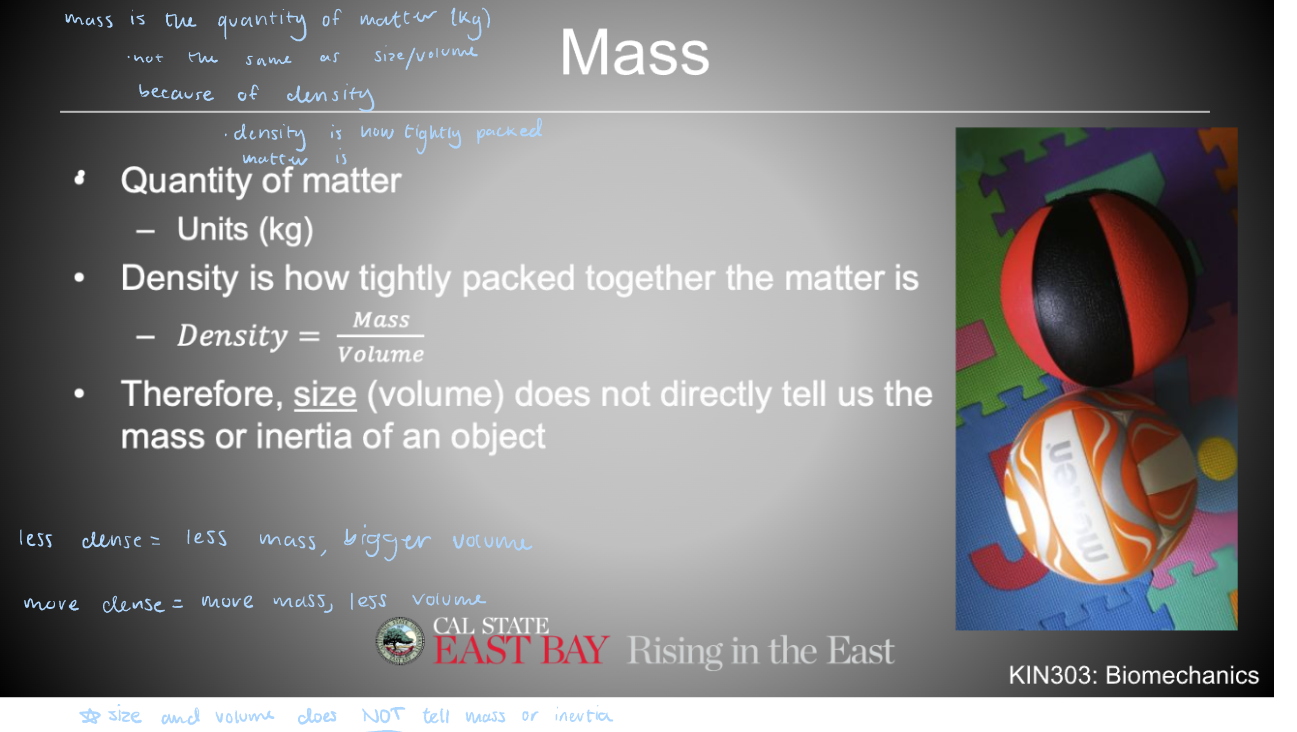
does size (volume) tell you mass and inertia?

NO
<p>NO</p>
8
New cards

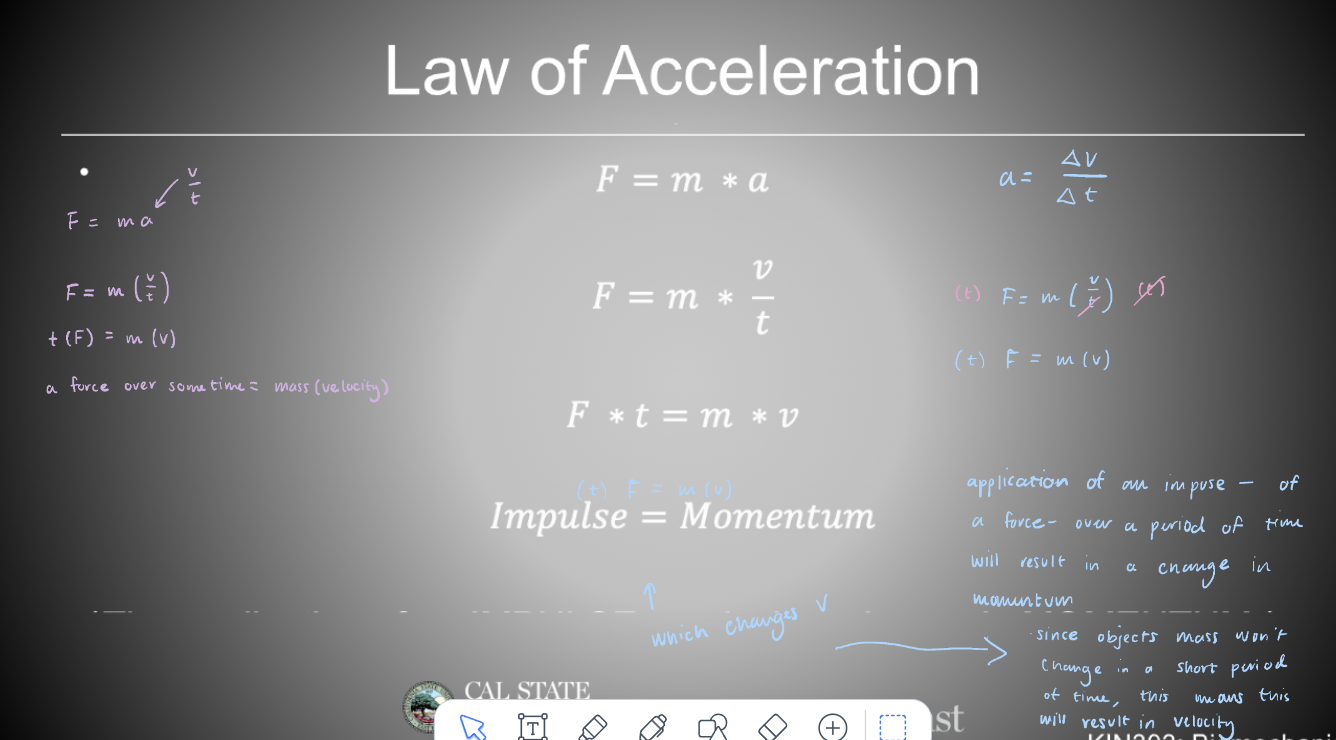
explain newton’s second law

law of acceleration: force is proportional to mass and acceleration

<p>law of acceleration: force is proportional to mass and acceleration</p>
9
New cards

when mass is high an object will accelerate ____(more/less) when a given given force is high

less

(vice versa is true also)

<p>less </p><p>(vice versa is true also)</p>
10
New cards
  1. The ____ on an object determines the acceleration. How much acceleration is determined by the object’s _____ .

  2. what is the equation that represents this?

  3. relate the movement of the object to kinematics (hint: use acceleration)


  1. force, mass

  2. F = ma

  3. read all bullet points on slide for answer


<ol><li><p>force, mass </p></li><li><p>F = ma</p></li><li><p>read all bullet points on slide for answer </p></li></ol><p></p>
11
New cards

connect newton’s first and second law

see image

<p>see image </p>
12
New cards

what is derived from F = ma?

impulse = Momentum

<p>impulse = Momentum </p>
13
New cards

Momentum equation

mass * velocity

<p>mass * velocity </p>
14
New cards

Impulse equation

force * time

<p>force * time </p>
15
New cards

derive impulse = momentum

see image

<p>see image </p>
16
New cards
  1. what is impulse?

  2. TRUE OR FALSE: impulse will result in a change in velocity. explain


  1. force applied over a certain period a time

  2. true since impulse = momentum and momentum = m * v


<ol><li><p>force applied over a certain period a time </p></li><li><p>true since impulse = momentum and momentum = m * <strong>v</strong>  </p></li></ol><p></p>
17
New cards
<p>explain two ways to stop the football player’s momentum (low velocity) by using impulse </p>

explain two ways to stop the football player’s momentum (low velocity) by using impulse

see image and hope you can read my handwriting

<p>see image and hope you can read my handwriting </p>
18
New cards

Is GRF and impulse of a momentum?


Impulse

<p>Impulse</p>
19
New cards
<ol><li><p>What can you find under the blue curve?</p></li><li><p>The area under the curve is equal to ____</p></li></ol><p></p>
  1. What can you find under the blue curve?

  2. The area under the curve is equal to ____


  1. vertical impulse (F * t)

  2. momentum


<ol><li><p>vertical impulse (F * t)</p></li><li><p>momentum</p></li></ol><p></p>
20
New cards

impulse can be found using the area under the curve of what kind of graph?

vertical impulse component of GRF

<p>vertical impulse component of GRF </p>
21
New cards
<ol><li><p>Review: anterior/posterior GRF is…</p></li><li><p>how do you find propulsion and breaking impulse? </p></li><li><p>0 on the graph is what phase? </p></li><li><p>breaking impulse is from ____ (concentric/eccentric) activation of ____ muscles </p></li></ol><p></p>
  1. Review: anterior/posterior GRF is…

  2. how do you find propulsion and breaking impulse?

  3. 0 on the graph is what phase?

  4. breaking impulse is from ____ (concentric/eccentric) activation of ____ muscles


  1. breaking (posterior) and propulsion (anterior), horizontal component of GRF

  2. area under the curve (green and blue)

  3. heel strike

  4. eccentric activation of quads


<ol><li><p>breaking (posterior) and propulsion (anterior), horizontal component of GRF</p></li><li><p>area under the curve (green and blue) </p></li><li><p>heel strike </p></li><li><p>eccentric activation of quads </p></li></ol><p></p>
22
New cards
<ol><li><p>how can you tell if the person is speeding up or slowing down? </p></li><li><p>how is this ^^^ related to momentum? </p></li></ol><p></p>
  1. how can you tell if the person is speeding up or slowing down?

  2. how is this ^^^ related to momentum?


  1. looking at the area under the curve

  2. impulse is equal to momentum, and momentum equation is mass * velocity and mass isn’t changing so velocity must be


<ol><li><p>looking at the area under the curve  </p></li><li><p>impulse is equal to momentum, and momentum equation is mass * velocity and mass isn’t changing so velocity must be </p></li></ol><p></p>
23
New cards
  1. define momentum

  2. equation

  3. units


  1. quantity of motion

  2. mass * velocity

  3. kg*m/s


<ol><li><p>quantity of motion </p></li><li><p>mass * velocity </p></li><li><p>kg*m/s</p></li></ol><p></p>
24
New cards
  1. what is the pattern for momentum and impulse?

  2. explain it


  1. impulse — momentum — impulse

  2. see image (purple)


<ol><li><p>impulse — momentum — impulse </p></li><li><p>see image (purple) </p></li></ol><p></p>
25
New cards
<p>impulse — momentum — impulse pattern: </p><ol><li><p>in phase 1, during take off ____ is applied to the body </p></li><li><p>That creates a ____. During flight phase this is _____(got rid of/preserved) </p></li><li><p>To stop, velocity is brought to zero by ____ </p></li><li><p>what are two ways to bring velocity to zero? </p></li></ol><p></p>

impulse — momentum — impulse pattern:

  1. in phase 1, during take off ____ is applied to the body

  2. That creates a ____. During flight phase this is _____(got rid of/preserved)

  3. To stop, velocity is brought to zero by ____

  4. what are two ways to bring velocity to zero?


  1. impulse

  2. momentum (velocity), preserved

  3. another impulse

  4. see image (very bottom)


<ol><li><p>impulse </p></li><li><p>momentum (velocity), preserved </p></li><li><p><em>another </em>impulse </p></li><li><p>see image (very bottom) </p></li></ol><p></p>
26
New cards
<p>explain the graph </p>

explain the graph

idk man

27
New cards
  1. explain newton’s third law


  1. for every action there is an equal opposite reaction


28
New cards
  1. what law can be applied to friction?

  2. what are the two types friction. explain them


  1. newtons third law

  2. static (from a not moving object) and kinetic (moving object)


<ol><li><p>newtons third law </p></li><li><p>static (from a not moving object) and kinetic (moving object) </p></li></ol><p></p>
29
New cards
  1. definition of static friction

  2. equation for static friction

  3. what do the variable mean

  4. example of static friction

  5. once you overcome static friction it is _____ (easier/hard) to keep the object moving


  1. resists onset of movement

  2. Fmax = mews * R

  3. see image for variable meanings

  4. poking something and it doesn’t move bc you did not overcome the static friction

  5. easier


<ol><li><p>resists onset of movement </p></li><li><p>F<sub>max</sub> = mew<sub>s</sub> * R </p></li><li><p>see image for variable meanings</p></li><li><p>poking something and it doesn’t move bc you did not overcome the static friction </p></li><li><p>easier </p></li></ol><p></p>
30
New cards
  1. definition of kinetic friction

  2. equation for kinetic friction

  3. what do the variable mean


  1. resists ongoing movement

  2. Fmax = mewk * R

  3. see image


<ol><li><p>resists ongoing movement </p></li><li><p>F<sub>max</sub> = mew<sub>k</sub> * R </p></li><li><p>see image </p></li></ol><p></p>
31
New cards

is static or kinetic friction larger

static is always larger

32
New cards
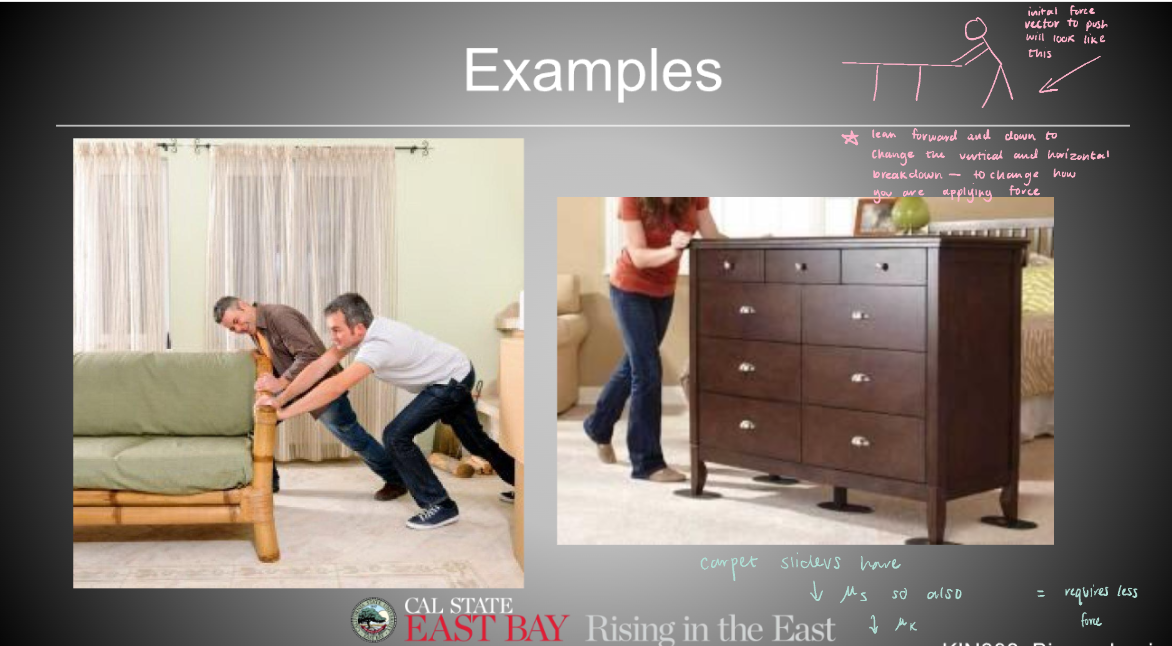
<ol><li><p>what will the force vector for leaning forward to push something look like? </p></li><li><p>why do you lean forward and down to push something </p></li><li><p>why is it easier to push something with carpet sliders? </p></li></ol><p></p>
  1. what will the force vector for leaning forward to push something look like?

  2. why do you lean forward and down to push something

  3. why is it easier to push something with carpet sliders?


  1. see image (top right drawing)

  2. so that you change the vertical and horizontal breakdown — you are changing how you apply the force

  3. reduces the static friction therefore kinetic also goes down

<ol><li><p>see image (top right drawing) </p></li><li><p>so that you change the vertical and horizontal breakdown — you are changing how you apply the force </p></li><li><p>reduces the static friction therefore kinetic also goes down </p></li></ol><p></p>
33
New cards
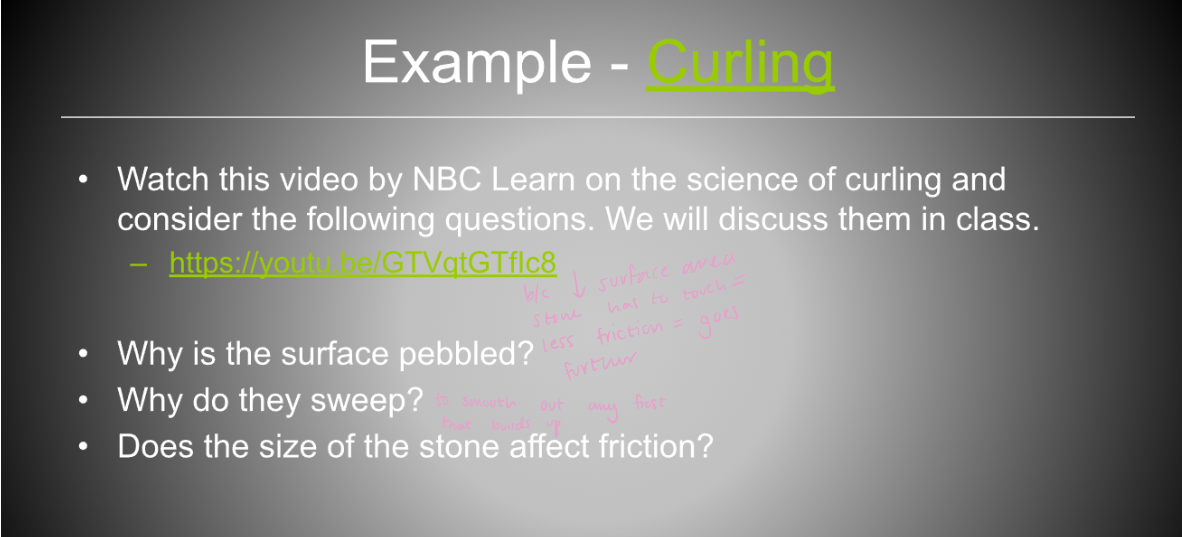
<p>curling…</p>

curling…

knowt flashcard image
34
New cards
<p>understand this  </p>

understand this

knowt flashcard image
35
New cards
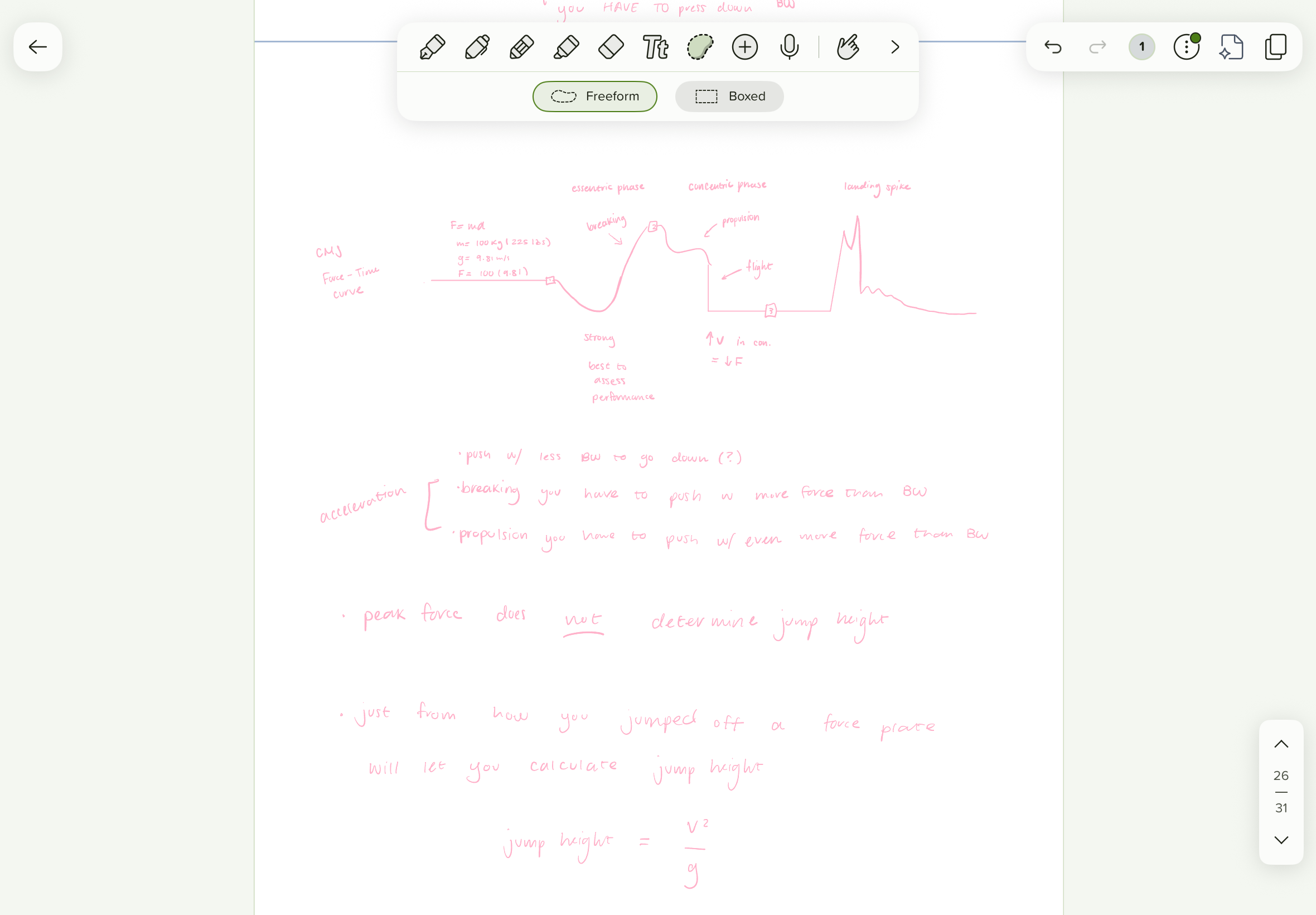
<p>this is a CMS graph showing the force-time curve (pretty sure the person was jumping but idk):</p><ol><li><p>that means this graph is showing an ____</p></li><li><p>what does the dip in the graph represent between 1 and 2</p></li><li><p><span style="background-color: transparent; font-size: 1.6rem;">explain the breaking phase</span></p></li><li><p>explain the propulsion phase</p></li></ol><p></p>

this is a CMS graph showing the force-time curve (pretty sure the person was jumping but idk):

  1. that means this graph is showing an ____

  2. what does the dip in the graph represent between 1 and 2

  3. explain the breaking phase

  4. explain the propulsion phase


  1. impulse

  2. pressing down on the ground to make the velocity go up (before you jump)

  3. not 100% sure but it has to do with GRF and pressing down on the ground to jump


36
New cards
  1. during a jump is breaking phase concentric or eccentric?

  2. during a jump is propulsion phase concentric or eccentric?

  3. does velocity go up or down in concentric phase?


  1. see image

  2. see image

  3. up


<ol><li><p>see image </p></li><li><p>see image </p></li><li><p>up </p></li></ol><p></p>
37
New cards
<p>read </p>

read

READ IT

<p>READ IT </p>