AQA Alevel biology - biological molecules
 Call Kai
 Learn
Learn Practice Test
 Spaced Repetition
 Match
Match Flashcards
 Knowt Play
1/66

There's no tags or description
Looks like no tags are added yet.
Name | Mastery | Learn | Test | Matching | Spaced | Call with Kai | Chat |
|---|
No analytics yet
Send a link to your students to track their progress
67 Terms
what are monomers ?
Monomers are the smaller units from which larger molecules are made.
what are polymers ?
Polymers are molecules made from a large number of monomers joined together.
what does a condensation reaction do ?
A condensation reaction joins two molecules together with the formation of a chemical bond and involves the elimination of a molecule of water.
what does a hydrolysis reaction do ?
A hydrolysis reaction breaks a chemical bond between two molecules and involves the use of a water molecule.
what is a monosaccharide ?
Monosaccharides are the monomers from which larger carbohydrates are made. A single monomer.
what are the examples of monomers ?
Glucose, galactose and fructose
what is a disaccharide ?
Disaccharides are formed by the condensation of two monosaccharides
What bond forms between monosaccharides ?
glycosidic bond
what are the disaccharides and what 2 monosaccharides do they consist of ?
Maltose - glucose + glucose
Sucrose - glucose + fructose
Lactose - glucose + galactose
what is the alpha glucose isomer look like ?
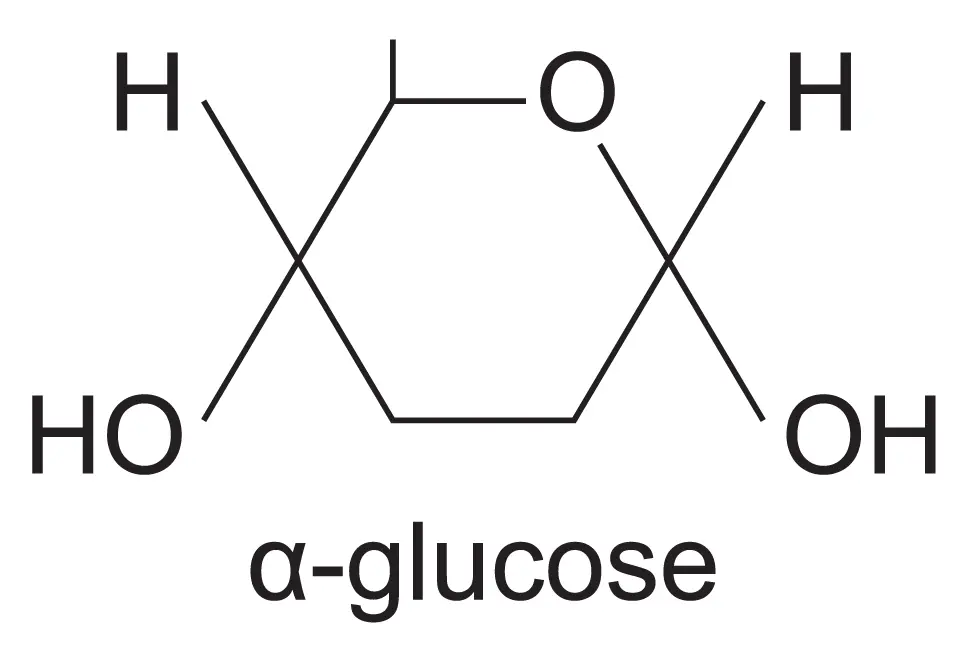
what does the beta glucose isomer look like ?
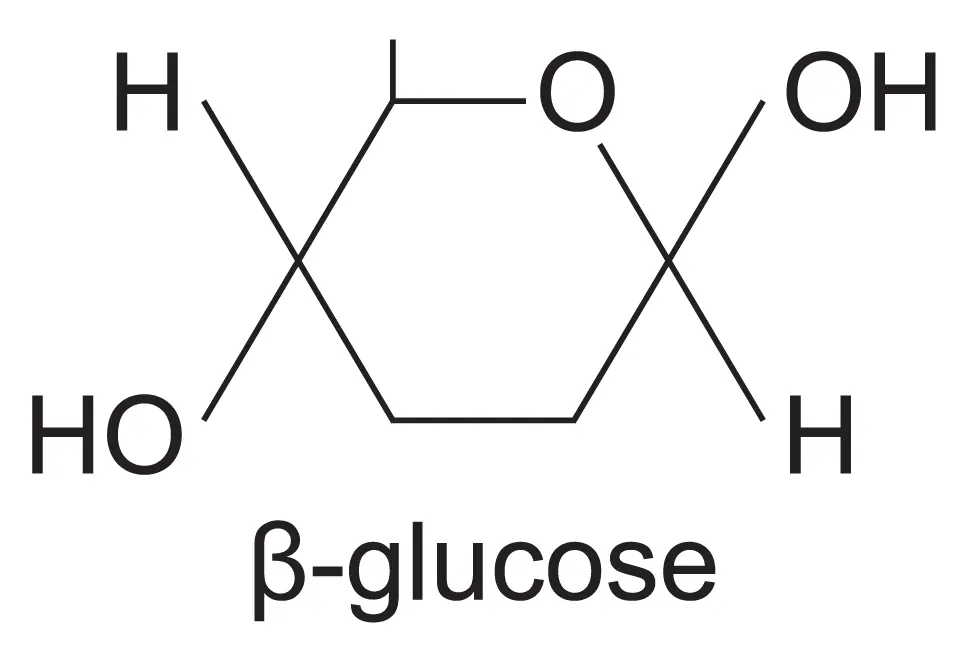
what is a polysaccharide ?
Polysaccharides are formed by the condensation of many glucose units
what are the polysaccharides of alpha glucose ?
glycogen and starch
what is a polysaccharide of beta glucose ?
cellulose
what is the structure of glycogen ?
1,4 or 1,6 glycosidic bonds
large number of side branches
large but compact
insoluble
why is having a large number of branches important ?
energy can be released quickly as enzymes can simultaneously act on the branches
why is important to be compact ?
so you can fit more , increasing amount of energy
why is it important to be insoluble ?
It doesnt affect the water potential and cannot diffuse out of the cell
what is the structure of amylose ?
unbranched
1,4 glycosidic bonds
coiled (very compact )
what is the structure of amylopectin ?
many side branches
1,4 + 1,6 glycosidic bonds
what is the method for reducing sugars ?
Add equal volumes (e.g., 2 cm³) of the food sample test solution and Benedict's reagent into a test tube.
Place the test tube into a boiling water bath.
Heat the mixture for 5 minutes
what is a positive result for reducing sugars ?
Blue turns into Brick Red
what is the test for non-reducing sugars ?
erform Benedict's test: Test a sample first. If it stays blue, reducing sugars are absent.
Acid Hydrolysis: Add 2 cm³ of the fresh sample and an equal volume of dilute hydrochloric acid (HCl) to a new test tube.
Heat: Place the tube in a boiling water bath for 5 minutes to break glycosidic bonds.
Neutralise: Add sodium hydrocarbonate (NaHCO₃) or sodium hydroxide (NaOH) until the solution stops fizzing. Benedict's reagent requires alkaline conditions to work.
Re-test: Add equal volume Benedict's reagent. Heat in a boiling water bath for 5 minutes.
Observe: A color change to green, yellow, orange, or brick-red confirms non-reducing sugars.
what is the test for starch ?
Prepare Sample: Add 2 cm³ of your liquid food sample (or a solid piece of food) into a test tube or onto a spotting tile.
Add a few drops of iodine
positive result : orange to blue-black
what are triglycerides made of ?
Triglycerides are formed by the condensation of one molecule of glycerol and three molecules of fatty acid.
what type of bond is formed between a glycerol and fatty acid ?
A condensation reaction between glycerol and a fatty acid (RCOOH) forms an ester bond.
what is substituted in a phospholipid from a triglyceride ?
In phospholipids, one of the fatty acids of a triglyceride is substituted by a phosphate-containing group.
what makes an unsaturated fatty acid different to a saturated fatty acid ?
Unsaturated has a carbon-carbon double bond. Therefore they are liquids at room temp
what are the properties of triglycerides and why are they important ?
large and non-polar so they are insoluble in water and thus do not affect water potential
low mass to energy ratio so a lot of energy can be stored n a small volume
high ratio of hydrogen - oxygen atoms
what is the structure of a phospholipid ?
hydrophilic head and hydrophobic tail creates a bilayer and makes the cell polar
glycerol , phosphate and 2 fatty acids
what is the method of the emulsion test ?
add the sample to test tube
add ethanol
shake the test tube
then add water and shake again
positive result is a milky white emulsion
what is the general structure of an amino acid ?
where NH2 represents an amine group, COOH represents a carboxyl group and R represents a side chain
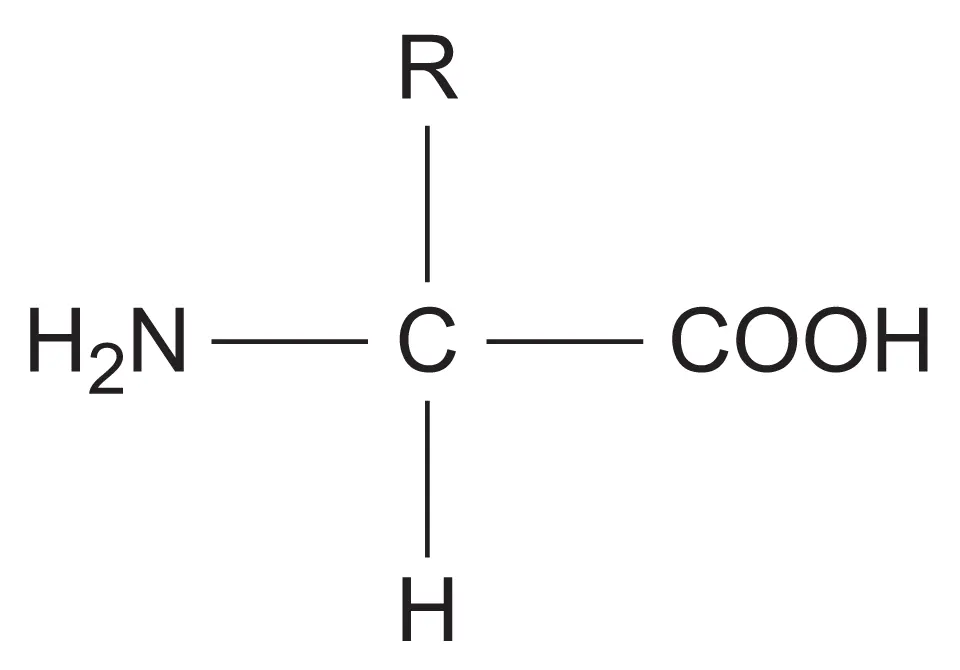
what bond forms between 2 amino acids ?
A condensation reaction between two amino acids forms a peptide bond.
what is a dipeptide ?
Dipeptides are formed by the condensation of two amino acids.
what is a polypeptide ?
Polypeptides are formed by the condensation of many amino acids.
what is the primary structure of proteins ?
Sequence of amino acids joined by peptide bonds
what is the secondary structure of proteins ?
the shape that the amino acid chain makes - either beta pleated or alpha helix
what is the tertiary structure of proteins ?
the 3D shape of the protein by further twisting and folding
held together by disulphide bridges , hydrogen bonds and ionic bonds
what is the Quaternary structure of proteins ?
2 or more polypeptide chains
what is the method for testing for proteins ?
add biuret to sample
positive result is purple
how do enzymes work ?
lower the activation energy without being used up themselves
what is the induced fit model ?
When the active site slightly alters to fit the substrate
what is the lock and key model ?
the active site and substrate are perfectly complementary
how does enzyme activity change with temperature ?
An increase in temperature increases the rate of reaction as kinetic energy increases up to the optimum
how does pH change the rate of reaction ?
it increases rate of reaction up tp optimum where it denatures thereafter
how does enzyme concentration affect rate of reaction ?
It increases until substrate conc becomes the limiting factor
how does substrate concentration effect rate of reaction ?
It increases until enzyme conc becomes the limiting factor
how is DNA and RNA used to carry info ?
DNA holds genetic information and RNA transfers genetic information from DNA to the ribosomes.
what are ribosomes made of ?
RNA and proteins
what are the components of DNA ?
The components of a DNA nucleotide are deoxyribose, a phosphate group and one of the organic bases adenine, cytosine, guanine or thymine.
what are the components of RNA ?
The components of an RNA nucleotide are ribose, a phosphate group and one of the organic bases adenine, cytosine, guanine or uracil.
what bond is formed between nucleotides ?
A condensation reaction between two nucleotides forms a phosphodiester bond.
what is the structure of DNA ?
A DNA molecule is a double helix with two polynucleotide chains held together by hydrogen bonds between specific complementary base pairs.
what is the structure of RNA ?
An RNA molecule is a relatively short, single stranded polynucleotide chain.
why is DNA stable ?
Phosphodiester backbone protects the more chemically reactive nitrogen containing bases inside the double helix
Hydrogen bonds between bases
what is the process of semi - conservative replication in DNA ?
DNA helicase causes the DNA helix to unwind.
DNA helicase breaks the hydrogen bonds between the complementary base pairs.
This separates the two strands, leaving both strands to act as templates
Free DNA nucleotides align alongside the exposed template strands.
They attach via complementary base pairing.
Adenine pairs with Thymine and Cytosine pairs with Guanine
DNA polymerase joins the new nucleotides together in a condensation reaction.
This forms phosphodiester bonds to create the new sugar-phosphate backbone.
Each new DNA molecule retains one original (parental) strand and one new strand.
what is the structure of ATP ?
A single molecule of adenosine triphosphate (ATP) is a nucleotide derivative and is formed from a molecule of ribose, a molecule of adenine and three phosphate groups.
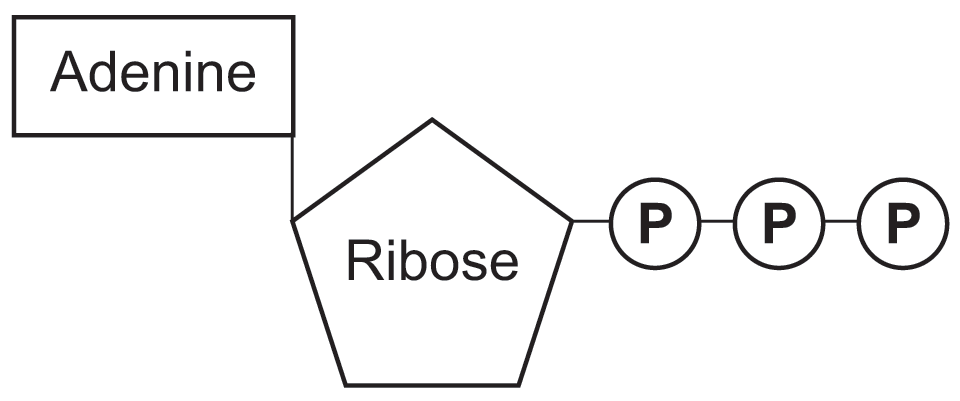
how does ATP release energy ?
ATP is hydrolysed with the help of ATP hydrolase to form ADP and a phosphate molecule
how is ATP produced ?
ATP Synthase catalyses the condensation reaction of ADP and inorganic phosphate
what happens to the inorganic phosphate in ATP ?
Can be used to phosphorylate other compounds , making them more reactive
what are the properties of ATP ?
its an immediate source of energy
What are the properties of water ?
is a metabolite in many metabolic reactions, including condensation and hydrolysis reactions
is an important solvent in which metabolic reactions occur
has a relatively high heat capacity, buffering changes in temperature
has a relatively large latent heat of vaporisation, providing a cooling effect with little loss of water through evaporation
has strong cohesion between water molecules; this supports columns of water in the tube-like transport cells of plants and produces surface tension where water meets air.
what is the role of hydrogen ions ?
determine the pH of substances such as blood
what is the role of iron ions ?
a component of haemoglobin
what is the role of sodium ions ?
involved in the co-transport of glucose and amino acid ions
what is the role of phosphate ions ?
a component of DNA and ATP