7.5 - Decay
 Call Kai
 Learn
 Practice Test
 Spaced Repetition
 Match
 Flashcards
 Knowt Play
1/5

There's no tags or description
Looks like no tags are added yet.
6 Terms
How has decay in taphonomy changed in the last 40ish year?
transition from regular observations of decay, now experients occurs within labs and can have control over the environments in which an organism decays
What patterns can decay experiments observe?
changes and loss of morphology at different levels can be done by puttin thins in brines to see decay, inlcuding:
sub-cellular (melanosomes)
cellular (embryos)
whole bodies (anatomy)
tissues/ structures (muscles)
communities (brine seeps)
What variables need to be considered when testing a hypothesis in decay experiments?
Phylogeny, ontogeny, physical, chemcal, biological, history
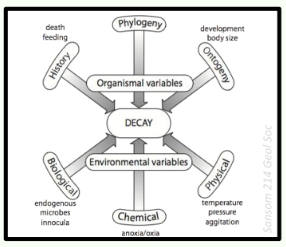
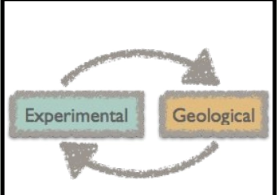
What can decay experiments be used to inform?
interpretations of geology, this works both ways round
Discuss the Melanosome Shape experiment (McNamara et al, 2013)
Experiment = muturation of feathers for implications of fossil feather colour reconstructions
Aim = test feasibility of interpretations
Hypotheis = taphonomic porcesses do not alter geometry of melanosomes
Organismal variables = feathers from range of modern birds
Environmental variables = high temp, high pressure
Output = measuring geometry
Result = shape change, thus implication taphonomy does alter feather geometry
Discuss the Chordate Decay experiment (Sansom et al, 2010,2011)
Experiment = non-random decay of chordates causes biases in fossil interpretation, discussions around chordate ancestry is highly disbuted
Aim = assess interpretations of controversial fossil chordates
Hypotheis = chordate characters decay in random order with respect to informativeness
Organismal variables = hagfish, amphioxus, lamprey
Environmental variables = artifical seawater, bacteria
Output = quantative charcater scores
Result = charcater type correlated with order of loss during decay, thus implication slippage is stem-ward
in some species, the look more primitive than actual form when decayed (what does this say about biases in fossil interpretation?)