Ecology - Lecture 8: Introduction to populations
 Call Kai
 Learn
Learn Practice Test
 Spaced Repetition
 Match
Match Flashcards
 Knowt Play
1/19

There's no tags or description
Looks like no tags are added yet.
Name | Mastery | Learn | Test | Matching | Spaced | Call with Kai | Chat |
|---|
No analytics yet
Send a link to your students to track their progress
20 Terms
what does population ecology explain?
what factors determine the variation in the size and structure of populations over time and space
What is a population?
a group of individuals of the same species that live in the same area at the same time and interact with one another
What do individual interaction mean?
includes sexual reproduction and competition
What does 'populations are dynamic' mean?
distribution and abundance can change over time and space
what is population size?
number of individuals
what is population density?
number of individuals per unit area
what are the two ways abundance can be reported?
population size or density
How can abundances and distributions be estimated?
area based counts, distance methods, mark-recapture
how do you characterize a population?
age class distribution or size class distribution
Why is understanding population structure important?
Understanding the factors that influence population dynamics helps us manage populations for harvest or conservation
geometric growth
discrete time periods
exponential growth
continuous reproduction
when do populations grow geometrically?
when reproduction occurs at regular time intervals

what does Nt represent?
population size after t generations or after t time periods

what does λ mean?
geometric population growth rate

what does N0 mean?
initial population size

what does N(t) represent?
the population size at each instant in time t

what does N0 represent?
initial population size

what does dN/dt represent?
rate of change in population size at each instant in time t
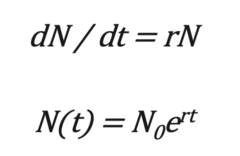
what does r represent?
exponential growth rate