Biology
 Call Kai
 Learn
Learn Practice Test
 Spaced Repetition
 Match
Match Flashcards
 Knowt Play
1/99

There's no tags or description
Looks like no tags are added yet.
Name | Mastery | Learn | Test | Matching | Spaced | Call with Kai | Chat |
|---|
No analytics yet
Send a link to your students to track their progress
100 Terms
Five Characteristics of Life:
Cells, Replication, Information, Energy, Evolution
Five Characteristics of Life: Cells
The most basic unit of structure and function in living organisms
Five Characteristics of Life: Replication
A cell producing another cell that is an exact copy of them
Five Characteristics of Life: Information
All cells carry hereditary information that is encoded in genes as well as information from the environment.
Five Characteristics of Life: Energy
All living organisms need energy to survive
Five Characteristics of Life: Evolution
Populations of organisms are continually evolving
Cell Theory #1
All living organisms have one or more cells
Cell Theory #2
Cells are the most basic unit of structure and function of all living organisms
Cell Theory #3
All cells come from pre-existing cells
Modern Cell Theory #1
All living organisms have one or more cells
Modern Cell Theory #2
Cells are the most basic unit of structure and function of all living organisms
Modern Cell Theory #3
All cells come from pre-existing cells
Modern Cell Theory #4
All cells carry hereditary information
Modern Cell Theory #5
All cells are the same in chemical composition
Modern Theory #6
Energy flows occur within the cells
Properties of Life:
Order, Response to Stimuli, Reproduction, Growth and Development, Energy Processing, Evolution, Homeostasis, Adaptation
Order
Atoms to Molecules to Organelles/Structure
Stimuli
Detectable change in an organism’s internal or external environment that causes a reaction or response
Response to Stimuli
Metabolic Changes, Physiological changes, Unicellular, and Pluricellular
Unicellular
A single-celled organism
Pluricellular
An organism made up of multiple cells
What does an Unicellular respond to?
Responds to other cells in a colony
What does a Pluricellular respond to?
Responds to other cells in an organism. They listen, communicate, and adapt to instructions from neighboring cells to keep the whole body working together.
Central Dogma
Flow of genetic information
What is Asexual Reproduction?
When a single celled organism reproduce by cell division, making an exact copy.
What results in Adaptations?
Natural selection
Who does adaptation occur to?
To an individual
Evolution
The change in characteristics and genetic makeup of a population over time
When does Evolution occur?
Occurs through natural selection and genetic mutations
What is Descent with Modifcation?
Characteristics of species can be modified from generation to generation.
What is one of the two conditions needed in order for natural selection to occur?
Individuals must have characteristics that are heritable
What is two of the two conditions needed in order for natural selection to occur?
When a heritable trait helps the individual reproduce more than other traits
What does a experiment include?
One or more variable and one or more controls
What is a control group?
A standard baseline in an experiment that does not receive the treatment or intervention being tested
What is an inductive reasoning?
Uses related observations to come to a general conclusion
What is deductive reasoning?
Uses a principle or law to forecast specific results
Levels of Organizations:
Atoms, molecules or macromolecules, organelle, cell, tissue, organ, organ system, organism, population, community, ecosystem, biosphere
What is a tissue?
Group of cells with a common function
What is an organ system?
A group of organs that perform a common function
What forms an organ?
When different tissues interact
What forms an organ system?
Different organs that have a similar function
What are the four types of tissue?
Connective, Nervous, Muscle, Epithelial
What does the extracellular matrix (ECM) do?
Links cells between each other, provides anchorage to cells, and gives structural support and strength to the tissue
What does “provides anchorage to cells” mean?
Providing anchorage to cells means acting like an anchor or a solid physical base that holds cells in place so they do not drift away
What is the Phylogenetic tree?
Visually summarizes the evolution of species
What are the three domains?
Bacteria, Archaea, and Eukarya
What is the Taxonomic Rank from smallest to largest?
Species, Genus, Family, Order, Class, Phylum, Kingdom, Domain
What is Dalton (Da)?
Mass of atom is equal to its mass number
Shells can be filled by…
Formation of chemical bonds
Octet Rule
Elements are most stable when their outermost shell is filled with elements
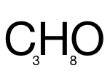
What formula is this?
Molecular Formula
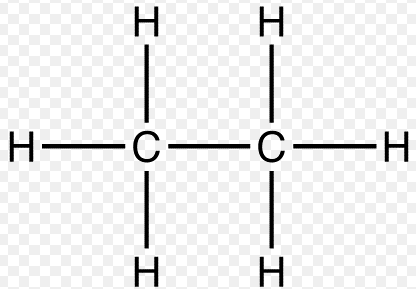
What formula is this?
Structural Forumula
What does the molecular formula indicate?
The numbers and types of atoms
What does the Structural formula indicate?
Indicates the atoms bonded together and type of bond
What are ionic bonds?
Attraction between charged atoms
What are electrolytes?
Ions that are important for cellular functions
What role do Hydrogen bonds have?
They play a critical role in structure, solubility, water molecules, etc.
What are hydrogen bonds?
They are an interaction between: Hydrogen bound to electronegative atom and electronegative atom
What is the proton donor in a hydrogen bond?
The hydrogen bound to electronegative atom
What is the proton acceptor in a hydrogen bond?
The electronegative atom
The Hydrogen bound to electronegative atom is the…
Proton donor
The electronegative atom is the
Proton acceptor

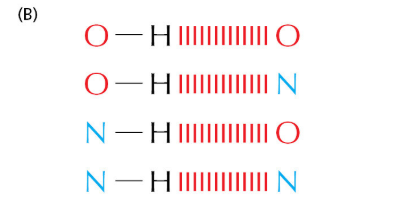
Which side is the donor atom?
Left

Which side is the acceptor atom?
Right
What is Van der Waals?
Electrostatic between dipoles of two molecules
Is Van der Waals weaker or stronger than Hydrogen Bonds?
Weaker
Why are the Van der Waals important?
They stabilize structures such as DNA
What composition does Nonpolar Molecules have?
Hydrocarbon
Are Nonpolar Molecules charged?
No
What molecules are energetically favorable? And why?
Nonpolar Molecules are energetically favorable because they reduce exposure to hydrophilic molecules
Electrons are…between two atoms in a Non-Polar Covalent Bond
evenly shared
Electrons are…, so more time is spent close to nucleus of more electronegative atom
shared unevenly
Nonpolar covalent bonds do…
not create partial charges
Polar covalent bonds do…
create partial charges
Which partial charge is positive and negative in a hydrogen bond?
Hydrogen is positive partial charge, Oxygen is negative partial charge
Since water molecules have partial charges, they will
form hydrogen bonds with forming a hydration shell
What is Cohesion?
Attraction between like molecules
What is Adhestion?
Attraction between unlike molecules
Is water cohesive?
Yes
What is Surface Tension?
Cohesive forced caused by attraction between molecules at surface of liquid
What does surface of a water act like?
Elastic membrane
When heated, water molecules have more what?
Kinetic energy
What is Specific Heat?
Energy needed to raise temperature of 1 gram of substance by 1C
What is Heat of Vaporization?
Energy needed to change 1 gram of a substance from liquid to gas
As molecules increase in polarity,…
it takes more energy to change their energy
-OH forms…
hydrogen bonds with water molecules
What do Acids do?
They release protons during a chemical reaction, which increases the proton concentration in a solution
What do Bases do?
They accept protons during a chemical reaction, which lowers the proton concentration in a solution
What do Buffers do?
Helps maintain homeostasis by resisting changes in pH
How do you resist changes in pH?
By releasing or donating H+
What does the pH scale represent?
Represents change in [H+]
What pH level is considered acids?
pH less than 7
What pH level is considered bases?
pH greater than 7
What is neutral in the pH scale?
Neither acidic or basic
What number is neutral in the pH scale?
pH 7
When reactants undergo chemical reaction by binding to an enzyme, they are…
substrates
Enzymes work by…
lowering the activation energy
Before reaction can take place, reactants need to: Collide…
in precise orientation
Before reaction can take place, reactants need to: Have enough…
kinetic energy to overcome activation energy barrier and achieve transition state