Psychology 4th edition of Schacter Chapter 7 - Learning
 Call Kai
 Learn
Learn Practice Test
 Spaced Repetition
 Match
Match Flashcards
 Knowt Play
1/75

There's no tags or description
Looks like no tags are added yet.
Name | Mastery | Learn | Test | Matching | Spaced | Call with Kai | Chat |
|---|
No analytics yet
Send a link to your students to track their progress
76 Terms
Learning
Acquisition from experience of new knowledge, skills, or responses that results in a relatively permanent change in the state of the learner.

Adaptation
A trait that helps an organism survive and reproduce

Hebbian Learning
-Neurons that fire together wire together.
-Learning involves making new brain connections/circuits
-Strength of the circuit depends on how often it fires.

Learning is based on
experience
Learning produces
changes in the organism
Learning changes are
relatively permanent, not transitory
Habituation
A general process in which repeated or prolonged exposure to a stimulus results in a gradual reduction in responding.

Sensitization
A simple form of learning that occurs when the presentation of a stimulus leads to an increased response to a later stimulus

John Watson argued psychologists should never do what?
Never use the terms consciouness, mental states, mind, content, introspectivity verifiable, imagery and the like
Classical Conditioning (CC)
A neutral stimulus produces a response after being paired with a stimulus that naturally produces a response "Involuntary"

Principles of Classical Conditioning
1) acquisition,
5) generalization,
3) discrimination
4) extinction,
5) spontaneous recovery,
6) second-order conditioning,

Acquisition
The phase of classical conditioning when the CS and US are presented together

Unconditional Stimulus (US)
Something that reliably produces a naturally occurring reaction in an organism

Unconditioned Response (UR)
A reflexive reaction that is reliably produced by an unconditional stimulus

Conditional Stimulus (CS)
A previously neutral stimulus that produces a reliable response in an organism after being paired with a US.

Conditional Response (CR)
A reaction that resembles an unconditional response but is produced by a conditioned stimulus.

Second-order Conditioning
A type of learning where a new CS is paired with an existing CS that is associated with the US in an earlier procedure

Extinction
Loss of the behavior following the removal of a reward.
Spontaneous Recovery
The tendency of a learned behavior to recover from extinction after a rest period

discrimination (classical conditioning)
in classical conditioning, the learned ability to distinguish between a conditioned stimulus and similar stimuli and by doing so do not signal an unconditioned stimulus.
e.g. Being able to distinguish between the conditioned bell noise and a similar bell sound (doorbell) and not trigging a UR.

Generalization
The CR is observed even though the CS is slightly different from the CS used during acquisition
Skinner's three-term contingency
Discriminative Stimulus (a stimulus that indicates response will be reinforced), Response, and Reinforcement.
Behaviour exists within stimulus control.
Which means a particular behaviour is likely only to occur when the response to said behaviour will lead to reinforcement.
E.g. Gravy is sitting on the table (discriminative stimulus suggests the response to "Pass the gravy" will result in gravy being passed (reinforced behavior)
Classical vs Operant Extinction
In Classical, Extinction occurs when CS is presented with US.
Operant, extinction occurs was reinforcement/punishment cesses.

Three mechanisms of classical conditioning
1) Congivitive
2) Neural
3) Evolutionary elements
Rescorla-Wagner model
a cognitive model of classical conditioning; it holds that the strength of the CS-US association is determined by the extent to which the unconditioned stimulus is unexpected
When does classical conditioning occur (rescorla-wagner)?
when two stimuli are repeatedly paired together, in an expectable reliable way

What role does the central nucleus in the amygdala serve?
Plays a role in produces behavior (fear response) and physiological (hormonal) changes as a response to CS-US
evolutionary adaptation
An accumulation of inherited characteristics that enhance organisms' ability to survive and reproduce in specific environments.

Properties of evolutionary adaptive learning
1) Rapidity (form with few trials)
2) Conditioning can take place over several hours
3) Smell or Taste can/should be the CS, opposed to ingestion
4) Learned aversion happens more with the unfamiliar, than the familiar
Biological Preparedness
A propensity for learning particular kinds of associations over others

Delay Conditioning (Standard Pairing)
CS is paired simultaneously with the US

Trace Conditioning
the presentation of the CS, followed by a short break, followed by the presentation of the US

Operant Conditioning (Skinner)
A type of learning in which the consequences of an organism's behaviour determine whether it will repeat that behavior in the future "Voluntary"

Operant vs. Classical Conditioning
in operant conditioning a behavior is learned; in classic conditioning a response to a stimuli is learned
instrumental behavior (thorndike) [operant]
Behavior that requires the organism to do something; Problem Solving, or otherwise manipulate elements of its environment.
Law of Effect
"The principle that behaviors that are followed by a ""satisfying state of affairs"" tend to be repeated, and those that produce and ""unpleasant state of affairs"" are less likely to be repeated"

Operant Behavior
Behavior that an organism performs that has some impact on the environment

Operant Behavior Reinforcement / Punishment
Positive & Negative Reinforcement and/or punishment.
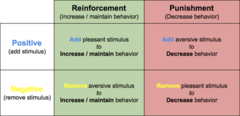
Methods of Reinforcement
Successful approximation Reinforcement
Reinforcer
Any stimulus or event that increases the likelihood of the behavior that led to it (More effective than punishment)
positive reinforcement (adding)
Increasing behaviors by presenting positive stimuli, such as food. A positive reinforcer is any stimulus that, when presented after a response, strengthens the response.
negative reinforcement (Removing)
increasing the strength of a given response by removing or preventing a painful stimulus when the response occurs
Primary reinforcers and punishers
naturally reinforcing or punishing (ex. Drugs, sex, pain) "Biological Needs"
secondary reinforcer (conditioned reinforcer)
a stimulus that gains its reinforcing power through its association with a primary reinforcer
Punisher
Any stimulus or event that decreases the likelihood of the behavior that led to it

positive punishment (Add)
the administration of a stimulus to decrease the probability of a behavior's recurring
Negative Punishment (Remove)
the removal of a stimulus to decrease the probability of a behavior's recurring
Reinforcement vs. Punishment
Reinforcement increases the likelihood of something happening again. Punishment is the consequence of a behavior; it will decrease the likelihood of a behavior happening again.
Punishment signifies unacceptable behavior but doesn't specify what should be done instead. Whereas reinforcement shows which behaviors are rewarded.

Schedules of Reinforcement are
Reinforcers are provided in either Fixed or Variable conditions
The conditions are measured by interval or Ratio timing:
1) Interval (X time passed)
2) Ratio (X conditions met)

Fixed-interval Schedule (FI)
An operant conditioning principle whereby reinforcers are presented at fixed time periods, provided that the appropriate response is made
"Reinforcement at fixed, predictable, times"
E.g. Pay-checks

Variable-interval Schedule (VI)
An operant conditioning principle whereby behavior is reinforced on the basis of an average time that has expired since the last enforcement
"Reinforcement at unfixed, unpredictable, times"
e.g. Checking cell phone

fixed-ratio schedule (FR)
in operant conditioning, a reinforcement schedule that reinforces a response only after a specified number of responses
"Reinforcement after a predictable number of responses"
e.g. Bonus pay after X sales

Variable-ratio Schedule (VR)
An operant conditioning principle whereby the delivery of reinforcement is based on a particular average number of responses.
"Reinforcements after an unpredictable number of responses"
E.g. Gambling (think slot machines)
intermittent reinforcement effect
Operant behaviors that are maintained under intermittent reinforcement schedules resist extinction better than those maintained under continuous reinforcement

shaping behavior
learning that results from the reinforcement of successive steps/trials to a final desired behavior
successive approximation (shaping)
An explanation for the acquisition of complex behaviour. Behaviour such as learning to speak will be reinforced only as it comes to approximate or approaches the final desired behaviour.
Supersticious Behavior
can be acquired through coincidential association of a response to a reinforcer
Cognitive Understanding of Operant Conditioning
1) Latent Learning
2) Cognitive Map
Latent Learning
A process in which something is learned, but it is not manifested as a behavioral change until sometime in the future

Cognitive Map
A mental representation of the physical features of the environment

cognitive capacity
a broad concept including intelligence, educability, concept formation, self-awareness, self-evaluation, attention span, sensitivity in discrimination, and creativity
Pleasure centers of the brain include:
NUcleus Accumbens, medial forebrain bundle and the hypothalamus

Neurons involved in the 'reward center' are ...
dopaminergic (DA)
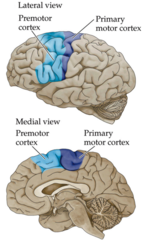
mirror neuron system (44,40)
Frontal lobe(Area 44) and parietal lobe, (area 40) neurons that fire when performing certain actions or when observing another doing so.
The brain's mirroring of another's action may enable imitation, language learning, and empathy.
Observational Learning
An organism learns by watching the actions of others
Diffusion Chain is a method of observational learning

Diffusion Chain
A process in which individuals initially learn a behavior by observing another individual perform that behavior, and then become models from which other individuals learn the behavior.
enculturation hypothesis
the process by which people learn the requirements of their surrounding culture and acquire values and behaviors appropriate or necessary in that culture
Implicit Learning
Learning that takes place largely independent of awareness of both the process and the products of information acquisition
Occipital Lobe activation

explicit learning
Learning that involves conscious awareness of what has been learned.
left temporal, right frontal lobe, parietal lobe

Anatomy of Explicit Memory
Hippocampabl formation
Mediatemporal lobe (MTL)

Massed Practice
Repeatedly studying information with little or no time between repetitions

Distributed Practice
Studying information with time between repetitions (Best kind, especially when coupled with interleaved)

Desirable Difficulties Hypothesis
Practicing "more difficult to retrieve" information that was studied less recently benefits subsequent learning more than easy retrieval.
Interleaved Practice
A practice schedule that mixes different kinds of problems or materials within a single study session
Judgements of Learning
Subjective assessements of the person's own knowledge