Experimental techniques and analysis
 Call Kai
 Learn
 Practice Test
 Spaced Repetition
 Match
 Flashcards
 Knowt Play
1/37

There's no tags or description
Looks like no tags are added yet.
38 Terms
How do you do crystallisation?
Take copper (II) oxide and add it until it’s in excess to sulphuric acid
Filter out the excess copper (II) oxide
Heat the solution over a bunsen burner until it becomes saturated. Check by adding a stirrer and blowing on it to see whether crystals are formed.
Leave it to cool.
Filter the crystals from the solution
Pat with filter paper to dry
Wash crystals with distilled water if you want pure crystals.
Solute
Substance that dissolves in a solution
Solvent
Liquid that dissolves the solute
Solution
Mixture of two or more solutes dissolves in a solvent.
Aqueous
When water is the solvent, the solution is called aqueous
Saturated solution
When a solution can no longer dissolve solute at that temperature.
Methods to separate a solid from a liquid
Crystallisation
Filteration
Evaporation
Simple distillation
Used to separate a solid substance from a liquid mixture and ensuring the liquid isn’t lost. Heat the flask, pass it through a condenser and you get the solvent as well.

What comes in and out of the condenser
Water in, water out
Fractional distillation
Used to separate two liquids from each other, making use of their different boiling points.
Heat the mixture in the flask. Once it reaches the first liquids boiling point, liquid A begins to boil. Some of liquid B evaporates too.
The vapours condense on the glass beads in the fractionating column. The beads heat up.
When the beads reach the boiling point of liquid A, only liquid A evaporates. Liquid B condenses and drips back done onto the flask.
Once the temperature has gone above 78 degrees, all of liquid A is gone following the latent heat of evaporation.
Paper chromatography - three uses
Separates a substance from a mixture
Check the purity of a mixture
Identify the substances in a mixture
Solvents for chromatography
Use ethanol - water is also possible but ethanol is PREFERABLE.
Identifying colourless substances
After the chromatography experiment is done (you can know that it is done once the solvent reaches the solvent front), spray a locating agent such as NINHYDRIN. Use it in a FUME CUPBOARD. Warm the paper in an oven for 10 minutes. The spot changes colour.
Formula for retention factor
Rf = Distance from origin to dot / distance from origin to solvent front
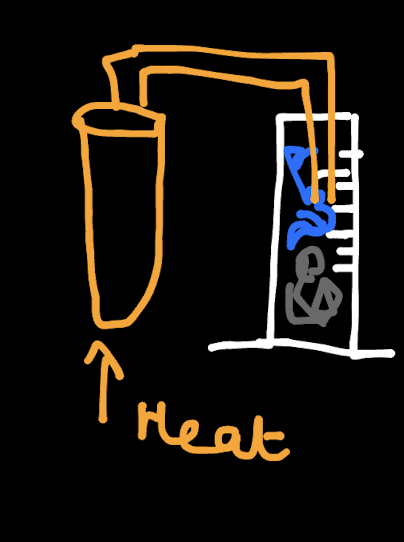
Describe downward displacement of water
Gases sparingly soluble in water
Eg: CO2, H2, O2
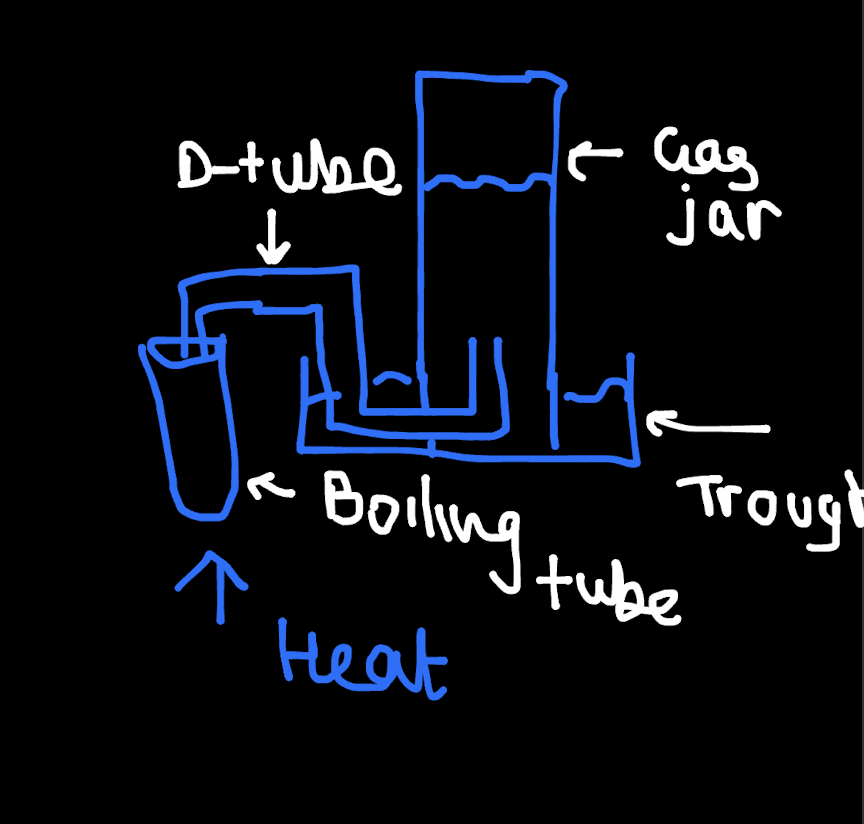
Describe upward displacement of air
Gases heavier than air sink to the bottom.
Eg: CO2, SO2, HCl
Describe downward displacement of air
Gases lighter than air.
Eg: NH3, H2
Test for chlorine
Bleaches damp litmus paper
Test for carbonates/carbon dioxide
Turns limewater milky
Test for oxygen
Relights a glowing splint
Test for hydrogen
Lit splint goes off with a pop
Ammonia
Colourless alkaline gas with a sharp, strong smell. Turns damp red litmus paper blue.
Sulfur dioxide
Turns Acidified Potassium Manganate from purple to colourless.
It is a colourless, poisonous acidic gas with a choking smell.
Tests for cations and anions
DO using paper 6 notes
Flame tests
Potassium - lilac flame
Sodium - yellow flame
Barium - Yellow green flame
Calcium - orange-red flame
Copper - blue-green flame
Lithium - Red flame
Suggest an apparatus suitable for measuring mass
Digital mass balance
Define residue
A substance left behind after filteration, evaporation, distillation or any similar process.
A student adds HCl using a burette. How can the student determine the volume of dilute Hal used in this titration?
By taking the final and initial burette reading and subtracting the initial reading from the final reading
Why is cotton wool put on top of a test tube?
Acts as an insulator and prevents heat loss.
In the downward displacement of water, why aren’t the first few bubbles of air taken?
They are air
Why doesn’t ammonia collect at the top of the measuring cylinder after the downward displacement of water
Ammonia dissolves in the water.
Why are experiments carried out in fume cupboards
One of the resulting gas may be toxic/poisonousI
Suggest why it is important that an excess of sodium sulphate is added to the water in the beaker.
To ensure a saturated solution is formed and to ensure all the reactants are used up.
Why stir during titration?
To speed up dissolving (solid + liquid) and to mix the reactants quicker (liquid + liquid)
How do you ensure all the water has been evaporated?
Reheat and reweigh until the mass stops changing.T
To drop coloured compounds on the chromatography paper, use:
glass rod
Dropping pipette
Dropper
What happens if a polystyrene cup is used instead of a beaker?
Larger temperature change as more heat is preserved. Better insulator
Why are the first few bubbles of gas passing through a measuring cylinder not collected?
They are the air in the delivery tube