Bio 172 Exam 1 Content + Info
 Call Kai
 Learn
Learn Practice Test
 Spaced Repetition
 Match
Match Flashcards
 Knowt Play
1/171

There's no tags or description
Looks like no tags are added yet.
Name | Mastery | Learn | Test | Matching | Spaced | Call with Kai | Chat |
|---|
No analytics yet
Send a link to your students to track their progress
172 Terms
levels of biological organization
biosphere → ecosystem → communities → populations → organisms → organs and organs systems → tissues → cells → organelles → molecules
Common properties of living things
order
response to environment
reproduction
energy utilization
regulation/homeostasis
evolution and adaptation
growth and development
2 major themes of bio
diversity of life
unity of life
natural selection
species change over time and are related to one another
translation
convert information in their chromosomes to proteins
ribosomes
composed of rRNA and proteins
ALL living orgganiams…
use DNA as genetic material
do translation (convert info in their chromosomes to proteins)
Should closely related species have ribosomal RNA sequences more similar than those from distantly related species?
Yes!
rRNA genes can be used to produce a phylogenetic tree showing evolutionary relationships
Tree of Life
Eukaryotes more closely related to archaea than bacteria
eukaryotes
all land plants lie on this branch
bacteria
most of life’s diversity, and so most of its deep evolutionary history, is microbial
archaea
animal diveristy lies on this branch of the tree
2 fundamental types of cells
Prokaryotes: bacteria, archaea
Eukaryotes: protists, plants, fungi, animals
what is a cell?
enclosed by a plasma membrane that regulates passage of materials in and out of the cell
ALL cells use DNA for their genetic info
2 major types: eukaryotic and prokaryotic
Eukaryotic cells
Unicellular or multicellular
contains organelles
has nucleus that contains DNA
Prokaryotic
unicellular only
does NOT conatin organelles
ex: bacteria and archaea
Atomic structure
protons: positively charged particles (+1 charge)
neutrons: neutral particles (0 charge)
electrons: negatively charged particles (-1 charge)
protons & neutrons located in nucleus
electrons found in orbitals surrounding nucleus
orbitals grouped into levels → electron shells
valence electrons: electrons in outermost shell
atomic number
chracteristic number of protons in the nucleus
atoms with same atomic number have same chemical properties and belong to same element
(bottom number of periodic table)
isotopes
forms of element with different number neutrons
atomic mass
number of protons + neutrons of most common isotope
(top number on periodic table)
valence
number of unpaired electrons in an atom
molecules
2 or more atoms held together by chemical bonds
octet rule
atoms most stable when outermost orbital has either 8 electrons or at least pairs of electrons
types of chemical bonds in cells
covalent
ionic:
hydrogen
hydrophobic
covalent bonds
bonds hold molecules together in cells
atoms share pairs of valence electrons
ex: corbon has 4 unpaired valent electrons = “tetravalent”
Nonpolar
equal sharing of electrons
Polar
form when 2 atoms shre elctrons unequally
ex: oxygen has > electronegativity than H so partial charges exist on the O and H atoms in H2O molecules
Electronegativty
Carbon abd hydrogen have approx equal eN
oxygen most eN of biological molecules
O>N,S,P>C,H
Hydrogen bonds
weak bonds
very important in chem of life
formed as result of unequal sharing of electron pairs in covalent bonds
Oxygen more eN than hydrogen
ionic
electron transfer
cation (+) and anion (-)
ionic copmpounds are salts
ions form when molecule gain or lose an electron
Van der. Waals or Hydrophobic
small, when comapred to covalent and ionic and hydrogen bonds
result from NON polar covalent bonds (equal sharing of electron pairs)
carbon and hydrogen have approxiamtely equal electronegativities
very important in chemistry of cells
transient “hot spots” of positive an dnegativ echarge in a molecule with non polar covalent bonds; creates wea interactions when molecules are very close
Properties of Water
Water is a great solvent (substances dissolve easily in it)
H—O bonds in water are polar covalent
hydrogen bonds between H2O and other polar molecules or ions help substances stay in solution
Nonpolar molecules do not easily dissolve in water
H2O molecules interact with other water molecules via hydrogen bonds
cohesion and adhesion
water has high surface tension
in ice: water molecules form crystal lattice. in water: no crystal lattice forms. liquid water is denser than ice
hydrophilic
ater-loving, soluble in water
hydrophobic
water-hating, not dissolved in water
Chemical properties of water that support life
cohesion (hydrogen bonds)
moderation of temperature (hgh speciifc heat)
insulation by floating ice (reduced density in solid)
solvent for polar compounds
pH scale = -log[H+]
acid increases [H+]
base reduces[H+]
buffer minimizes changes in [H+] and [OH-]
water has VERY high speciifc heat capacity
bodies of water can absorb heat from sun and fly modestlyincrease in temperature
at night (and during winter!) the warm ater will warm air
coatsal areas have more moderate temperatures than inlands
our bodies are over 60% water
biological macromolceules
Monomers v Polymers
proteins. amino acids v polypeptide
carbohydrates. monosaccharide v polysaccharides
nucleic acids. nucleotides v nucleic acids
lipids
larger molecules made of smaller molecules linked together with covalent bonds
proteins
chain of amino acids that’re linked together by a covalent bond
20 different types of amino acis
each has carboxyl group and amino group
differ in charge, polarity, size, and R group
do the work of the cell
function as enzymes, structural components, in transport, in signaling, in defense
Monomers
protein: amino acids
carbohydrates: monosaccharides
nucleic acids: nucleotides
polymers
protein: polypeptides (proteins)
carbohydrates: polysaccharides
nucleic acids: nucleic acids
functional groups affect reactivity
R groups differ in size, shape, reactivity, and interactions with water
polar: hydrophilic, form hydrogen bonds, readily dissolve in water
nonpolar: hydrophobic, don’t form hydrogen bonds, poorly dissolve in water
amino acids with hydroxyl, amino (polar), carboxyl (polar), or sulfhydryl (polar) functional groups in side chains can potentially form hydrogen or ionic bonds w/ other molcules and those w/ side chains composed of only carbon and hydrogen atoms (non-polar) potentially form hydrophobic interactions w/ other molecules
Polypeptides
synthesis of proteins
have a amino end and carboxyl end
peptide bond
Proteins are made of many amino acids linked together with a covalent bond that is an important enough covalent bond
amino acids linked between carboxyl & amino groups . . . to make a peptide bond
condensation
makes a peptide bond (lose h2o)
hydrolysis
breaks a peptide bond (add h2o)
hydrolysis of phosphate groups off nucleotides RELEASES ENERGY
four levels of protein structure
primary structure
secondary structure
tertiary structure
quaternary structure
Primary. structure
linear sequence of amino acids in chain; amino acids are held together in a chain with peptide bonds
held together by covalent bonds (peptide bonds) between amino acids
secondary structure
interactions between atoms in backbone
the 2D folding into beta-strands and alpha helices; held together by hydrogen bonds between the carbonyl and amide groups on amino acids of another
a polypeptide must bend to allow these hydrogen, forming alpha-helices nd beta-strands/sheets
depnds onprimary strucrure
tertiary structure
the 3D shape of a protein/polypeptide; held together by bonds/interactions between atoms in the R-groups
hydrophobic interactions
hydrogen bonds
ionic bonds
covalent (disulfide bonds)
alpha helices
held together by hydrogen bonds that form between carbonyl and amide groups that are on every amino acid
-each carbonyl group in the backbone forms a hydrogen bond with an amide group 4 residues away
beta strands
held togetehr by hydrogen bonds between carbonyl groups in 1 polypepetide and mide groups in a different part of polypeptide
-adjacent strands can run in same direction (parallel) or in opposite directions (antiparallel)
can interact to make tertiary structure
quaternary structure
when multiple polypeptide chains (subunits) come together in a single complex
held togetehr by covalent, ionic, hydrogen, and/or hydrophobic interactions
Denaturing
breaking of protein structure; loss of protein confirmation
can be done by changing conditions in cell
temperature
salts (ions)
pH
inhibited by chaperones
*renaturstion - possible for some proteins
Folding aids
chaperone proteins which assist in folding other proteins
creates a sheltered enviornment to allow protein to adopt specific configuration
helps with one of the biggest problems for parially unfolded or unfolded proteins - premature or inappropiate assocation of hydrophobic regions between denatured polypeptides
chemical reactions
allow proteins or molecules to do work
reactants → products *reactants must have more energy than products (for forward motion)
energy comes from movement of electrons from high energy states to lower energy states
source of chemical energy
electrons = source of chemical energy
changing bonds from non polar covalent to polar covalent releases energy
non-polar covalent bonds generaly have more potential energy than polar covalent bondsl
potential/free energy
capacity of. a molecule or object to do work
can be used to do work
higher: less stable, more concentrated, more ordered (less entropy), greater work capacity
lower: more stable, less concentrated, less ordered (more entropy), less work capacity
molecules tend to move from high free energy (more order) to lower free energy (less order)
kinetic energy
energy a molecule or object has while moving
Gibbs free energy
amount of free energy that molecules have
dellta G = Gibbs free energy change: Gproducts - Greactants
Change in free energy…
…determines chemical reaction chracteristics
energy-releasing reactions: expergonic (work), exothermic (heat) → SPONTANEOUS
energy-consuming reactions: endergonic(work), endothermic (heat) → NON-SPONTANEOUS
spontaneous reactions
delta G < 0; do NOT occur immediately or without kickstart
requires activation energy
activation energy
energy required for reactants to reach transition states (unsatble intermediate)
can be overcome by heat or catalysts (proetin enzymes - enzymes)
exergoic reactions
rectants have more potential/free energy than products
catalyst (enzyme) effect on reaction
doesn’t change amount of energy released
doesn’t change equilibrium constant Keq
does lower energy of activiation Ea
does increases rate of reaction
is not itslef changed by reaction
typical properties of enzyme catalysts
enzymes are proteins and substrate-specific
bring substrates together so that they can react
bidning involves interactions between enzyme’s R-groups and substrate
bidning destabilizes bond(s) in substrate
active site
region that binds substrate (reactant) on enzyme
whee catalysis occurs
amino acids that form active site are often far apart in linear sequence of unfolded enzyme; protein folding brings specific amino acids close to each other to form active site
if you denature protein enzyme then active site doesn’t form and enzyme is NOT functional
what do enzymes do?
binding destabiilizes chemical bonds in substrate -→ lowers activition energy → reaction goas faster
induced fit
binding between enzyme and substrate can cause shape change in enzyme protein
enzyme efficiency is dependent on…
how well does the active site match shape and chemistry of substrate (hw good is enzyme at bidning to its substrate
how well does the enzyme drive catalysis for that substrate
When can enzymes catalyze reactions?
can only catalyze reactions that are ultimately “downhill” where delta G is negative
sometimes 2 or more reactions need to be coupled so that overall delta G is negative
Reaction coupling
involveds at least 2 reactions:
one that reeases energy (exergonic) that drives the energy consuming (endergonic) reaction
together, reactionsa re spontaneous
enzymes can mediate reaction coupling
exergonic reactions are coupled to endergonic reactions
ATP
nucleotide commonly used by enzymes as a source of potential/free energy; high free energy molecule
much of the potential energy comes from 3 phosphate groups that are negatively charged and crowded together
consists of 3 phosphate groups, ribose, and adenine
energy moving through biological systems
anabolic: building molecules; energy from ATP used to help build things
catabolic: breaking molecules down; ATP can be made
ADP + P → catabolism (- delta G) → ATP energy (more disorder/entropy, less chemical energy in bonds) → anabolism (+ delta G) → ADP + P (less disorder/entropy, more chemical energy in bonds
enzyme kinetics
substrate (S) + enzyme (E) →← ES (transition state) →← enzyme (E) + product (P)
vary with substrate concentration
reaction rate
amount of product formed (or substrate used)/time
Velocity = product per unit time
factors that affect rate of reaction (ROR)
substrate concentration
enzyme concentration
temperature
pH (and the concentration of other ions)
concentration affects reaction rates
when concentration of reactants is high → more collisions occur, reactions should proceed more quickly
for most reactions to proceed: 1. or more chemical bonds have to break; others have to form
substances must collide in a specific orientation that brings electrons involved near each other
ROR increases as [S] increases to a maximum rate (velocity, Vmax )
Vmax
enzyme is processing substrate to product as fast it can (substrates are not limiting)
KM
substrate concentration needed to get ½ Vmax
more efficient enzymes have lower KM
described affinity of an enzyme for its substrate
low: enzyme binds substrate tightly (high affinity) and is very efficint at converting to product
high: enzyme binds substrate more loosely (lower affinity) and is less efficient at converting it to product
Enzyme concentration
less enzyme results in reduced Vmax (fewer products in given time)
*KM is unchanged
how to increase Vmax?
increase enzyme concentration
if we double number of enzymes, we have twice as many substrate molecules bound to active sites, so reaction rate would double
doesn’t affect KM; it would take the same amount of substrate to occupy ½ of enzyme’s active sites
Vmax is proportional to enzyme concentration
how can enzyme activity be regulated in cells?
environemtal factors: temperature, pH, etc.
reversible inhibition/activators: competitive inhibitors; noncompetitive inhibitors and accelerators
how do temp, salts, and pH affect enzymes?
temeperature
increase can break hydrophopbic interactions easily
salts (ions)
can break ionic and hydrogen bonds
pH changes
can break ionic and hydrogen bonds
Competitive inhibirtors
directly block enzyme’s active site
compete with substrate for active site of enzyme
often resemble substrate
Vmax is same
KM is greater KM is ALWAYS changed
affinity is less
at very high [S], substrate “out-competes” the inhibitor; Vmax is same
Noncompetitive/Allosteric regulation
can be positive and negative
occurs when a regulatory molecule binds away from active site
allosteric effectors": activators or inhibitors that activate or inhibit enzyme by chnagung its conformation
binds at site other than active site → regulatory site
alters properties of enzyme function (ALWAYS AFFECTS Vmax)
**KM can be unchanged, up or down
Can’t be overcome by excess substrate since regulator binds away from active site
Diffusion
if a molecule is small enough and uncharged, it can move through the membrane like the membrane is not there
simple diffusion
movement down a concentration gradient across
small. non polar molceules can sometimes move across a membrane like its not even there
no energy required
not saturable
facilitated diffusion
movement down a concentration gardient through a transport protien
transport proteings are specific for their cargo
no energy required
is saturable
is necessary for molceules that are hydrophilic
ex: water movemnet across a membrane
example of facilitated diffusion: water movemment across a membrane
water moves across membrances through water channels
aquaporins = channel proteins
hypotonic: a solution that has LESS solutes than the surrounding media
hypertonic: a solution with more solutes than the surrounding media
hypotonic
a solution that has LESS solutes than the surrounding media
hypertonic
a solution with more solutes than the surrounding media
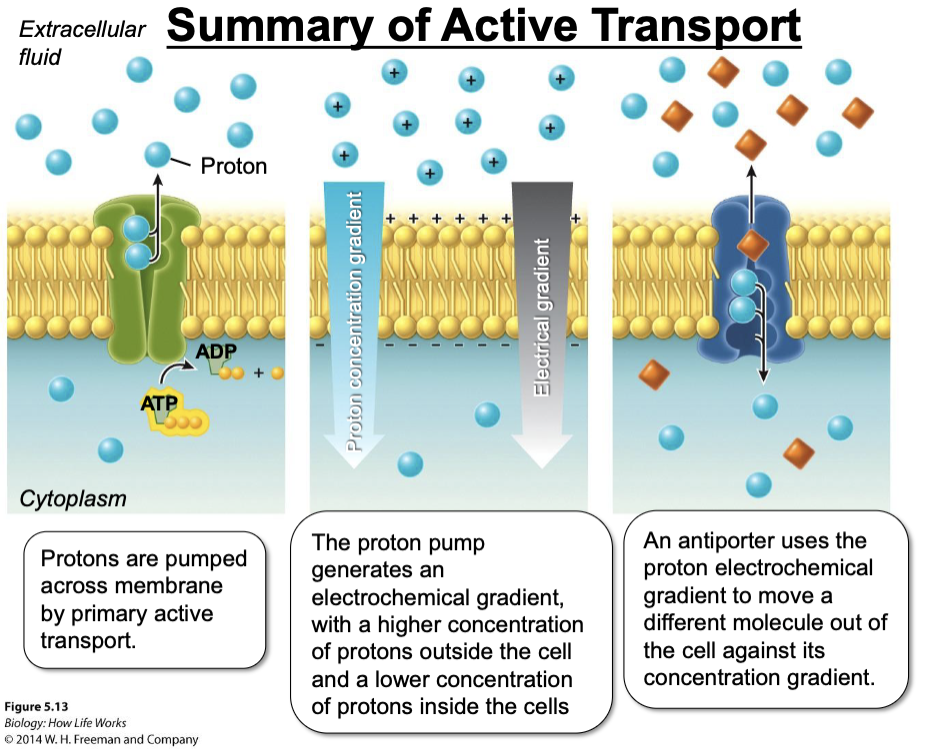
active transport
movement against (up) a concentration gradient through a transport protein
uses transport proteins
requires energy
is saturable
different types of active transport mechanisms
uniporter: moves molecules across the membrane across the membrane in one direction
antiporter: moves 2 molecules across the membrnce in opposite directions
symporter: moves 2 molecules across the membrane in the same direction
sodium-potassium pump
example of anti porter (still active transport!)

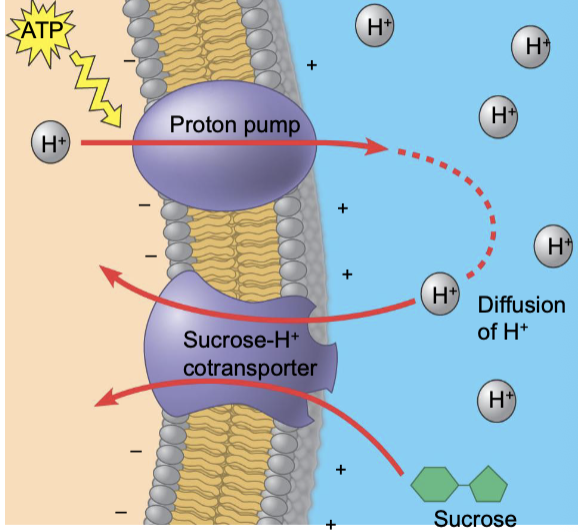
example of symporter (also called secondary active transport)
cell wants to bring in sucrose, but sucrose is in low concentration outside cell
can do so in 2 steps
1st: primary active transport uses ATP energy to move H+ ions from low to high concentration
2nd: can use high concentration of H+ ions on outside of cell to couple with the sucrose and then when the H+ comes into the cell, so will sucrose
summary of active transport
Carbohydrates
monosacchradies
disaccharides
polysaccharides
carbohydrate structure
basic formula: (CH2)ON
can be monosaccharides (mono sugars) or polysaccharides (many sugars)
names of most sugars end in -ose
vary in carbon number, position of carbonyl group, arrangement of atoms