BIOC*3560 Part C: Carbohydrate Metabolism
0.0(0)
Studied by 1 person Call Kai
 Learn
Learn Practice Test
 Spaced Repetition
 Match
Match Flashcards
 Knowt Play
Card Sorting
1/174

Earn XP
Description and Tags
175 Terms
1
New cards
Define metabolism
the sum of all chemical transformations that occur in an organism for it to stay alive
2
New cards
The "sum of all chemical transformations that occur in an organism for it to stay alive" is termed:
a) catabolism
b) energism
c) anabolism
d) metabolism
e) none of the above
a) catabolism
b) energism
c) anabolism
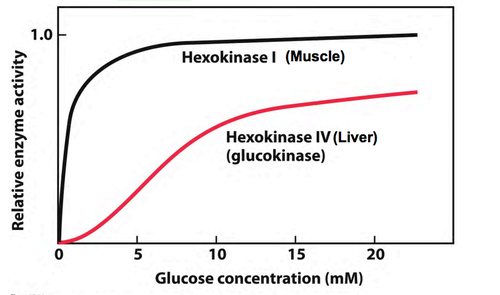
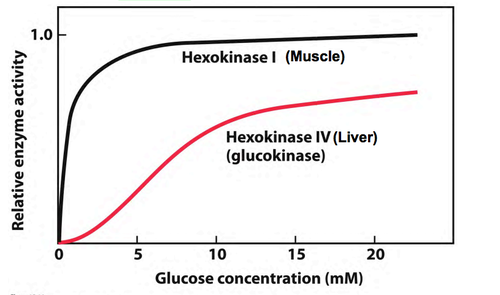
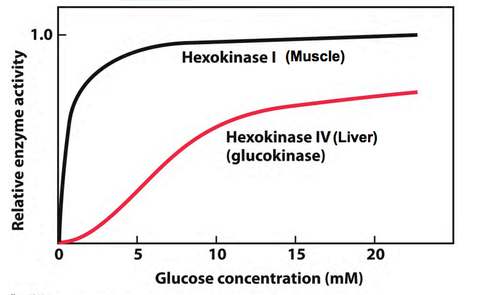
d) metabolism
e) none of the above
d) metabolism
3
New cards
Define anabolism
synthesis of biomolecules; the synthesis of complex molecules in living organisms from simpler ones together with the storage of energy
4
New cards
Which of the following is the term for 'synthesis of biomolecules'?
a) anabolism
b) catabolism
c) metabolism
d) degradation
e) none of the above
a) anabolism
b) catabolism
c) metabolism
d) degradation
e) none of the above
a) anabolism
5
New cards
Define catabolism
degradation of biomolecules; the breakdown of complex molecules in living organisms to form simpler ones, together with the release of energy
6
New cards
Which of the following is the term for "degradation of biomolecules"?
a) anabolism
b) catabolism
c) metabolism
d) synthesis
e) none of the above
a) anabolism
b) catabolism
c) metabolism
d) synthesis
e) none of the above
b) catabolism
7
New cards
List the three general types of pathways
1. converging catabolism
2. cyclic pathways
3. diverging anabolism
2. cyclic pathways
3. diverging anabolism
8
New cards
In any given metabolic pathway, what is the rate of most of the enzymes limited by?
a) substrate-limited
b) product-limited
c) enzyme-limited
d) inhibitor-limited
e) activator-limited
a) substrate-limited
b) product-limited
c) enzyme-limited
d) inhibitor-limited
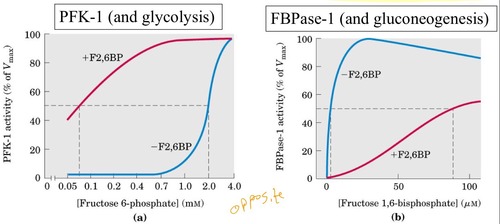
e) activator-limited
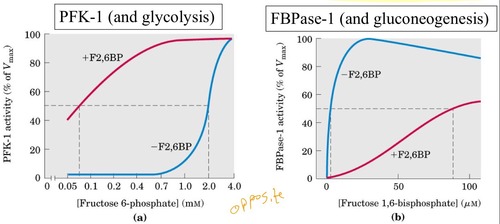
a) substrate-limited
9
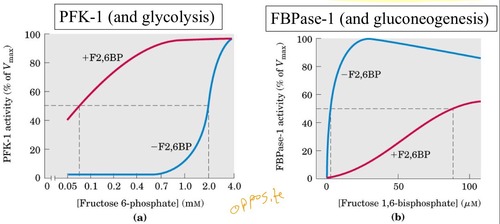
New cards
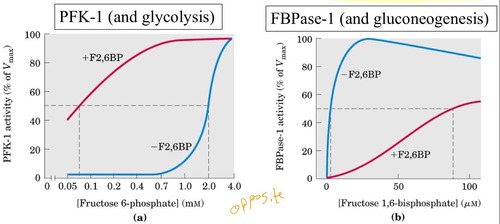
T/F: "There can only be one rate limiting step per metabolic pathway."
False, there can be multiple rate-limiting steps
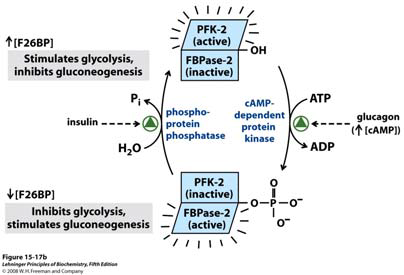
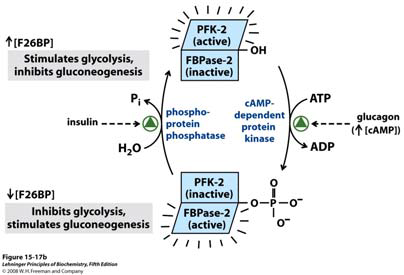
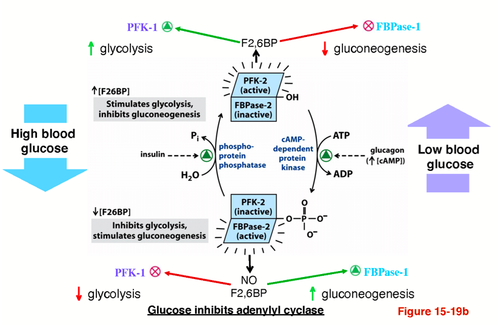
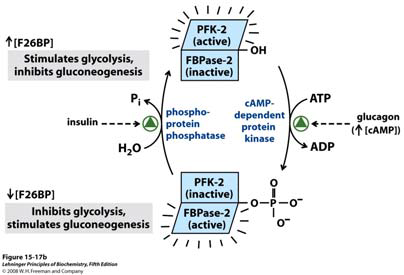
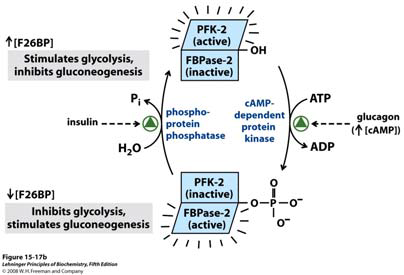
10
New cards
Which step in a metabolic pathway will determine the overall speed of the pathway?
a) always the first step
b) always the last step
c) always either the first or last step
d) whichever step is rate limiting
e) no single step can determine the speed of a whole pathway
a) always the first step
b) always the last step
c) always either the first or last step
d) whichever step is rate limiting
e) no single step can determine the speed of a whole pathway
d) whichever step is rate limiting
11
New cards
Rate limiting steps are often______________ under cellular conditions.
a) exergonic & reversible
b) exergonic & irreversible
c) endergonic & reversible
d) endergonic & irreversible
e) endothermic & reversible
a) exergonic & reversible
b) exergonic & irreversible
c) endergonic & reversible
d) endergonic & irreversible
e) endothermic & reversible
b) exergonic & irreversible
12
New cards
Which steps in metabolic pathways are usually targets of metabolic regulation?
Those catalyzing exergonic, rate-limiting reactions
13
New cards
Why are pathways regulated only at rate-limiting steps, and not all steps?
This allows the cell to regulate the overall rate of the metabolic pathway without expending too many resources
14
New cards
List the 10 ways enzymes can be regulated
*1.* Extracellular signals
*2.* Transcription of specific gene(s)
*3.* mRNA degradation
*4.* mRNA translation on ribosome
*5.* Protein degradation (ubiquitin, proteasome)
*6.* Enzyme sequestered in organelle (e.g., ER)
*7.* Enzyme binds substrate
*8.* Enzyme binds ligand (allosteric effector)
*9.* Enzyme undergoes phosphorylation/ dephosphorylation
*10.* Enzyme combines w/ regulatory protein
*2.* Transcription of specific gene(s)
*3.* mRNA degradation
*4.* mRNA translation on ribosome
*5.* Protein degradation (ubiquitin, proteasome)
*6.* Enzyme sequestered in organelle (e.g., ER)
*7.* Enzyme binds substrate
*8.* Enzyme binds ligand (allosteric effector)
*9.* Enzyme undergoes phosphorylation/ dephosphorylation
*10.* Enzyme combines w/ regulatory protein
15
New cards
Being strongly _____________ makes reactions essentially irreversible.
exergonic
16
New cards
a) How many steps in glycolysis are irreversible?
b) Which steps are they?
b) Which steps are they?
a) three
b) 1, 3 & 10
b) 1, 3 & 10
17
New cards
List the three irreversible steps of glycolysis and the enzymes that catalyze them
Step 1: hexokinase
Step 3: phosphofructokinase-1
Step 10: pyruvate kinase
Step 3: phosphofructokinase-1
Step 10: pyruvate kinase
18
New cards
Which reaction does hexokinase catalyze?
The reaction that allows entry of glucose into glycolysis; step 1 of glycolysis:
glucose + ATP ➡ glucose 6-phosphate + ADP
glucose + ATP ➡ glucose 6-phosphate + ADP
19
New cards
Which of the following is the hexokinase isozyme found in muscle?
a) hexokinase a
b) hexokinase b
c) hexokinase I
d) hexokinase IV
a) hexokinase a
b) hexokinase b
c) hexokinase I
d) hexokinase IV
c) hexokinase I
20
New cards
Which of the following is the hexokinase isozyme found in the liver?
a) hexokinase a
b) hexokinase b
c) hexokinase I
d) hexokinase IV
a) hexokinase a
b) hexokinase b
c) hexokinase I
d) hexokinase IV
d) hexokinase IV
21
New cards
Glucokinase is another name for:
a) hexokinase a
b) hexokinase b
c) hexokinase I
d) hexokinase IV
e) none of the above
a) hexokinase a
b) hexokinase b
c) hexokinase I
d) hexokinase IV
e) none of the above
d) hexokinase IV
22
New cards
T/F: "The the two hexokinase isozymes -- hexokinase I & hexokinase IV -- are transcribed from the same gene, but receive different post-translational modifications."
False, they are from two different genes
23
New cards
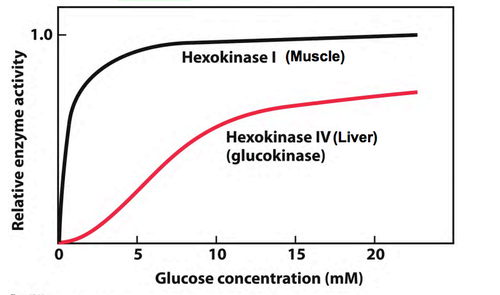
T/F: "Hexokinase I normally has maximal activity."
True
^Recall that hexokinase I is the isozyme found in muscles
^Recall that hexokinase I is the isozyme found in muscles
24
New cards
T/F: "Hexokinase IV normally has maximal activity."
False
^Hexokinase *I* normally has maximal activity
^Hexokinase *I* normally has maximal activity
25
New cards
T/F: "Hexokinase I is inhibited by high [glucose 6-phosphate]."
True
Hexokinase I is inhibited by high [Glucose 6-P]
Hexokinase IV is inhibited by high [Fructose 6-P]
Hexokinase I is inhibited by high [Glucose 6-P]
Hexokinase IV is inhibited by high [Fructose 6-P]
26
New cards
T/F: "Hexokinase IV is inhibited by high [glucose 6-phosphate]."
False
Hexokinase I is inhibited by high [Glucose 6-P]
Hexokinase IV is inhibited by high [Fructose 6-P]
Hexokinase I is inhibited by high [Glucose 6-P]
Hexokinase IV is inhibited by high [Fructose 6-P]
27
New cards
T/F: "Hexokinase IV is inhibited by high [fructose 6-phosphate]."
True
Hexokinase I is inhibited by high [Glucose 6-P]
Hexokinase IV is inhibited by high [Fructose 6-P]
Hexokinase I is inhibited by high [Glucose 6-P]
Hexokinase IV is inhibited by high [Fructose 6-P]
28
New cards
T/F: "Hexokinase I is inhibited by high [fructose 6-phosphate]."
False
Hexokinase I is inhibited by high [Glucose 6-P]
Hexokinase IV is inhibited by high [Fructose 6-P]
Hexokinase I is inhibited by high [Glucose 6-P]
Hexokinase IV is inhibited by high [Fructose 6-P]
29
New cards
T/F: "Hexokinase IV has a lower affinity for glucose than hexokinase I."
True
30
New cards
T/F: "Hexokinase I has a lower affinity for glucose than hexokinase IV."
False
Corrected statement:
Hexokinase IV has a lower affinity for glucose than hexokinase I
Corrected statement:
Hexokinase IV has a lower affinity for glucose than hexokinase I
31
New cards
Inhibition of hexokinase IV by fructose 6-P is effected through _____________________
glucokinase regulatory protein
32
New cards
T/F: "Hexokinase I has a relatively large K0.5."
False
33
New cards
T/F: "Hexokinase IV has a relatively large K0.5."
True
34
New cards
T/F: "Hexokinase I has a relatively poor K0.5."
False
35
New cards
T/F: "Hexokinase IV has a relatively poor K0.5."
True
36
New cards
Which hexokinase isozyme increases its rate when blood glucose is higher than optimal (~5 mM)
hexokinase IV (glucokinase; liver isozyme) *does*
hexokinase I (muscle isozyme) does *not*
hexokinase I (muscle isozyme) does *not*
37
New cards
Which hexokinase isozyme has a higher Km?
Hexokinase IV (glucokinase)--> liver
38
New cards
*When* & *how* does glucokinase regulatory protein inhibit hexokinase IV?
When [fructose 6-P] is high, *glucokinase regulatory protein* sequesters hexokinase IV in the nucleus
![When [fructose 6-P] is high, *glucokinase regulatory protein* sequesters hexokinase IV in the nucleus](https://knowt-user-attachments.s3.amazonaws.com/0a04763739784ec9a75d82858969f582.png)
39
New cards
Once glucokinase regulatory protein has sequestered hexokinase IV in the nucleus, what causes hexokinase to be localized back into the cytosol? Why/ how does this happen?
High [glucose] causes cytosolic localization of hexokinase IV, because it weakens the enzyme-regulator interaction.
![High [glucose] causes cytosolic localization of hexokinase IV, because it weakens the enzyme-regulator interaction.](https://knowt-user-attachments.s3.amazonaws.com/b07f4a9b032b4e46b851aed3a63a78ee.png)
40
New cards
Which reaction does phosphofructokinase-1 catalyze?
The third reaction of glycolysis:
fructose 6-phosphate + ATP ➡ fructose 1, 6-bisphosphate + ADP
fructose 6-phosphate + ATP ➡ fructose 1, 6-bisphosphate + ADP
41
New cards
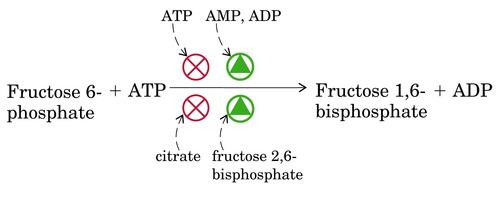
Which of the following is an inhibitor of phosphofructokinase-1?
a) AMP
b) ADP
c) ATP
d) fructose 2,6-bisphosphate
e) none of the above
a) AMP
b) ADP
c) ATP
d) fructose 2,6-bisphosphate
e) none of the above
c) ATP
42
New cards
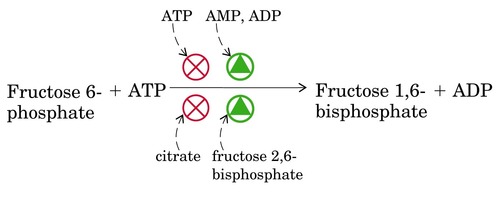
Which of the following is NOT an activator of phosphofructokinase-1?
a) AMP
b) ADP
c) ATP
d) fructose 2,6-bisphosphate
e) none of the above
a) AMP
b) ADP
c) ATP
d) fructose 2,6-bisphosphate
e) none of the above
c) ATP
43
New cards
T/F: "Every glucose 6-P molecule in a cell has the same fate."
False, glucose 6-P has several possible fates in the cell
44
New cards
Phosphorylation by _____________________ commits fructose 6-P to glycolysis.
phosphofructokinase-1
45
New cards
Phosphorylation by PFK-1 commits fructose 6-phosphate(in equilibrium with ____________________) to glycolysis.
glucose 6-phosphate
46
New cards
What effect does ATP have on phospofructokinase-1? How does it accomplish this?
It lowers PFK-1's affinity for fructose 6-phosphate, by binding to an allosteric site on PFK-1
47
New cards
What effect do AMP & ADP have on phosphofructokinase-1? How do they accomplish this?
They promote PFK-1 activity by relieving inhibition caused by ATP
48
New cards
What effect does citrate have on phosphofructokinase-1? How does it accomplish this?
Citrate contributes to the inhibition of PFK-1 activity, by increasing the inhibition caused by ATP
49
New cards
What effect does fructose 2, 6-bisphosphate have on phosphofructokinase?
It is a strong activator
50
New cards
T/F: "High [ATP] greatly reduces the affinity of PFK-1 for fructose 6-P."
True
51
New cards
T/F: "High [AMP] greatly reduces the affinity of PFK-1 for fructose 6-P."
False
52
New cards
T/F: "High [fructose 2,6-bisphosphate] greatly reduces the affinity of PFK-1 for fructose 6-P."
False
^fructose 2,6-bisphosphate is a strong activator of PFK-1
^fructose 2,6-bisphosphate is a strong activator of PFK-1
53
New cards
T/F: "When [ATP] is low, higher fructose 6-phosphate affinity allows PFK-1 to become more active."
True
54
New cards
T/F: "When [ADP] is low, higher fructose 6-phosphate affinity allows PFK-1 to become more active."
False
55
New cards
T/F: "When [fructose 2,6-bisphosphate] is low, higher fructose 6-phosphate affinity allows PFK-1 to become more active."
False, low [fructose 2,6-bisphosphate] would not increase PFK-1's affinity for F6P, as F2,6-BP is a strong activator of PFK-1. However, removing a strong inhibitor, such as ATP, would increase PFK-1 activity.
56
New cards
Which reaction does pyruvate kinase catalyze?
The tenth step of glycolysis:
phosphoenolpyruvate + ADP ➡ pyruvate + ATP
phosphoenolpyruvate + ADP ➡ pyruvate + ATP
57
New cards
In the 10th reaction of glycolysis, pyruvate kinase transfers ________ from phosphoenolpyruvate to _______.
Pi to ADP
58
New cards
High _______________ allosterically inhibits pyruvate kinase, decreasing its affinity for phosphoenolpyruvate (PEP)
[ATP]
59
New cards
T/F: "High [ATP] allosterically inhibits pyruvate kinase, decreasing its affinity for phosphoenolpyruvate (PEP)."
True
60
New cards
T/F: "High [ATP] allosterically activates pyruvate kinase, increasing its affinity for phosphoenolpyruvate (PEP)."
False.
Corrected statement:
High [ATP] allosterically *inhibits* pyruvate kinase, *decreasing* its affinity for phosphoenolpyruvate (PEP).
Corrected statement:
High [ATP] allosterically *inhibits* pyruvate kinase, *decreasing* its affinity for phosphoenolpyruvate (PEP).
61
New cards
List the four inhibitors of pyruvate kinase.
- ATP
- acetyl-CoA
- long chain fatty acids
- alanine
- acetyl-CoA
- long chain fatty acids
- alanine
62
New cards
Name an allosteric activator of pyruvate kinase (PK)
fructose 1,6-bisphosphate
63
New cards
Which of the following does NOT inhibit pyruvate kinase (PK)?
a) acetyl CoA
b) long chain fatty acids
c) ATP
d) fructose 1,6-bisphosphate
e) alanine
a) acetyl CoA
b) long chain fatty acids
c) ATP
d) fructose 1,6-bisphosphate
e) alanine
d) fructose 1,6-bisphosphate
64
New cards
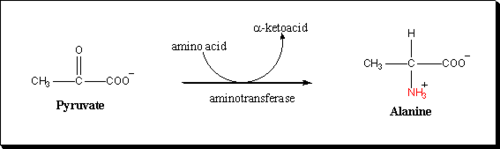
__________________ (intermediate of glycolysis) can be interconverted with alanine via transamination.
pyruvate
65
New cards
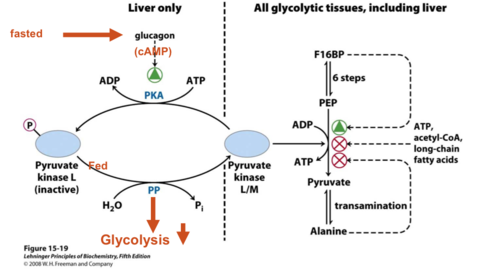
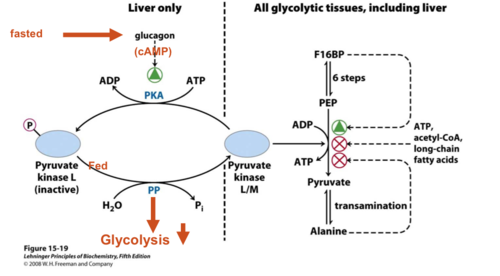
Which hormone can activate PKA in the liver?
glucagon
66
New cards
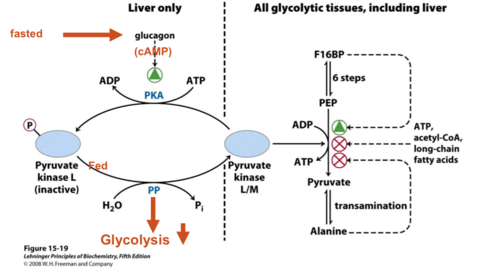
T/F: "The liver isoform of pyruvate kinase can be inactivated by glucagon."
True
67
New cards
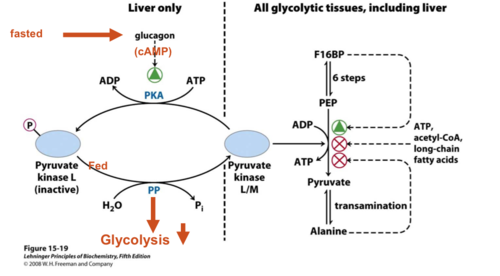
T/F: "The muscle isoform of pyruvate kinase can be inactivated by glucagon."
False, only the liver isoform is affected by glucagon
68
New cards
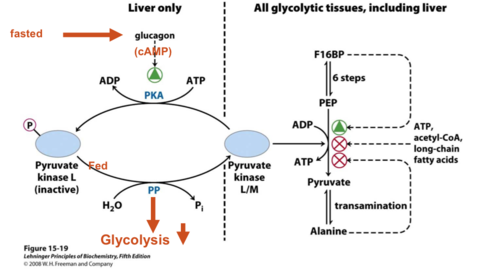
When the liver isoform of pyruvate kinase is phosphorylated, it becomes:
a) activated
b) inactivated
c) is unaffected by phosphorylation
a) activated
b) inactivated
c) is unaffected by phosphorylation
b) inactivated
69
New cards
The activated liver isoform of pyruvate kinase is:
a) phosphorylated
b) unphosphorylated
a) phosphorylated
b) unphosphorylated
b) unphosphorylated
70
New cards
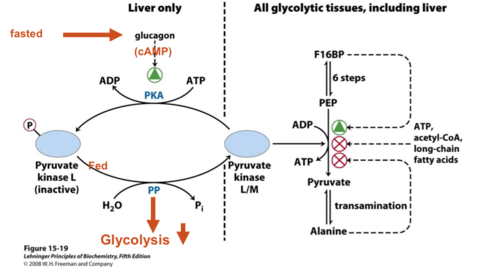
PKA catalyzes the reaction that:
a) activates the liver isoform of pyruvate kinase
b) deactivates the liver isoform of pyruvate kinase
c) activates the muscle isoform of pyruvate kinase
d) deactivates the muscle isoform of pyruvate kinase
a) activates the liver isoform of pyruvate kinase
b) deactivates the liver isoform of pyruvate kinase
c) activates the muscle isoform of pyruvate kinase
d) deactivates the muscle isoform of pyruvate kinase
b) deactivates the liver isoform of pyruvate kinase
71
New cards
Approximately how many hours/days worth of glucose is stored in the body?
1 day (as glycogen)
72
New cards
What is gluconeogenesis?
The synthesis of glucose from *non-glucose* precursors
73
New cards
List the three main precursors for gluconeogenesis.
- lactic acid
- glycerol
- glucogenic amino acids
- glycerol
- glucogenic amino acids
74
New cards
How is step 10 of glycolysis bypassed? [step 1 of gluconeogenesis]
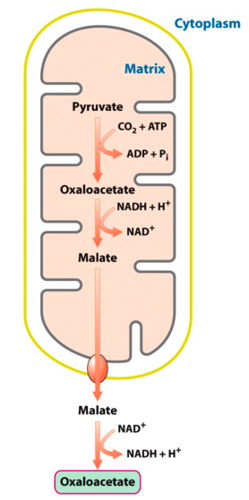
In the forward direction (i.e., in glycolysis) phosphoenolpyruvate is converted to pyruvate.
In the reverse direction (i.e., in glucogenogenesis), pyruvate needs to be converted to phosphoenolpyruvate.
In Mitochondria:
- *pyruvate* enters the mitochondria
- in the mitochondria, pryuvate is converted to *oxaloacetate* (by pyruvate carboxylase)
- oxaloacetate cannot leave the mitochondria, so it is converted into *malate* (by mitochondrial malate dehydrogenase)
- the malate then leaves the mitochondria for the cytosol
In cytosol:
- in the cytosol, malate is converted back to *oxaloacetate* (by cytosolic malate dehydrogenase)
- oxaloacetate is converted to *phosphoenolpyruvate* (by phosphoenolpyruvate carboxykinase) <-- requires *GTP*
In the reverse direction (i.e., in glucogenogenesis), pyruvate needs to be converted to phosphoenolpyruvate.
In Mitochondria:
- *pyruvate* enters the mitochondria
- in the mitochondria, pryuvate is converted to *oxaloacetate* (by pyruvate carboxylase)
- oxaloacetate cannot leave the mitochondria, so it is converted into *malate* (by mitochondrial malate dehydrogenase)
- the malate then leaves the mitochondria for the cytosol
In cytosol:
- in the cytosol, malate is converted back to *oxaloacetate* (by cytosolic malate dehydrogenase)
- oxaloacetate is converted to *phosphoenolpyruvate* (by phosphoenolpyruvate carboxykinase) <-- requires *GTP*
75
New cards
Why is a malate intermediate used in the 1st step of gluconeogenesis, instead of just exporting oxaloacetate directly from the mitochondrial matrix -> cytosol?
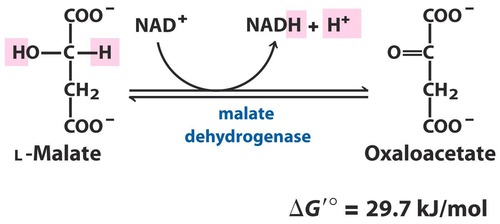
It has to do with NADH.
Recall that (liver) mitochondria will be breaking down fatty acids (beta-oxidation), which produces NADH.
Also recall that gluconeogenesis consumes NADH (glyceraldehyde 3-phosphate dehydrogenase).
Therefore the NADH needs to get out of the matrix, into the cytosol. However NADH cannot be directly exported from the mitochondria.
The solution is for NADH to be consumed in the mitochondrial malate dehydrogenase reaction, and then produced on the cytosolic side by cytosolic malate dehydrogenase.
Recall that (liver) mitochondria will be breaking down fatty acids (beta-oxidation), which produces NADH.
Also recall that gluconeogenesis consumes NADH (glyceraldehyde 3-phosphate dehydrogenase).
Therefore the NADH needs to get out of the matrix, into the cytosol. However NADH cannot be directly exported from the mitochondria.
The solution is for NADH to be consumed in the mitochondrial malate dehydrogenase reaction, and then produced on the cytosolic side by cytosolic malate dehydrogenase.
76
New cards
When lactate is the feedstock for gluconeogenesis, which enzyme produces cytosolic NADH?
lactate dehydrogenase
77
New cards
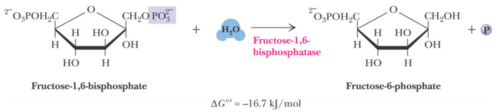
Which reaction is calatyzed by *fructose 1,6-bisphosphatase*?
Step 8 of gluconeogenesis:
fructose 1,6-bisphosphate + H2O ➡ fructose 6-phosphate + Pi
fructose 1,6-bisphosphate + H2O ➡ fructose 6-phosphate + Pi
78
New cards
Fructose 1,6-bisphosphatase converts _______________ to _________________.
fructose 1,6-bisphosphate ➡ fructose 6-phosphate
79
New cards
Which step of gluconeogensis corresponds to the following steps of glycolysis?
a) 1
b) 3
c) 10
a) 1
b) 3
c) 10
a) 10
b) 8
c) 1
b) 8
c) 1
80
New cards
State whether each of the following enzymes is part of glycolysis, gluconeogensis, or both.
a) phosphoenolpyruvate carboxykinase
b) hexokinase IV
c) phosphofructokinase-1
d) cytosolic malate dehydrogenase
e) enolase
f) glyceraldehyde 3-phosphate dehydrogenase
g) fructose 1,6-bisphosphatase
h) pyruvate kinase
i) hexokinase I
j) glucose 6-phosphatase
k) triose phosphate isomerase
l) mitochondrial malate dehydrogenase
m) phosphoglycerate mutase
n) phosphoglycerate kinase
o) pyruvate carboxylase
p) phosphohexose isomerase
q) aldolase
a) phosphoenolpyruvate carboxykinase
b) hexokinase IV
c) phosphofructokinase-1
d) cytosolic malate dehydrogenase
e) enolase
f) glyceraldehyde 3-phosphate dehydrogenase
g) fructose 1,6-bisphosphatase
h) pyruvate kinase
i) hexokinase I
j) glucose 6-phosphatase
k) triose phosphate isomerase
l) mitochondrial malate dehydrogenase
m) phosphoglycerate mutase
n) phosphoglycerate kinase
o) pyruvate carboxylase
p) phosphohexose isomerase
q) aldolase
a) phosphoenolpyruvate carboxykinase- *gluconeogenesis*
b) hexokinase IV - *glycolysis*
c) phosphofructokinase-1 - *glycolysis*
d) cytosolic malate dehydrogenase - *gluconeogenesis*
e) enolase - *both*
f) glyceraldehyde 3-phosphate dehydrogenase - *both*
g) fructose 1,6-bisphosphatase - *gluconeogenesis*
h) pyruvate kinase - *glycolysis*
i) hexokinase I - *glycolysis*
j) glucose 6-phosphatase - *gluconeogenesis*
k) triose phosphate isomerase - *both*
l) mitochondrial malate dehydrogenase - *gluconeogenesis*
m) phosphoglycerate mutase - *both*
n) phosphoglycerate kinase - *both*
o) pyruvate carboxylase - *gluconeogenesis*
p) phosphohexose isomerase - *both*
q) aldolase - *both*
b) hexokinase IV - *glycolysis*
c) phosphofructokinase-1 - *glycolysis*
d) cytosolic malate dehydrogenase - *gluconeogenesis*
e) enolase - *both*
f) glyceraldehyde 3-phosphate dehydrogenase - *both*
g) fructose 1,6-bisphosphatase - *gluconeogenesis*
h) pyruvate kinase - *glycolysis*
i) hexokinase I - *glycolysis*
j) glucose 6-phosphatase - *gluconeogenesis*
k) triose phosphate isomerase - *both*
l) mitochondrial malate dehydrogenase - *gluconeogenesis*
m) phosphoglycerate mutase - *both*
n) phosphoglycerate kinase - *both*
o) pyruvate carboxylase - *gluconeogenesis*
p) phosphohexose isomerase - *both*
q) aldolase - *both*
81
New cards
In step 8 of gluconeogensis, F1,6-BP ➡ F 6-P. This reaction is:
a) a phosphatase reaction
b) endergonic
c) a kinase reaction
d) exergonic
e) 2 of the above
a) a phosphatase reaction
b) endergonic
c) a kinase reaction
d) exergonic
e) 2 of the above
e) 2 of the above
(a & d) --> phosphatase reaction & exergonic
(a & d) --> phosphatase reaction & exergonic
82
New cards
Which reaction is catalyzed by glucose 6-phosphatase?
It catalyzes the dephosphorylation of G6P; the 10th step of gluconeogenesis:
glucose 6-phosphate + H2O ➡ glucose + Pi
glucose 6-phosphate + H2O ➡ glucose + Pi
83
New cards
Which of the following enzymes is expressed in few tissues (such as the liver, kidney, and small intestine --> a.k.a. gluconeogenic tissues)?
a) pyruvate carboxylase
b) phosphofructokinase-1
c) glucose 6-phosphatase
d) phosphoenolpyruvate carboxykinase
a) pyruvate carboxylase
b) phosphofructokinase-1
c) glucose 6-phosphatase
d) phosphoenolpyruvate carboxykinase
c) glucose 6-phosphatase
84
New cards
Why is it important that the regulation of glycolysis and gluconeogenesis be coordinated?
Because glycolysis and gluconeogenesis are opposing cellular processes, so having them run in parallel would simply waste energy
85
New cards
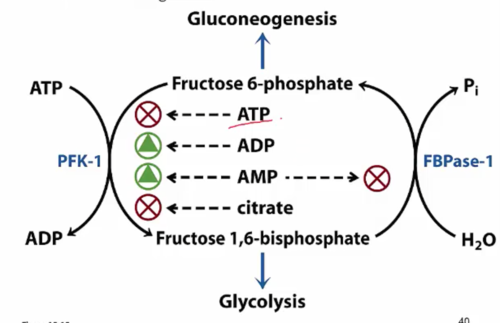
Name two allosteric modulators that increase the activity of PFK-1 [glycolysis, step3] but decrease the activity of FBPase-1 [gluconeogenesis, step8].
*F2,6-BP* & AMP
86
New cards
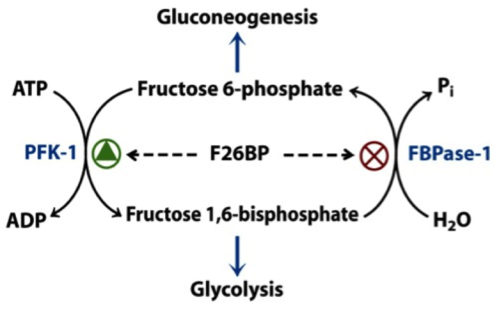
_________________________ allosterically regulates phosphofructokinase-1 and fructose 1,6-bisphosphatase-1 in a reciprocal manner.
a) fructose 2,6-bisphosphate
b) ATP
c) citrate
d) none of the above
a) fructose 2,6-bisphosphate
b) ATP
c) citrate
d) none of the above
a) fructose 2,6-bisphosphate
(also AMP, to a lesser degree)
(also AMP, to a lesser degree)
87
New cards
Fructose 2,6-bisphosphate greatly increases _________________ activity.
a) pyruvate carboxylase
b) fructose 1,6-bisphosphatase
c) phosphofructokinase-1
d) all of the above
e) none of the above
a) pyruvate carboxylase
b) fructose 1,6-bisphosphatase
c) phosphofructokinase-1
d) all of the above
e) none of the above
c) phosphofructokinase-1
88
New cards
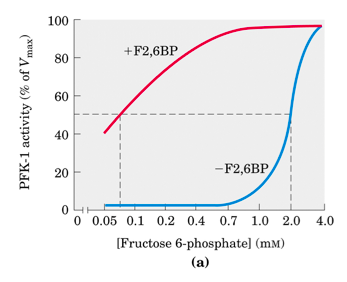
In the *absence* of F2,6-BP, phosphofructokinase-1 has _______________ affinity for fructose 6-P.
a) high
b) low
c) unaffected by F2,6-BP
a) high
b) low
c) unaffected by F2,6-BP
b) low
89
New cards
In the *presence* of F2,6-BP, phosphofructokinase-1 has _______________ affinity for fructose 6-P.
a) high
b) low
c) unaffected by F2,6-BP
a) high
b) low
c) unaffected by F2,6-BP
a) high
90
New cards
In the presence of F2,6-BP, the affinity of phophofructokinase-1 for fructose 6-P....
a) increases >10x
b) increases >100x
c) decreases >10x
d) decreases >100x
e) decreases <1000x
a) increases >10x
b) increases >100x
c) decreases >10x
d) decreases >100x
e) decreases <1000x
b) increases >100x
91
New cards
What effect does the presence of F2,6-BP have on fructose 1,6-bisphosphatase-1 activity?
a) drastically increases it
b) drastically decreases it
c) slightly increases it
d) slightly decreases it
e) has no effect
a) drastically increases it
b) drastically decreases it
c) slightly increases it
d) slightly decreases it
e) has no effect
b) drastically decreases it
92
New cards
In the *absence* of F2,6-BP, fructose 1,6-BPase-1 has _______________ affinity for fructose 1,6-BP.
a) high
b) low
c) no change
a) high
b) low
c) no change
a) high
93
New cards
In the *presence* of F2,6-BP, the affinity of fructose 1,6-bisphosphatase-1 for fructose 1,6-bisphosphate...
a) increases >10x
b) increases >100x
c) decreases >10x
d) decreases >100x
e) decreases <1000x
a) increases >10x
b) increases >100x
c) decreases >10x
d) decreases >100x
e) decreases <1000x
c) decreases >10x
94
New cards
Which two enzymes control *fructose 2,6-bisphosphate* concentration?
phosphofructokinase-2 (PFK-2)
&
fructose 2,6-bisphosphatase (FBPase-2)
&
fructose 2,6-bisphosphatase (FBPase-2)
95
New cards
Increased [F26BP]...
a) stimulates glycolysis
b) inhibits gluconeogenesis
c) inhibits glycolysis
d) stimulates gluconeogenesis
e) 2 of the above
a) stimulates glycolysis
b) inhibits gluconeogenesis
c) inhibits glycolysis
d) stimulates gluconeogenesis
e) 2 of the above
e) 2 of the above
(a & b)
(a & b)
96
New cards
Which enzyme activates FBPase-2 (fructose 2,6-bisphosphatase)?
PKA (a.k.a. cAMP dependent protein kinase)
97
New cards
Which enzyme activates PFK-2?
phosphoprotein phosphatase
98
New cards
Which of the following is activated by insulin?
a) phosphoprotein phosphatase
b) PKA
c) both
d) neither
a) phosphoprotein phosphatase
b) PKA
c) both
d) neither
a) phosphoprotein phosphatase
99
New cards
Which of the following is activated by glucagon?
a) phosphoprotein phosphatase
b) PKA
c) both
d) neither
a) phosphoprotein phosphatase
b) PKA
c) both
d) neither
b) PKA
note: in diagram cAMP dependent protein kinase = PKA
note: in diagram cAMP dependent protein kinase = PKA
100
New cards
When blood sugar is low, which of the following becomes active? Why?
a) phosphofructokinase-2 (PFK-2)
b) fructose 2,6-bisphosphatase (FBPase-2)
c) both
d) neither
a) phosphofructokinase-2 (PFK-2)
b) fructose 2,6-bisphosphatase (FBPase-2)
c) both
d) neither
b) fructose 2,6-bisphosphatase (FBPase-2)
b/c when blood sugar is low, glucagon is released, and glucagon stimulates PKA, which activates FBPase-2 via phosphorylation, while simultaneously inactivating phosphoprotein phosphatase
b/c when blood sugar is low, glucagon is released, and glucagon stimulates PKA, which activates FBPase-2 via phosphorylation, while simultaneously inactivating phosphoprotein phosphatase