The ocean atmosphere
 Call Kai
 Learn
 Practice Test
 Spaced Repetition
 Match
 Flashcards
 Knowt Play
1/156

There's no tags or description
Looks like no tags are added yet.
157 Terms
Pressure
Is the force exerted by a substance on a surface
in a low pressure environment the particles are
fewer particles and they push less on external surfaces
-In a high pressure environment the particles are
there are more particles and they push more on external surfaces
Air pressure and unit
Is the force exerted by a mass of air above a location
-Typically measured in millibars mb, inches of mercury Hg or kilopascals kPa
Troposphere
The layer of the atmosphere we live in
-It extends from earth's surface to around 10,000 meters
-Temperature decreases as we get higher until we hit the tropopause, transition zone between layers in the atmosphere
-Pressure decreases as we get higher in the atmosphere
Stratosphere
Extends from the top of the troposphere to around 50,000 meters
-Stratopause transition zone from temperature
-There is a temperature inversion in the stratosphere, means the relationship between temperature and altitude flips, due to absorption of solar energy, because of the ozone layer ultraviolet radiation from the sun is absorbed by oxygen in the stratosphere
-Pressure continues to decrease as we get higher up in the atmosphere
-Has high amounts of ozone O3 and contains the ozone layer
Ozone Layer
- Ultraviolet radiation from the sun is absorbed by ambient oxygen in the stratosphere
-Powerful sunlight splits O2 to O but wants to join O2 making the ozone layer, creating a constant cycle

Mesosphere
Above the stratosphere is the mesosphere in which temperature decreases again as we run out of O3
-Mesopause transition
thermosphere
continues until we hit the mesopause above the thermosphere where temperature climbs again due to oxygen absorption of UV and x ray radiation
-Exosphere is the edge of our atmosphere and space
how to distinguish between layers in atmopshere
temperature
trace gases
gases in a small percentag
Anthropogenic trace gases
NO2 VOC CFC CO CO2 SO2 NH3
Aerosols-
Source of Aerosols or particulate matter are broken down into two categories, suspended particles
natural aerosols
wildfires, dust, volcanoes
Anthropogenic sources aerosol
fossil fuel, agriculture, waste burning
Meteorological observations importance
-Accurate weather forecast
-Improve our understanding of the atmosphere
-Undercover how the weather and climate are changing
Synoptic observations
Provide information on the present state of the atmosphere
-Provided by the UK Met Office
-Average separation of stations is about 40km
-Ideally on flat ground, no trees, no buildings
-Weather is observed at least 4 times a day
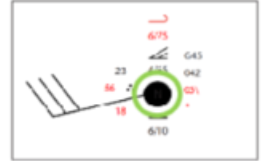
Station circle
When world weather observations are plotted on a weather map the different elements are grouped around the position of the observing station

station circle elements place

Total cloud amount
Is the fraction of the sky covered by cloud of any type or height above the ground
-Measured in oktas, eighths
-Sky obscured, can't see the clouds, e.g. a wildfire
Stro-
Flat layer shape
Cumulus
Bumpy broccoli shape
Nimbus-
Generate rain clouds
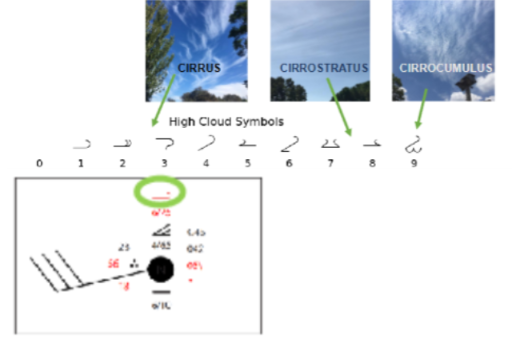
Cirrus-
Feather shape
high clouds
Cirrus, Cirrostratus, Cirrocumulus
medium clouds
Altostratus, Altocumulus

Low clouds
Cumulus, Stratocumulus, Stratus

Measuring cloud height
-Measured by a cloud base recorder
-LIDAR- Short laser pulses are emitted vertically, the backscatter caused by laser reflections off the cloud surface, precipitation or other particles are analysed to determine the height of the cloud base
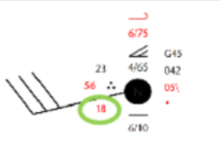
Cloud height rules
-Measured in feet and the height is reported in code
-Number right of the slash
-If the height number is less than 50 it gives the cloud base directly in 100s of ft as
-If the height number is greater than 50 you subtract 50 from the code and then multiply by 1000s of ft as

Wind Direction and speed
-Line in which way the from the wind is blowing/coming from
-Wind is measured 10m above the ground
-Measured in knots, nautical mie per house
-More lines you have faster the wind, in a 5knot distance apart, when there is 5 lines they form a block

1 knot
0.51 m/s = 1.15mph
Mean sea level pressure
-Reported to the nearest tenth of a millibar mb with the hundreds omitted
-Rarely lie outside the range 960-1050mb
-Measured using a barometer

Mean sea level pressure rule
RULE Move a decimal over and add an 10 Infront when number starts with 8 or below
-If it starts with a 9 add a 9 Infront
Pressure tendency
Is the pressure change over the past 3 hours reported to the nearest 0.1 millibar
-Symbol to the right is the direction of change

Temperature-
Reported to the nearest degree in Celsius
-Measured 1.25m above the ground

Dewpoint temperature
The temperature to which air must be cooled (at constant pressure and constant water vapour content) for saturation to occur
-When air cools to the dew point condensation occurs
-The difference in air temp and dew point temp can indicate whether relative humidity is low or high
large dew difference
low humdity
small dew difference
high humidity
Past weather
Covers the 6 hour period since the previous measurement

Visibility and rule
Measured in kilometres and reported in code
-<50 visibility is reported in 0.1km, 24=2.4km
-Between 50 and 80, visibility is reported in 1km after 50 has been subtracted from the number
->80 visibility is reported in 5km, 81 is 35km 82 is 40km

Other observations for weather
radar and satellite remote
First law of thermodynamics
Energy cannot be created or destroyed
-Energy can only change form from one form to another via some physical or chemical process
Energy
-Is the capacity to do work on some form of matter
-Measured in JOULES
-In the atmosphere we are typically concerned with: Kinetic, Potential, Heat and Latent heat
Kinetic
The energy an air mass had due to its motion
-Macroscopic air motion, the faster the wind moves the greater the kinetic energy

Potential
The energy due the position or form of an air mass
-Gravitational potential energy, associated with work done against gravity, the amount stored determines how much work the object can do

Internal-
The total energy in a thermodynamic system, proportional to temperature in the atmosphere
-Kinetic energy is associated with random motions of atmospheric molecules plus rotational and vibrational energies
-The absolute temperature T is proportional to the mean kinetic energy associated with random motion of molecules
Latent
The heat energy absorbed or released during a phase change
-Energy released during the condensation of water vapour
Temperature
Is a measure of the kinetic energy of air molecules
-Absolute zero
describes a theoretical system that neither emits nor absorbs energy
-Known as 0K or –273.13'c
Heat
Is energy transferred between objects from a temperature differential between them
Latent heat LH
-The energy required to change a substance from one phase to another
-Condensation, freezing and deposition release heat to the environment
-Melting, evaporation and sublimation take heat from the enviroment
Sensible heat SH
-The heat that we feel
-Measured with a thermometer
-When an object is heated, the objects increases in temperature is its sensible heat
Heat transfer equation

Radiation
-Energy that travels through air as waves or particles
-Moves at speed of light so is very fast
-Radiation transfers heat from the sun or hot objects to the air
Conduction
-Heat transported from one molecule to the next molecule
-In fluids conduction is slow compared to convection
-In solids conduction is the only heat transfer system
-Conduction transfers heat from the surface to the soil and a very thin layer of atmosphere
Convection
-Transfers heat through bulk motion as a substance moves it carries heat with it
-In the atmosphere convection occurs through vertical circulation and mixing
-Free convection, gravitational or buoyancy
-Forced convection, mechanical forces such as wind
-Convection transfers heat from a thin layer near the surface to air higher up
Surface balance equation

Air parcel model
-Physical and chemical processes are applied to a small volume of air
-Imagine that the parcel has its own properties and forces act on the parcel to move it and change its energy
-It can be compressed or expanded, heated or cooled, dried or moistened
-We assume that is does not mix with the surrounding air
Air parcel characteristics
-Pressure, force of air molecules
-Temperature, measure of the average speed of the molecules in an air parcel
-Volume, a defined space our air parcel occupies
As temp increases particeles… (fixed volume)
-Air molecules move faster and collide with the sides of the air parcel and each other move often
-More collisions mean that our molecules will exert a greater force and the pressure increases
-If volume fixed, temp increases, pressure increases
Gay Loussac Law
-At constant volume, the pressure of a gas is proportional to its temperature

As volume increases particles.. (temp fixed)
-Molecules occupy a larger space
-Collide with the sides and each other less often
-Less force and the pressure decreases
-If temp is fixed, volume increases, pressure decreases
Boyles Law
-At constant temperature, the product of pressure and volume is constant

As volume decreases.. (pressure fixed)
-Air molecules have smaller space
-Collide with the sides and each other more often
-For the pressure to remain the same the molecules must move slower, temp decreases
-If pressure is fixed, volume decreases, temp decreases
Ideal gas law
-volume fixed, pressure proportional to temp
-Pressure fixed, volume is proportional to temp
-Temp fixed, pressure is inversely proportional to volume

ideal gas equation

Force
Is an influence that change the motion or shape of an object
-Cause mass to accelerate or decelerate
-Vector quantities, mean they have both magnitude and direction
Newtons first law of motion
-An object at rest will remain at rest and an object in motion will remain in motion as long as no force is exerted on the object
-In atmosphere, apply to air, to start air moving need to apply external force
Newtons second law of motion
-The acceleration of an object is directly proportional to the net force acting on it and inversely proportional to its mass
-The net force is equal to the mass of the body M times the acceleration of the body A
-Mass x Acceleration
-The direction of acceleration is the same as the direction of the net force

Net force
Is the vector sum of forces acting on a particle or body
-If the net force acting on a body is zero then it acceleration is also zero and the body said to be in equilibrium
-F=0
-Equal in magnitude at different directions
Wind-
Determines the weather we experience and is driven by competing forces
-Wind is the movement of air driven by many competing forces
-Can move heat and moisture
-Causes air to rise
wind direction
-Horizontal wind directions are based on the compass, talk about wind in the direction it comes from
-Named after direction they come from
Pressure gradient force
-The pressure gradient force is the force that pushes air from areas of high pressure to low pressure
-When the pressure is uniform, pressure acting on one side of an air parcel balances the pressure on the other side
-When the pressure varies from one side to the other a pressure gradient force acts on the parcel
-Fp is directed from high pressure towards low pressure
-The pressure gradient force is the force that causes the wind to blow
-Main thing moving air
Isobars
-An isobar is a line of constant pressure in the atmosphere
-Isobars help us understand the direction of pressure gradients and the wind
-Isobars decrease near a low and increase near a high
-Isobars are generally drawn every 4mb
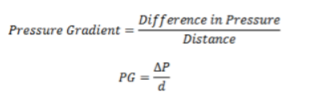
pressure gradient equation
and can have direction
Isobar multidirectional
generally they circle areas of high and low pressure
-This the direction of the pressure gradient force PGR depends on the location of an air parcel relative to the high
Coriolis force
-Apparent force due to the earth's rotation
-Acts on oceans and atmosphere
-It only acts on air parcels that are moving
-It can only change a parcels direction not its speed
-Larger force for larger parcels
coriolis force southern hemisphere
the earth is spinning clockwise and Coriolis force is to the left
coriolis force northen hemisphere
the earth is spinning counterclockwise and Coriolis force is to the right
Geostrophic balance
Is the balance between pressure gradient force and Coriolis force
-Blows parallel to isobars
-Steeper pressure gradient means stronger winds
The spacing between isobars shows the pressure gradient.
An isobar is a line drawn on a weather map that connects points of equal atmospheric pressure
-However isobars are often curved so there is centripetal force

Centripetal force
-If air is moving parallel to curved isobars it is constantly changing direction
-The acceleration is centripetal acceleration
-Directed at right angles to the wind, inward towards centre of rotation
-center-seeking force that compels an object to follow a curved or circular path

Centripetal
-Force necessary to keep an object moving in a curved path and that is directed toward the centre of rotation
Centrifugal
-Force that is felt by an object moving in a curved path that acts outwardly away from the centre of rotation
flow around cyclones

Sub geostrophic
Coriolis force needs to decrease to achieve balance, reduction in windspeed
Super geostrophic
Coriolis force needs to increase to achieve balance, increase in windspeed
Hydrostatic balance
occurs when the downward force of gravity acting on an air column is exactly balanced by the upward pressure gradient force
-If pressure is kept constant and temperature goes down, than density increases
-Cold air is more dense
-Hot air is less dense
-Pressure increases more rapidly with height in cold air compared to warm air
hydrostatic balance equation

Adiabatic Process
-Is a change of the state (temp and pressure) of an air parcel without an exchange of heat with the environment
Because no heat enters or leaves, energy changes occur strictly through work done on or by the system
Adiabatic processes in the atmospher
-Air parcel has the same temperature and pressure as the air surrounding it
-Air pressure increases as we got closer to the surface
-So we lower an air parcel air pressure surrounding the parcel increases
-This increase in external pressure compresses the air parcel
-This squeezing increases the average speed of the air molecules resulting in a higher parcel temperature
-Sinking parcel is compressed and warms
Work
Is the transfer of energy between a mass of air and its surroundings due to anything other than temperature difference
First law of thermodynamics equation
E- Is the internal energy. Which is equivalent to the kinetic energy of the air molecules
-This is the same as the temperature of the air parcel

Atmospheric stability
-Refers to how comfortable an air parcel is at its current altitude and whether it will resist or promote movement
-Stability is driven by temperature differences
-If the temp of an air parcel is warmer than the surrounding air it is unstable and it will rise
-Unstable air leads to convection, cloud development and rainfall, in stable environment there is less movement
Dry adiabatic lapse rate DALR
-Measure stability of dry air
-No water in it
-No heat in it
the rate at which an unsaturated parcel of air cools as it rises—or warms as it sinks—without exchanging heat with its surrounding environment
-If the air is dry, it cools as it rises according to the dry adiabatic lapse rate 9.81K km-1
Moisture
-Warm air can hold more moisture than cooler air
-As we cool an air parcel the amount of moisture if can hold decreases
-At some point the parcel reaches saturation and condensation
-Condensation releases latent heat to the environment
-Hits dew point temperature, forms clouds at condensation level
Environmental lapse rate
-What actually is happening in the atmosphere
-Determines if its stable or unstable
Saturated adiabatic lapse rate
-The rate at which air cools depends on its temperature
Average value is 6.5K km-1
Q- change in heat
the rate at which a saturated parcel of air cools as it rises vertically through the atmosphere
Absolute stable air
is air in which the ELR is less than both the SALR and DALR
-This air is stable because it cools faster than (warmer) ambient air so it is denser and will sink
Absolutely unstable air
is in which the ELR is greater than both the SALR and DALR
-Air here is unstable (warmer) because it cools slower than ambient air because of this it will continue to rise