MCDB 6 Midterm 1
 Call Kai
 Learn
 Practice Test
 Spaced Repetition
 Match
 Flashcards
 Knowt Play
1/156

There's no tags or description
Looks like no tags are added yet.
157 Terms
Smallest to Largest
atom, molecule, macromolecule, organelles, cells
Four Big Elements
H, C, O, N
H, C, O, N make what kind of bonds?
the most stable covalent bonds
Atomic Number
# of protons
Mass Number
protons + neutrons
Atoms with completed valance shells are...
unreactive or inert
Valence electrons...
determine the chemical behavior of atom
Covalent Bonds
sharing a pair of valence electrons
H2, O2, H2O, CH4
some of the strongest bonds
establish the basic structure of macromolecules
Non polar covalent bonds
atoms share electrons equally
Polar covalent bonds
one atom is more electronegative, do not share electrons equally
Ionic Bonds
atoms sometimes strip electrons from their bonding partners
after the transfer, both atoms have chargers and are called ions
What are the weak chemical bonds?
ionic bonds, hydrogen bonds, van der waals interactions
these determine the precise folding pattern
Hydrogen Bonds
forms when hydrogen atom is covalently bonded to one electronegative atom
Van de Waals
electron may be distributed asymmetrically in molecules or atoms
occurs only when molecules or atoms are very close
pretty weak, only strong when there are mannnyyy interactions
What does the molecular shape reveal?
its function
Is water polar or non polar?
polar (and held together by hydrogen bonding)
4 Properties of Water
1. cohesive behavior
2. moderate temperature
3. expansion upon freezing
4. versatility as a solvent
What would happen if we tried to dissolve non-polar compounds in H2O, such as oil?
they'll form two separate layers because it would be hydrophobic
What do all organic compounds include?
carbon
Four Ways Carbon Skeleton can vary
1. length
2. branching
3. double bond position
4. presence of rings
Isomer
same number of atoms, different structure (properties)
Structural Isomers
differ in the covalent arrangements of their atoms
ex: both compounds can be C5H12 but have different structures
Cis-Trans Isomer
differ in their spatial arrangements due to the inflexibility of double bonds
Cis
X's on the same side

Trans
X's on opposite sides

Enantiomers
mirror images of each other and differ in shape due to the presence of an asymmetric carbon
ex: like left hand vs right hand

Adenosine Triphosphate (ATP)
energy currency of the cell attached to a string of 3 phosphate groups
stores the potential to react with water
Macromolecules
polymers built from monomers
Polymer
long molecule consisting of many similar building blocks
Monomer
small building block
Dehydration Reaction
synthesizing a polymer
occurs when 2 monomers bond together through the loss of a H2O molecule

Hydrolysis
breaking down polymers

Carbohydrates
serves as fuel and building material
sugars, monosaccharides, polysaccharides, starch, glycogen, cellulose
Monosaccharides (CH2O)
the simplest carbs
glucose is the most common
Polysaccharides (starch)
composed of many sugar building blocks
Disaccharide
formed when a dehydration reaction joins two monosaccharides
a glycosidic linkage bonds the two monosaccharides
Glycosidic Linkage
a covalent bond that bonds the two monosaccharides
Polysaccharides
the polymers of the sugar (have structural and storage roles)
structure is determined by its sugar monomers and type of glycosidic linkage
Storage Polysaccharides
starch: made in plants, both branched and unbranched
glycogen: made in animals, highly branched
cellulose: unbranched, hydrogen bonding
Structural Polysaccharides
cellulose: major component of tough cell plant wall
chitin: found in exoskeleton of arthropods (spiders, lobsters)
Lipids
energy storage, diverse group of hydrophobic molecules
little to no affinity for water
hydrophobic
consists mostly of hydrocarbons
Phospholipids
makes up most of the cell membrane
the tail is hydrophobic
the head is hydrophilic
when in water they will self-assemble into a bilayer
Amphipathic
when it has two characteristics (like phospholipids)
Lipid Bilayer
thin polar membrane made of 2 layers of lipid molecules
barrier around the cell
Most important Triglycerides
fats, phospholipids, steroids
Triglycerides
fats; constructed from two types of smaller molecules (glycerol and fatty acid)
formed by dehydration reaction
Fatty Acid
consists of a carboxyl group attached to a long carbon skeleton
Saturated Fats
fatty acid chain has maximum number of hydrogen atoms and no double carbon bonds
ex: butter
its straight
Unsaturated Fats
chain has one or more double carbon bonds
cis double bond causes bending
usually liquid at room temp
ex: oil
Hydrogenation of Fatty Acids
used to solidify an oil
formation of trans (more solid at room temperature) fatty acid
Trans Fat
produced artificially from unsaturated fatty acids
it increases risk of heart disease, stroke, etc
worse than saturated fats
Steroids
characterize by a carbon skeleton consisting of four fused rings

Cholesterol
found in animal cell membranes
too much is bad for humans
Proteins
molecules that consists of one or more polypeptide (unbranched polymer built from set of 20 amino acids)
Polypeptide
unbranched polymer built from amino acids
range in length from a few to more than a thousand amino acids
each one has a unique linear sequence of amino acids with an amino end (N-terminus) and a carboxyl end (C-terminus)
Enzymatic proteins
selective acceleration of chemical reactions
ex: digestive enzymes catalyze the hydrolysis of bonds in food molecules
Defensive proteins
function: protection against disease
ex: antibodies inactive and help destroy viruses and bacteria
Storage Proteins
function: storage of amino acids
ex: casein (protein of milk) major source of amino acids for baby mammals
Transport Proteins
function: transport of substance
ex: hemoglobin
Hormonal Proteins
function: Coordination of an organism's activities
ex: Insulin, a hormone secreted by the pancreas, causes other tissues to take up glucose, thus regulating blood sugar concentration.
Receptor Proteins
function: Response of cell to chemical stimuli
ex: Receptors built into the membrane of a nerve cell detect signaling molecules released by other nerve cells.
Contractile and Motor Proteins
function: Movement
ex: Motor proteins are responsible
for the undulations of cilia and flagella. Actin and myosin proteins are responsible for the contraction of muscles.
Structural Proteins
function: support
ex: Keratin is the protein of hair, horns, feathers, and other skin appendages. Insects and spiders use silk fibers to make their cocoons and webs, respectively. Collagen and elastin proteins provide a fibrous framework in animal connective tissues.
Making Proteins
to make a protein thats 10 amino acids long:
there are 20 amino acids in nature
so there are 20 possibilities for the 1st position and the 2nd and so on
20^10 = 200 billion combinations
The protein's structure determines?
its function
The amino acid sequence of each polypeptide determines?
the proteins 3D structure
Which compounds are formed by dehydration reaction?
triglycerides
Which is not a function of proteins?
to carry the information for synthesis from nucleus to ribosome
Four Levels of Protein Structure
primary
secondary
tertiary
quaternary
Primary Structure
unique sequence of amino acids; peptide bonds
change in it causes sickle cell disease
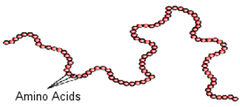
Secondary Structure
found in most proteins, consists of coils and folds in polypeptide chain (hydrogen bonds)

Tertiary Structure
determined by interactions among various side chains (R groups); disulfide bridge
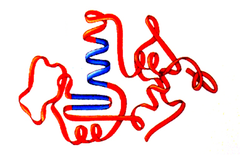
Quaternary Structure
interactions between multiple polypeptide chains
arises when the protein consists of two or more polypeptide chains

Sickle Cell Disease
slight change in primary structure
an inherited blood disorder, from results from a singe amino acid substitution in the protein hemoglobin
What can cause a protein to unravel?
alterations in pH, salt concentration, temperature, etc
Denaturation
loss of a protein's native structure
makes it biologically inactive
X-ray Crystallography
determines 3D protein structure based on diffractions of an x-ray beam by atoms of crystallized molecules
Nucleic Acids
store, transmit, and help express hereditary info
polymers called polynucleotides
Roles of Nucleic Acids
1. deoxyribonucleic acid (DNA)
2. ribonucleic acid (RNA)
gene expression = DNA --> RNA --> protein
Pyrimidines
cytosine, thymine, uracil
way to remember: pyrimidines has a "y" and so does cytosine and thymine
Purines
Adenine, Guanine
Structure of DNA
two polynucleotides (forming a double helix)
antiparallel strands
Structure of RNA
one polypeptide chain
Genomics
approach used to analyze large sets of genes or compare the genomes of different species
Bioinformatics
use of computer software and other tools to analyze the data
The helix is an example of:
a secondary structure stabilized by hydrogen bonds
Watson and Crick Model
first to determine a structure
double stranded helix
later on, the conservative models, etc
2 sugar phosphate backbones on outside
bases on inside
backbone runs antiparallel
1 purine and 1 pyrimidine per base pair
discovered that A only paired with T and G only paired with C

T.H. Morgan
showed that genes are located on chromosomes
the two components of chromosomes—DNA and protein—became candidates for the genetic material
the key factor in determining the genetic material was choosing appropriate experimental organisms
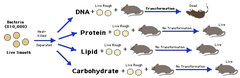
Griffith Experiment
discovery of genetic role of DNA
genetic material survived heating and can be transferred from S cells into R cells, stably converting them into S cells; called transformation
did not say what genetic material was
S is pathogenic, R is non-pathogenic

Avery Experiment
Conclusion:
DNA carries the genetic material, not protein
the transforming substance is DNA
Virus
DNA (or RNA) enclosed by a protective protein coat
must infect cells and take over the cells' metabolic machinery in order to reproduce
ex: phages
Hershey and Martha Experiment
DNA is the genetic material of a phage known as T2
DNA was found in pellet with bacterial cells,
Protein found in supernatant with no cells
DNA but not protein enters cell, DNA must be genetic material

Chargaff's Rules
The base composition of DNA varies between
species
In any species the percentages of A and T bases are equal and the percentages of G and C bases are equal
(these were not understood until the discovery of the double helix)
Wilkins and Franklin
using a technique called X-ray crystallography to study molecular structure
Franklin's X-ray Crystallography
produced an image of the DNA molecule
DNA is helical, like a spiral staircase
DNA is composed of more than one chain, likely 2-3
DNA has a regular structure=long and narrow, constant width
Watson's and Crick's Semiconservative Model of Replication
predicts that when a double helix replicates
each daughter molecule will have one old strand (derived or "conserved" from the parent molecule) and one newly made strand
the "right" model
Three alternative models of DNA replication
the semiconservative is the "right model"

Meselson and Stahl Experiments
main question do the 2 strands of DNA separate from one another during replication??
supported the semiconservative model of DNA replication
N15=heavy DNA, N14=light DNA
used density gradient centrifugation
How many mistakes with every 10 billion nucleotides?
approximately one
Replication begins at sites called?
origins of replication
where the two DNA strands are separated, opening up a "bubble"