12 - arenes
 Call Kai
 Learn
 Practice Test
 Spaced Repetition
 Match
 Flashcards
 Knowt Play
1/36

There's no tags or description
Looks like no tags are added yet.
37 Terms
phenyl
name of a substituent when benzene is attached to an alkene/alkane with 7 carbon atoms or more
shape about each C atom in benzene
trigonal planar, 120 degrees due to each carbon atom being sp2 hybridised
(one 2s and two 2p orbital undergoes hybridisation to form three sp2 hybrid orbitals with a trigonal planar arrangement about each carbon)
hybridisation of carbon atoms in benzene
each carbon atom in benzene is sp2 hybridised.
carbon has an electronic configuration of 1s2 2s2 2p2
one 2s and two 2p orbitals undergo hybridisation to form three sp2 hybrid orbitals with a trigonal planar arrangement about each carbon atom
2 sp2 orbitals overlaps head-on to form two C-C bonds, the other overlaps head-on to form a C-H bond
the remaining six unhybridised 2p orbitals overlap side-on with one another to form a pi ring of 6 delocalised electrons forming regions of overlap above and below the plane of the carbon skeleton
resonance stability
is the extra stability gained when the molecule’s pi electrons are delocalised over multiple adjacent atoms instead of localised on just one atom.
why does benzene react with electrophiles?
the ring of delocalised pi electrons contributes to the high electron density in the benzene ring. this makes the bezene highly susceptble to attack by electrophiles.
explain, in terms of the delocalisation of pi electrons, the difference in the reactivity towards electrophiles between benzene and alkenes
explain, in terms of the delocalisation of pi electrons, why benzene prefers to undergo substitution instead of addition reaction
the delocalised pi electron cloud results in resonance stability
the addition product destroys the aromatic ring of delocalised pi electrons, resulting in a loss of resonance stability (in the addition product).
this results in the product losing its aromaticity, which is not favoured energetically.
electrophiles
an electron-deficient species that forms a bond by accepting a pair of electrons from an electron-rich species using its empty orbitals.
nucleophiles
an electron-rich species that forms a bond by donating a pair of electrons to an electro-deficient species.
why are the C-C bonds in benzene identical?
due to the continuous side-on overlap of the unhybridised p orbitals of the sp2 hybridised carbon atoms.
this results in a delocalised pi electron cloud above and below the plane of the benzene ring, resulting in resonance
why is benzene less reactive than alkenes?
the aromatic stability of benzene renders the pi electron cloud less susceptible to electrophilic attack compared to that of the C=C in alkenes.
stronger electrophiles are required for benzene to react as compared to alkenes
a positively charged halogen X+ is required for benzene while a polarized halogen X2 is sufficent for alkenes to undergo electrophilic substitution
reagents, conditions, products and observations for the halogenation of benzene (both chlorination and bromination)
chlorination :
reagents : Cl2, anhydrous FeCl3 or AlCl3 or Fe
conditions : room temperature
products : chlorobenzene, HCl
observation : yellowish green Cl2 decolourises to give white fumes of HCl
bromination :
reagents : Br2, anhydrous FeBr3 or AlBr3 or Fe
conditions : room temperature
products : bromobenzene, HCl
observations : reddish-brown Br2 decolourises to give white fumes of HCl
reagents, conditions, products and observations for the (friedel-crafts) alkylation of benzene
reagents : alkyl chloride, anhydrous FeCl3 or AlCl3 (no Fe)
conditions : room temperature
products : alkylbenzene (eg. ethylbenzene), HCl
observation : white fumes of HCl evolved.
reagents, conditions, products and observations for the nitration of benzene
reagents : concentrated HNO3, concentrated H2SO4
conditions : heat under reflux at 50 degrees Celcius
products : nitrobenzene, H2O
observation : yellow oil of nitrobenzene formed
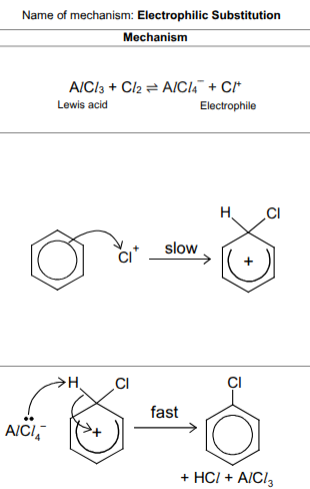
describe (draw) the mechanism of the mono-chlorination of benzene
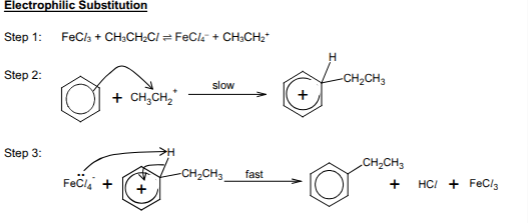
describe (draw) the mechanisim of the ethylation of benzene
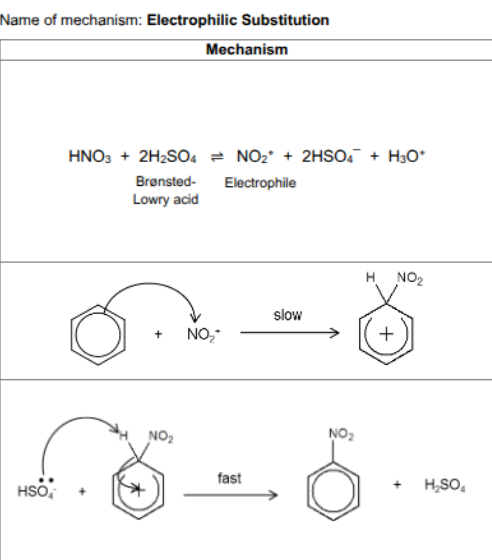
describe (draw) the mechanism of the nitration of benzene
why does electrophilic substitution reactions require lewis acid catalysts
electrophilic substiution involves the disruption of the resonance stability of benzene
an electrophile stronger than X2, which has a partial positive charge (from forming a dipole), is required.
a stronger electrophile X+, can be generated FeX3/AlX3 (which are lewis acid cataylsts) accepts an electron pair from X2.
how does an activating group affect the reactivity of the benzene ring?
an activating group is electron donating,
so it will increase the electron density in the benzene,
causing it to be more susceptible to electrophilic attack.
this increases the benzene ring’s reactivity towards electrophiles
(the electron density on carbons 2- and 4- positions increases, thus making them more vulnerable to attack by an electrophilic reagent. thus, the incoming electrophile has a relative position of 2- and/or 4-.)
how does a deactivating group affect the reactivity of the benzene ring?
a deactivating group is electron withdrawing,
so it will decrease the electron density in the benzene ring
making it less susceptible to electrophilic attack
thus decreasing the benzene ring’s reactivity towards electrophiles
(the electron density on carbons 2- and 4- will decrease, thus making the electron density on the carbon 3- position relatively higher. thus, any subsequent attack by an electrophile will take place preferentially in the 3- position.)
3-directing
a substituent which causes the incoming electrophile to be substituted predominately on the 3rd position relative to the original substituent.
2,4-directing
a substituent which causes the incoming electrophile to be substituted predominately on the 2nd and 4th position, relative to the original substituent.
a substituent (eg. methyl group) which is 2,4-directing will result in the formation of two major products (the 2-isomer and the 4-isomer.)
these two major products are NOT produced in equal amounts, as the substituent already present will hinder the approach of the incoming electrophile at the carbon-2 position. (steric hinderance)
the 4-isomer will thus be produced in higher amounts
the 3-isomer is produced, but in a significantly smaller amount as compared to the two other products
explain why anhydrous FeX3 / AlX3 catalyst must be used in the electrophilic substitution with a benzene ring
in water, the FeX3 / AlX3 catalyst will hydrolyse
and will no longer be able to accept a lone pair of electrons from Cl2 to generate the desired electrophile, Cl+
why is AlX3 able to act as a lewis acid catalyst?
Al in AlCl3 has a unhybridised and vacant 3pz orbital that can accept an electron pair (only has 6 electrons). thus it can act as a lewis acid (accepts a pair of electrons) catalyst
reagents, conditions, products and observations of the halogenation of METHYLbenzene (chlorination and bromination)
chlorination
reagents : Cl2 (g), anhydrous FeCl3 / AlCl3 catalyst or Fe
conditions : room temperature, absence of UV light
products : a mixture of 2-chloromethylbenzene and 4-chloromethylbenzene
observations : yellowish green Cl2 decolourised to give white fumes of HCl
bromination
reagents : Br2 (g), anhydrous FeBr3 / AlBr3 catalyst or Fe
conditions : room temperature, absence of UV light
products : a mixture of 2-bromomethylbenzene and 4-bromomethylbenzene, HBr
observations : reddish-brown Br2 decolourises to give white fumes of HBr.
reagents, conditions and products for the nitration of METHYLbenzene
reagents : concentrated HNO3, concentrated H2SO4
conditions : 30 degrees Celcius
products : a mixture of 2-nitromethylbenzene and 4-nitromethylbenzene, water
why does the nitration of methylbenzene require a lower temperature than the nitration of benzene?
the nitration of methylbenzene requires only 30 degrees Celcius, while the nitration of benzene requires heat under reflux at 50 degrees Celcius.
a lower temperature is required as the methyl group in methylbenzene is electron donating, so it has a higher electron density in the ring than benzene
this makes methylbenzene more susceptible to attack by electrophiles, so a milder temperature can be used for the nitration of methylbenzene.
state the differences between the nitration of methylbenzene and benzene
temperature (30 vs heat under reflux at 50)
a mixture of products (2- and 4- nitromethylbenzene ; along with water) is formed for the nitration of methylbenzene. while for the nitration of benzene, only nitrobenzene and water is produced.
state the differences between the halogenation of benzene and methylbenzene
the halogenation of methylbenzene needs to be conducted in the absence of UV light (to prevent the free radical substitution of the methyl group in methylbenzene)
a mixture of products (2- and 4- bromomethylbenzene) is produced alongside HBr, while for the halogenation of benzene, only bromobenzene and HBr is produced.
suggest a reason why the nitration of fluorobenzene is greater than the rate of nitration of chlorobenzene
the valence orbitals of F are smaller and less diffuse (concentrated closer to the nucleus) than Cl, resulting in a more effective overlap with pi electron cloud of the benzene ring
this increases the electron density of the benzene ring to a greater extent, making fluorobenzene more reactive. thus having a greater rate of nitration
explain why free radical substitution occurs to the C-H bond in the alkyl group and not the C-H bond on the benzene ring.
the C-H bond in benzene is formed from a 2ps2-1s overlap while the C-H bond in the alkyl group is formed from a 2sp3-1s overlap.
percentage of s character in the hybrid orbitals of the C-H bond in benzene is greater than in the alkyl group
the C-H bond in the benzene ring thus has a more effective orbital overlap,
and so forms a stronger bond that requires more energy required to break (thus FRS happens to the alkyl group instead)
reagents, conditions, products and observations for the oxidation of the methyl group in benzene when in the ACIDIC medium.
reagents : KMnO4, dilute/aq H2SO4
conditions : heat under reflux
products : benzoic acid, H2O (, CO2 and/or carboxylic acid)
observations : purple KMnO4 decolourised (MnO4- reduced to Mn2+). white ppt of benzoic acid formed
what is required for the alkyl chain bonded to benzene to undergo oxidation to give benzoic acid?
at least one hydrogen atom bonded to the first carbon in the alkyl chain
reagents, conditions, products and observations for the oxidation of the methyl group on the benzene ring when in ALKALINE conditions
reagents : KMnO4, NaOH
conditions : heat under reflux
products : benzoate ion, H2O, (carbonic ion and/or carbonate ion)
to produce a white ppt of benzoic acid, the benzoate ion produced can be acidified
observations : purple KMnO4 decolourised (MnO4- reduced dot MnO2). brown precipitate of MnO2 is formed.
explain why FeBr3 is required for Br2 to react with benzene but not for alkene
alkenes are unsaturated and not resonance stabilised
benzene is resonance stabilised due to the delocalisation of 6 pi electrons, and so a stronger electrophile is required for the electrophilic substitution of benzene
the lewis acid FeBr3 can be used to generate the stronger Br+ electrophile required for electrophilic substitution to occur.
why is the nitration of benzene exothermic?
the C-N bond in nitrobenzene is stronger than the C-H bond in benzene due to the partial double bond character between the C and N atom.
since a stronger bond is formed, the reaction is exothermic