WEEK 1: Physical Activity Basics
 Call Kai
 Learn
Learn Practice Test
 Spaced Repetition
 Match
Match Flashcards
 Knowt Play
1/44

There's no tags or description
Looks like no tags are added yet.
Name | Mastery | Learn | Test | Matching | Spaced | Call with Kai | Chat |
|---|
No analytics yet
Send a link to your students to track their progress
45 Terms
What is physical activity?
Physical activity is any bodily movement produced by skeletal muscle that results in energy expenditure, and increases heart and breathing rates
What are the 24 hour movement guidelines for 5-17 years?
Sweat 60+ minutes of moderate-to-vigorous aerobic activity daily, with vigorous and strengthening exercises at least 3 days a week Step Several hours of diverse structured and unstructured light activities daily Sleep 9–11 hours (ages 5–13) or 8–10 hours (ages 14–17) per night, maintaining consistent sleep schedules Sit Under 2 hours of daily recreational screen time and avoiding extended sitting

What are the 24 hour movement guidelines for adults 18-64 yrs?
Physical activity Variety of types and intensities Moderate to vigorous aerobic PA, at least 150 mins per week Muscle strengthening activities at least twice a week Several hours of light physical activities Sleep 7 to 9 hours of good quality sleep, maintaining consistent sleep schedules Sedentary behaviour Limit to 8 hours or less per day No more than 3 hours of recreational screen time Breaking up long periods of sitting

What is exercise?
Exercise is planned, structured, repetitive PA, performed with the goal of improving health, fitness, or performance
What is physical fitness?
Physical fitness is the ability to carry out daily tasks with vigor and alertness, without undue fatigue, and with ample energy to enjoy leisure-time pursuits and meet unforeseen emergencies
What are the components of physical fitness?
Skill related vs health related

What is cardiovascular endurance?
Cardiovascular endurance is the ability of your heart, lungs, and blood vessels to supply oxygen during long periods of activity
What is muscular endurance?
Muscular endurance is the ability of muscles or muscle groups to perform repeated or sustained contractions
What is muscular strength?
Muscular strength is the maximum amount of force a muscle can produce in a single effort
What is body composition?
Body composition is the relative proportions of fat and fat-free masses
What is flexibility?
Flexibility is the range of motion about a body joint
How do we achieve physical fitness?
FITT principles
What is FITT?
Frequency Intensity Time Overload Type
What is moderate physical activity?
Moderate physical activity: Any activity that causes you to sweat a little and to breathe harder RPE: 5 to 6 % VO2max: 50 to 70%
What is vigorous physical activity?
Vigorous physical activity: Any activity that causes you to sweat a lot and be “out of breath” RPE: 7 or 8 % VO2max: 85%
What is VO2?
VO2 is the volume of oxygen your body consumes and processes per minute mL of O2 consumed per minute per kilogram of body weight
What is the talk test?
Ventilation increases in a linear manner from 50-75% VO2max Then rises exponentially – ventilation threshold (also, point of lactate threshold) At this point, your ability to voluntary talk is overridden by your muscles need for oxygen (and removal of CO2) ~85% VO2max

What are the health benefits of physical activity?
Aging → longevity More energy Prevent neurodegenerative diseases Sleep Reduce chronic disease risk Quality of life Mental health Body composition Social Injury prevention Self confidence
What are the respiration effects of physical activity on human physiology?
Being active increases oxygen consumption Resting: 250 ml/min Untrained male: 3600 ml/min Trained male: 4000 ml/min
What are the goals of respiration?
The goals of respiration: To provide oxygen to tissues To remove CO2 from tissues
What are the events of respiration?
Respiration has 4 major events: Pulmonary ventilation or the exchange of O2 and CO2 between the atmosphere and the lungs Diffusion of O2 and CO2 between lungs and blood Transport of O2 and CO2 in the blood to tissues Regulation of ventilation
What are the CV system effects of physical activity on human physiology?
The end result of CV function during exercise is to deliver O2 and other nutrients (e.g., glucose, amino acids) to the muscle Muscle blood flow increases drastically during exercise Resting: 3.6 ml/100 g muscle/min Max exercise: 90 ml/100 g muscle/min This is caused not only by factors in the muscles themselves, but to an increase in mean arterial pressure
What is arterial pressure?
Arterial pressure is the force by which blood is pushed through the vessels and distends the vessels to decrease resistance
What happens as muscle work output increases?
As muscle work output increases, O₂ consumption increases which leads to dilation of vessels
What causes cardiac output to increase?
Increased venous return causes cardiac output to increase
What is cardiac output at rest and during maximal output in an untrained person?
Cardiac output Rest: 5.5 L/min Max output (untrained): 23 L/min
What are the CV system adaptations with training?
Potential increases in heart muscle mass Resting cardiac output remains similar to a normal person, however.. ↑ stoke volume at a heart rate ↓ More blood pumped out of the heart per beat Resting heart rate is lower Bottom line: heart works less
What is improved insulin sensitivity?
Improved insulin sensitivity is associated with increases in insulin-signalling intermediates and GLUT4 protein GLUT4 is a protein involved in glucose uptake into muscle cells Improved insulin sensitivity may require an exercise intensity of approximately 70% VO₂max or more due to the use of carbohydrates

What is the timing of glucose improvement?
Exercising after a meal can be beneficial to lower glucose levels and increase insulin sensitivity through the insulin pathway

What are blood pressure improvements from exercise?
Improvements in blood pressure can occur acutely and at relatively low intensities of approximately 40% VO₂max

What are the effects of exercise on blood lipids?
Improved blood lipids Exercise can increase HDL and decrease triglycerides (TG) Decreases in LDL may require prolonged exercise
What is TEE?
TEE = BMR/RMR + DIT + AEE
What is RMR?
RMR Makes up about 60-75% of TEE The amount of energy required at rest to maintain body temperature and involuntary muscle contractions (e.g., ventilation) BMR + arousal/wakening Affected by age, gender, body composition, body size
What is DIT?
DIT stands for diet induced thermogenesis DIT makes up about 10% of TEE
What is AEE?
AEE stands for activity energy expenditure AEE makes up 20-30% of TEE
What is EPOC?
EPOC stands for excessive post-exercise oxygen consumption This is the elevated rate of oxygen intake and calorie burning after strenuous exercise as your body returns to its resting state

What is the relationship between intensity and EPOC?
The higher the intensity, the longer you hold the intensity, the higher the EPOC

What are the contributions to EPOC?
Rapid, short phase (lasts 1 hr) Replenishment of oxygen in blood and muscles ATP/P-creatine synthesis Lactate removal Body temp regulation Ventilation and respiration regulation Prolonged phase Re-esterification of FA - fatty acids Protein resynthesis
What is RMR vs. EPOC?
RMR measured after 72 hours of last bout Treatments (9 wk) Control Resistance training (4d/wk) RT + aerobic training Results: RT: The increase in RMR is attributed to increase in FFM (muscle) RT + Aerobic Decrease in RMR → adaptive thermogenesis,

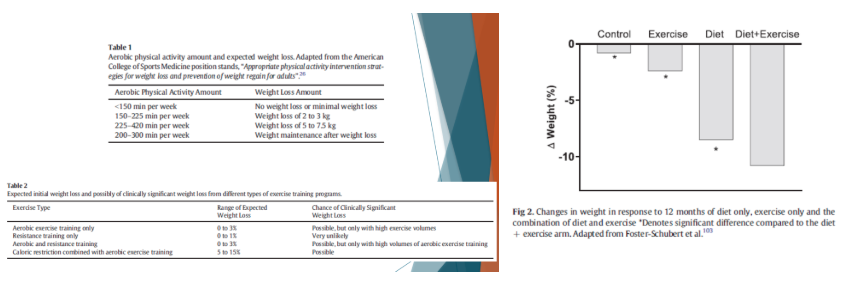
What was the PA and Weight Loss study?
12-month, postmenopausal women 1: 1200-2000 kcal diet 2: MVPA (5 days per week, 225 min per week) 3: Combo Combo = greatest weight loss, fat loss But don't reduce too much Don't go under 1200 calories → hard to get enough nutrients Aerobic > resistance Meeting exercise guidelines does not guarantee weight loss Aerobic training is more sustained and you tend to burn more calories
What is the Fitness vs. Fatness: Gaesser article?
Being fit appears to reduce mortality risk even when someone is overweight or obese, while being unfit is associated with substantially higher mortality risk
What is visceral adiposity?
Visceral adiposity Problematic fat, stored around your organs Symptom over overnutrition due to adipose tissue Associated with metabolic and cardiovascular health problems Breaking down can have a huge health impact
Why is visceral fat sensitive to epinephrine?
Visceral fat is sensitive to epinephrine because it has adrenergic receptors that respond to SNS activity
What happens to visceral fat during exercise?
During exercise, SNS activation increases epinephrine, which promotes the breakdown of stored fat
How can exercise affect visceral fat and waist circumference?
Exercise can therefore reduce visceral fat and waist circumference even when there is little overall weight loss