Master Set (reptiles, amphibians, mammals, Trees, birds)
 Call Kai
 Learn
 Practice Test
 Spaced Repetition
 Match
 Flashcards
 Knowt Play
1/105

There's no tags or description
Looks like no tags are added yet.
106 Terms
Common shrew (Sorex araneus)
Dark brown fur with silver fur below
Tiny eyes, small ears pointy nose
Tail half body length
Prefer woodland and grassland
day and night
may hear fighting squeaks in summer over territory
Pygmy shrew (Sorex minutus)
Dark brown fur with silver fur below
Tiny eyes, small ears very long pointy nose
tail 2/3 body
Smaller than common shrew
None in Scilly, Scot, and Orkney
Bank vole (Myodes glareolus)
Chestnut brown, white below
Long tail
Eats hazelnuts and blackberries frequently
Round grassy weaved nests, or burrows
Very active
European hedgehog (Erinaceus europaeus)
Brown with yellow tipped spines over head and face
Hides under logs, leaves and refugia during day
Droppings 5cm, dark, filled with worms and berries
PRIORITY UK POST 2010 BIODIVERSITY FRAMEWORK
RED LIST FOR BRITISH MAMMALS
Red Fox (Vulpes vulpes)
Orange red abouve, pale below, black ear tips, white tipped orange bushy tail
burrow system scent marked with musty odor
Nocturnal
Dog like droppings 1 pointy end, full of fur feathers or berries, musky smell
WILD MAMMAL PROTECTION ACT 1996
ANIMAL WELFARE ACT 2006
European badger
Large and grey with short bushy tail, black and white face
Live in large family group in sette, latrine nearby
Cubs born Jan, Feb
PROTECTION OF BADGERS ACT 1992
Pine Marten (Martes martes)
Cat sized, brown fur with yellow bib over throat and chest, long bushy tail
Agile climbers, dens in tree cavities / squirrel nests
N + central scot, S scot, S eng rarely
SCHEDULE 5 WCA
Field vole (Microtus agrestis)
Grey brown above, pale grey below
Shaggy shortish tail
Territorial males in breeding season
Day and night
Water vole (Arvicola amphibius)
Brown fur
Small ears and furry tail
Bigger than other voles
Only one found near water, wetland etc
45' grass cuttings near water in piles
Brown Hare (Lepus europaeus)
Golden brown, pale belly, longer legs and ears with black tips
Square face and more lean
No burrows, sleep in depressions
Lives in mosaic habitat
Ball like yellow green droppings
POST 2010 Biodiversity Framework
Red Squirrel (Sciurus vulgaris)
Conifer woods
Red brown, bushy tail, smaller than gray
Scot, N Ire, Lake district
UK POST 201O Biodiversity Framework
Grey squirrel (Sciurus carolinensis)
Introduced
Not tree picky
Silver grey and brownish face and feet
American Mink (Neovison vison)
Small brown black fur, white chin and throat
Dens close to water and territorial
if caught illegal to rerelease
Introduced and invasive
Water shrew (Neomys fodiens)
Black fur, white underneath
Large hind feet, pointy nose
Only shrew found near water
None in Scilly, Scot islands, Isle of Man and N Ire
House Mouse (Mus musculus)
Grey brown
Large ears and small snout
Scaly long tail
Common near people and very widespread
Wood mouse (Apodemus sylvaticus)
Golden brown but pale below
Large eyes, ears and long tail
Browner than house mouse
More common in farm, woods, grassland, less so near people
Rabbit (Oryctolagus cuniculus)
Grey brown, long ears and hind legs
Warrens with waste piles outside, and low runs through grass
Introduced but naturalised
European otter (Lutra lutra)
Large grey brown broad snouted, pale chest and throat
Underground burrows
Require clean rivers with vegetation to hide in
CHSR 2017
Stoat
Orange brown back, white throat and belly
Black tipped tail
Larger than Weasel arches back when moves
APP 3 Bern Converntion 2007
Ireland subspecies also protected
Weasel (Mustela nivalis)
Brown back, white throat and belly
Smaller than stoat and shorter tail with no black tip
Straight backed gait
Red Deer
Rusty red, brown in winter
Highly branched antlers
Native
Moor, woods, and grassland
Roe Deer (Capreolus capreolus)
Brown fur
No visable tail, small antlers
Prefer habitat edges of woodland and grassland
Native
Fallow Deer (Dama dama)
White-spotted brown fur
Moose-style antlers
Medium sized, in deciduous woods
Introduced
Sika Deer (Cervus Nippon)
Found in scottish moors / conifer plantations, and Dorset heaths
Mainly Scotland
Introduced
Muntjac deer (Muntiacus reevesi)
Small deer with pronounced nose pores
Woodland and grassland
Introduced
Small single point antlers
Chinese Water Deer (Hydropotes inermis)
Only deer with visable tusks
Smaller
Lowland reed beds, and arable fens
Introduced
What are the differences between dog and badger fur?
Badger:
- Dense and coarse
- uneven when rolled between fingers
- hair feels bumpy and flips when rolled
Dog:
- soft
- Varied colour
- Often smells
check barbed wire, bramble, branches and rubbing posts
How do you camera trap mammals?
Placement varies, either use grid, random or transects
Mount Knee height, parrellel to ground, north facing, vegetation clear
Make sure metadata is accurate
Check regularly
What legal protections do mammals have?
WCA 1981
CHSR 2017
Protection of Badgers act 1992
Wild Mammals protection act 1996
Hunting act 2004 - no hunting with dogs
Hare Preservation act 1892 - dont sell in breeding season
How many visits are needed in mammal surveys
2-4 good middle ground
Hazel Dormice - footprint tunnels 2/month for 3-5 month
- nest tubes or boxes monthly
Bats - presence 2-3 2 weeks apart
Water Voles - presence 2+ 1 in Apr-Jun 1 Jul-sep
Badgers - field visits 1-2 more if sette
Mice voles and shrew - live trapping 3-5 consecutive nights or mornings
what TOY do you survey mammals
Bats - activity May-Aug hibernation Dec-Feb
Badgers - Nov-Mar can be done year round
Dormice - nut searches Nov-Apr Nest tubes Apr-Oct
Otter - Mar-Sep
Water Vole - Apr-Sep
Mar - Sep or Oct covers most active periods
How do footprint tunnels work
Tunnel with bait
Place masking tape covered with charcoal powder and veg oil
Make sure to place near cover or vegetation
Check daily
How do hair tubes work
Tube with strips of tape inside
baited in fixed internal section
great for welfare but possible bycatch
Check daily
What is the mitigation hierarchy
Avoid - reduce impact, avoid species rich area
Minimise - reduce extent of impact
Mitigate - improve or protect affected area
Compensate - compensate loss to site or species bng credits etc
What are the signs of a badger sette
Neat and tidy
Clean doorway with used bedding made of dry grass
Smelly latrine with feces nearby - dark, sausage shaped, sweet smelling musk
Fresh earth outside
well worm paths neaby
What is BNG how is it met
Defra 2012 legal requirement to increase a sited biodiv by 10% measured with biodiv metric tool in units
Can improve habitats, create new, allocate offsite gains, or buy units
Ecologist pea/phase 1 - losses vs gains - get +10%
Badger mitigation techniques
Avoid isolating badger territory
Avoid artificial light and noise
Retain vegetation, and reduce disturbance around settes
Avoid activity around dusk/dawn
Maintain foraging space, watering areas, hab connectivity
If sette lost make a new one
NO TRANSLOCATION
What is a EIA
Potential impacts of development on environment, species AND social, health etc
For a large scale or important site
Identify effects to mitigate and compensate
EIA Regulations 2017 more details
What is a ECIA
Ecological impact assessment
Just the effect on nature
Otter and Water Vole mitigation
Closure of otter holts at appropriate times
Artifical holt creation
New travel routes under roads etc
Buffer habitat
Sympathetic bank profiles, mammal ledges, reduce light and noises
Translocation and displacement possible - Nat Eng Liscense
What are the signs of animal feeding on hazel nuts
Hazel Dormice - round hole, smooth inner rim
Wood Mice - rough gouges
Bank Vole - round hole prominant tooth gouges
Squirrels and birds - Split
Signs of feeding on bark or bark stripping
Deer - upward stripping
Rabbits and hares - roots exposed
squirrels - high up
Signs of feeding on grass
Field Vole - shredded 1-2 cm along paths
Water Vole - 45' cut stem
rabbit - scissor cut neatly
Deer - ragged and uneven
Signs of predation in species
Fox and Badger - crush bones completely, messy sites
Avian - pluck feathers
Natterjack toad (Epidalea calamita)
- Olive green to brown with central yellow back stripe
- Small and compact
- Rapid walking and running
- Restricted to coastal dune, salt marsh and inland heath ponds
Palmate newt (Lissotriton helveticus)
- Pale and unspotted throat
- Males: needle tail filament
- Beige, olive, or brown body but similar to smooth newt
- Occur at higher altitudes
- None in East Anglia and East Midlands
Smooth newt (Lissotriton vulgaris)
- Beige, olive or brown body similar to Palmate Newt
- Spots on underside of throat
- Male: undulating smooth crest
- Common in garden ponds and most widespread
Great Crested Newt (Triturus cristatus)
- Largest british newt
- Bumpy brown / black skin
- Yellow to orange belly with spots
- Male: jagged crest, smoother on tail
-- and iridescent flash on tail
- Occur rarer and in larger ponds
Common toad (Bufo bufo)
- Drier and bumpier skin
- Rounded shape
- Walks or hops
- Grey, brown or reddish skin with a white underside
- Copper eyes
- Occurs in deep ponds and lakes but spends more time on land
Common frog (Rana temporaria)
- Smooth moist skin
- Moves in short jumps
- Longer hind legs than toads
- Dark mask behind eyes
- Variable colour
- Occurs in countryside and urban ponds
What non-native amphibians are present in the uk?
- Marsh frog
- Pool frog
- Edible frog
Pool frog (Pelophylax lessonae)
- One native population in East Anglia site
- Brown or green
- Has dark splotches and yellow dorsal line
- Not bumpy
What are the key threats to amphibian species?
- Habitat loss
- Habitat fragmentation
- Pollution
- Chytrid fungus and invasives
What liscense is required to survey GCN?
- Natural England mitigation liscense (European protected species liscense)
- Applied for by ecologist on behalf of developer when GCN evidence found
- For any unavoidable activity likely to affect GCN pr their habitats
What is the HSI?
- Determines the suitability of the habitat for GCN
- Used in addition to surveys
- Scale of 0-1 higher scores are more likely to support GCN
- Some example factors:
-- Geographical location
-- Pond area
-- Pond permanence or water quality
How do you tell amphibian eggs apart?
- Frogs: dense unordered clump
- Newt: hidden in folded leaf, gcn is yellower
- Toad: 2 long strings of eggs
- Natterjack: 1 string of eggs
When is the best toy to survey amphibians?
- Breeding season Mar-May
- Early spring feb-mar: grog and toad spawn
- Summer-early autumn Jun-Sep: Juveniles and adults
- warmer and milder evenings above 5' with low wind
How do you survey for GCN and other amphibians?
- HSI (aka refugia searches) - how likely a GCN is present
- EDNA sampling collected later from Apr-Jun
- Common survey methods:
-- Torching at night along waters edge
-- Bottle trapping with newt traps (need liscense)
-- Netting around margins and egg searching margins
What are the signs of GCN presence?
- Direct evidence of presence
- eggs or folded leaves with eggs
- GCN larvae (orange spotted gills, long toes, dark blotchy skin and tail filament)
- habitat suitability:
-- terrestrial refuges
-- water body within 500 m
-- no fish presence
What amphibians are protected in the UK?
- GCN: Schedule 5 WCA 1981, CHSR 2017, UK BAP
- Natterjack: Schedule 5 WCA 1981
-WCA partially protects common toad and frog
- if in captivity protected under animal wefare act 2006
What happens in a GCN survey?
- 1: HSI calculation
- 2: Presence/absence:
-- EDNA 1 visit Mid apr-Jun
-- Traditional (torch, bottle,egg searching) Mid Mar-Mid Jun 4 visits
- 3: Population size estimates = +2 visits (Bottle trapping and Torchlight counts)
- 4: Report compiled
- Mitigation and licensing
What mitigations can be put in place for amphibians?
- Protecting individuals caught
- Maintaining habitat:
-- New fish free ponds
-- Restoring existing ponds or habitat cover
-- Planting hedgerow
-- Artificial hibernacula
Common lizard (Zootoca vivipara)
- Mostly green or brown but can be black, grey, blue or yellow
- can have light or dark fine markings
- females have striped appearance
- Males have dark spots on stomach
- Distinctly pointed snout
- Heath and grassland but declining
Slow Worm
(Anguis Fragilis)
- Cylindrical hard and smooth
- Shiny metallic appearance
- In young and females silver or gold with brown or black sides and dark stripe or zigzag on back
- In males more evenly creme coloured
Sand lizard (Lacerta agilis)
- Stockier and longer than common lizard
- Grey beige or brown with brown or black spots, pale center
- Males have green underside in breeding season
- Females grey to yellow underside
- Head less pointed more bulky
- Rare only sand heaths and dunes
Grass snake (Natrix natrix)
- Longest British snake
- Variable colour and pattern olive green to brown
- Distinctive yellow to orange red collar
- Regular black side markings
- Strongly associated with water and can swim
- None in N Eng, Scot, and Ireland
Smooth snake (Coronella austriaca)
- Slim snake smallest of uk
- grey to brown
- Dark heart shaped markings on top
- Dark stripe from nose to eye and then side of head
- Underside colour can vary
- Scales with no keel
Adder (Vipera berus)
- Short and stocky
- Central zigzag along back
- In females pale brown to red and brown zigzag
- In males lighter grey to white and beige and dark zigzag
What habitat are each reptile species most likely found
- All species need sunny patchy habitat
- Heathland: All species
- Grassland / Scrub: Slow worm and common Lizard
- Woodland edges: Adder
- Urban fringe and garden: Slow worm, Common Lizard
- Wet habitats: Grass Snake
What are the best conditions to survey reptiles
- April may and september peak activity - Mar to Oct
- Sunny dry and calm 9' to 20'
- 9 to 11 AM or 4 to 6 PM
Which reptiles are protected
- All protected under WCA 1981
- Smooth snake and sand lizard CSHR 2019
--> Only handled by liscensed ecologists
What environmental signs are there for reptiles
- Fleeting rustles
- Basking sites and patchy grassland
- Shed snake and lizard sloughs
How can you identify reptile sloughs?
- Grass Snake: long, large head scales, dark collar
- Adder: zigzag and heavily keeled
- Smooth Snake: no keels
- Slow worm: rare small ripped or folded skin
What is the reptile survey process
- PEA to establish species presence
- Phase 1 of habitat and area, and look at past records
- phase 2 refugia placed in hotspots identified in phase 1 (apr-sep)
- then mitigation
- 5-7 visits but leave refugia for 14 days after placement
Where are reptiles found in the uk
- Common Lizard: Nationwide
- Slow worm: Common across England, Wales, and Scotland
- Grass Snake: Lowlands of England and Wales
- Adder: Southern England and Wales
- Sand Lizard: Scarce. Specific coastal sand dunes in Southern England and Wales
- Smooth Snake: Dorset, Devon, Hampshire, Surrey. rare
How do you set up a refugia survey
- Placed in hotspots - shelter nearby, and sun trap
- South facing and sunny areas
- Place on grass or low vegetation to increase humidity
- 10 or more refugia per hectare
check above and around from distance
approach slowely and carefully
lift from corner
replace and retreat
What mitigation techniques are used for reptiles
- key habitat and location features kept - eg, ponds, course grass
- if a small reptile progressive slow cutting of grass, scaring reptiles to adjacent area plus reptile proof fencing
- section of areas placing refugia and moving individuals
- Create patchy grassland, south facing slopes, new ponds, rotting veg as egg laying sites, artificial hibernacula
Pedunculate Oak
4-5 deep lobed leaves, Long yellow catkins, acorns with long stalk, few overlapping scales on winter buds

Hawthorn
Leaves lobed halfway to middle with sub lobes 3 lobes each side and 1 front, branched flower structure white flowers with yellow or pink anthers, red berry 1 stone, short thorns, short red buds in early year

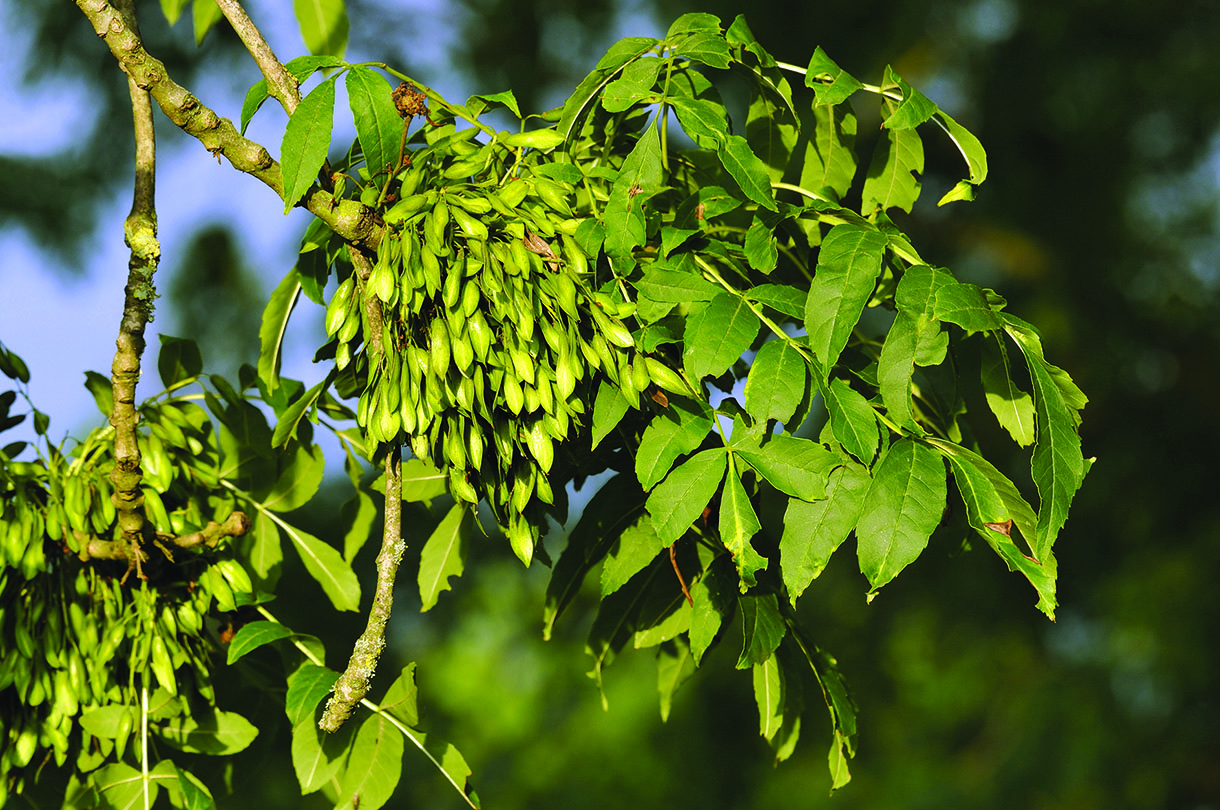
Ash
9 tooth edged (pinnate) leaflets no leaflets meet leaf midrib, dense purple red clustered leaves, fruit keys (look like peapods), very black buds, largest hedgerow tree
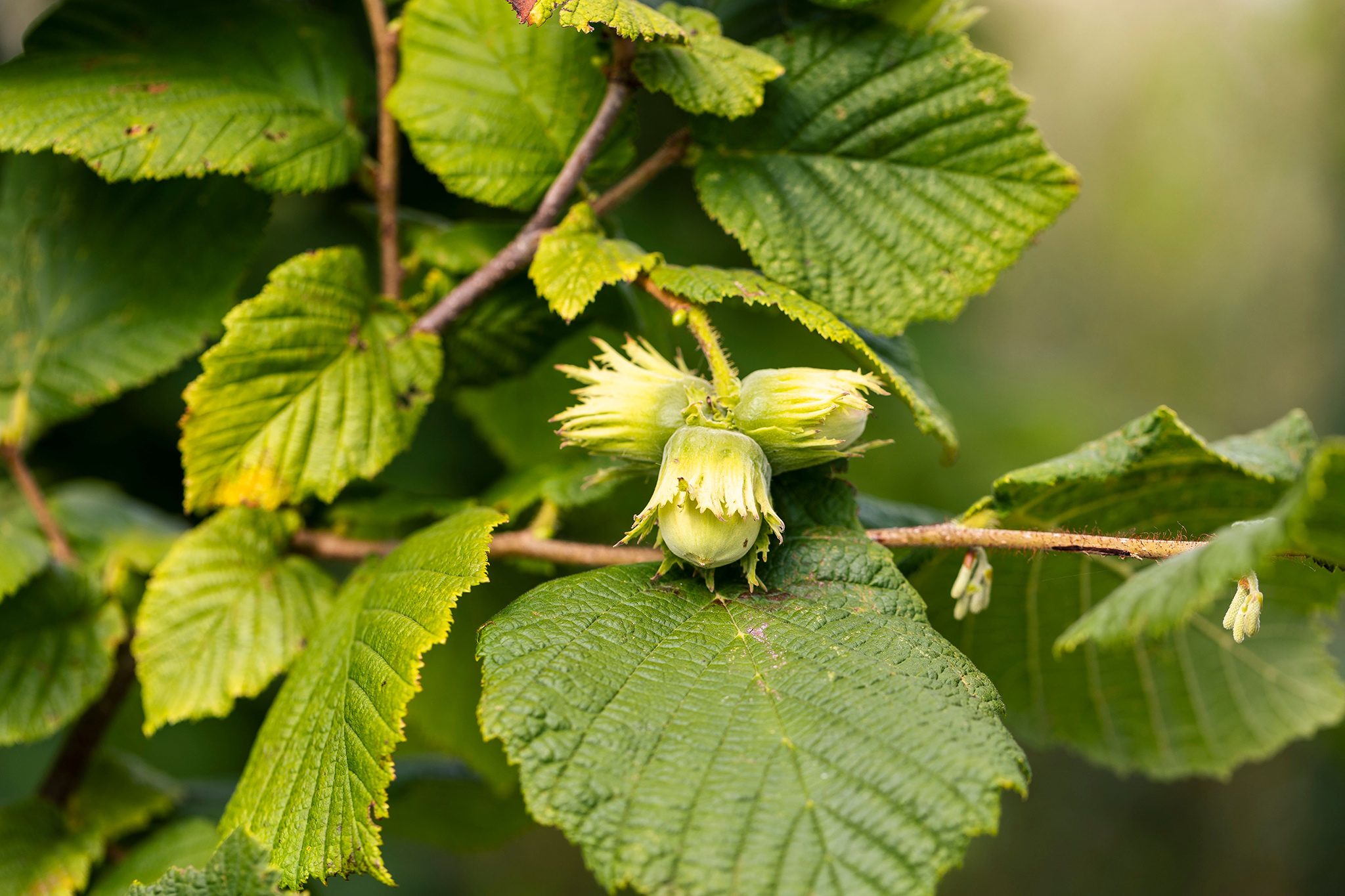
Hazel
Heart shaped hairy leaf with pointed tip and very edged, yellow catkins and small red female flowers, hazel nuts fit in leafy cups, green hairy buds flat on one side, shiny bark with horizontal breathing lines
Blackthorn
Small toothed tongue shaped, white flowers that appear before leaves, dark or blue fruit, long thorns that can become branches, short and shrub like

Silver Birch
arrow shaped leaves with large teeth that bend toward leaf tip and smaller teeth between those, green and yellow/orange/brown catkins, purple long and pointed buds may also have brown developing catkins in winter, white cracked bark

Sessile Oak
Highly lobed leaves with a long stalk, acorns have no stalk and sit on the branch, more common in the upland N and W, buds with many overlapping scales,

Grey Willow
alternate leaves with small leaves between, bushy yellow catkins, buds are small red and pressed flat

Goat Willow
Oval shaped and twisted at end of leaf, grey yellow bushy catkins, yellow brown fat buds that stick out from shoot


Robin
Small plump red breasted bird, territorial. young are brown with golden brown spots. Often do single high pitched chirps when alerted.
have a long song similar to wren but not as loud.
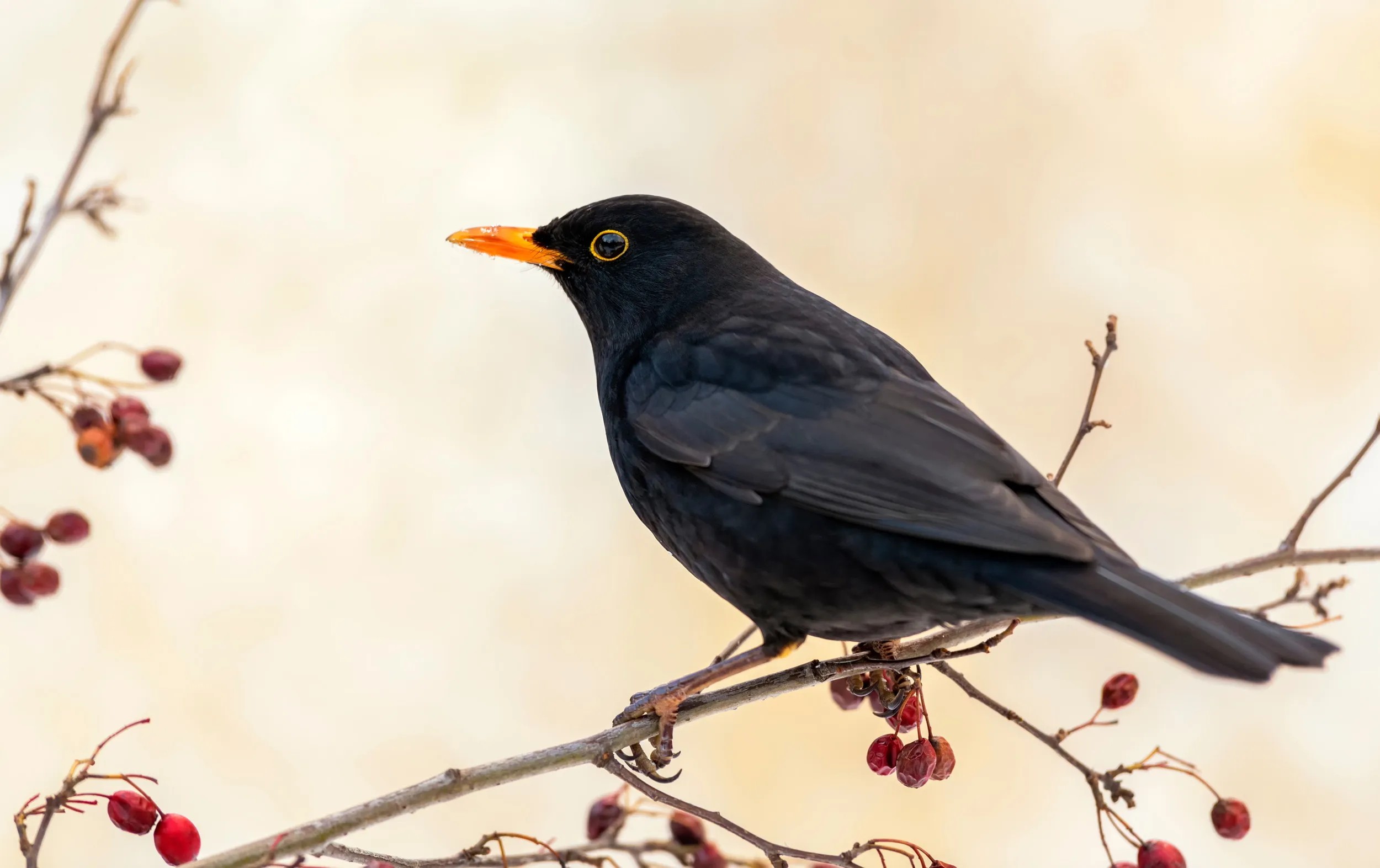
Blackbird
Males are black with orange beak and yellow eye ring. Females are brown with lighter beak.
Often sits high with a loud repeating song.

Wren
Tiny round bird, brown with long legs and short often cocked tail. Thin sharp beak and a pale eyebrow stripe.
Loud voice and often first to call in the morning.

Blue Tit
Mix of blue yellow white and green feathers. Short and thin black beak. Very small.

Great Tit
Black cap, yellow stomach with stripe down middle, no blue and larger than blue tit. Long thin beak.
2 toned wee-wo song.

Chafffinch
Males blue grey crown brown back and pink breast. Females are brown with white shoulder patches and wing bars. Blunter beak.

Dunnock
Small brown and grey bird. quiet and very shy often doing a single peep between long breaks.
About the size of a house sparrow but has a thinner beak, greyer and solitary or in pairs.

Woodpigeon
Grey with white neck patch and white wing patches. coo coo cocoo. pinker breast.
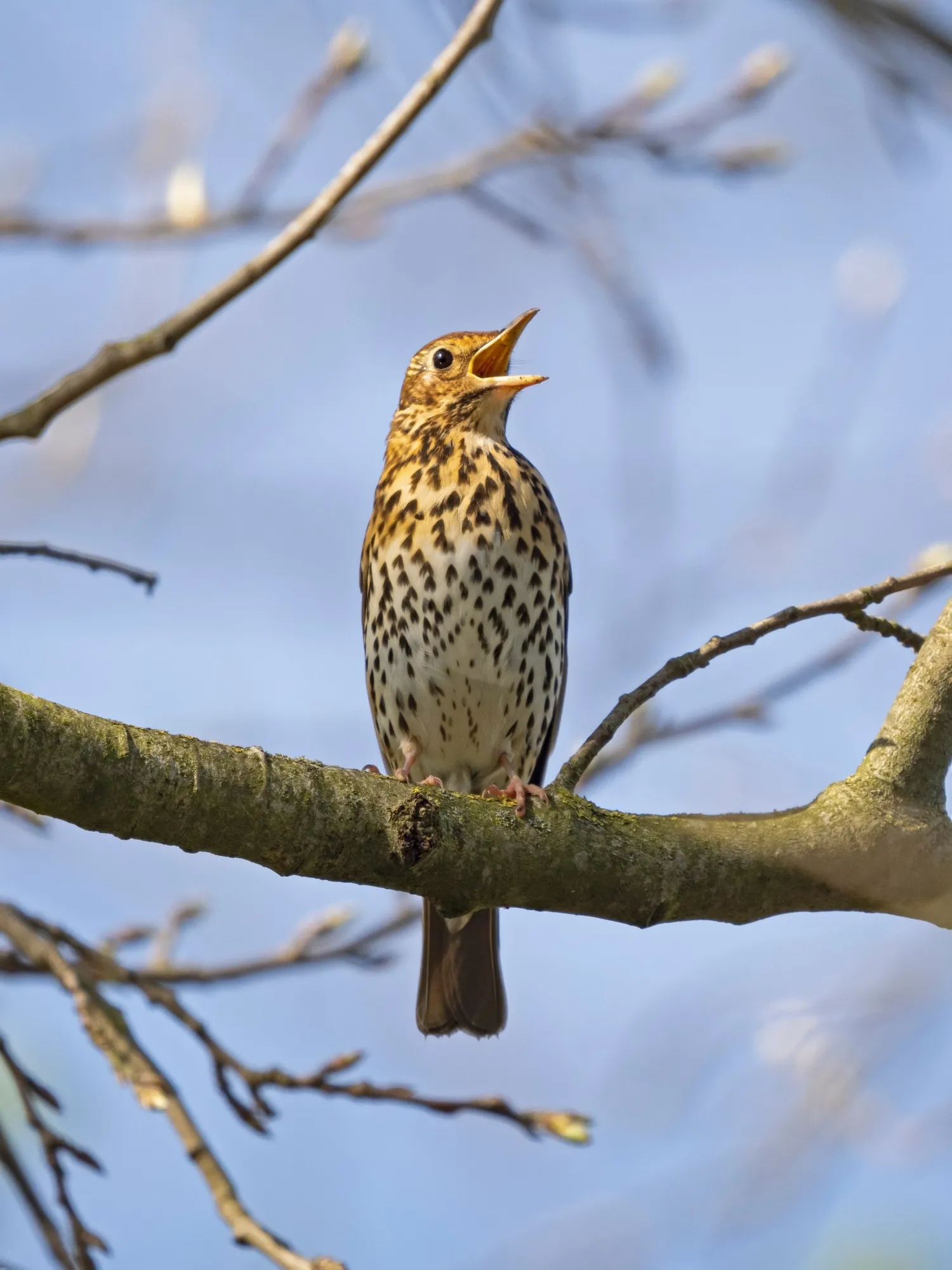
Song Thrush
Warm brown above with speckled cream chest, spots on upper breast live upside hearts. Smaller than a blackbird. repeats song phrases.

House Sparrow
Males are chestnut brown backed with black markings pale grey underparts and a black bib. females and juveniles have no black bib and a pale streak behind the eyes along with the brown back.
Short chunky beak. Small. very sociable.
Alder
reverse triangle shaped with no point instead pulling inwards long dark green leaves. tiny wooden cone like fruit. red oval cone like female catkins that stay year round. purple twigs with orange markings.

Holly
dark green glossy and oval, young leaves are spiky. scarlet berries that can stay in winter. green year round.

Elder
pinnate (like feather) with 5 to 7 oval toothed leaflets that smell bad then bruised. many clustered white or pinkish flowers. purple black sour berries. in winter green unpleasent smelling twigs with white pith. ragged buds with leaves showing through scales sometimes.

Field maple
Typical maple shape, small dark green and shiny. large winged fruit nearly horizontal line. new seeds are tinged in pink. older twig buds have corky ridges and are grey buds.
