Mats Lab II | Metals
 Call Kai
 Learn
Learn Practice Test
 Spaced Repetition
 Match
Match Flashcards
 Knowt Play
1/16

There's no tags or description
Looks like no tags are added yet.
Name | Mastery | Learn | Test | Matching | Spaced | Call with Kai | Chat |
|---|
No analytics yet
Send a link to your students to track their progress
17 Terms
Solidification Microstructures
Solidification microstructures are the patterns of grains, crystals, and other features that form when a liquid material cools and becomes a solid.
Alloy Solidification
Alloy solidification is the process in which a liquid mixture of two or more elements cools and becomes a solid, forming one or more solid phases.
Rolled Metals
Rolled metals are metals that have been passed between rotating rollers to reduce their thickness or change their shape. This process is called rolling, a type of PLASTIC deformation.
Processing Sequencing
Processing sequence in materials science means the order of manufacturing steps used to turn a raw material into a finished product.
When a material solidifies directionally, the interface between its solid and liquid phases may be either planar, columnar, or dendritic.
This statement means that even when a material solidifies in one controlled direction, the boundary between the solid metal and the remaining liquid can have different shapes. That boundary is called the solid–liquid interface.

1. Planar interface — flat boundary: The boundary between the solid and liquid is relatively flat and smooth. The solid grows FORWARD EVENLY, with little variation along the interface. This is favored when the temperature gradient in the liquid is sufficiently high relative to the rate of solidification and the alloy's tendency to develop compositional instabilities. Think: A flat wall separating solid metal from liquid metal.
2. Columnar interface — elongated crystal growth. Crystals grow preferentially in a particular direction, forming long, column-like GRAINS. The grains extend from the already-solid region toward the LIQUID. Columnar grains can form when crystals grow preferentially along the direction of heat flow!!
3. Dendritic interface — branching, tree-like growth (branching, tree-like crystals grow into the liquid): The SOLID develops branching, tree-like crystals called dendrites. Some parts of the interface grow FARTHER INTO the liquid than others. This often happens when the liquid AHEAD of the interface becomes constitutionally SUPERCOOLED, making a flat interface UNSTABLE. Dendrites are common during the solidification of metal alloys!!
Why do these different structures form? The main factors are the temperature gradient, solidification rate, and alloy composition. A stable, relatively uniform interface can remain planar. Under conditions favoring DIRECTIONAL crystal growth, columnar grains can develop. If the interface becomes UNSTABLE, PROTRUSIONS grow into the liquid and may develop into dendrites.
Planar is defined as being a flat interface (the growth direction is normal to the plane of the solid-liquid interface).
This definition means that during planar solidification, the solid–liquid boundary is FLAT, and the solid grows PERPENDICULAR (NORMAL TO THE PLANE IS PERPENDICULAR SINCE planes are defined by the direction normal to the plane!) to that boundary. The interface is the boundary separating the solid material from the liquid material. A planar interface is flat, like a sheet of glass. What does “growth direction is normal to the plane” mean? Normal = perpendicular (90°) to a surface or plane. Imagine the interface is a flat horizontal line: The interface extends horizontally. The solid grows vertically into the liquid. The growth direction forms a 90° angle with the interface!! In planar solidification, the interface advances evenly without developing significant bumps or branches. This differs from dendritic growth, where the interface develops protrusions and branching crystals.
Solid-State Miscibility
Solid-state miscibility is the ability of two or more components to dissolve in each other and form a SINGLE solid phase.
Simulation of dendrites GROWING IN a solidifying liquid.
Figure 4: Simulation of dendritic solidification, seen from a longitudinal cross section. [3]
Longitudinal cross-section = means a cut made lengthwise along the LONG axis of an object or material. In materials science, it is used to examine the internal microstructure of a metal, casting, or specimen along its length.
![<p>Figure 4: Simulation of dendritic solidification, seen from a longitudinal cross section. [3]</p><p>Longitudinal cross-section = means a cut made lengthwise along the LONG axis of an object or material. In materials science, it is used to examine the internal microstructure of a metal, casting, or specimen along its length.</p>](https://assets.knowt.com/user-attachments/d2c281bf-9562-47b4-bc80-8c257784b3be.png)
Longitudinal versus Transverse Cross Section
Longitudinal section: Cut parallel to the long axis.
Transverse cross section: Cut perpendicular to the long axis.
This is particularly useful for studying directional solidification, because a longitudinal section can reveal how columnar grains extend along the direction of growth.

Classification of Dendrites
Primary dendrites are the first to grow and can be considered analogous to a tree TRUNK. Secondary dendrites grow FROM the primary dendrites AND and are analogous to tree BRANCHES. Tertiary dendrites grow FROM the secondary dendrites and are analogous to leaves, or SMALLER branches. Figure 5 illustrates the growth of primary, secondary, and tertiary alloys in a CUBIC material!! Figure 5: A simplified image of dendritic SOLIDIFCATION (a type of directional solidification), showing dendritic arms as cylinders. This image highlights the chronical classification of primary, secondary, and tertiary dendrites.
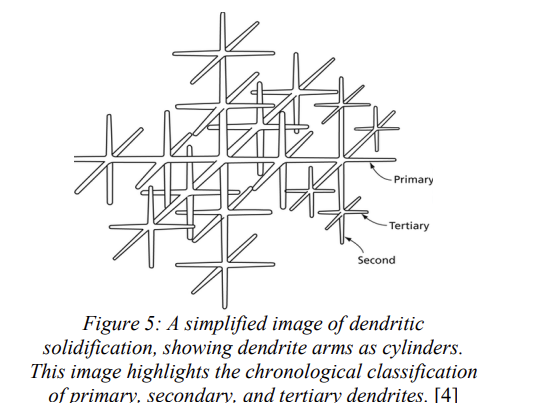
Figure 6 compares the structure of metal dendrites growing IN an aluminum melt (aluminum melt => aluminum that has been heated until it becomes liquid) to conifer trees.
Analogous = similar or comparable in some way.
Conifer trees are trees that usually produce cones and have needle-like or scale-like leaves. Most are evergreen, meaning they keep their leaves throughout the year.
(Left) an x-ray image showing dendrites forming in an aluminum melt. [5] (Right) a photograph of conifer trees next to a lake in Yosemite, CA. [6]
![<p>Analogous = similar or comparable in some way. </p><p>Conifer trees are trees that usually produce cones and have needle-like or scale-like leaves. Most are evergreen, meaning they keep their leaves throughout the year.</p><p>(Left) an x-ray image showing dendrites forming in an aluminum melt. [5] (Right) a photograph of conifer trees next to a lake in Yosemite, CA. [6]</p>](https://assets.knowt.com/user-attachments/5e18297f-6c1f-4d28-8c28-670739906d09.png)
Solute Segregation
Solute segregation is the UNEVEN distribution of SOLUTE atoms throughout a material, especially DURING solidification.
Formation of Interdendritic Eutectics!!!
Formation of interdendritic eutectics describes how a mixture of two SOLID phases forms in the remaining liquid metal located BETWEEN dendrite branches during the final stages of solidification!!!
Reminder: Eutectic = 1 liquid transforms into 2 different solid phases at the same time at a specific temperature (the eutectic temperature)!! For a binary alloy containing elements A and B: L => alpha + beta.
2. How do interdendritic eutectics form? Imagine an aluminum–copper alloy solidifying. Primary dendrites grow. Aluminum-rich solid crystals form first. Solute is REJECTED. If the solid accepts less copper THAN the liquid, copper ACCUMULATES in the remaining liquid. The spaces between dendrites become SOLUTE-RICH. As the dendrites GROW, the remaining liquid becomes increasingly CONCENTRATED in copper. The remaining liquid reaches the eutectic composition!! At the eutectic temperature, it transforms into two solid phases together!!!!
“If the solid accepts less copper THAN the liquid”: It means that when aluminum starts turning from liquid into solid, the solid aluminum contains LESS copper than the surrounding liquid does. (Following previous sequence of explanation): Then copper ACCUMULATES in the remaining liquid. The spaces BETWEEN dendrites (aka interdendritic hehe!) become SOLUTE-RICH (Solute = Cu!). As the dendrites GROW!!!, the remaining liquid becomes increasingly CONCENTRATED in copper!!! The remaining liquid reaches the eutectic composition!! At the eutectic temperature, it transforms into two solid phases together!!!! Okay!
Key Connection: Dendritic growth → solute segregation → solute-rich remaining liquid → eutectic formation. The dendrites form FIRST, and the remaining liquid becomes ENRICHED in solute. If that liquid reaches the eutectic composition, it can form a eutectic structure as it solidifies! Btw: Interdendritic eutectics can influence the alloy's hardness, strength, ductility, and cracking behavior, depending on the phases and their distribution. Quick active recall: An aluminum alloy solidifies, and copper accumulates in the liquid between dendrite branches. 1.) What is this uneven distribution called? Is variation between nearby dendrite branches microsegregation or macrosegregation?
Answers: 1. Solute segregation. 2. Microsegregation.
Segregation is the enrichment of atoms in a microscopic region in a material.
This definition means that segregation occurs when certain atoms accumulate in a small region of a material, making that region more concentrated in those atoms than the surrounding material.
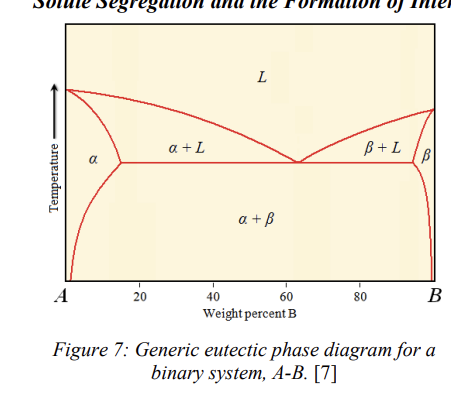
Segregation occurs WHENEVER a molten material cools through a liquid + solid region (shown as either L+α or L+β in Figure 7)!!!!! This region is bounded by the liquidus and eutectic temperatures.
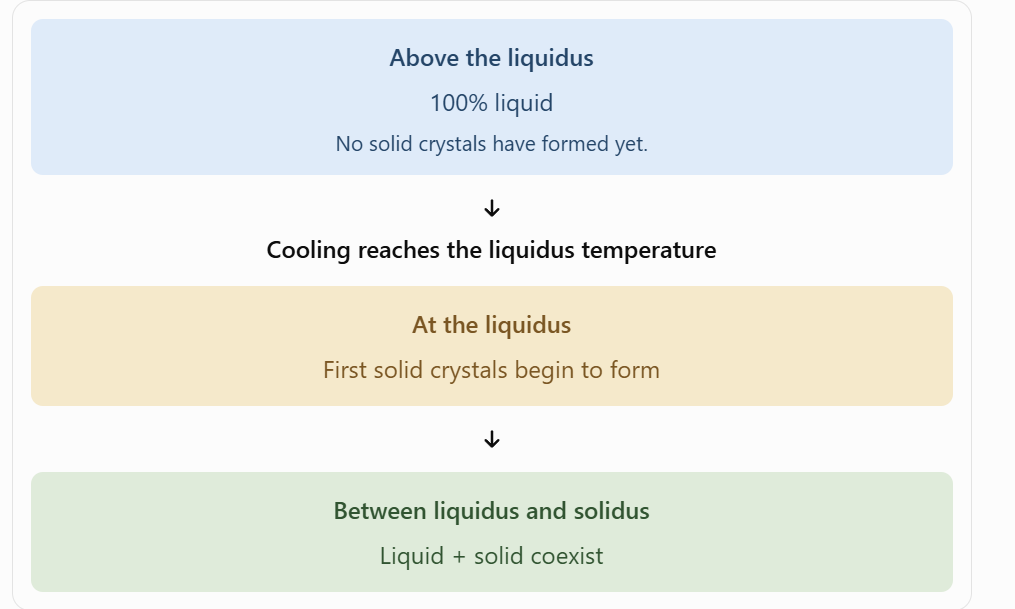
Liquidus temperature is the temperature above which a material is completely liquid. When a molten alloy cools below its liquidus temperature, the first solid crystals begin to form.
What happens at the liquidus temperature?
PL1: Casting Reference
TLP = In materials science, it may refer to Transient Liquid Phase (TLP) bonding, a joining process in which a liquid phase forms temporarily!!! and then solidifies through diffusion!!!
Casting: This TLP introduces a number of important processes through which metallic items can be fabricated from molten metal. As well as detailing the practical aspects of these manufacturing processes, attention is given to the important parameters which determine the microstructure of the finished items.
On completion of this TLP you should:
Understand the meaning of the Biot number (a dimensionless number used in heat transfer to determine whether the temperature inside a solid changes significantly during heating or cooling; Bi = (h* Lc)/ k; h = convective heat transfer coefficient; Lc = characteristic length of the solid; k = thermal conductivity of the solid; the Biot number compares RESISTANCE to heat conduction inside the solid with RESISTANCE to heat CONVECTION at its surface; Bi < 0.1: the temperature inside the solid is approximately uniform. You can often use the lumped-capacitance method!!; Bi > 0.1: Significant internal temperature gradients may develop, so you may need to account for temperature VARIATIONS within the solid; think of heat trying to enter or leave a solid: small Biot number: Heat moves through the solid easily compared with how quickly it transfers at the surface!!, SO the interior stays nearly uniform in temperature; Large Biot number: Heat transfers at the surface relatively easily, but moves through the SOLID LESS EASILY, CREATING internal temperature differences), how it affects the temperature profile in a casting, and the resulting microstructure.
Be able to explain the formation of the microstructure observed in a cast [liquid metal => mold] ingot.
Be familiar with some common METHODS of casting, their advantages and disadvantages, and be able to choose a suitable process for manufacturing a variety of metallic components.
Before you start: It will be helpful to have an understanding of solute partitioning (the redistribution of solute atoms between the solid and liquid phases during solidification!!) and the formation of dendrites. The TLP on Solidification of Alloys covers these topics.
PL1 Resource 2: Solidification of Alloys
This teaching and learning package (TLP) (oh! That is what TLP stands for!) is an introduction to how SOLUTE affects the solidification of metallic (means having the properties of a metal, such as high electrical and thermal conductivity, luster, and the ability to deform plastically) alloys.
Aims: On completion of this TLP you should:
Know how LIMITED!!! diffusion in the solid and liquid phases affects the distribution of solute!! in a solidified alloy, and be able to predict these effects in certain samples.
Understand the factors that control the shape of a solid growth front (solid growth front = the boundary between the solid that has already been formed and the liquid that has not yet solidified during an alloy’s solidification), and the resulting microstructure.
Before You Start: You should understand phase diagrams, and how they can be used to predict the FORM of a solidified alloy. It would also be helpful to have an understanding of (Fick's FIRST law of diffusion [steady-state diffusion: states that the diffusion flux is proportional to the negative concentration gradient; J = -D (dC/dx); J = diffusion flux, or amount of material crossing a unit area per unit time; D = diffusion coefficient; dC/dx = concentration gradient aka how concentration changes with distance; negative sign means diffusion occurs from higher concentration toward lower concentration] and Fick's SECOND law of diffusion [NON-steady-state diffusion; for a CONSTANT diffusion coefficient in one dimension:

What does non-steady state mean? The CONCENTRATION at a particular position changes over time! as atoms diffuse through the material!). You might want to look at the TLPs on Diffusion, Phase Diagrams and Solidification, and Solid Solutions,
Introduction: Metals and alloys are almost always cast from a liquid at some point during the manufacturing process, as they are typically obtained from their ores in liquid form, or melted down from scrap. Also, alloying two or more elements is usually done in the liquid phase!!, because rapid diffusion!! is required to ensure a UNIFORM composition. This means that an understanding of how metals and alloys solidify is essential to allow us to explain and control the properties of the solid that is formed.
Solute Partitioning: The TLP Phase Diagrams and Solidification explains the method for determining the CONCENTRATIONS and PROPORTIONS of the phases formed in solidification of a binary alloy, from the phase diagram, ASSUMING that EQUILIBRIUM can be achieved, and the most thermodynamically favorable phases formed!! This method is known as the lever rule!!!
Consider the case of a binary alloy, Al-5wt%Cu (blue vertical line!) (BTW means 5 WT% CU NOT AL; LOOK AT X-axis: Weight % Cu!!):

The phase diagram shows that the first solid formed, CS, at 650 °C, will be 0.5 wt%Cu (look at red vertical line!), but the stable phase after total solidification is a complete solid solution with a concentration of 5 wt%Cu!! Clearly there will need to be significant diffusion in the SOLID? to allow the solute to distribute evenly, and for equilibrium to occur.
This diffusion can be described mathematically by Fick’s laws:
Look on Google Docs.