ANATOMY-Lab quiz 9 (nervous system)
 Call Kai
 Learn
 Practice Test
 Spaced Repetition
 Match
 Flashcards
 Knowt Play
1/74

There's no tags or description
Looks like no tags are added yet.
75 Terms
Structures in the central nervous system
Brain, spinal cord
Structures in the peripheral nervous system
Peripheral nerves, ganglia
What are ganglia?
Pockets of neuronal cells
Somatic sensory
Sensory input to the CNS from special senses
Visceral Sensory
Sensory input to CNS from internal organs/visceral organs
Somatic motor
Motor instructions out from the CNS to skeletal muscle to activate the skeleton
Autonomic motor
Motor instructions out from the CNS to control activity of smooth and cardiac muscle
What are dendrites?
Receptive regions of neurons that allow the cell to recieve communication signals from many other neurons

A
Dendrites
What are somas/cell bodies?
Large cells with a defined nucleus and other organelles that have dendrites extending, they are important for reception of signals

B
Soma (cell body)
What is an axon hillock?
Where electrical impulses are generated and where axons emerge

C
Axon hillock
What is an axon?
The conducting region of the neuron for electrical impulses, myelinated, and most neurons have only one
What is myelin?
A fatty covering that increases the speed of electrical conduction
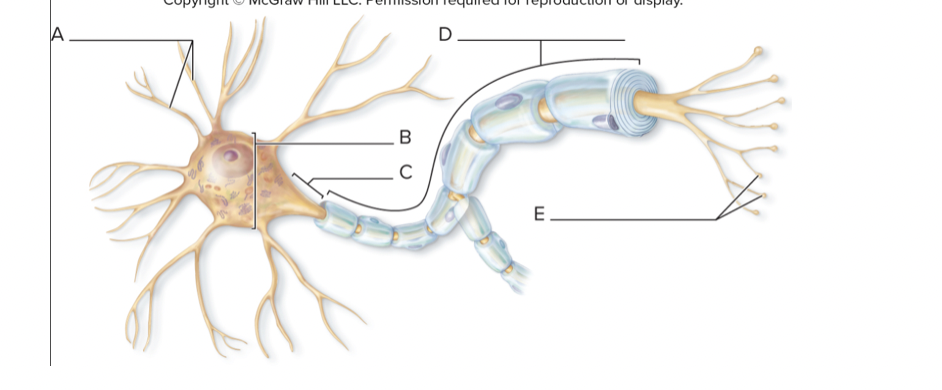
D
Axon
What are axon terminals (synaptic knobs)
Terminal ends of axons form the region where neurons can release chemicals (neurotransmitters) onto target cells to affect their function

E
Axon terminals
Bundles of neuron axons in the PNS
Nerve/nerves
Bundles of neuron axons in the CNS
Tracts
Clustered cell bodies in the PNS
Ganglio/Ganglia
Clustered cell bodies in the CNS
Nucleus/nuclei
Sensory/afferent neurons
Cells generate an impulse in the body periphery from a sensory stimulus
Cell bodies are in the PNS
Sensory signals are transmitted to the CNS
Motor/efferent neurons
Transmit signal from the CNS to target tissue to produce a response
Cell bodies are located in the CNS but axons travel in the PNS in nerves
Interneurons
Located in the CNS (spinal cord) and serve in the information chain
Function as part of the integration center which interpret what the body is experiencing
They communicate with the motor neurons
What are the four main regions of the brain?
Cerebrum, diencephalon, cerebellum, brain stem
What is the cerebrum
Responsible for conscious function, thought, and voluntary actions

Cerebrum
What is the Diencephalon?
Central region of the brain (between cerebrum and brainstem)
It is responsible for relaying information, processing information, and maintaining homeostasis
It is the control center for sensory, motor, and autonomic signals

Diencephalon
What is the brainstem?
Lower part of the brain that connects your cerebrum and cerebellum to your spinal cord
It relays signals traveling between the brain and the rest of the body and controls automatic and life necessary functions (ex. breathing)
What are the parts of the brainstem?
Midbrain, Pons, Medulla oblongata
What is the midbrain?
Upper brainstem, connects forebrain and hindbrain
It relays sensory and motor signals and coordinates reflexes

Midbrain
What is the pons?
It is the middle of the brainstem
It connects different regions of the nervous system, regulates breathing, manages sleep, and works with some autonomic functions

Pons
What is the medulla oblongata?
Bottom of the brainstem and connects the brain to the spinal cord
Regulated involuntary processes, reflexes, and nerve signals

Medulla oblongata
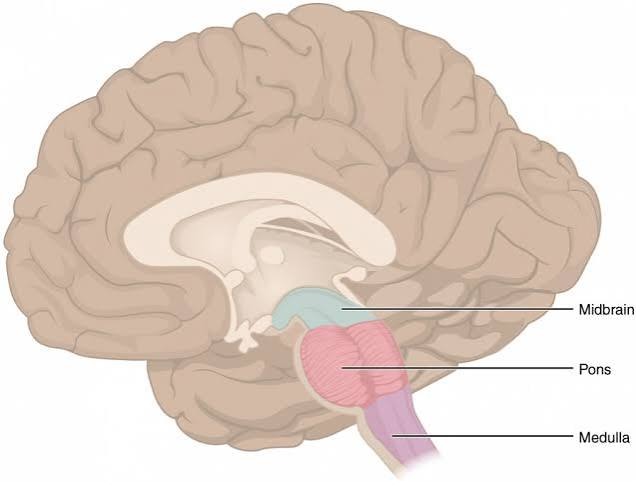
Brainstem
What is the cerebellum?
Located at the back and bottom of the brain
Coordinates voluntary movement, works on balance and posture, and actions we don’t need to think about
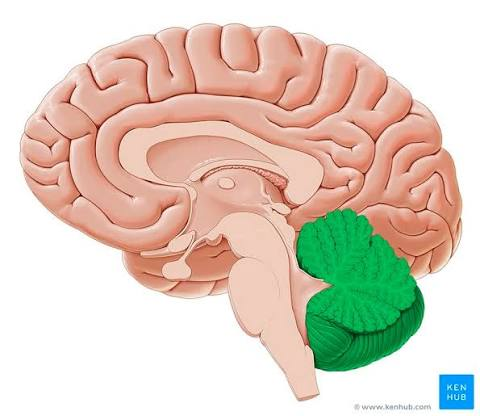
Cerebellum
What is gray matter made of?
Neural cell bodies, dendrites, nervous tissue
What is white matter made of?
Myelinated axons/nerves
Gyrus
Elevated ridge of tissue
Sulcus
Depressed area/groove
Longitudinal fissure
Divides into right and left hemispheres

Longitudinal fissure
Central sulcus
Separates frontal and parietal lobes

Central sulcus
Lateral sulcus
Separates temporal from parietal lobes

Lateral sulcus
Parieto-occipital sulcus
Separates occipital from parietal lobes
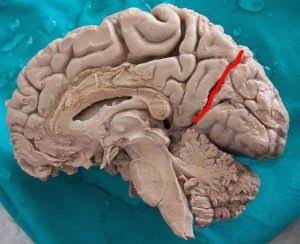
Parieto-occipital sulcus
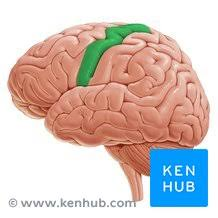
Precentral gyrus

Postcentral gyrus
Where is the frontal lobe?
Cerebrum
Where is the temporal lobe?
Cerebrum
Where is the parietal lobe?
Cerebrum
Where is the corpus callosum?
Cerebrum
Where is the fornix?
Cerebrum
Where is the precentral gyrus?
Cerebrum
Where is the postcentral cyrus?
Cerebrum
Where is the olfactory bulb?
Cerebrum
Where is the olfactory tracts?
Cerebrum
Where is the optic nerves?
Cerebrum
Where is the optic chiasm and tract?
Cerebrum

Frontal lobe
Frontal lobe
Cerebrum, forehead
Responsible for emotional control, physical movement, thinking, and decision making
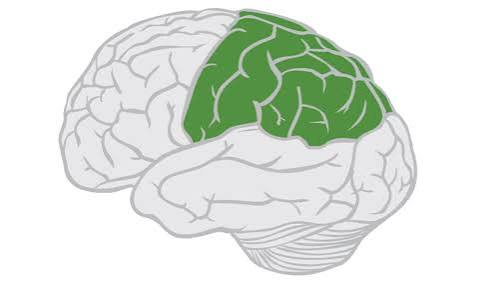
Parietal lobe
Parietal lobe
Cerebrum, top of the head
Responsible for sensory integration, spatial awareness, and learning complex movements
Occipital lobe
Cerebrum, back of brain
Responsible for visual processing, perception, and recognition

Occipital lobe
Corpus callosum
Cerebrum, center of the brain,
Neural bridge connecting the left and right cerebral hemispheres allowing for rapid communication and integration of sensory information

Corpus callosum
Fornix
Cerebrum,