Calculus: Notable Strategies for Solving Problems (Calculus Toolbox)
 Call Kai
 Learn
 Practice Test
 Spaced Repetition
 Match
 Flashcards
 Knowt Play
1/47

There's no tags or description
Looks like no tags are added yet.
48 Terms
Evaluating Limits of Various Types of Functions (Strategy 1)
Algebraically: Direct Substitution (Plugging-in and Solving) using the various Properties of Limits, used mainly for Polynomials (but can also be used for Rational and Radical Functions if when substituted into the denom., the denom. doesn't equal zero)
Evaluating Limits of Various Types of Functions (Strategy 2)
Algebraically: Factorization (Canceling Factors by Factoring or by Factoring Out a Factor and then cancelling), used mainly for Rational Functions
Evaluating Limits of Various Types of Functions (Strategy 3)
Algebraically: Rationalization (Conjugates), used mainly for Radical Functions
Evaluating Limits of Various Types of Functions (Strategy 4)
Algebraically: Using Trig Identities (Canceling Factors), used mainly for Trigonometric Functions
Evaluating Limits of Various Types of Functions (Strategy 5)
Algebraically: Approximation (plugging in values really close to the left and right side of the limit and make a conjecture about where the limit will be)
Evaluating Limits of Various Types of Functions (Strategy 6)
Graphically: Using the Graph of the Function to find points on the graph that can be used to find the namesake value (which could also be represented by positive or negative infinity) but that may also give other values such as defined points, undefined points, asymptotes, and/or holes
Evaluating Limits of Various Types of Functions (Strategy 8)
Algebraically: Using Direct Substitution, already given values of limits that just need to be plugged into a formula that displays functions that correspond to the limits given
Evaluating Limits of Various Types of Functions (Strategy 7)
Algebraically: Simplifying a Rational Function with a fraction in the numerator and/or denominator by finding the Least Common Denominator of the fraction in the numerator and/or denominator and simplifying
Evaluating Limits of Positive/Negative Infinity (Strategy 1)
Sign Analysis: find the limit to the left and to the right of the value that x is approaching by taking a number that is slightly to the left of the value that x is approaching and evaluating the function to see if the num. and denom. come out to be +/+, -/- (in which case its positive infinity) +/-, or -/+ (in which case its negative infinity) and doing the same for the right side of the limit by taking a number that is slightly to the right of the value that x is approaching and evaluating the function to see if the num. and denom. come out to be +/+, -/- (in which case its positive infinity) +/-, or -/+ (in which case its negative infinity), and then finding the limit by seeing whether or not they equal each other (if they do, its either positive or negative infinity; if they don't, the limit doesn't exist)
Evaluating Left/Right-Sided Limits of Positive/Negative Infinity (Strategy 1)
Sign Analysis: find the limit to the left/right of the value that x is approaching by taking a number that is slightly to the left/right of the value that x is approaching and evaluating the function to see if the num. and denom. come out to be +/+, -/- (in which case its positive infinity) +/-, or -/+ (in which case its negative infinity)
Creating Graphs of a Series of Limits (Strategy 1)
Given a set of conditions such as limits and defined points, (conceptually) make a graph that satisfies those conditions (conceptualizing any type of limit from a basic limit to an infinite/unbounded limit to a one-sided limit)
Evaluating Limits of Composite Functions (Strategy 1)
Use the Theorem for Limits of Composite Functions
Evaluating Limits of Composite Functions (Strategy 2) [Fact 1]
If the Theorem for Limits of Composite Functions does NOT work because the Inner Function's Limit does not exist, then take the left-sided and right-sided Limits of the two functions and finding out whether or not they are equal to each other, and if they are, knowing that that value is the limit
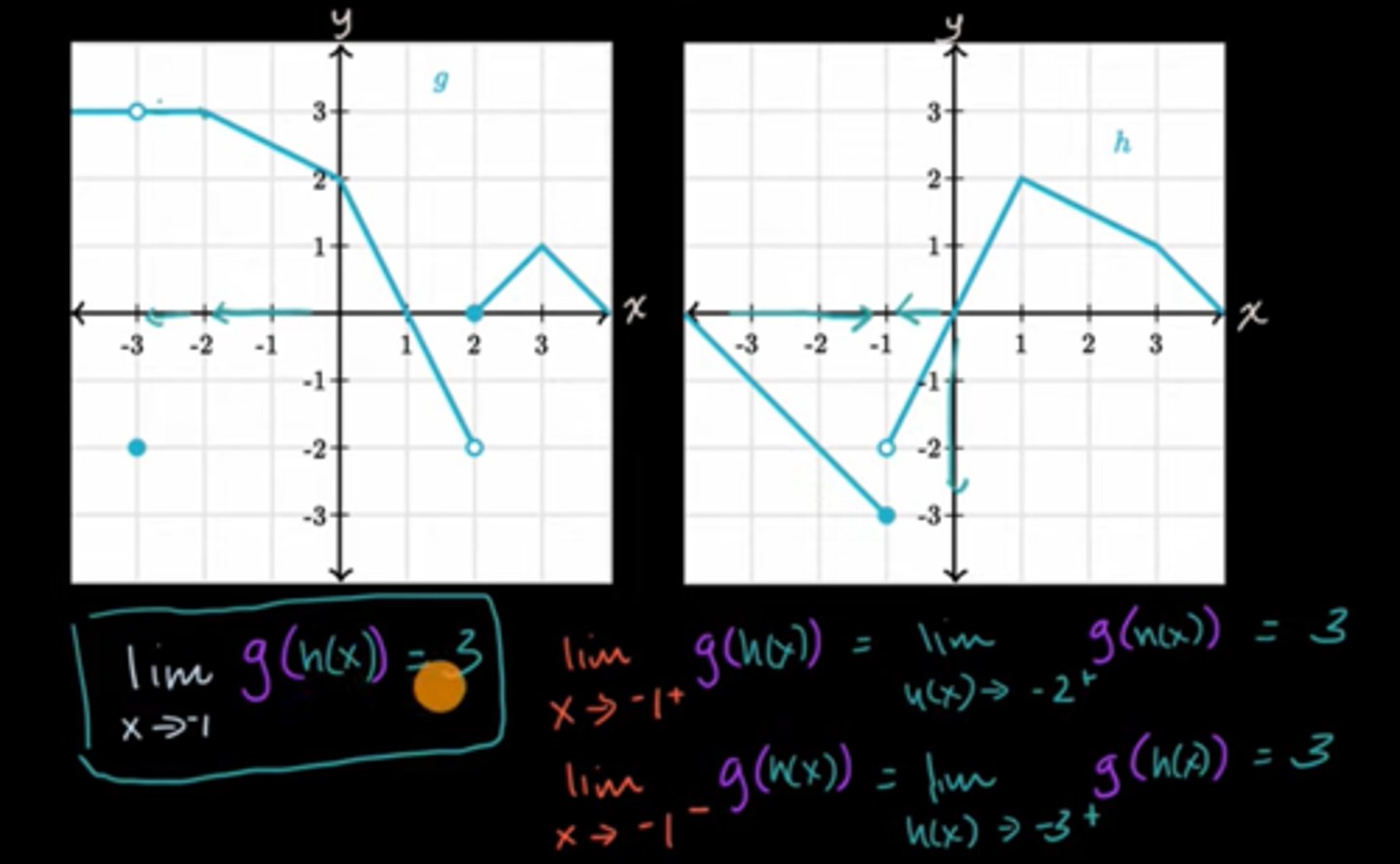
Evaluating Limits of Composite Functions (Strategy 2) [Fact 2]
Values that approach the right-sided Limit of the Inner Function correspond with values that approach the right-sided Limit of the Outer Function such that values that approach the Inner Function's Limit that are "above" the limit and/or "coming down" correspond with values that approach the Outer Function's Limit that are "to the right of" the limit and/or "approaching the left" (and are thus denoted as a plus sign after the Inner Limit)
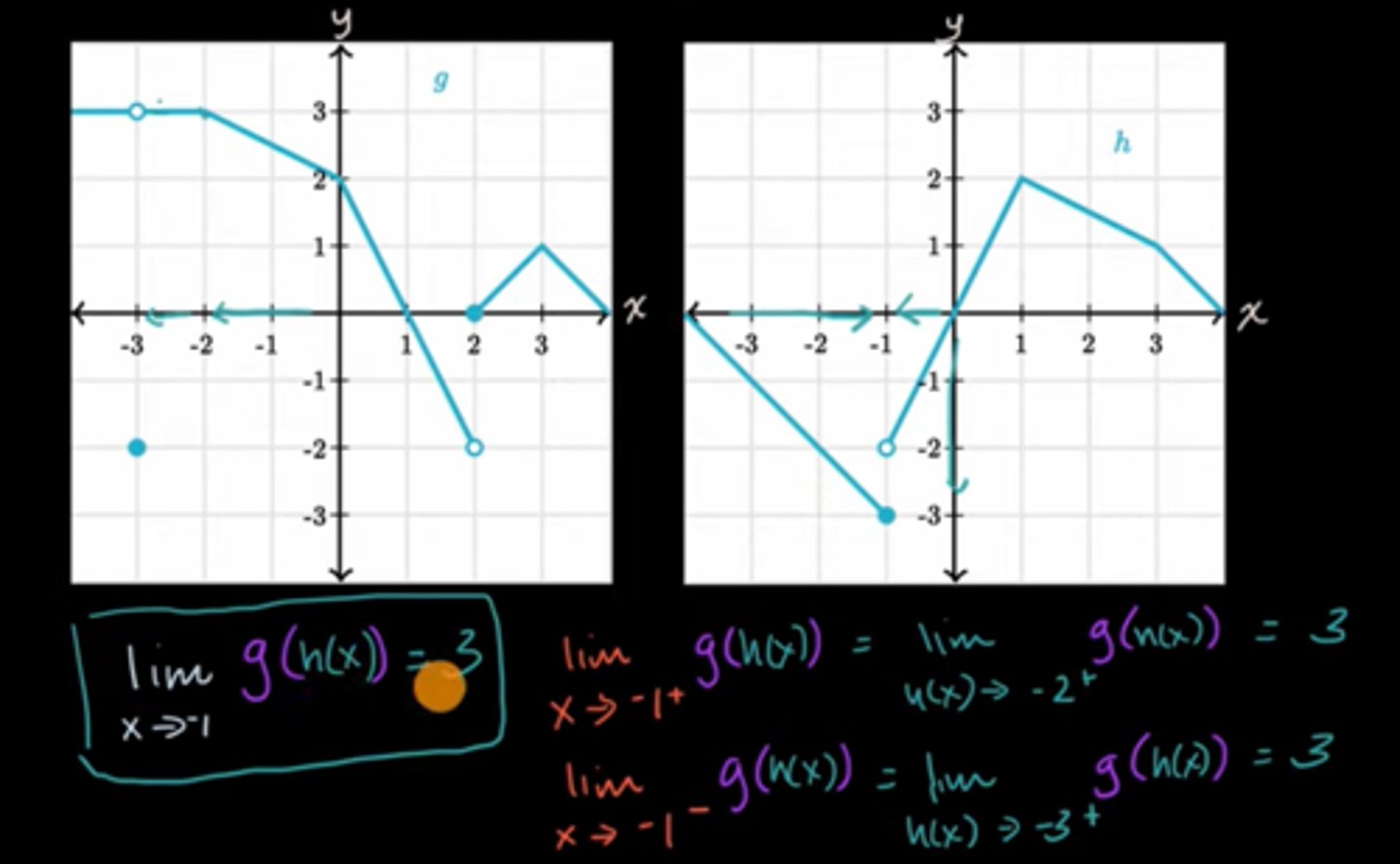
Evaluating Limits of Composite Functions (Strategy 2) [Fact 3]
Values that approach the left-sided Limit of the Inner Function correspond with values that approach the left-sided Limit of the Outer Function such that values that approach the Inner Function's Limit that are "below" the limit and/or "coming up" correspond with values that approach the Outer Function's Limit that are "to the left of" the limit and/or "approaching the right" (and are thus denoted as a minus sign after the Inner Limit)
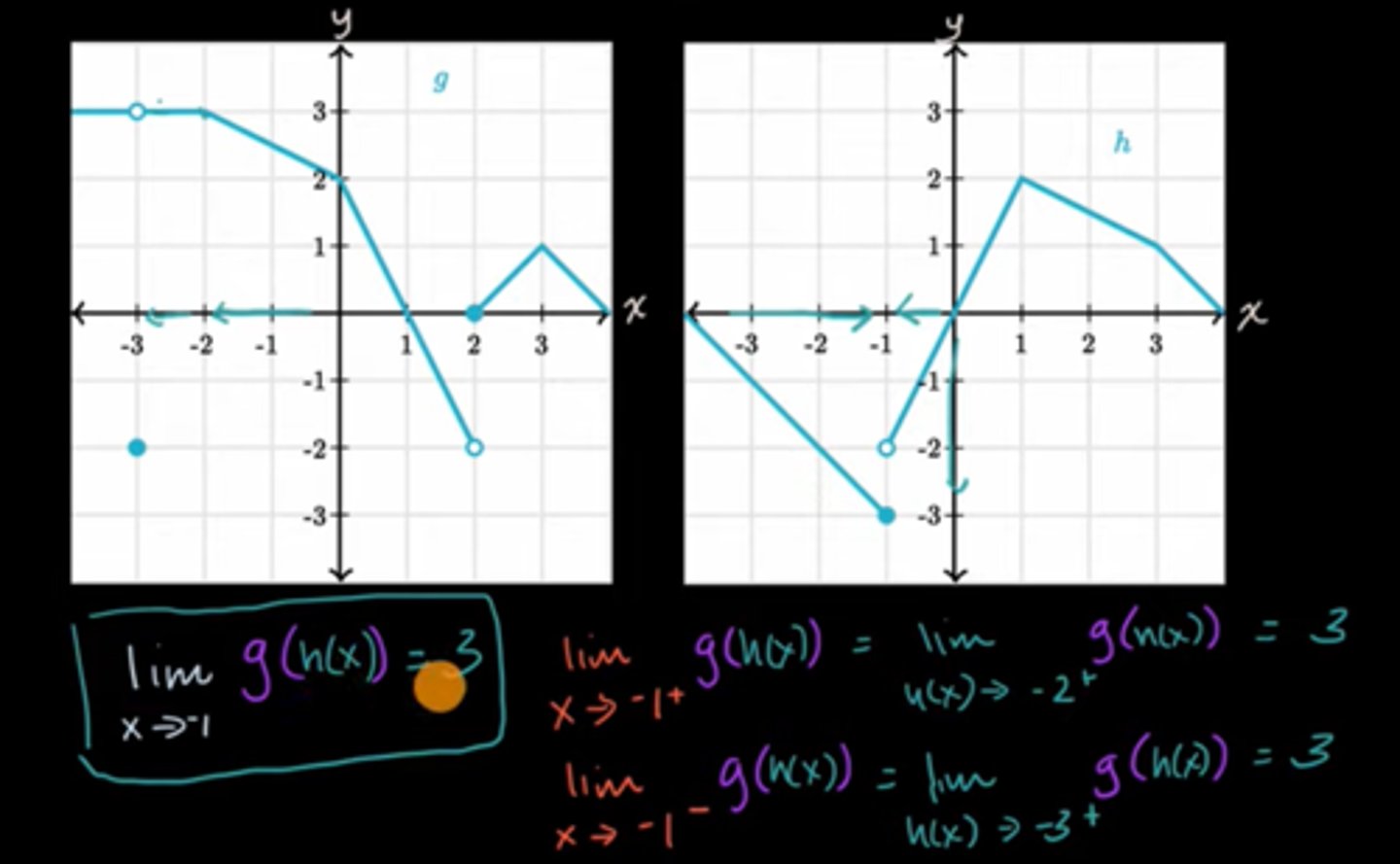
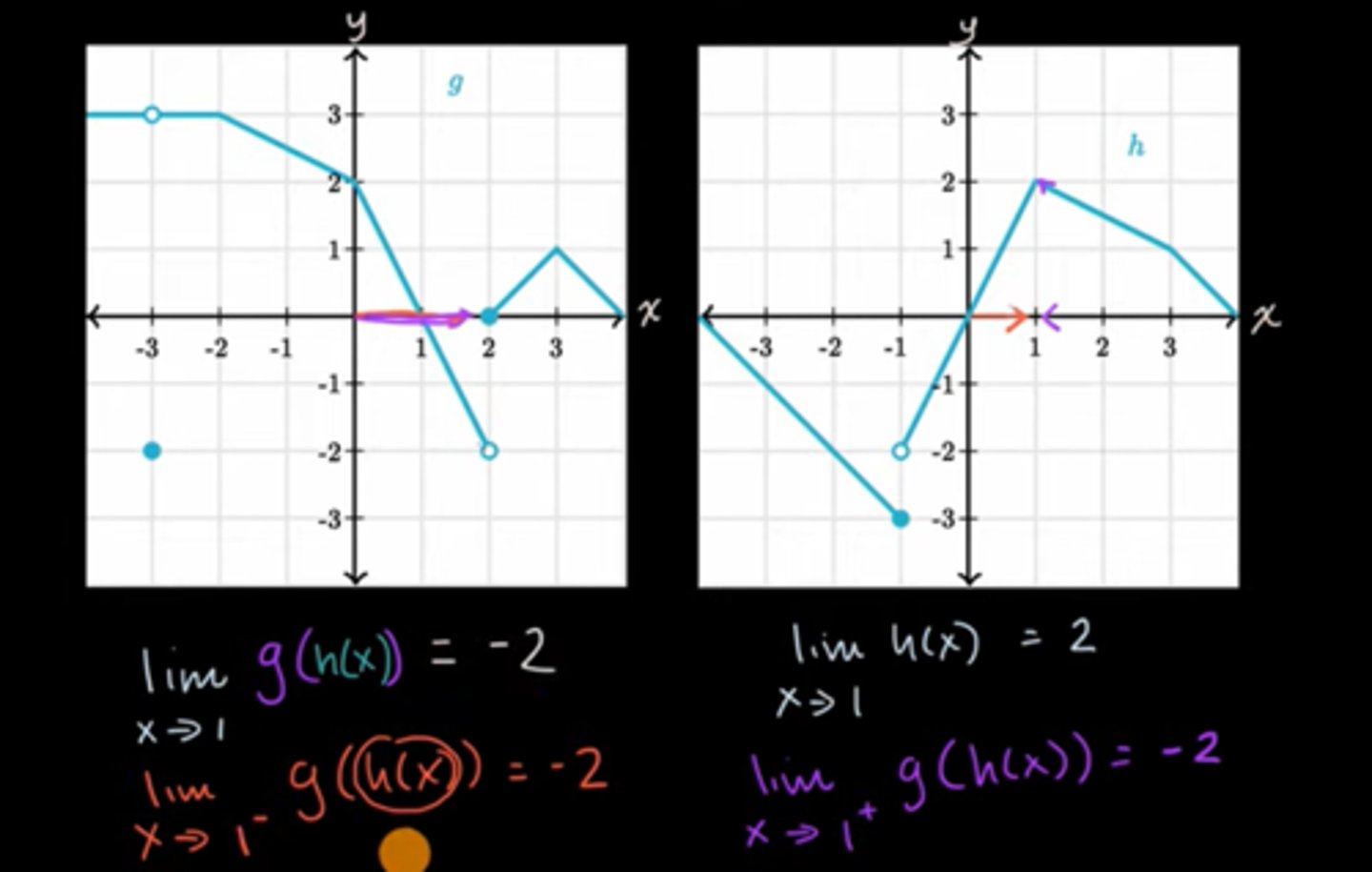
Evaluating Limits of Composite Functions (Strategy 3) [Fact 1]
If the Theorem for Limits of Composite Functions does NOT work because the Outer Function's Limit does not exist then take the left-sided and right-sided Limits of the two functions and finding out whether or not they are equal to each other, and if they are, knowing that that value is the limit
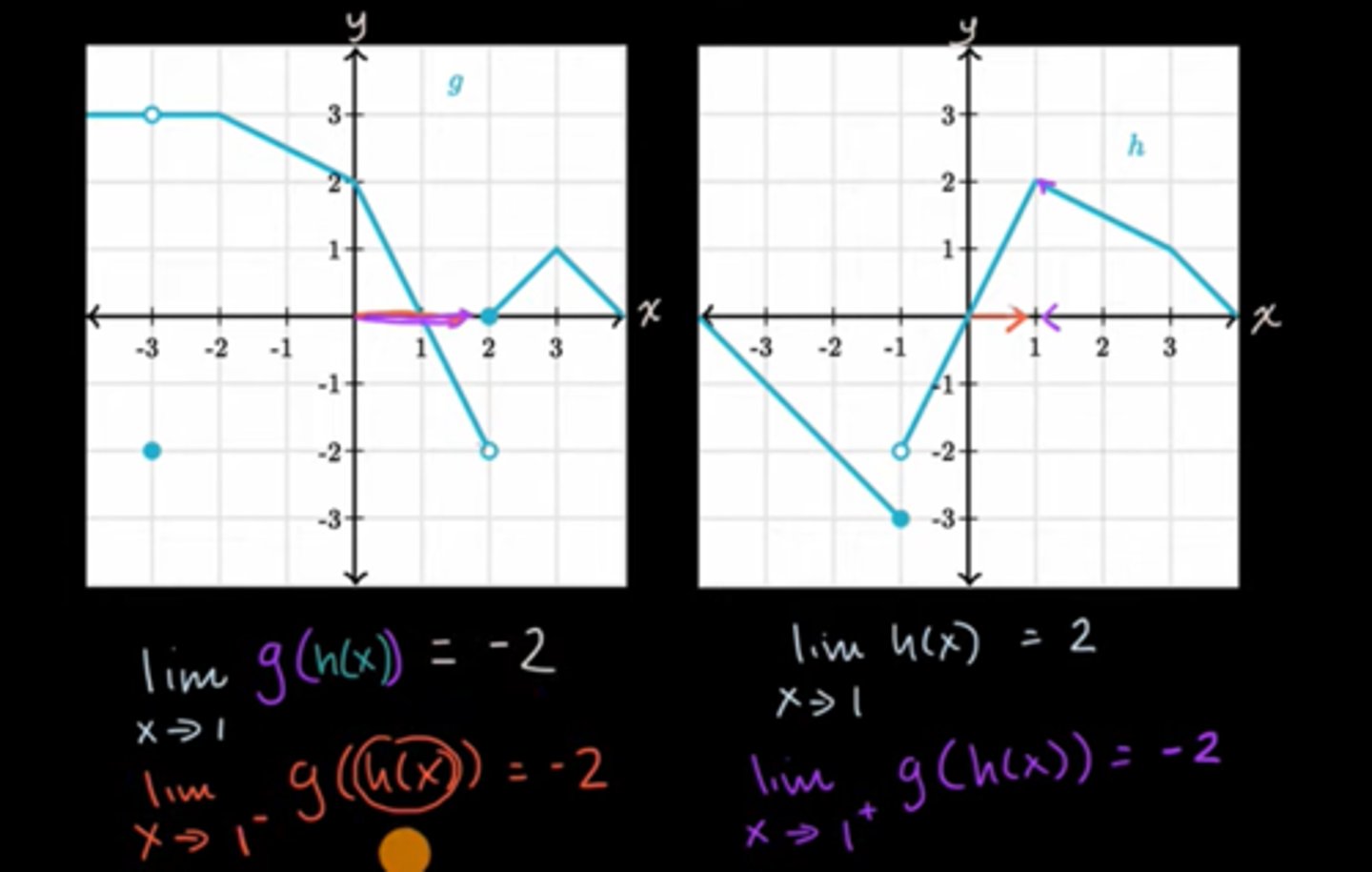
Evaluating Limits of Composite Functions (Strategy 3) [Fact 2]
Values that approach the right-sided Limit of the Inner Function correspond with values that approach the right-sided Limit of the Outer Function such that values that approach the Inner Function's Limit that are "above" the limit and/or "coming down" correspond with values that approach the Outer Function's Limit that are "to the right of" the limit and/or "approaching the left" (and are thus denoted as a plus sign after the Outer Limit)
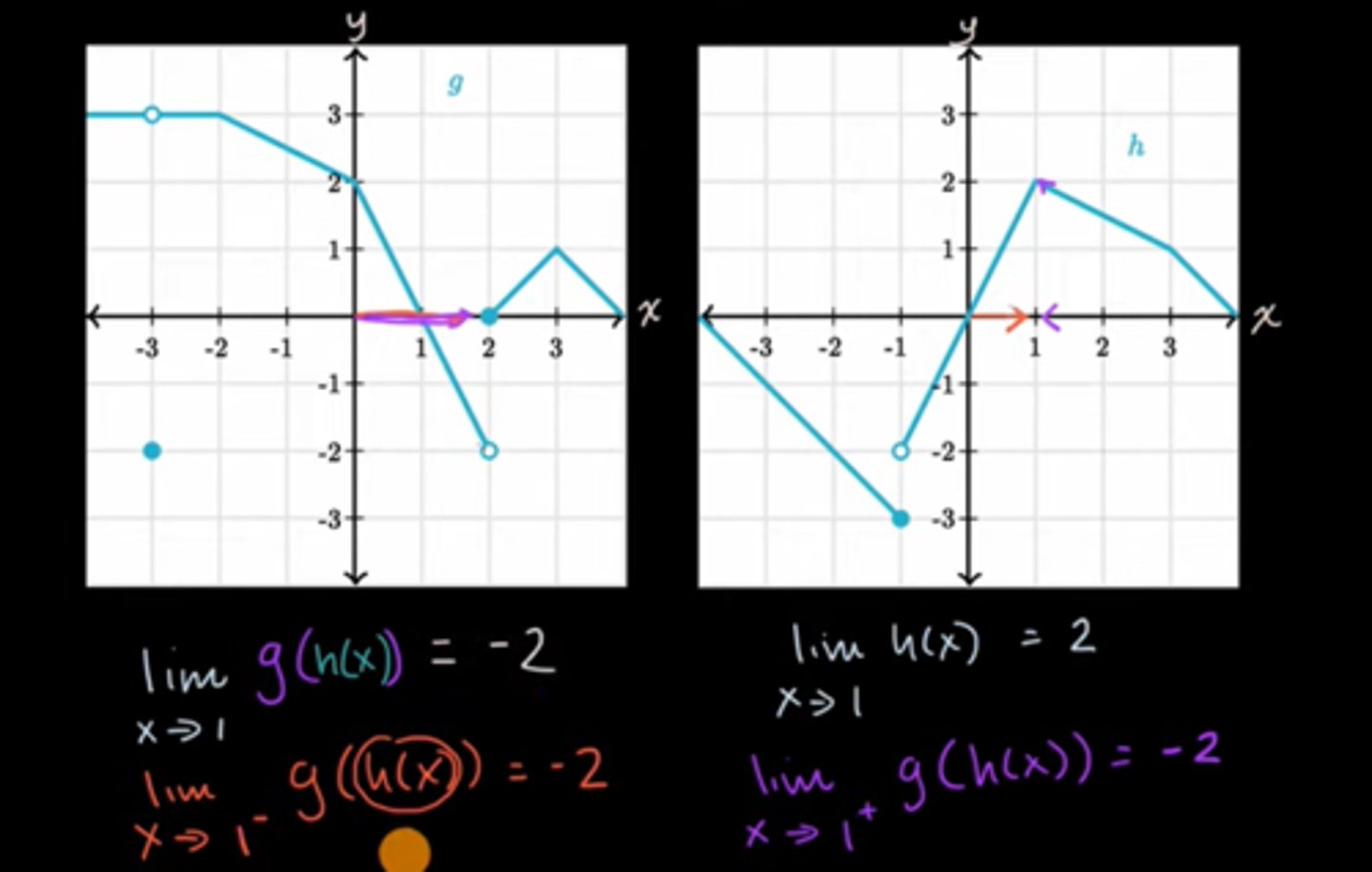
Evaluating Limits of Composite Functions (Strategy 3) [Fact 3]
Values that approach the left-sided Limit of the Inner Function correspond with values that approach the left-sided Limit of the Outer Function such that values that approach the Inner Function's Limit that are "below" the limit and/or "coming up" correspond with values that approach the Outer Function's Limit that are "to the left of" the limit and/or "approaching the right" (and are thus denoted as a minus sign after the Outer Limit)
Evaluating Epsilon-Delta-Defined Limits by Finding Delta (Strategy 1, Step 1)
Given a series of inequality expressions, graph the function in the expression that represents the absolute value of the difference between what the x is approaching and x itself being less than Delta if not already done so
Evaluating Epsilon-Delta-Defined Limits by Finding Delta (Strategy 1, Step 2)
Find the Epsilon Value in the given series of inequality expressions and then go up and down along the y-axis accordingly to find the values that suffice for that Epsilon value in the problem, and then find what x-values are at those y-values, and then take each difference between both x-values (the one on the left and the one on the right) and the given point, this difference is Delta
Finding Average Velocity - As a Slope of the Secant Line (Strategy 1)
Given an interval [a,b] and s(a) and s(b), plug into the formula for the Slope of a Secant Line, the resulting answer or Slope is the namesake value which represents the average velocity over the given interval [a,b]
Evaluating Limits of Piecewise Functions (Strategy 1)
Given the namesake function, plug in the value less than the middle value into the equation that represents the values that come before the middle value and do the same for the value greater than the middle value into the equation that represents the values that come after the middle value
Finding a value "a" that's a coefficient w/ in an expression w/ in a piecewise function (Strategy 1)
Given that the Limit exists, this means the 2 functions w/ in the piecewise function are equal, so set them equal to each other and solve for a, plugging in the "middle value" of the piecewise function (or the value that the expressions w/ in the piecewise function are geared around at) for x
Evaluating Limits at Infinity (Strategy 1)
Direct Substitution
Evaluating Limits at Infinity (Strategy 2)
Using Limits at Infinity Rules (comparing highest degree of numerator to highest degree of denominator)
Evaluating Limits at Infinity (Strategy 3)
Multiplying by 1/x^2 in a numerator that is a radical expression and 1/-x or 1/x depending on whether or not x approaches negative or positive infinity in the denominator since the entire function is a rational function and simplifying to find the limit (and carefully making sure the sign in front of the limit matches the sign in front of the infinity that x is approaching)
Finding Intervals of Continuity for a Function (Strategy 1)
If it is a Polynomial, it is continuous from negative to positive infinity
Finding Intervals of Continuity for a Function (Strategy 2)
If it is a Rational Function, it is continuous for all real numbers EXCEPT at places where the denom. is equal to zero before factors are cancelled (in which case it is a hole and/or vertical asymptote) or after factors are cancelled (in which case it can only be a vertical asymptote)
Limit Problem Type #1: Given a Limit as x approaches some # and a continuous function
Solve by plugging in #
Limit Problem Type #2: Given a Limit as x approaches some # and a rational expression
Solve by factoring and cancelling out Like Terms, then plug in #
Limit Problem Type #3: Given a limit as x approaches some # and square-root containing rational expression
Solve by multiplying the square-root-containing part of the fraction by its conjugate, cancelling out terms, and then plugging in #
Limit Problem Type #4: Given a limit as x approaches some # and a parametric expression
Solve by plugging in # in correct domain
Limit Problem Type #5: Given a one-sided limit as x approaches some # and a parametric expression
Solve one-sided limit by plugging in #, solve limit if it exists
Limit Problem Type #6: Given a limit as x approaches some # and parametric expression assuming/knowing the limit exists
Solve for k in the parametric expression by setting the left and right limits equal to each other, plugging in # for x, and then solving for k by algebraic means
Limit Problem Type #7: Given a limit as x approaches some # and a trigonometric expression
Solve by using the Squeeze Theorem
Limit Problem Type #8: Given a limit as x approaches some # and an expression by which is undefined when plugging in the # (an infinite limit) from the left/right
Solve by determining if +/- infinity, solve for limit if it exists
Limit Problem Type #9: Given a limit as x approaches some # and thus an infinite limit from the left/right
Solve by plugging in a decimal slightly to the left/right of the #, doing a sign analysis, and then determining +/- infinity (possibly sketch a graph afterwards for a better understanding of this through a visual)
Limit Problem Type #10: Given a limit as x approaches +/- infinity and a continuous function
Solve by plugging in infinity to get either +/- infinity and/or drawing a graph of the function and observing what happens
Limit Problem Type #11: Given a limit as x approaches +/- infinity and a rational function
Solve by ignoring insignificant terms and/or finding the ratio of the leading coefficients (depending on the function given and the limit being prompted to find)
Limit Problem Type #12: Given a limit as x approaches +/- infinity of a rational function
Solve by finding the Horizontal Asymptote knowing the degrees of the top and bottom terms are equal
Limit Problem Type #13: Given a limit as x approaches +/- infinity of a rational function
Solve by finding the Horizontal Asymptote knowing the degree of the top term is greater than the bottom term and dividing
Limit Problem Type #14: Given a limit as x approaches +/- infinity of a rational function
Solving by finding the Horizontal Asymptote knowing the degree of the top term is greater than the bottom term, and using sign analysis (by plugging in +/- infinity)
Limit Problem Type #15: Given a limit as x approaches +/- infinity of a rational function (if given a square root for these problems, make sure to take the absolute value when canceling the square with the root)
Solving by finding the Horizontal Asymptote knowing the degree of the top term is less than the bottom term
Limit Problem Type #16: Given a function
Sketch a graph by factoring, cancelling like terms (finding a hole and its coordinate by plugging in the x-value into the factored expression to find the y-value), and then 1) setting the denominator equal to zero to find the Vertical Asymptote, 2) comparing the degrees of the leading coefficients to find the Horizontal Asymptote), 3) setting the numerator equal to zero to find the x-intercept, 4) plugging in x for zero to find the y-intercept, and then finally, verifying all of this using properties of limits
Limit Problem Type #17: Given a function
Finding the "End Behavior Model" (by which a function grows more (+/- infinity) depending/based on the indicated domain
Limit Problem Type #18: Given a Parametric or Rational Function
Sketch a graph and determine the type of discontinuity if it is discontinuous
Limit Problem Type #19: Given a function, domain, and "k" value
Solve for a c value by using the Intermediate Value Theorem by 1) checking for continuity on the given domain by plugging-in domain values and getting defined values, 2) making sure f(a) does not equal f(b), 3) making sure "k" is in between f(a) and f(b), and 4) finding c such that f(c) equals "k", adding that it was resolved by the Intermediate Value Theorem
Finding (All) Absolute Extrema (or Absolute Extreme Values) on [a,b] (a closed interval)
0) Evaluate Domain of the given function of f
1) Locate the critical points of f on (a,b)
2) Evaluate f at the critical points of [a,b]
3) Evaluate f at the endpoints of [a,b]
4) Find the largest value (absolute maximum) and smallest value (absolute minimum)