Gen Chem 2 Chapter 14 Concepts
 Call Kai
 Learn
 Practice Test
 Spaced Repetition
 Match
 Flashcards
 Knowt Play
1/36

There's no tags or description
Looks like no tags are added yet.
37 Terms
What is Chemical Kinetics?
Chemical Kinetics is the study of rate of reactions
The rate of reaction depends on:
Mechanism of reaction
Concentration of reactants
Temperature
Pressure
Presence of catalyst
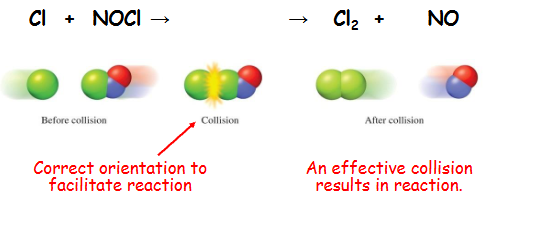
Collision Theory of Chemical Reactions
You need the correct orientation to facilitate reaction, and an effective collision results in reaction.
rate of reaction depends on number of collisions.
that means that the rate of reaction depends on the concentration of reactants.

Measuring Reaction Progress and Expressing Reaction Rate (Basics)
A —> B
rate of [A] = -△[A]/△t
rate of [B] = △[B]/△t
Where the change of concentration is concentration final - concentration initial

Continuous Monitoring
Total pressure - the total pressure of a gas mixture is stoichiometrically related to partial pressures of the gases in the reaction.
Polarimetry - this measures the change in the degree of rotation of plane-polarized light caused by one of the components over time.
Spectrophotometry - this measures the amount of light of a particular wavelength absorbed by one component over time.
The component absorbs its complementary color
Measuring Reaction Progress and Expressing Reaction Rate (The reaction rate)
2A + B —> C + 3D
aA + bB —> cC + dD
Where general rate of reaction is
-1/a x △[A]/△t = -1/b x △[B]/△t = 1/c x △[C]/△t = 1/d x △[D]/△t
But the rate of consumption/production of a certain substance is simply:
△[D]/△t = rate of production for D compound/molecule

How do you find concentration at a time t?
2A + B —>
Concentration of A at time t
[A](t) = [A]0 - a * rate of reaction * time
or….
[A](t) = [A]0 - rate of consumption/production of [A] * time
 = [A]0 - a *<em> rate of reaction </em>* time</p><p>or…. </p><p>[A](t) = [A]0 - rate of consumption/production of [A] * time</p>](https://assets.knowt.com/user-attachments/405b78a7-899f-4f53-92d5-3a96f0c8c969.png)
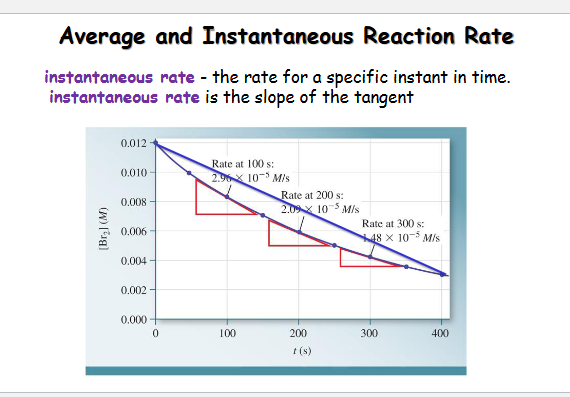
Average and Instantaneous Reaction Rate
Instantaneous rate - the rate for a specific instant in time
Instantaneous rate is the slope of the tangent of the graph of
Concentration of a certain molecule in a reaction versus time.
What is the rate law?
The rate law is an equation that relates the rate of reaction to the concentrations of reactants.
aA + bB —> cC + dD
rate of reaction = k * [A]^x * [B]^y
k: is the rate constant
x: order with respect to A
y: order with respect to B
x and y are determined experimentally
x+y: represents the overall reaction order
Reaction order is always defined in terms of the reactant’s concentrations, never in product’s concentrations.

Method of Initial Rates
Comparing changes in individual reactant concentrations with changes in rate shows how the rate depends on each reactant concentration.

What are units of rate constant?
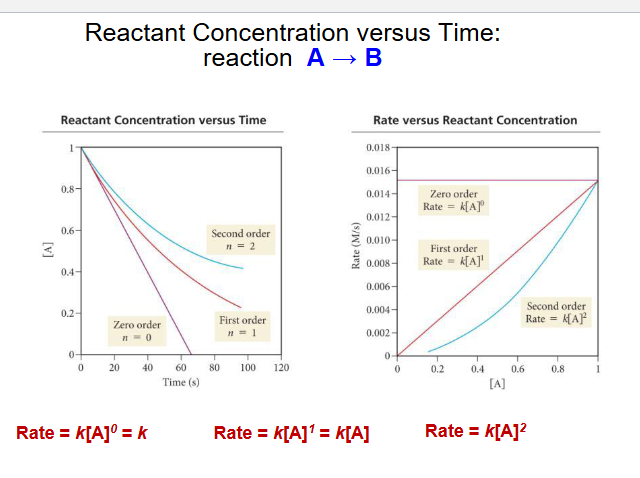
Zero Order: (when x+y=0) k has units of (M/s)
First Order: (when x+y=1) k has units of (1/s)
Second Order: (when x+y=2) k has units of (1/Ms)
Third Order: (when x+y=3) k has units of (1/M²s)
First - Order Reactions Integrated Rate Law
In a first order reaction of the type:
A —> B
The rate can be expressed as the rate of change in reactant concentration,
rate = -△[A]/△t
As well as in the form of the rate law:
rate = k[A]
Setting the two expressions to each other yields:
-△[A]/△t = k[A]
Using some funky calculus, itis possible to show that
ln[A](t)/ln[A](0) = -kt
Where ln is the natural logarithm
[A](0] is initial concentration and
[A](t) is concentration at particular time t
/ln[A](0) = -kt </p><p>Where ln is the natural logarithm </p><p>[A](0] is initial concentration and </p><p>[A](t) is concentration at particular time t </p>](https://assets.knowt.com/user-attachments/4b8bf6f0-6dd7-4404-adeb-093feb3a5153.png)
Plot of the first - order integrated rate law
ln[A](t) = -kt + ln[A](0)
y = mx + b
linear equation
Slope = -k
Intercept = ln[A](0)
Slope is a straight line of negative slope (this indicates that the reaction is first order and the units of k as a result)
 = -kt + ln[A](0) </p><p>y = mx + b</p><p>linear equation </p><p>Slope = -k </p><p>Intercept = ln[A](0) </p><p></p><p>Slope is a straight line of negative slope (this indicates that the reaction is first order and the units of k as a result)</p>](https://assets.knowt.com/user-attachments/73a79187-4c37-4f2f-8fc3-a09c5229a28c.png)
The half-life time (specifically for first order)
The half-life time t(1/2) is the time required for the reactant concentration to drop to half its original value.
For first order reactions this is:
t(1/2) - 0.693/k
For the 1st order t(1/2) is independent of [A](0). So each next t(1/2) is the same.
Kinetic and Stoichiometry in Integrated Rate Law problems (In this case this is a 1st order example)
These problems look like ICE problems sorta
You’re given initial concentrations and the goal is to find P(total), in order to do this you need to find concentrations of [A] AND [B] at the corresponding times.
In order to do that, you need to set up an ice table.
1 -x
0 + 2x
Using the initial condition t(1/2), you can find what x is, 1 - x = 0.5. And then find ptotal at t(1/2) from there.
In order to do it for 8.5h, do the same thing except use the integrated rate law equation to find [A](t) to find what x is.
Note: If you’re given a k that is in minutes, keep to minutes.
 to find what x is.</p><p></p><p>Note: If you’re given a k that is in minutes, keep to minutes. </p>](https://assets.knowt.com/user-attachments/8cbde1a6-40f2-4eb2-b2cd-085bb0618dcf.png)
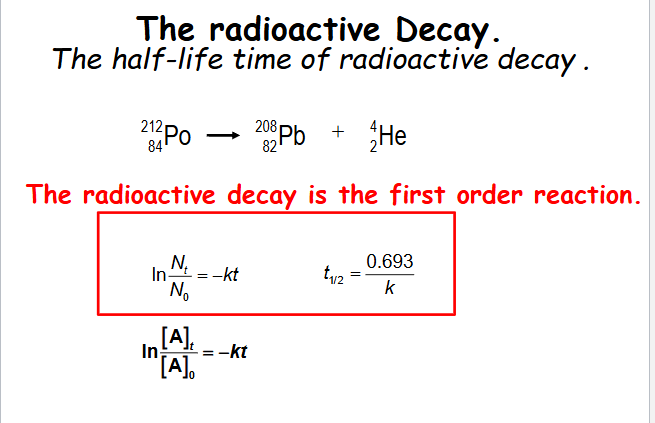
The Radioactive Decay
The half-life time of radioactive decay.
The radioactive decay is a first order reaction, so you can apply integrated rate law equation to radioactive decay.
Radiocarbon Dating
The half-life of carbon-14 is 5730 years
So radiocarbon dating method has a limit of around 60,000 years

Nuclear Radioactivity problem (Specifically for Carbon 14 Dating)
Since carbon 14 decay is a 1st rate reaction we can use 1st rate integrated raw law equation to this kind of problem.
The [A](t) would be the C14 activity found in the artifact, while the [A](0) would be the C14 activity of the living mass that used to be that artifact. The half life in this problem would stay the same in 5715 years.
Do not convert the 5715 years in to seconds, that’ll throw the problem off, and the answer you should get is in the thousands, in years.
 would be the C14 activity found in the artifact, while the [A](0) would be the C14 activity of the living mass that used to be that artifact. The half life in this problem would stay the same in 5715 years. </p><p></p><p>Do not convert the 5715 years in to seconds, that’ll throw the problem off, and the answer you should get is in the thousands, in years. </p>](https://assets.knowt.com/user-attachments/f9e0b4b1-f764-4fee-ac72-432938921b26.png)
Second - Order Reactions
A second - order reaction is a reaction whose rate depends on the concentration of one reactant raised to the second power or on the product of the concentrations of two different reactants (first order each).
rate = k[A]^1[B]^1 or rate = k[A]²
Second-Order Integrated Rate Law:
1/[A](t) = kt + 1/[A](0)
y = mx + b
Second Half-Life:
t(1/2) = 1/k[A](0)
The graph for this reaction is instead a straight line of positive slope instead, so keep that in mind.
 = kt + 1/[A](0)</p><p>y = mx + b</p><p>Second Half-Life: </p><p>t(1/2) = 1/k[A](0)</p><p></p><p>The graph for this reaction is instead a straight line of positive slope instead, so keep that in mind.</p>](https://assets.knowt.com/user-attachments/7c692a3a-f945-495e-97e3-4b7648e591fe.png)
What are Zero-Order Reactions
Rate law = k[A]^0 = k
Integrated rate law:
[A](t) = -kt + [A](0)
AA graph of zero order:
[A] versus time results in a straight line
Where slope = -k
y-intercept = [A](0)
Half Life:
t(1/2) = [A](0)/2k
Rate constant = M/s
 = -kt + [A](0)</p><p></p><p>AA graph of zero order: </p><ul><li><p>[A] versus time results in a straight line </p><ul><li><p>Where slope = -k </p></li><li><p>y-intercept = [A](0)</p></li></ul></li></ul><p></p><p>Half Life: </p><p>t(1/2) = [A](0)/2k </p><p></p><p>Rate constant = M/s </p><p></p>](https://assets.knowt.com/user-attachments/bbd5dfd2-24f8-4c8d-a7ff-f278273f5346.png)
Comparing half life with different ordered reactions
For the 1st order reactions:
t(1/2) is independent of A(0), each next t(1/2) is the same
For 0th order reactions, second t(1/2) is half of first t(1/2)
For 2nd order reactions, second t(1/2) is twice first t(1/2)
Collision Theory of Chemical Reactions
Collisions that result in a chemical reaction are called effective collisions.
The activation energy E(a) is the minimum amount of energy required to initiate a chemical reaction.
Molecules must also be oriented in a way that favors reaction.
One molecules collide, they may react together or they may not, depending on two factors:
Whether the collision has enough energy to “break the bonds holding reactant molecules together”
Whether the reacting molecules collide in the proper orientation for new bonds to form.
Activation Energy
When molecules collide in an effective collision, they form an activated complex. (also called a transition state)
The simple equation for this relationship with the graph is:
△H = Ea(forward) - Ea(reverse)
Ea(reverse) = Ea(forward) - △H

How is rate of reaction affected by temperature? Is activation energy also affected?
The rate of reaction increases with increasing temperature.
Activation energy is not affected by increasing temperature. It does not increase, stays the same. The rate constant increases instead because fraction of molecules with sufficient energy increases.
Rate constant k doesn’t depend on concentration, it only depends on temperature and the nature of the reactants (A, Ea)
Dependence of Reaction Rate on Temperature
The dependence of the rate constant on temperature can be expressed by the Arrhenius Equation
k = Ae^(-Ea/RT)
A represents the collision frequency and is called the frequency factor
Ea is the activation energy (in kJ/mol)
R is the gas constant (8.314 J/(mol*K))
T is absolute temperature (Kelvin)
BTW you have to convert the Ea into J/mol because R is in J/mol*K
Summarizing Temperature and Reaction Rate
The frequency factor is the number of times that the reactants approach the activation barrier per unit time - (fraction of collision with proper orientation) - also called orientation factor.
The exponential factor is the fraction of successful collisions for surmounting the activation barrier and forming products.
The exponential factor increases with increasing temperature but decreases with increasing activation energy.
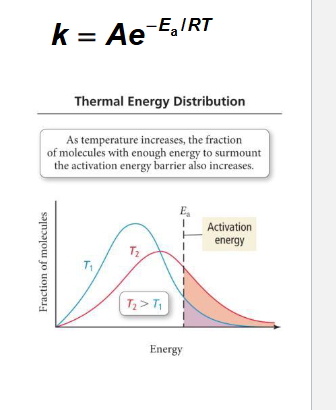
How to find fraction of all molecules that have enough energy to overcome the Ea barrier (or the exponential factor)
Is simply 1/ e^(-Ea/RT)

Dependence of Reaction Rate on Temperature, Linear Equation
Taking the natural log of both sides of the previous equation, the Arrhenius equation may be written in a more linear form:
lnk = (-Ea/R)(1/T) + lnA
y = m x + b
Slope is -Ea/R
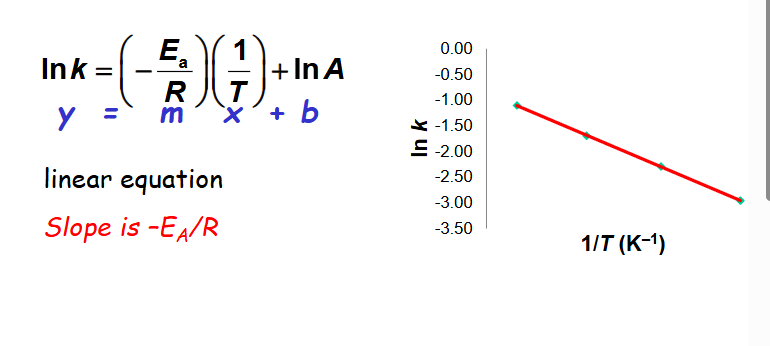
How to find slope lnk = (-Ea/R)(1/T) + lnA
slope is (-Ea/R)(1/T)
if given k and T as a table, find its corresponding lnk values and 1/T values, and then find slope using those values.
Using that, when you found the slope don’t forget to multiple slope by R to find Ea

Two Point form of the Arrhenius Equation can be written as:
lnk2/lnk1 = Ea/R (1/T1 - 1/T2)
If the rate constants at two different temperatures are known, it is possible to calculate the activation energy.
If the activation energy and the rate constant at one temperature are known, it is possible to determine the rate constant at any other temperature.
Reaction Mechanisms
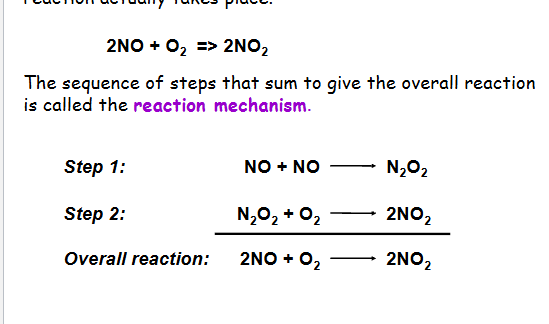
A balanced chemical equation doesn’t indicate how a reaction actually takes place.
The sequence of steps that sum to give the overall reaction is called the reaction mechanism.
Chemical species that appear in the reaction mechanism but are not in the overall chemical equation are called intermediates.

Elementary Reaction
Each step in a reaction mechanism represents an elementary reaction, one that occurs in a single collision of the reactant molecules.
The molecularity of an elementary reaction is essentially the number of reactant molecules involved in the collision.
Unimolecular (one reactant molecule)
A —> products rate = k[A] first order
Bimolecular
A + B —> products rate = k[A][B] second order
A + A —> products rate = k[A]² second order
Termolecular (three reactant molecules) are rare.

Rate of elementary Reaction
Exponents in the rate law of elementary reaction are stoichiometric coefficients of reactants.
For example:
A + 2B —> products rate = k[A][B]²
Disclaimer:
This is valid for elementary reactions only. The rate of the multi-step reaction can only be determined experimentally.
Overall Rate of Reaction
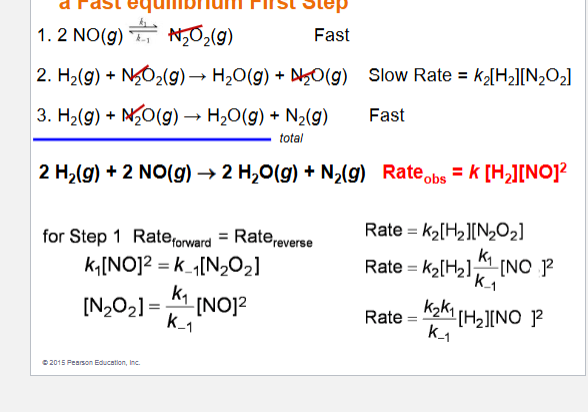
In a reaction mechanism consisting of more than one elementary step, the rate law for the overall process is given by the rate-determining step.
The rate determining step is the slowest step in the sequence.
So therefore, the rate of the slowest step is the rate for the overall reaction.

Validating a Mechanism: Criteria
To validate (not prove) a mechanism, two conditions must be met:
The elementary steps must sum to the overall balanced chemical equation
The rate law predicted by the rate determining step of the mechanism must be consistent with the experimentally observed rate law.
Example of a Mechanism with a Fast Equilibrium Step
In a example, where the slow step has concentration of molecule/compound that isn’t found in the overall reaction, you equate that compound to the fast equilibrium step and substitute that back into the rate law of the slow step to be the rate law of the general reaction.
Look at notebook if you need to clear up about these kind of examples
Catalysis
A catalyst is a substance that increases the rate of a chemical reaction without itself being consumed.
A catalyst speed up a reaction by providing a set of elementary steps with more favorable kinetics than those that exist in its absence.
A catalyst usually speeds up a reaction by lowering the activation energy.
Catalysts doesn’t change the enthalpy △H of the reaction.
Catalyst increases the rate of both: forward and reverse reactions however.

How much faster is a catalyzed reaction?
If you know activation energies before and after catalysis, you can find a rate constant of catalyzed reaction
Where:
ln(k1/k2) = -(1/RT)[Ea1 -Ea2]
k2 - rate constant after it was catalyzed
k1 - rate constant before it was catalyzed
Ea1 - activation energy before it was catalyzed
Ea2- activation energy after it was catalyzed
Larger k value, or faster k value is supposed to minused now, or on other side of equation, but other than that everything works the same/