Human Phys Exam 2
 Call Kai
 Learn
Learn Practice Test
 Spaced Repetition
 Match
Match Flashcards
 Knowt Play
1/264

There's no tags or description
Looks like no tags are added yet.
Name | Mastery | Learn | Test | Matching | Spaced | Call with Kai | Chat |
|---|
No analytics yet
Send a link to your students to track their progress
265 Terms
The interaction of the nervous and muscles systems occurs during excitation-contraction coupling. The release of ACh from the axon terminal onto the motor end plate opens sodium channels, leading to the depolarization of the sarcolemma. This, in turn, causes changes in the conformation of the DHP receptor, leading to the opening of the ______channels and the release of calcium into the cytoplasm.
RyR
What can stimulate or inhibit depending on the tissue?
acetylcholine (ACh)
Both alpha-bungarotoxin and curare bind to the same neurotransmitter receptor, but only curare binds reversibly. Would either toxin be appropriate to use to temporarily paralyze a patient during surgery?
Curare as it reversibly binds causing temporary paralysis by attaching to nachr to temporarily stop ach from causing motion in skeletal muscles
Sympathetic neurotransmitter at target synapse is
norepinephrine
parasympathetic inactivation method at synapse
enzymatic breakdown or diffusion
sympathetic inactivation method at synapse
uptake or diffusion
parasympathetic receptor type on target cells
muscarinic
sympathetic receptor type on target cells
adrenergic
parasympathetic neurotransmitter at target synapse is
acetylcoline
In skeletal muscle ach does what to the post-synaptic potential? Which causes what?
excite, depolarization
What does the speed of the post-synaptic response depend on?
mechanisms of transduction
Ion channels are _____ due to _____
fast, action potentials
Temporal summation occurs when?
2 graded potentials from 1 presynaptic neuron occur close together.
How does spatial summation occur?
3 excitatory neurons will fire below threshold. When these graded potentials arrive at the trigger zone together they will add to create a supra threshold signal. Creating an action potential
Both alpha-bungarotoxin and curare bind to the same neurotransmitter receptor, but only curare binds reversibly. Which receptor is involved?
Nicotinic acetylcholine receptor (NAChR)

What is this?
spatial summation
Post-synpatic summation can be ______ or _____
temporal, or spatial
G-Protein are ______ because of _____
slow, multi-stage process
IPSP =
hyperpolarize
EPSP =
depolarize
In cardiac muscle ach does what to the post-synaptic potential? Which causes?
inhibit, hyperpolarization
What is glycine also known as?
inhibitory ACH
What decreases glutramate activity and increases GABA?
alcohol
How is neurotransmitter removal done?
diffusion, enzyme inactivation, and reabsorption
What do monoamine oxidase inhibitors (MAO-I) do?
prevent breakdown of monoamine neurotransmitters in the synpase thereby prolonging their activity
What is it when one issue is solved another is caused (side effects)
comorbility
What are MAO-I primarily used for?
to treat depression
What are some monoamine neurotransmitters?
serotonin, melatonin, epi, norepi
What increases GABA activity?
Tranquilizers (valium)
What increases glutamate activity and blocks GABA receptors
caffeine
What is the most common muscle in the ANS?
Glycine
What is over 50% of brain synapses, excitatory?
glutamate
What is the most common neurotransmitter in the body
Acetylcholine (AcH)
Dopamine
schizophrenia
The interaction of the nervous and muscles systems occurs during excitation-contraction coupling. The release of ACh from the axon terminal onto the motor end plate opens sodium channels, leading to the depolarization of the sarcolemma. This, in turn, causes changes in the conformation of the DHP receptor, leading to the opening of the RyR channels and the release of ______ into the cytoplasm.
calcium
The interaction of the nervous and muscles systems occurs during excitation-contraction coupling. The release of ACh from the axon terminal onto the motor end plate opens sodium channels, leading to the depolarization of the sarcolemma. This, in turn, causes changes in the conformation of the ______ receptor, leading to the opening of the RyR channels and the release of calcium into the cytoplasm.
DHP
In relaxed muscle, ______ partially blocks the myosin-binding site on actin. To initiate contraction, Ca2+ binds to troponin. This unblocks the myosin-binding sites and allows myosin to complete its power stroke.
tropomyosin
At a flexible joint, muscle contraction moves the skeleton. Flexors bring bones closer together; extensors move bones away from each other. Flexor-extensor pairs are examples of ______ muscle groups.
antagonistic
In relaxed muscle, tropomyosin partially blocks the myosin-binding site on actin. To initiate contraction, Ca2+ binds to ______. This unblocks the myosin-binding sites and allows myosin to complete its power stroke.
troponin
Which of the following muscle tissue(s) have intercalated disks?
cardiac
The contraction cycle begins when ATP binds to myosin, the myosin head then detaches from the actin binding site. ATP hydrolysis then provides the energy for the myosin head to ______ at a new binding site on the actin molecule. Myosin releases ADP after the power stroke.
pivot and re-attach
The interaction of the nervous and muscles systems occurs during ______. The release of ACh from the axon terminal onto the motor end plate opens sodium channels, leading to the depolarization of the sarcolemma. This, in turn, causes changes in the conformation of the DHP receptor, leading to the opening of the RyR channels and the release of calcium into the cytoplasm.
excitation-contraction coupling
Skeletal muscles are controlled by somatic motor neurons. Cardiac and smooth muscles are controlled by ______, paracrine signals, hormones. Some smooth and cardiac muscles are autorhythmic and contract spontaneously.
autonomic innervation
______ are intracellular bundles of contractile and elastic proteins.
Myofibrils
The contraction cycle begins when ATP binds to myosin, the myosin head then detaches from the actin binding site. ATP hydrolysis then provides the energy for the myosin head to pivot and re-attach at a new binding site on the actin molecule. Myosin releases ADP ______ the power stroke.
after
A ______ muscle is a collection of muscle fibers, large cells with many nuclei
skeletal
In an isometric contraction the elastic elements are stretched already and the muscle shortens
false
When the muscle contracts, which band(s) remain the same length?
A band
Rate the following in order of smallest to largest: sacromere, myofibrils, muscle fascicle, muscle fiber, skeletal muscle
sacromere, myofibrils, muscle fibers, muscle fascicle, skeletal muscle
Skeletal muscles are controlled by ______. Cardiac and smooth muscles are controlled by autonomic innervation, paracrine signals, hormones. Some smooth and cardiac muscles are autorhythmic and contract spontaneously.
somatic motor neurons
A ______ is composed of a group of muscle fibers and the somatic motor neuron that controls them. The number of muscle fibers in a motor unit varies, but all fibers in a single motor unit are of the same fiber type.
motor unit
What is the sarcolemma?
the muscle cell membrane
You are a sprinter. What type of muscle fibers do you use in a race?
fast glycolytic
Increasing the stimulus frequency causes summation of twitches with an increase of tension. A state of maximal contraction is known as ______.
tetanus
______ muscle fibers are striated, have a single nucleus, and are electrically linked through gap junction, Cardiac muscle shares features with both skeletal and smooth muscle fibers.
cardiac
What is the purpose of Calmodulin?
calmodulin is necessary to activate myosin light chain kinase (MLCK) that phosphorylates myosin heads in smooth muscle + increases myosin-ATPase activity
Which of the following structures would you expect to use multi-unit smooth muscle organization?
eye muscles
The ______ states that during contraction, overlapping thick and thin filaments slide past each other in an energy-dependent manner as a result of actin-myosin crossbridge movement
sliding filament theory of contraction
The force created by contracting muscles is called ______. The load is a weight or force that opposes contraction of a muscle.
muscle tension
Which of the following muscle tissue(s) use gap junctions?
cardiac + smooth
During relaxation, the sarcoplasmic reticulum uses a______ to pump Ca2+ back into its lumen
Ca2+-ATPase
The contractile unit of a myofibril. It is composed of two Z-disks and the filament between them. The sarcomere is divided into I bands(think filament only), and A band that runs the length of a thick filament and a central H zones occupied by thick filament only. The M lines and Z disk represent attachment sites for myosin and actin, respectively. look at the picture and draw this out. I promise it will help
sacromere
At a flexible joint, muscle contraction moves the skeleton. Flexors bring bones closer together; ______ move bones away from each other. Flexor-extensor pairs are examples of antagonistic muscle groups.
extensors
The contraction cycle begins when ATP binds to myosin, the myosin head then detaches from the actin binding site. ATP ______ then provides the energy for the myosin head to pivot and re-attach at a new binding site on the actin molecule. Myosin releases ADP after the power stroke.
hydrolysis
The interaction of the nervous and muscles systems occurs during excitation-contraction coupling. The release of ACh from the axon terminal onto the motor end plate opens ______channels, leading to the depolarization of the sarcolemma. This, in turn, causes changes in the conformation of the DHP receptor, leading to the opening of the RyR channels and the release of calcium into the cytoplasm.
sodium
The contraction cycle begins when ATP binds to ______, the myosin head then detaches from the actin binding site. ATP hydrolysis then provides the energy for the myosin head to pivot and re-attach at a new binding site on the actin molecule. Myosin releases ADP after the power stroke.
myosin
Which of the following structures would you expect to use single-unit smooth muscle organization?
digestive muscles
The interaction of the nervous and muscles systems occurs during excitation-contraction coupling. The release of ACh from the axon terminal onto the motor end plate opens sodium channels, leading to the ______ of the sarcolemma. This, in turn, causes changes in the conformation of the DHP receptor, leading to the opening of the RyR channels and the release of calcium into the cytoplasm.
depolarization
The interaction of the nervous and muscles systems occurs during excitation-contraction coupling. The release of ______ from the axon terminal onto the motor end plate opens sodium channels, leading to the depolarization of the sarcolemma. This, in turn, causes changes in the conformation of the DHP receptor, leading to the opening of the RyR channels and the release of calcium into the cytoplasm.
ACh
Which of the following pairs is incorrect in muscle sarcomeres?
tropomyosin- myosin
Where does the Ca2+ come from in a muscle contraction?
Sarcoplasmic Reticulum
The contraction cycle begins when ATP binds to myosin, the myosin head then ______ from the actin binding site. ATP hydrolysis then provides the energy for the myosin head to pivot and re-attach at a new binding site on the actin molecule. Myosin releases ADP after the power stroke.
detaches
______ allow action potentials to move rapidly into the interior of the muscle fiber and release calcium from the sarcoplasmic reticulum.
T-tubules
Skeletal and cardiac muscles are ______ muscles
striated
The motor unit is made up of the neuron and all the muscle fibers it innervates
true
______ is an oxygen-binding pigment that transfers oxygen to the interior of the muscle fiber
myoglobin
Chicken breasts are white meat. Why?
Breasts are fast glycolytic + do not contain a high number of mitochondria giving it the lighter hue
Which of the following muscle tissue(s) is the slowest to contract?
smooth
_______ muscle is slower than skeletal muscle but can sustain contraction for longer without fatiguing.
Smooth
How do bones move in an extension motion?
farther apart
How do bones move in a flexion motion?
closer together
At a flexible joint, muscle contraction moves the skeleton. ______ bring bones closer together; extensors move bones away from each other. Flexor-extensor pairs are examples of antagonistic muscle groups.
flexors
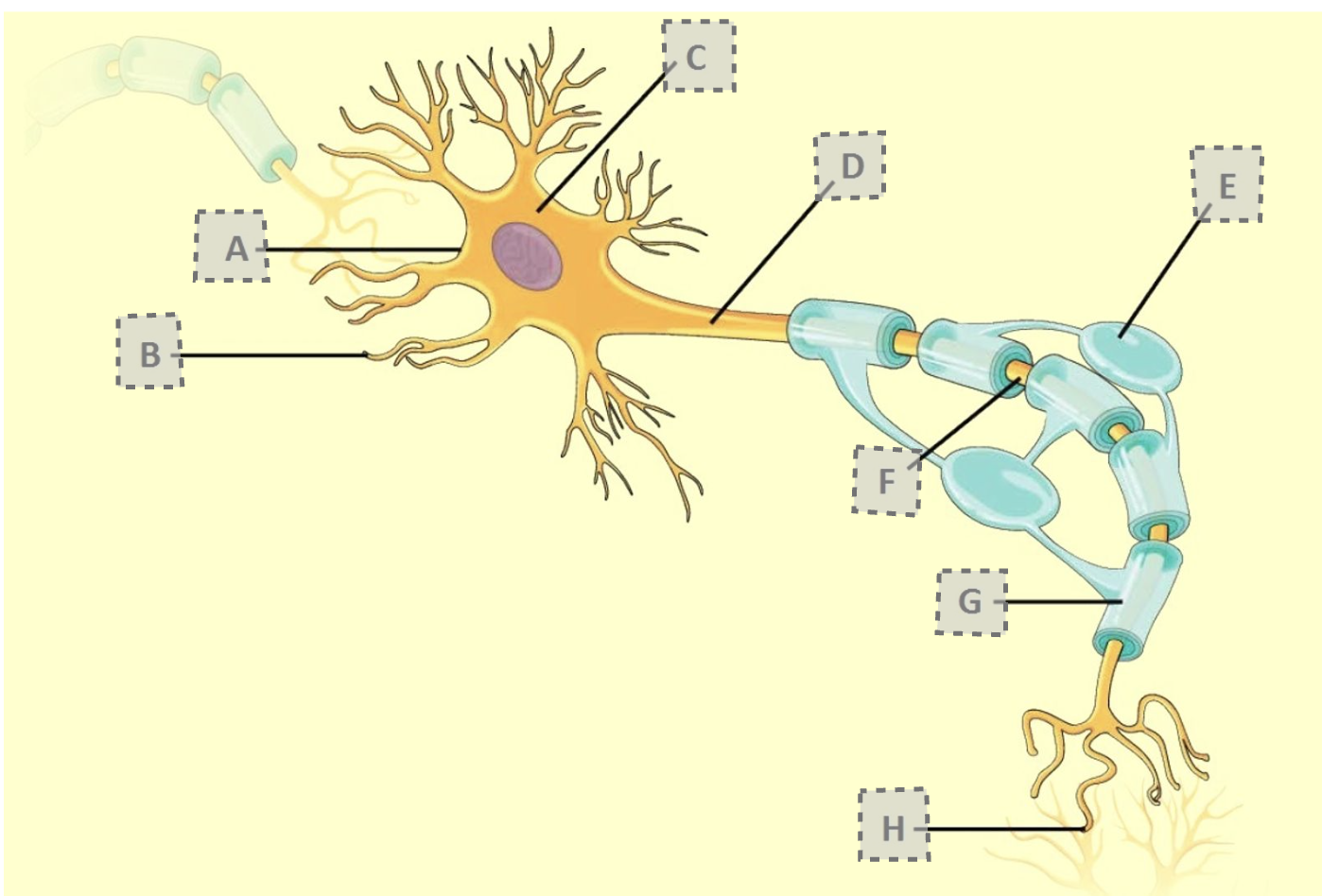
synapse
H

node of ranvier
F
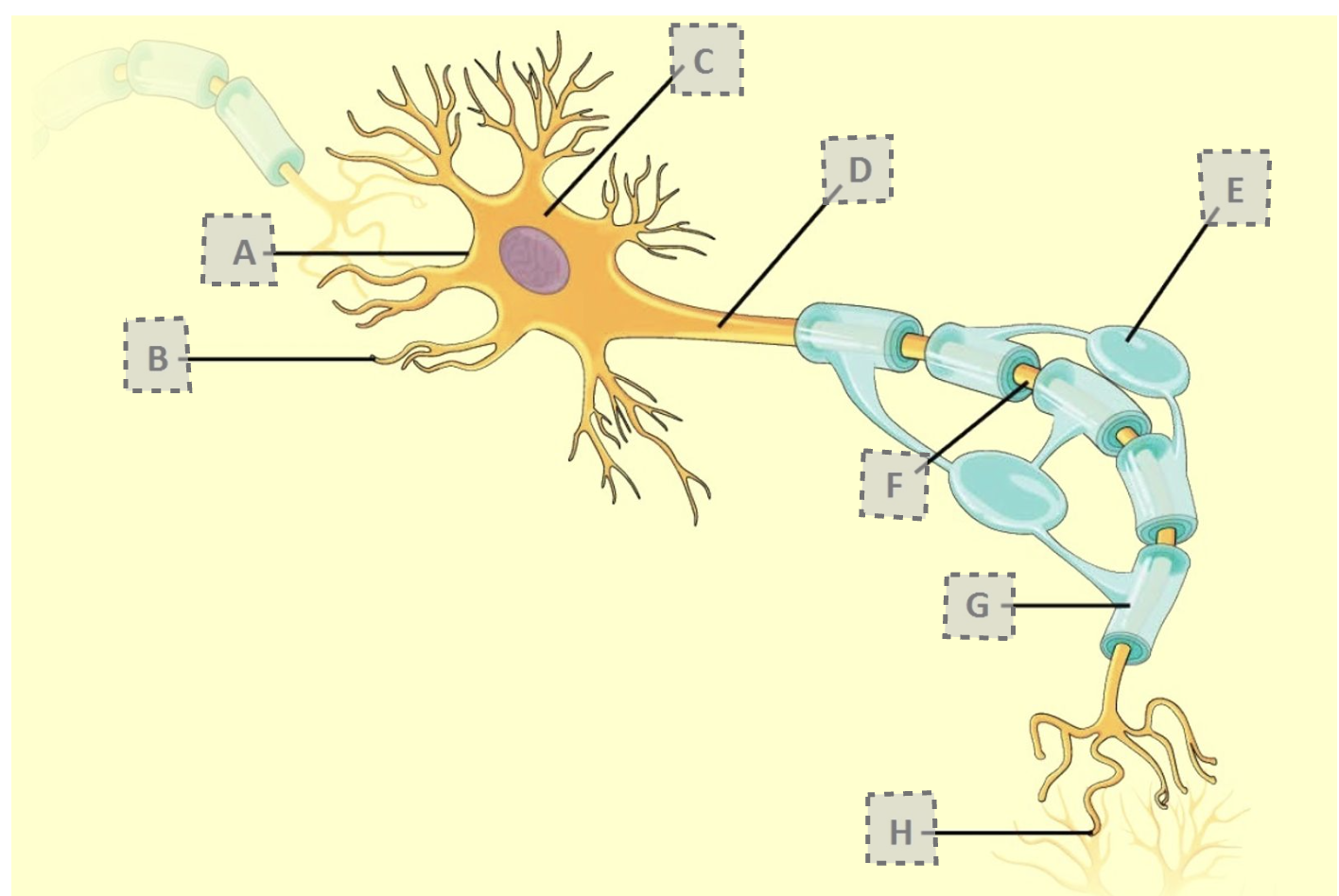
Soma
C
biogenic amine
Dopamine (DA)
A neuron at rest is negatively charged: the inside of a cell is approximately ______ millivolts more negative than the outside.
70
A neuron at rest is ______ charged: the inside of a cell is approximately 70 millivolts more negative than the outside.
negatively
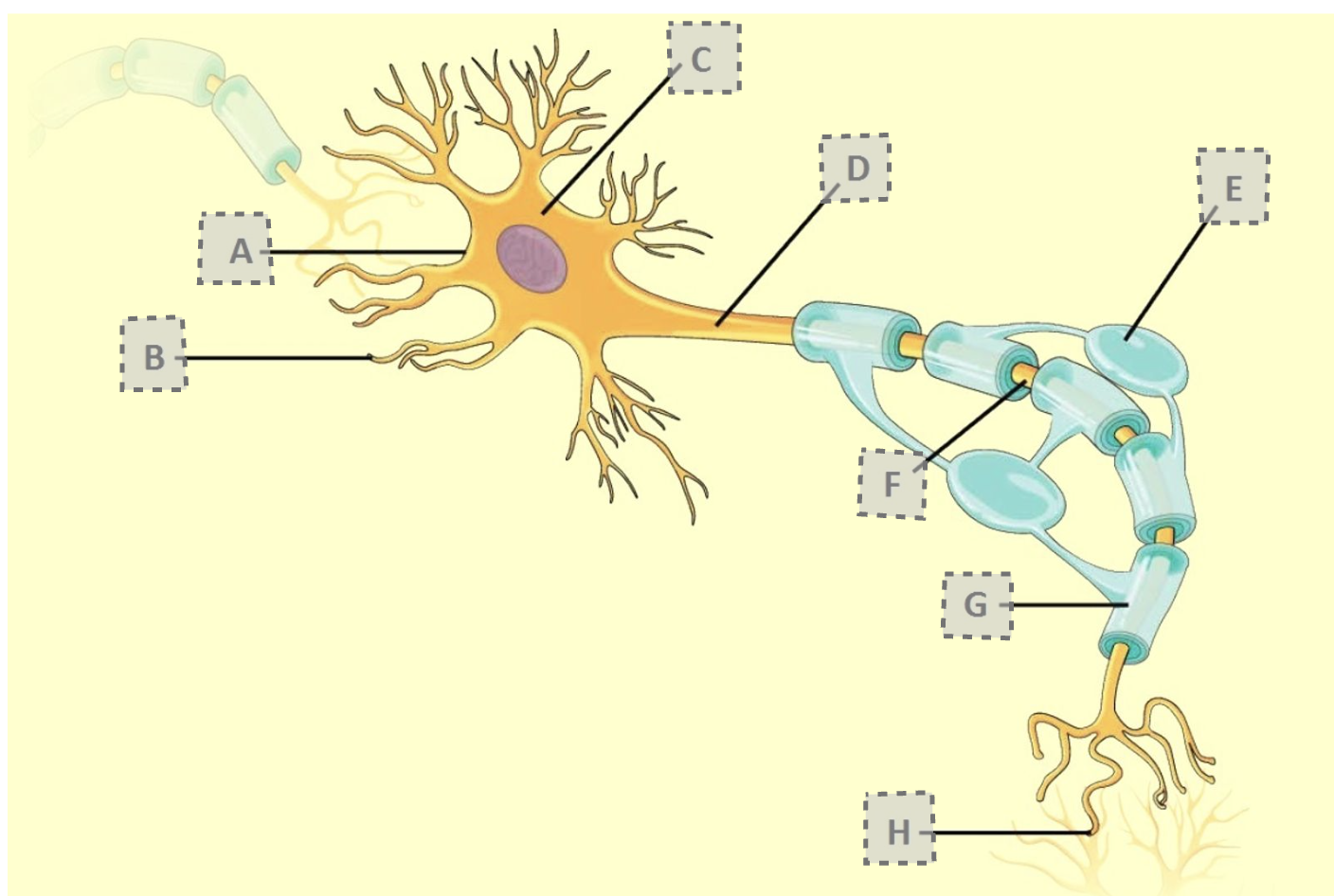
Cell membrane
A

Oligodendrocyte
E
neuromuscular junction
Acetylcholine (ACh)
Acetylcholine (ACh)
nicotinic receptors
In neurons, ______ ions are maintained at high concentrations within the cell while sodium ions are maintained at high concentrations outside of the cell. Calcium ions also tend to accumulate outside of the cell because they are repelled by negatively-charged proteins within the cytoplasm.
potassium
In neurons, potassium ions are maintained at high concentrations within the cell while sodium ions are maintained at high concentrations outside of the cell. ______ ions also tend to accumulate outside of the cell because they are repelled by negatively-charged proteins within the cytoplasm
calcium
The likelihood of an action potential firing is dependent on the extracellular environment. For example, during conditions of ______ and hyperkalemia, action potentials are more likely to occur. Conversely, during hypercalcemia and hypokalemia, they are less likely to occur.
hypocalcemia
The likelihood of an action potential firing is dependent on the extracellular environment. For example, during conditions of hypocalcemia and hyperkalemia, action potentials are more likely to occur. Conversely, during ______ and hypokalemia, they are less likely to occur.
hypercalcemia
The likelihood of an action potential firing is dependent on the extracellular environment. For example, during conditions of hypocalcemia and hyperkalemia, action potentials are more likely to occur. Conversely, during hypercalcemia and ______, they are less likely to occur.
hypokalemia
In the autonomic nervous system, the pre-ganglionic neurons release acetylcholine and the receptors are labeled as ______. In the parasympathic division, the post-ganglionic neurons release acetylcholine onto muscarinic receptors, while in the sympathetic division, they release catecholamines onto adrenergic receptors.
nicotinic
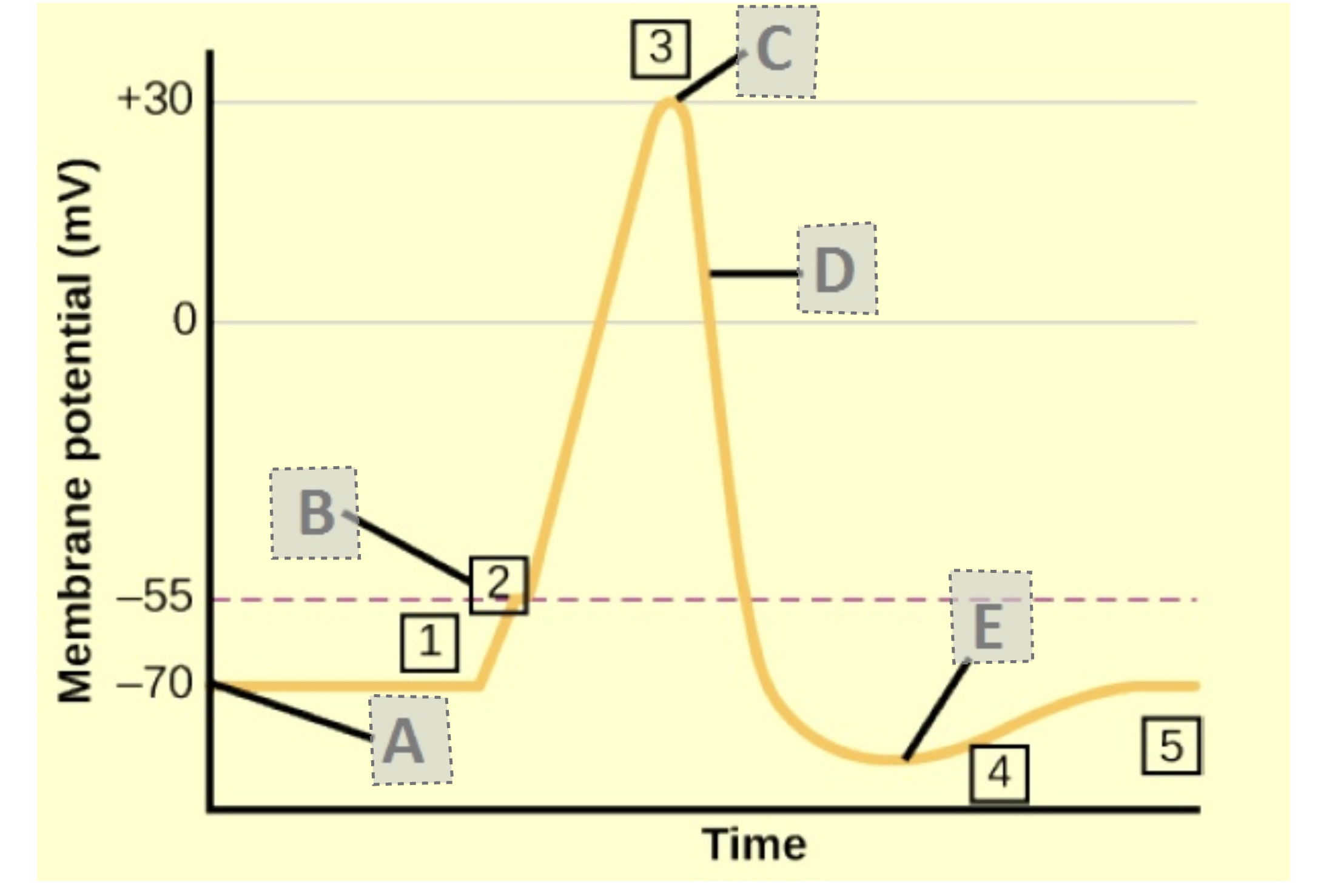
Repolarization
D