CPSC 253 - Week 3: Cryptography and Cryptanalysis
 Call Kai
 Learn
Learn Practice Test
 Spaced Repetition
 Match
Match Flashcards
 Knowt Play
1/42

There's no tags or description
Looks like no tags are added yet.
Name | Mastery | Learn | Test | Matching | Spaced | Call with Kai | Chat |
|---|
No analytics yet
Send a link to your students to track their progress
43 Terms
Threats to messages
• Interception: Confidentiality is compromised
• Interruption (blocking messages): Availability is compromised
• Modification and Fabrication: Integrity
Cryptology
Cryptography and Cryptanalysis
Cryptography
Science/art of securing messages
Cryptanalysis
Art/science of breaking Ciphertext
Basic Cryptographic scheme
• 𝑃 = 𝑝1, 𝑝2, … , 𝑝𝑛
– Where 𝑝𝑖 = i th char of 𝑃
– 𝑃 = “DO NOT TELL ANYBODY” (e.g., 𝑝1=“D”, 𝑝2=“O”, etc.)
– By convention, cleartext in uppercase
IS what gets encrypted
• 𝐶 = 𝑐1, 𝑐2, … , 𝑐𝑛
– Where 𝑐𝑖 = i th char of 𝐶
– 𝐶 = “ep opu ufmm bozcpez” (e.g., 𝑐1=“e”, 𝑐2=“p”, etc.)
– By convention, ciphertext in lowercase
Each letter in P has a corresponding letter in C.

Benefits of Cryptography
Improvement, not solution for security
Minimizes some problems
Adds an envelope(encoding) to a postcard(plain/cleartext)
Formal Notation(Important)
E: Encryption rule/algorithm
D: Decryption rule/algorithm
P: Plaintext
C: Ciphertext
C = E(P)
P = D(C)
You need a cryptosystem where P = D(C) = D(E(P)), allows you to get back original message

Cryptography in practice
Can happen through wired or wireless networks
Compromised confidentiality

Crypto System with Keys
𝐶 = 𝐸(𝐾_𝐸,𝑃)
𝐸 = set of encryption algorithms/𝐾𝐸 selects 𝐸_𝑖 ∈ 𝐸
• 𝑃 = 𝐷(𝐾_𝐷, 𝐶)
𝐷 = set of decryption algorithms/𝐾_𝐷 selects 𝐷_𝑗 ∈ 𝐷
• Crypto algorithms and keys are like door locks and keys
• We need: 𝑃 = 𝐷(𝐾_𝐷, 𝐸 (𝐾_𝐸, 𝑃) )
Plaintext must equal a set of decryption algorithms with the decryption key and the set of encryption algorithms which is a function of the encryption key and Plaintext
Each needs a key

Classification of Cryptosystem w.r.t Keys
Keyless
Symmetric
Asymmetric
Keyless cryptosystem
EX: Caesar cypher
Less secure
Symmetric cryptosystem
Encipher and decipher w/ same key, easy to derive from each other
K_E = K_D
K_E: Encryption key
K_D: Decryption key
Asymmetric Cryptosystem
Private key must always stay with user, one for each user
Public key system
Encipher and decipher with diff keys
Difficult to derive keys from each other
K_E ≠ K_D
Cryptanalysis goals
Breaking the messages
Find patterns in encryption to break them
Infer meanings without actually breaking encryption
EX: Enemy troops sending a lot of messages may be an attack, busy node may be headquarters
Deduce key to break subsequent messages
Find general weaknesses and vulnerabilities in implementation or environment in an encryption algorithm
Cryptanalysis
How to start off
Intercepted encrypted messages and plain text
Known encryption algorithms
Data suspected to be ciphertext
Math/statistical tools
Properties of natural language
EX: Adversary natural language like Americans using Navajo language in WW2
Properties of computer systems
Most important is ingenuity/luck?
No rules
Breakable Encryption
Based on Shannon’s theory of information
Practical cryptosystems should be breakable with enough time and computing power, but it should be possible to devise an unbreakable system.
Must be hard enough for the intruder to not break it
It is possible to make unbreakable ones theoretically
Requirements for Crypto protocols
Messages should get to destination(Availability)
Only the recipient should see and get it(confidentiality)
Message shouldn’t be corrupted in transit(Integrity)
Message should be sent/received once(availability)
Proof of sender’s id(non-repudiation)
Representing characters
Mapping input to 0 or 1 can be done with modulo 26(Uppercase letters rep with 0-25)
Letter operations
A + 2 = C → 0+2=2%26 = 2
X + 4 = B → 23+4= 27%26 = 1
Basic Ciphers
Substitution cipher
Letters of P replaced with other letters by E
Transposition(permutation) ciphers
Order of P’s letters rearranged by E
Product Cipher
E = E_1+E_2, a combo of 2 cipher
Caesar Cipher
Has a numeric key, which shifts the characters
Add the key to each character and use %26
One key, 1 letter is used to sub each letter in Plaintext(P)
A monoalphabetic substiution cipher
EX:
𝑃 (plaintext): HELLO WORLD
𝐶 (ciphertext): khoor zruog
Exhaustive Search
If there’s a small number for the possibility of keys try all of them
For caesar ciphers there are 26 possible ones from 0-25
Used to attack substitution ciphers
Breakable Encryption example
With a message consisting of 25 characters there are 26^ 25 possible decryptions
A brute force approach to find the right one could take 10^ 10(10 billion) decryption/sec 10^35/10^10=10^25 sec or 317 quadrillion years
Using ingenuity could reduce it to 10^15 decryptions to check at 10^10 decryptions/s → 10^15/10^10= 10^5 sec or 1 day
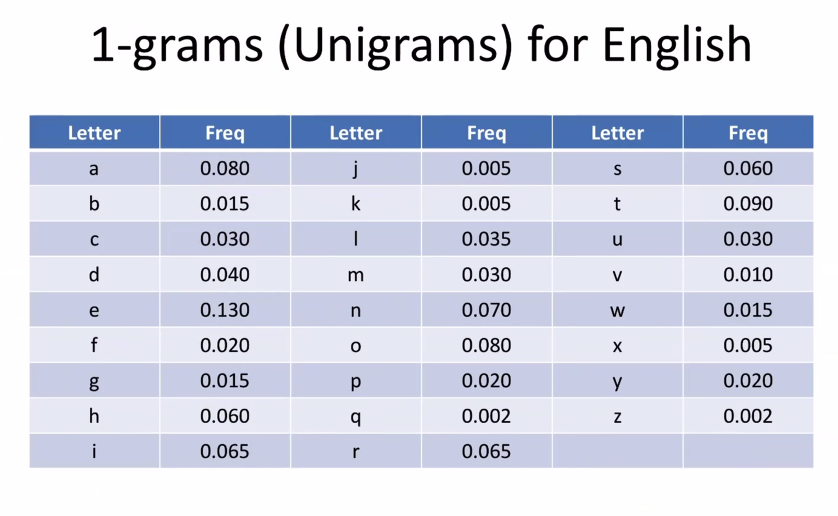
Frequency Table
Polyalphabetic Substitution
Flatten(diffuse) some of the letter dist. by combining high and low dist.
Ex 1
Key 1: Skip 2, take next letter
Key 2 in example: Skip 4, keep next letter
Ciphertext to plaintext example
Substitution or
Caesar substitution example and equation
Key = 3 or Key = “D” as D represents 3
𝑐𝑖 = 𝐸 𝑝𝑖 = (𝑝𝑖 + 𝑘ey) %26
– 26 letters in the English alphabet
– Change each letter to the third letter following it (circularly)
– If key=3: 𝐴 → 𝐷, 𝐵 → 𝐸, … , 𝑋 → 𝐴, 𝑌 → 𝐵, 𝑍 → 𝐶
Can also be represented through 𝜋

Caesar Cipher as a permutation
Represented as a 𝜋 symbol
𝜋(𝑖) = (𝑖 + 𝑘ey) 𝑚od 26
– For key=3: 𝜋 (0) = 3, 𝜋 (1) = 4, …, 𝜋 (23) = 26 𝑚od 26 = 0, 𝜋 (24) = 1, 𝜋( 25) = 2
Statistical Analysis
Used to attack substitution ciphers
Compare to so called 1-gram (unigram) model of
English
Shows frequency of (single) characters in English
The longer the C, the more effective statistical analysis
would be necessary
Statistical Attack - Step 1
Compute frequency f(c) of each letter in ciphertext
Example: c = ‘khoor zruog’
10 characters: 3 * ‘o‘, 2 * ‘r’, 1 * {k, h, z, u, g}
f(c) (whitespace ignored):
f(g)=0.1 f(h)=0.1 f(k)=0.1 f(o)=0.3 f(r)= 0.2
f(u)=0.1 f(z)=0.1 f(ci ) = 0 for any other ci
Apply 1-gram model of English
Frequency of (single) characters in English
1-grams on previous slide
Statistical Attack - Step 2
phi 𝜑(𝑖) - correlation of frequency of letters in ciphertext
with frequency of corresponding letters in English - for key i
For key i: 𝜑(𝑖) = ∑0≤𝑐𝑐≤25 𝑓 (𝑐) ∗ 𝑝(𝑐 − 𝑖)
c is representation of character (a-0, ..., z-25)
f(c) is frequency of letter c in ciphertext C
p(x) is frequency of character x in English
Intuition: sum of probabilities for words in P, if i were the key
Example: C = ‘khoor zruog’ (P = ‘HELLO WORLD’)
f(c): f(g)=0.1, f(h)=0.1, f(k)=0.1, f(o)=0.3, f(r)=0.2, f(u)=0.1, f(z)=0.1
c: g - 6, h - 7, k - 10, o - 14, r - 17, u - 20, z - 25
𝜑(i) = 0.1p(6 – i) + 0.1p(7 – i) + 0.1p(10 – i) + 0.3p(14 – i) +0.2p(17 – i) + 0.1p(20 – i) + 0.1p(25 - i)

Statistical Attack - Step 3
The result
The phrase left is i=3 or the key, signifying the cipher was broken

Problems with Caesar Cipher
Key is too short
Can be easily found with an exhaustive search
Can’t cover statistical frequencies due to length; too similar to regular English letters
1 Char-key - monoalphabetic substitution
Solution is making the key longer
Use a key of n>=2, polyalphabetic substitution
Will make exhaustive search and cryptanalysis harder
Polyalphabetic Subtitution Key example
Flatten (diffuse) somewhat the frequency
distribution of letters by combining high and low
distributions
Example: 2-key substitution
Key1 is defined by shifting by 3/skip 2 and take next starting from a, circular
Key2: Is defined starting with n, skip 4, take next, circular
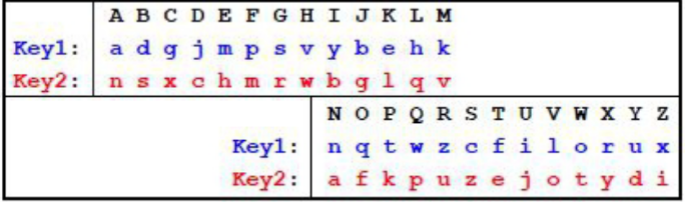
Using the keys in polyalphabetic substitution
Plaintext: TOUGH STUFF
Ciphertext: ffirv zfjpm
Key 1: fiv fp
Key 2: fr zjm
Use n (=2) keys in turn for consecutive P chars in P
Note:
Different chars mapped into the same one: T, O → f
Same char mapped into different ones: F → p, m
‘f’ most frequent in C (0.30); in English: f(f) = 0.02 << f(e) = 0.13

Vigenère Tableaux
EX
Row A - shift 0(a→a)
Row B - shift 1(a→b)
Row C - shift 2(a→c)
….
Row Z - shift 25(a→z)

Vigenère Tableaux Example
Key: exodus
Plaintext P: YELLOW SUBMARINE FROM YELLOW RIVER
Extended keyword(re-applied to mimic words in P):
Ciphertext: cbzoio wlppujmks ilgq vsofhb owyyj
Solution:
Ciphertext is created from Vigenère Tableaux
Row corrosponds with plaintext letter
Column with key letter
Example:
[Y][e] = ‘c’
[E][x]= ‘b’
[L][o] = ‘z’
![<ul><li><p>Key: exodus</p></li><li><p>Plaintext P: YELLOW SUBMARINE FROM YELLOW RIVER</p></li><li><p>Extended keyword(re-applied to mimic words in P):</p></li><li><p>Ciphertext: cbzoio wlppujmks ilgq vsofhb owyyj</p></li></ul><p></p><p>Solution: </p><ul><li><p>Ciphertext is created from Vigenère Tableaux</p></li><li><p>Row corrosponds with plaintext letter</p></li><li><p>Column with key letter</p></li><li><p>Example:</p><ul><li><p>[Y][e] = ‘c’</p></li><li><p>[E][x]= ‘b’</p></li><li><p>[L][o] = ‘z’</p></li></ul></li></ul><p></p>](https://assets.knowt.com/user-attachments/f8444369-060d-4d92-ad11-1e3421a54360.png)
Transposition Ciphers
Rearrange letters in plaintext to produce ciphertext
Example 1a and 1b: Columnar transposition
Plaintext: HELLO WORLD
Transposition onto:
a) 3 columns:
H E L
L O W
O R L
D X X
b) 2 Columns:
H E
L L
O W
O R
L D
XX - Padding
Ciphertext (read column-by column):
a) hlodeorxlwlx
b) hloolelwrd
• What is the key?
– Number of columns: a) key = 3 and b) key = 2
Transposition Cipher example
Example 2: Rail-Fence Cipher
Plaintext: HELLO WORLD
Transposition into 2 rows (rails) column-by-
column:
HLOOL
ELWRD
• Ciphertext: hloolelwrd (Does it look familiar?)
What is the key?
Number of rails: key = 2
Product/Combination Ciphers
Built of multiple blocks, each is:
Substitution or transposition
Example: two-block product cipher
𝐸2(𝐸1 𝑃, 𝐾E1 , 𝐾E2)
• Product cipher might not be stronger than its
individual components used separately!
– Might not be even as strong as individual
components
What makes a cipher good?
Depends on type of cipher and application
Substitution
C hides chars of P
If > 1 key, C dissipates high frequency chars
Transposition
C scrambles text
Product Ciphers
All of the above
What are the priorities and facilities for sender/reciever?
e.g., no supercomputer on the battlefield
Commercial Principles of Sound Encryption Systems
Another criteria for good systems
Sound mathematics
Proven vs. not broken so far
Verified by expert analysis, including outsiders
Standing the test of time, long-term success isn’t a guarantee
Examples of popular commercial encryptions
Data Encryption Standard (DES)
Rivest-Shamir-Adelman (RSA)
Advanced Encryption Standard (AES) - relatively new