Chapter 16 - DNA structure and replication
 Call Kai
 Learn
 Practice Test
 Spaced Repetition
 Match
 Flashcards
 Knowt Play
1/39

There's no tags or description
Looks like no tags are added yet.
40 Terms
The role of DNA in heredity
was first worked out by studying bacteria and the viruses that infect them
Fredrick griffith
was studying streptococcus pneumonia (early 1900s)
a bacteria that causes pneumonia in animals
found that when he mixed heat-killed remains of the pathogenic strain with living cells of the nonpathogenic strain, some of those living cells became pathogenic
Evidence that DNA can transform bacteria
Erwin Chargoff
reported that DNA composition varies form one species to the next
this evidence of diversity made DNA a more credible candidate for genetic material
made rules that state that the base composition of DNA varies between species and that in any species the percentages of A and T bases are equal and the percentages of G and C bases are equal
Chargoff’s rules
the base composition of DNA varies between species
in any species the percentages of A and T bases are equal and the percentages of G and C bases are equal
the basis for these were not understood until the discovery of the double helix
Alfred Hershey and Martha Chase
in 1952, they wanted to find out what makes up chromosomes, DNA or protein
to answer this, they used bacteriophages which are viruses that infect bacteria
they used a radioactive isotope of phosphorus to tag the DNA in one culture of bacteriophages and radioactive sulfur to tag the protein in a second culture
results: only DNA entered the bacteria
Nucleotides
the monomers of DNA; the subunit of DNA
The genetic material of DNA
DNA (deoxyribonucleic acid)
the monomers of DNA are called nucleotides
DNA is transcribed into RNA which then translates in proteins
the sugar in DNA is deoxyribose (missing oxygen)
Deoxyribose
sugar in DNA; has no oxygen
Ribose
sugar in RNA; has oxygen
Structure of DNA
nucleotides are the subunit of DNA
each nucleotides contains:
5 carbon sugar (deoxyribose)
phosphate
nitrogen bases (adenine, cytosine, guanine, and thymine)
5’ is attached to phosphate
3’ is attached to sugar
Phosphate
attached to 5’
Sugar
attached to 3’

Purine
double ring structure
guanine (G) and adenine (A)

Pyrimidine
single ring structure
thymine (T) and cytosine (C)
What holds nitrogenous bases together?
hydrogen bonds
Rosalind Franklin and Wilkin
x-ray diffraction photograph of DNA showed the DNA double helix structure
Watson and crick deduced that DNA structure was a double helix
Watson and crick
deduced that the structure of DNA is a double helix
built a model in which the backbones were antiparallel (their subunits run in opposite directions)
What nitrogenous base structures always pair together?
purine + pyramidine
A & T
G & C
DNA
is double stranded
in a double helix
is anti parallel
has 4 nitrogenous bases
RNA
has a nitrogenous base uracil (U) instead of thymine (T)
sugar is ribose
single stranded
replication is semiconservative
when a DNA molecule replicates, it opens up and the old strand serves as a template for the new strand that will be replicated to make new DNA
What does it mean for replication to be semiconservative?
at the end of replication, each DNA molecule has one old strand one new strand
Meselon and Stahl experiment
bacteria was grown in food (medium) with N15 (heavy density); this created DNA that was denser/heavier than normal
the bacteria was then grown in medium (food) with N14 (normal density); this created DNA that was half N15 and half N14 (weight hybrid)
over time the weight got lighter because all DNA is N14
the old strand served as a template for the new strand
discovered replication
Replication
the making of a DNA from an existing DNA strand
helicase: unwinds DNA
single stranded binding proteins: bind to and stabilize single stranded DNA
Topoisomerase: relives the strain caused by tight twisting ahead of the replication fork by breaking, swiveling, and rejoining DNA strands
RNA primer sites: short RNA code that starts where replication begins
DNA polymerase: adds the nucleotides to the new strand to complement the old strand (from 3’ end only)
Helicase
unwinds DNA
Single-stranded binding proteins
binds to and stabilize single stranded DNA
Topoisomerase
relives the strain caused by tight twisting ahead of the replication fork by breaking, swiveling, and rejoining DNA strands
RNA primer sites
short RNA code that starts where replication begins
the enzyme primate makes the primer
the primer is short (5-10 nucleotides long)
DNA polymerase
synthesizes DNA and adds the nucleotides to the new strand to complement the old strand during replication
can only add nucleotides to the 3’ end, never to the 5’ end
proofreads newly made DNA, replacing any incorrect nucleotides
5’ to 3’
the direction that DNA always proceeds in
Proofreading and repairing DNA
DNA polymerases proofreads newly made DNA, replacing any incorrect nucleotides
in mismatch repair of DNA, repair enzymes correct errors in base pairing
a hereditary defect in one such enzyme is associated with colon cancer
Nucleotide excision repair
enzyme (nuclease) cut out and replace damaged stretches of DNA during replication
thyminedimer: distorts the DNA molecule; caused by UV radiation
Chromosomes
consists of a DNA molecule packed together with proteins called histones
Histones
protein that are responsible for the first level of DNA packing in chromatic
four types are most common in chromatin
helpful for DNA packing in nucleus
Nucleosome
basic fundamental structure of DNA packaging; DNA wrapped twice around a protein core of 8 histones
Where does replication occur?
eukaryotic cells: nucleus
prokaryotic cells: in cytoplasm in the nucleoid region
Heterochromatin
condensed chromatin
the more dispersed, less compacted chromatin in called eurochromatin
dense packing of the heterochromatin makes it largely inaccessible to the machinery responsible for transcribing genetic information
most of our DNA is eurochromatin (90%)
heterochromatin make 10% of our DNA
Eurochromatin
the more dispersed, less compacted chromatin; makes 90% of our DNA
DNA Ligase
seals gaps between Okazaki fragments on the discontinuously synthesized lagging strand to form a continuous DNA strand

Leading strand
the newly synthesized strand of DNA that is built continuously in the 5' to 3' direction during DNA replication; a single RNA primer is placed near the origin of replication to start continuous synthesis
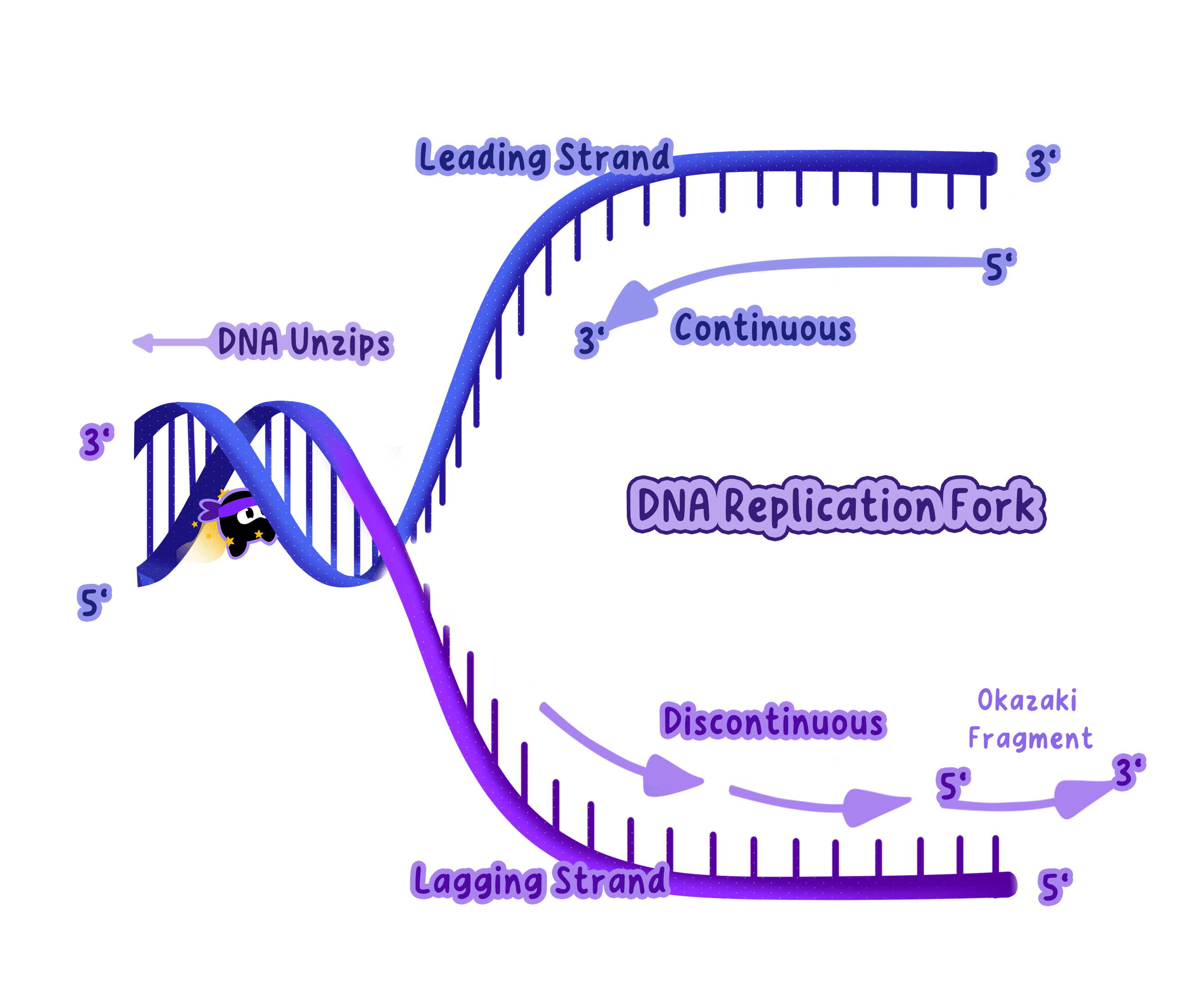
Lagging strand
the template DNA strand that is replicated discontinuously in short segments (called Okazaki fragments) during DNA replication; multiple RNA primers are laid down repeatedly along the exposed template to initiate each Okazaki fragment