cable assembler study
 Call Kai
 Learn
 Practice Test
 Spaced Repetition
 Match
 Flashcards
 Knowt Play
1/82

There's no tags or description
Looks like no tags are added yet.
83 Terms

What is a schematic diagram?
A drawing showing electrical components and their connections, not necessarily their physical locations.

What is a wiring or interconnect diagram?
A drawing showing how wires and connector pins connect between devices or assemblies.

What is a harness assembly drawing?
A drawing showing how a cable or wire harness is physically built, including dimensions, routing, labels, and materials.

What does a straight line usually represent on a schematic?
An electrical conductor or connection.
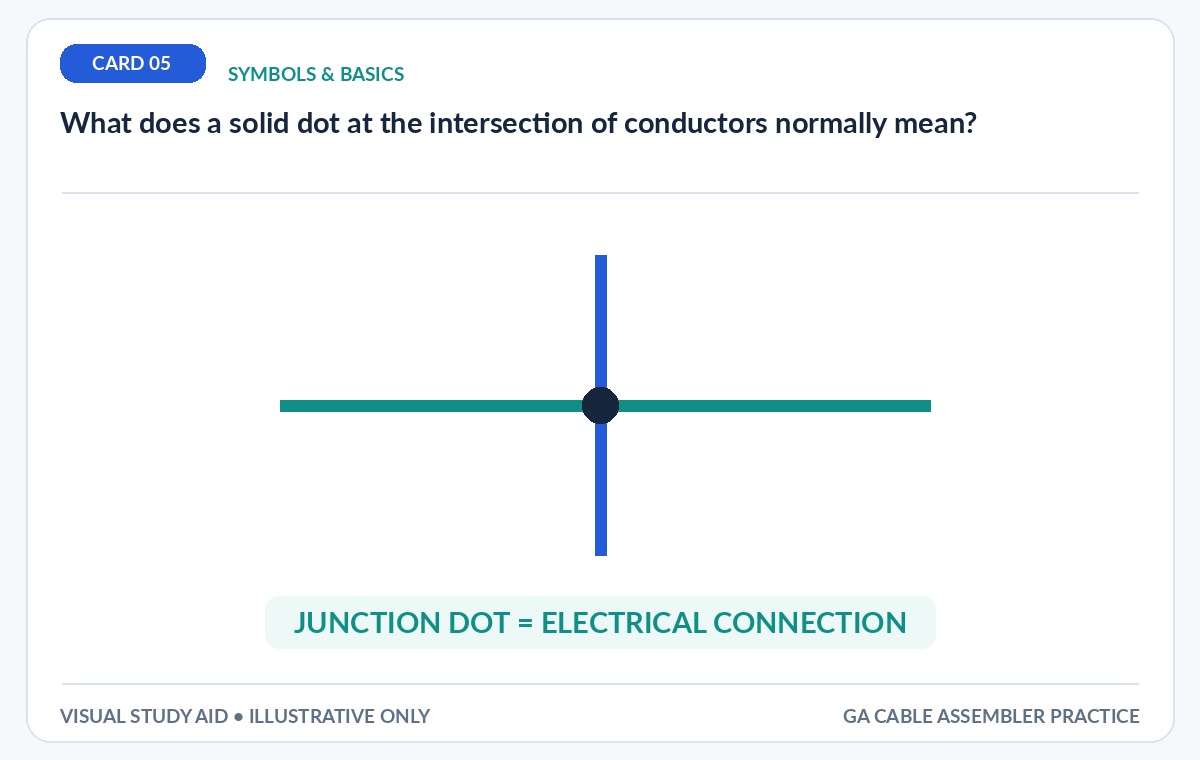
What does a solid dot at the intersection of conductors normally mean?
The wires are electrically connected at that junction.
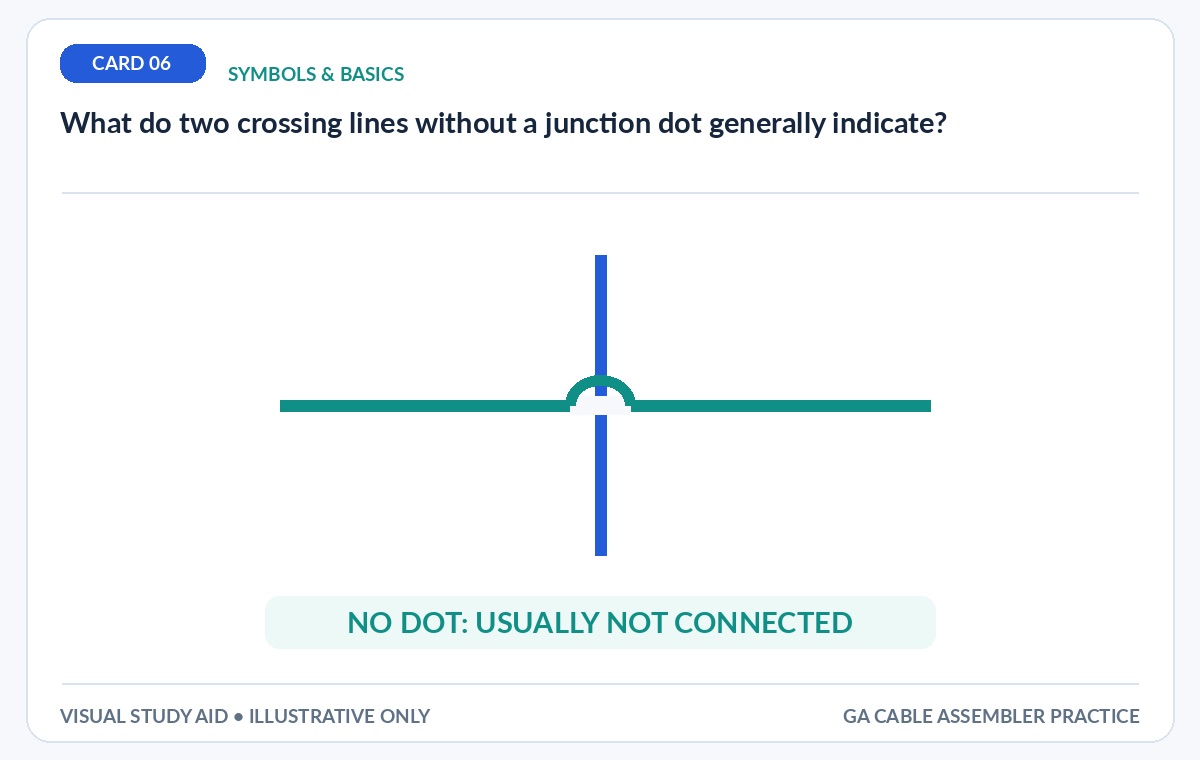
What do two crossing lines without a junction dot generally indicate?
They are not connected; always check the drawing legend/conventions.

What does a resistor do?
Limits or controls current and produces a voltage drop.

What does a fuse do?
Protects a circuit by opening when excessive current flows.

What is a normally open (NO) switch?
A switch whose contacts are open in the normal, unactuated state.

What is a normally closed (NC) switch?
A switch whose contacts are closed in the normal, unactuated state.

What does polarity mean?
The designation of positive versus negative terminals or electrical orientation.

What does GND mean on a drawing?
Ground or the designated electrical reference/return; its function depends on the specific design.

What is chassis ground?
A connection to an equipment frame or chassis, identified by the drawing.
What is a splice?
A specified joining point where two or more conductors are electrically connected.

What is continuity?
The presence of an electrically conductive path between two test points.

What is an open circuit?
A broken or missing electrical path where current cannot flow as intended.
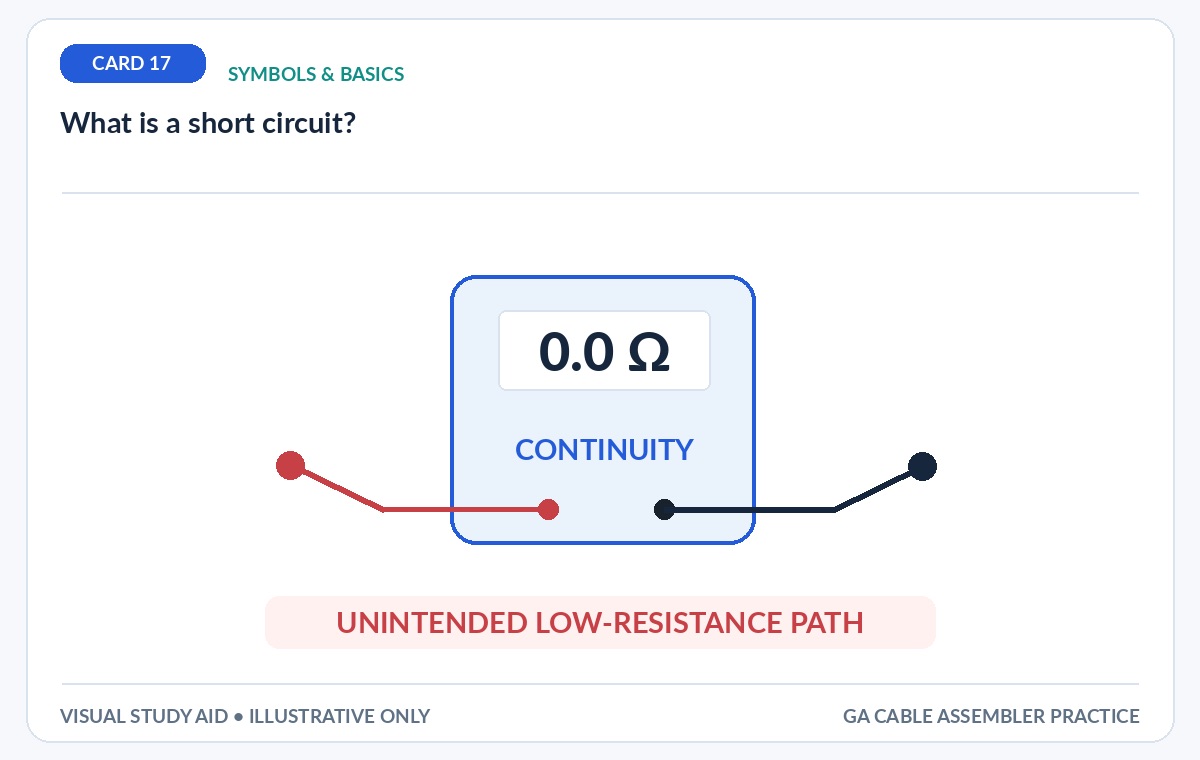
What is a short circuit?
An unintended low-resistance connection between points that should not be connected.

What does AWG stand for?
American Wire Gauge, a system used to describe conductor size.

Which is thicker: 18 AWG or 22 AWG?
18 AWG. In the AWG system, a lower gauge number means a larger conductor diameter.

Does the color black always mean ground?
No. Never infer a wire function from color alone; follow the drawing and wire list.

What is a connector pinout?
A map of a connector's numbered or lettered contact positions and their assigned connections.

What is a contact cavity?
The numbered or lettered connector position where a pin or socket contact is installed.

What does J1 pin 3 mean?
Contact/cavity position 3 on the connector designated J1.

What does FROM J1-2 TO J2-5 mean in a wire list?
A conductor must connect J1 cavity 2 to J2 cavity 5.
What is a wire list or wire table?
A table specifying each conductor's identification and endpoints, often with gauge, color, length, and notes.

What does a wire number such as W101 identify?
A particular wire or circuit according to that drawing's identification scheme.

What does the FROM column identify?
One specified endpoint of a wire, often a connector and contact/cavity.

What does the TO column identify?
The other specified endpoint of a wire, often a connector and contact/cavity.

What does BLK commonly abbreviate in a wire color table?
Black; verify the drawing's abbreviation legend.

What does WHT commonly abbreviate in a wire color table?
White; verify the legend.
What does RED commonly abbreviate in a wire color table?
Red; verify the legend.

What does GRN commonly abbreviate in a wire color table?
Green; verify the legend.

What does BLU commonly abbreviate in a wire color table?
Blue; verify the legend.

What does YEL commonly abbreviate in a wire color table?
Yellow; verify the legend.

What might RED/WHT mean for a wire?
A red-and-white color identification, such as a base color and stripe; check the drawing legend for exact ordering.

What is a mating-face view?
A view looking at the end of a connector that mates with its counterpart.

What is a wire-entry or rear view?
A view looking into the back of a connector where wires enter.

Why can a mating-face drawing be dangerous to copy directly while wiring from the rear?
The apparent left-to-right contact positions may reverse; use the specified view and cavity identifiers.

Can pin numbering be assumed to run left-to-right?
No. Pin/cavity numbering depends on the connector design and the documented viewing direction.

Does P always prove a connector is male and J always prove it is female?
No. P and J are common reference designators, but gender and contact type must be verified from documentation.

What is connector keying?
A physical feature that helps prevent incorrect mating or orientation.

What is a twisted pair?
Two conductors intentionally twisted together, often to reduce electromagnetic interference.
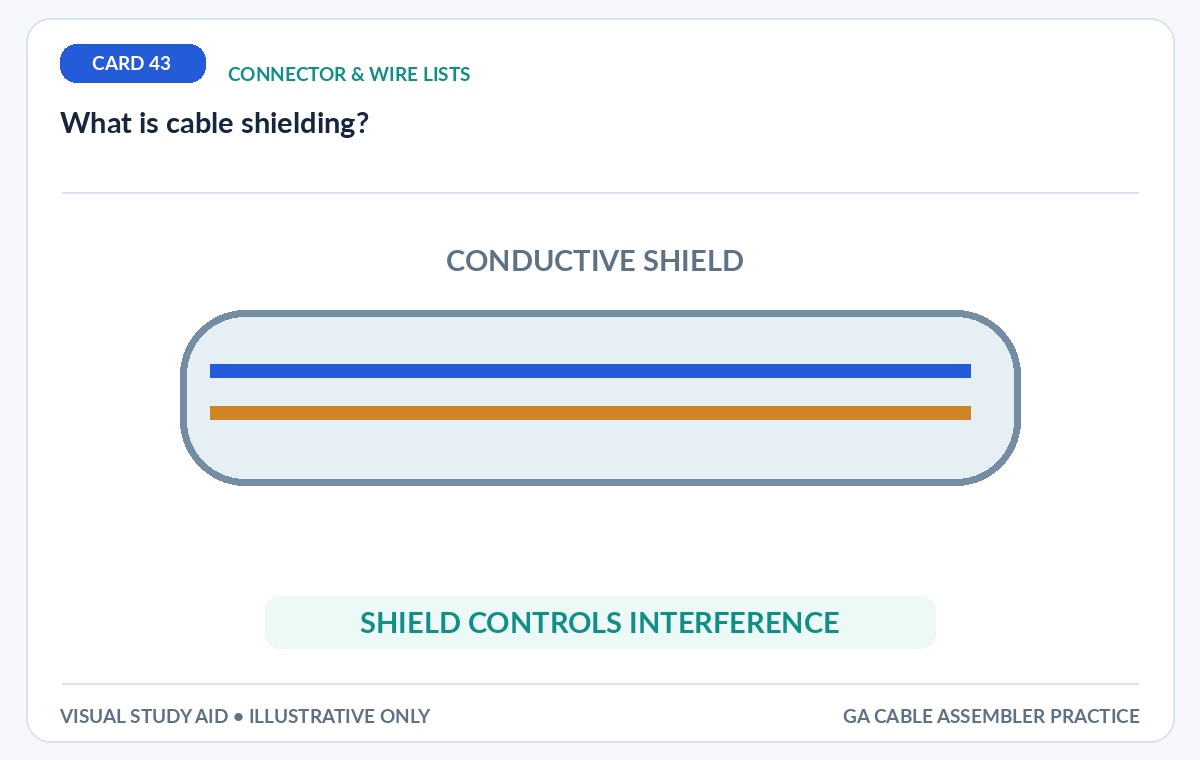
What is cable shielding?
Conductive material around wires that helps control electromagnetic interference.

What is a shield drain wire?
A conductor used to terminate or connect cable shielding as specified by the drawing.

How do you handle an unspecified extra wire at a connector?
Do not guess or insert it; stop and clarify using the authorized drawing/work instruction.

What is a drawing title block?
The area with the drawing title, number, revision, sheet information, and other document controls.

What is a drawing revision?
The controlled version of a drawing; changes must be tracked and the approved revision used.

What should you do if the work order lists Rev C but your drawing is Rev B?
Stop and verify the approved current drawing before proceeding.
What is a bill of materials (BOM)?
A list of the components, quantities, and part numbers required for an assembly.

What is a part number?
An identifier for a specified component or material; use the required part unless an approved substitute is authorized.

What does NTS mean on a drawing?
Not to scale; do not use the illustration to measure actual dimensions.

If a drawing is shown to scale, should you measure with a ruler instead of using stated dimensions?
No. Use the written dimensions and instructions as controlling information.

What does TYP mean in a drawing note?
Typical: a requirement generally applies to similar indicated features, subject to drawing conventions.
What does REF mean next to a dimension?
Reference dimension: usually provided for information, not as a controlling manufacturing tolerance.

What does 12.0 ± 0.2 in mean?
An acceptable dimension from 11.8 to 12.2 inches, unless other notes change the requirement.

What is a tolerance?
The permitted variation from a specified dimension.

What is strip length?
The specified length of insulation removed from the end of a wire.
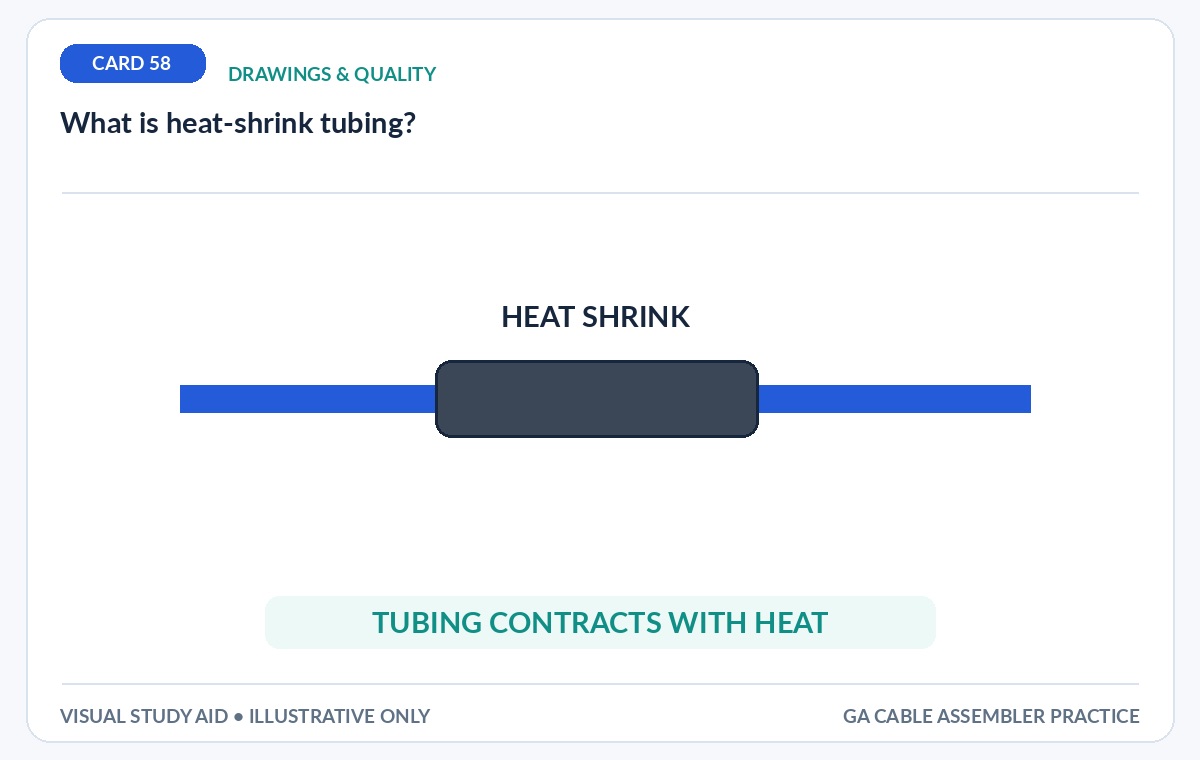
What is heat-shrink tubing?
Tubing that contracts when heated to provide specified insulation, protection, or identification.

What is a crimp termination?
A mechanical/electrical connection formed by compressing a specified terminal or contact around a conductor.

Why must a crimp tool match the terminal and wire?
Improper tooling can create weak or nonconforming electrical and mechanical connections.

What is tinning a wire?
Applying solder to the exposed strands, when required by the approved process.

Why avoid excess solder wicking up a stranded wire?
It can create a stiff section that is vulnerable to fatigue or breakage.

What is IPC/WHMA-A-620 primarily about?
Requirements and acceptance criteria for cable and wire harness assemblies.

What is IPC-A-610 primarily about?
Acceptability of electronic assemblies, especially assembled circuit boards.

What does 5S mean in manufacturing?
Sort, Set in order, Shine, Standardize, and Sustain: an approach to workplace organization.

What does FOD stand for in aerospace manufacturing?
Foreign Object Debris/Damage; keeping unwanted objects out of products and work areas is important.

Should a cable be accepted based on visual inspection alone?
Not automatically; follow required visual, dimensional, continuity, and other documented inspections.

When is a continuity test generally performed?
On a de-energized circuit or assembly using the specified safe test procedure.

Wire list: W101 = FROM J1 pin 2 TO J2 pin 5. What are the endpoints?
J1-2 and J2-5.

Wire list: W102 = J1-4 to J3-7. A wire is installed from J1-4 to J3-6. What is the issue?
Miswire: the far end is in cavity J3-6 instead of J3-7.

A connector pinout says MATING FACE VIEW. You are looking from the wire-entry side. What do you do?
Use the correct rear-view diagram or carefully translate the orientation; never assume the image is unchanged.

A 24 AWG wire is specified, but a 20 AWG wire was installed. Accept it because it is thicker?
No. It does not meet the specified gauge unless an approved deviation/substitution exists.

A dimension is 18.0 ± 0.5 in. Is 17.4 in acceptable?
No. The allowed range is 17.5â18.5 in.

A dimension is 18.0 ± 0.5 in. Is 18.3 in acceptable?
Yes. It falls within 17.5â18.5 in.

Continuity is required from J1-3 to J2-6, but the meter shows OL. What is a likely defect?
An open circuit or missing/broken connection; investigate according to the test procedure.

J1-1 and J1-2 should be isolated, but you measure unexpected continuity. What is a likely problem?
An unwanted short or miswire between the two circuits.

A diagram shows two wires crossing with no junction dot. Are they connected?
Usually no; confirm the drawing convention and legend.

A drawing calls for WHT insulation on wire W204, but you find GRN wire installed. What is the action?
Flag the mismatch and verify the approved specification; do not assume color is interchangeable.
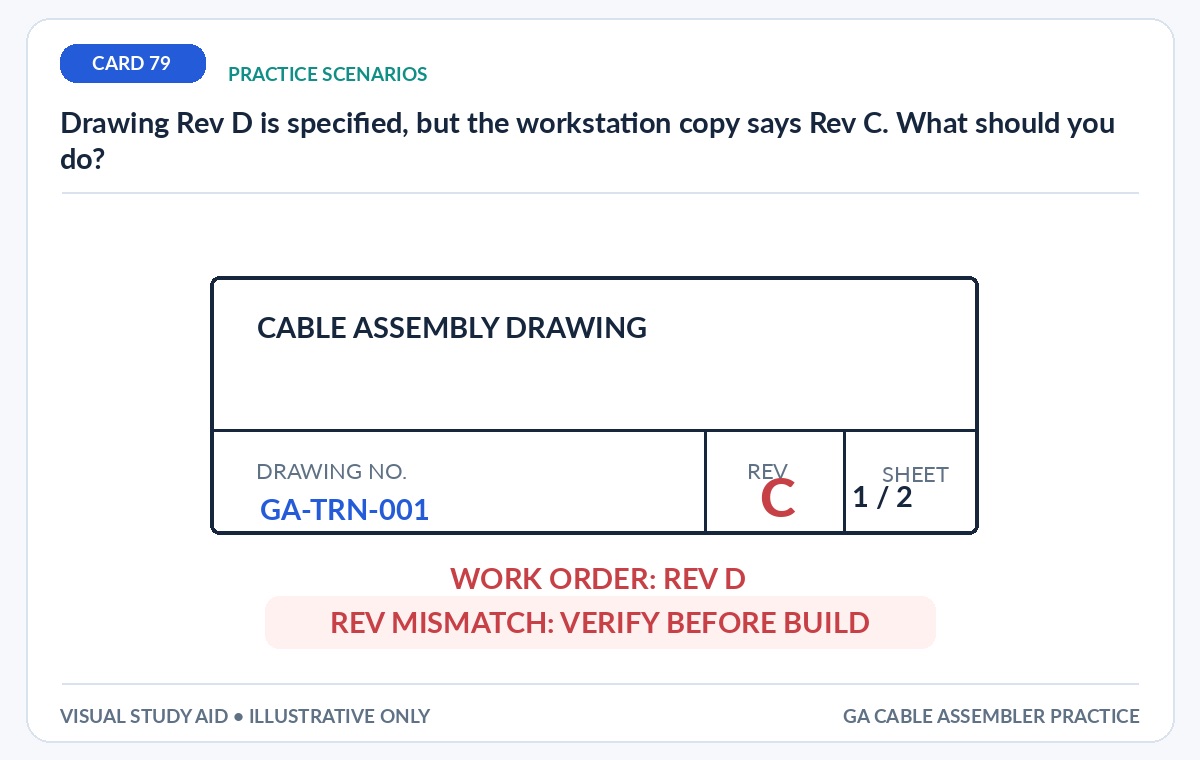
Drawing Rev D is specified, but the workstation copy says Rev C. What should you do?
Do not build from the older drawing; obtain/verify the controlled Rev D instructions.

The assembly requires a shield drain terminated to J2-8, but it is left floating. What is the issue?
Missing specified shield-drain termination.

The connector physically fits but its keyed orientation differs from the drawing. Is that acceptable?
No. Verify the correct connector, orientation, and mating configuration before assembly.

A required crimp contact has loose strands and a damaged insulation support. What should you do?
Identify it as potentially nonconforming and follow the approved rework/inspection procedure.
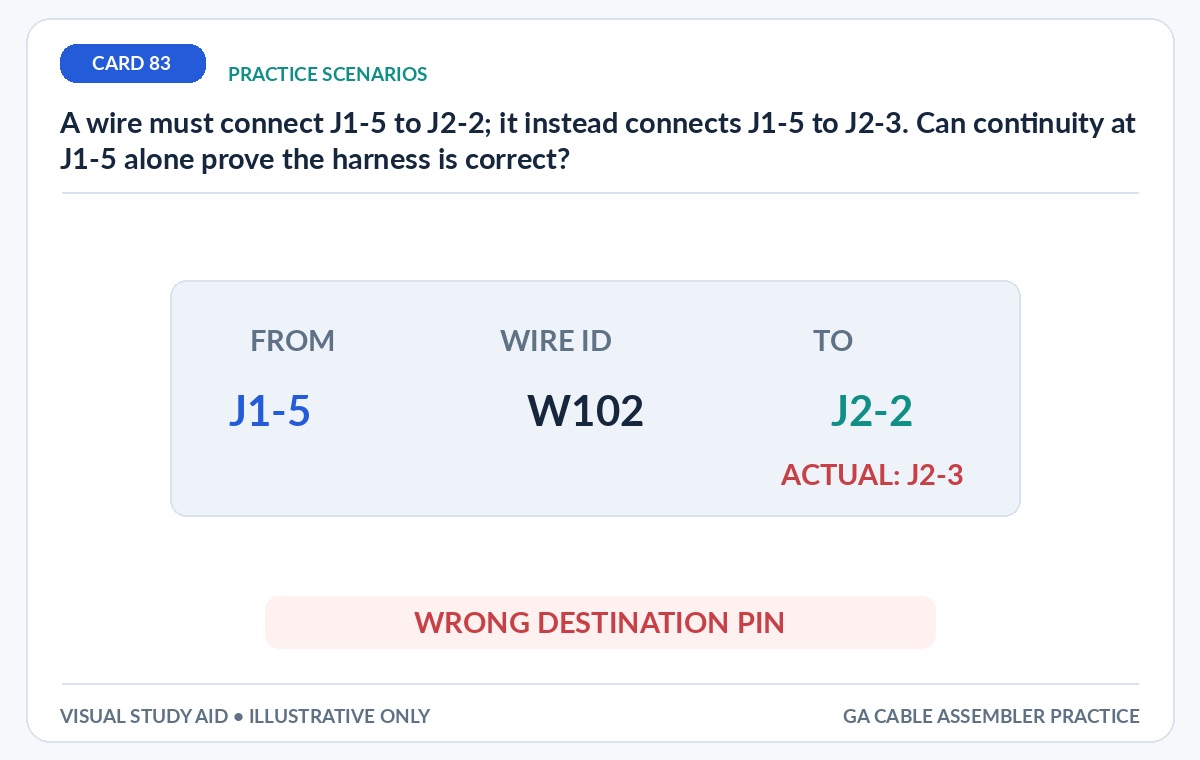
A wire must connect J1-5 to J2-2; it instead connects J1-5 to J2-3. Can continuity at J1-5 alone prove the harness is correct?
No. You must verify continuity to the specified endpoint and absence of unwanted connections.