Spaced repetition physiology
 Call Kai
 Learn
Learn Practice Test
 Spaced Repetition
 Match
Match Flashcards
 Knowt Play
1/375

There's no tags or description
Looks like no tags are added yet.
Name | Mastery | Learn | Test | Matching | Spaced | Call with Kai | Chat |
|---|
No analytics yet
Send a link to your students to track their progress
376 Terms
What hormones does the adrenal gland release

Adrenal cortex: releases cortisol, aldosterone, and adrenal androgens.
Adrenal medulla: releases epinephrine (adrenaline) and norepinephrine (noradrenaline).
way to remember: Cortex = steroid hormones
Medulla = fight-or-flight catecholamines
Where are the adrenal glands located?
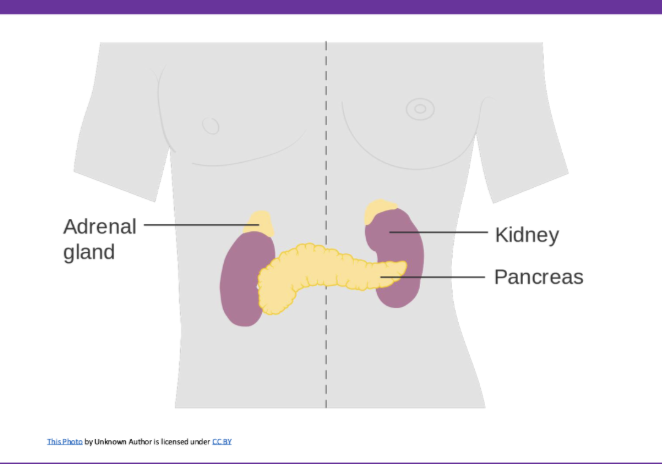
on top of kidneys
Adrenal cortex structure
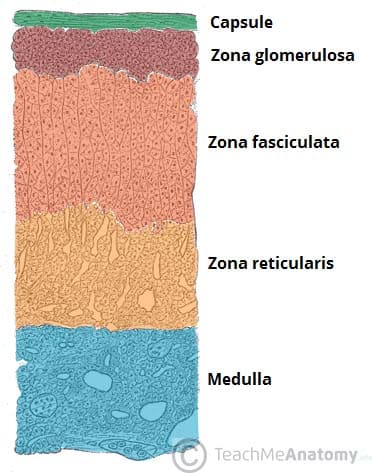
Made up of the cortex which is the outer layer with 3 different layers - and on the inside is the medulla

three layers of the adrenal cortex
Zona glomerulosa
Zona fasciculata
Zona reticularis
What hormone is released from the zona glomerulosa?
Aldosterone which acts on the kidneys
What hormone is released from the zona fasciculata?
This layer is made up of rod liek structures called fasicles - they release Cortisol
What hormone type is produced in the zona reticularis?
Adrenal androgens.
Are adrenal cortex hormones stored in adrenal
No. Steroid hormones are generally made on demand and released soon after synthesis.
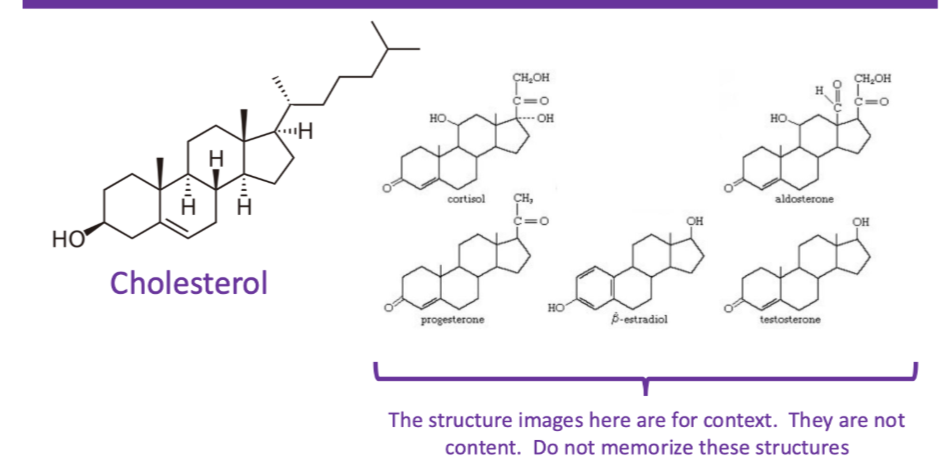
adrenal cortex only makes steroid hormones!
Adrenal gland hormone overview

GFR - glom, fas, ret
mineralcorticoids
glucocorticods
Androgens, Estrogens, Progestrins
MGAEP
Epinephrine is fight or flight
Are all hormoens produces by adrenal gland steroid hormones?
No the epinephrine and norepinephrine produced by the medulla are amine hormones
hypothalamic-pituitary-adrenal (HPA) axis
The pathway CRH → ACTH → adrenal cortex → cortisol.
What does the hypothalamus release in the HPA axis?
CRH (corticotropin-releasing hormone).
What does CRH stimulate the anterior pituitary to release?
ACTH (adrenocorticotropic hormone).
What does ACTH act on?
The adrenal cortex, especially the zona fasciculata.
What hormone does ACTH mainly stimulate the adrenal cortex to release?
Cortisol from the zona fasciculata
What happens to cortisol when CRH and ACTH increase?
Cortisol production and release increase.
What are the steps of the HPA axis and cortisol negative feedback?

Specialized neurons in the hypothalamus make CRH.
CRH is released into the hypothalamic-hypophyseal portal system.
CRH is a hydrophilic peptide neurohormone, so it binds to a receptor on the membrane of an anterior pituitary cell.
CRH stimulates the anterior pituitary to release ACTH that is already made and waiting to be released.
ACTH is a peptide hormone, so it travels freely in the blood without a carrier.
ACTH travels to the adrenal cortex, especially the zona fasciculata.
ACTH stimulates the adrenal cortex to make and release cortisol.
Cortisol is not stored — once it is made, it is released into the blood and travels throughout the body.
When cortisol gets high enough, it negatively feeds back on the hypothalamus and anterior pituitary.
This decreases CRH and ACTH, which lowers cortisol production.
When cortisol falls, there is less inhibition → CRH and ACTH go back up.
What determines how a hormone travels in the blood and where its receptor is located?
The hormone’s solubility — whether it is hydrophilic or hydrophobic.
How do hydrophilic hormones travel in the blood?
Usually unbound, because they dissolve freely in plasma.
their receptors are ON the cell surface, they cannot diffuse through cell membrane due to being hydrophilic.
examples) Protein/peptide hormones and epinephrine, which is an amine hormone.
How do hydrophobic hormones travel in the blood?
They travel bound to carrier proteins. Because blood is mostly water and hydrophobic hormones do not dissolve well in it.
their receptors are located inside the cell - they are able to diffuse staright through the membrane
example) Steroid hormones and thyroid hormone.
Where are the hypothalamus and pituitary gland located?
In the brain.
The hypothalamus regulates the pituitary gland.

Are the anterior and posterior pituitary made up of the same thing?
No. its made up of two kinds of tissues.
anterior: glandular tissue
posterior: neural tissue
What structure connects the hypothalamus to the pituitary gland?
The infundibulum.
What body tissues can be affected indirectly through the anterior pituitary?
The breast,
thyroid,
adrenal glands,
gonads,
and various other tissues.
What body tissues/functions can be affected through the posterior pituitary?
The kidneys
breast tissue
uterus
and some behaviours.
How is the hypothalamus connected to the posterior pituitary?
inside the infundibulum there is a hypothalamic-hypophyseal tract, which contains axons of hypothalamic neurons.

Where are posterior pituitary hormones actually made?
In the hypothalamus.An action potential occurs which travels down axons to the posterior pituitary, where they are stored and later released into the blood. Posterior pituitary is very closely linked with capillaries - for hormones to go into circulation.
Why are posterior pituitary hormones called neurohormones?
hey are produced by neurons but released into the bloodstream to act on distant targets.
What are the two main hormones released from the posterior pituitary?
Oxytocin and antidiuretic hormone (ADH).
oxytocin
A neurohormone involved in uterine contractions, milk ejection, and bonding. - hugs!
Antidiuretic Hormone (ADH)
A neurohormone that increases water reabsorption by the kidneys. In this way it decreases urine production.
What happens when ADH levels are low?
The kidneys reabsorb less water, so more dilute urine is produced.
What can happen if the body cannot produce or respond properly to ADH?
Diabetes insipidus - meaning the pee is almost all water - the kidneys did not reabsorb enough water.
Are all neurons myelinated?
No. Many neurons are naturally unmyelinated, especially when extremely fast signaling is not required. becasue myelin sheath and the support cells take up so much space and resources. if fast signalling isnt required than neurons will be unmyelinated.
this is seen int he stomach for digestion and in the posterior pituitary.
Is the hypothalamic-hypophyseal tract myelinated?
No. The axons in this tract are unmyelinated. However they do have large axon terminals for storing large amounts of neurohormoens before they can be released into the bloodstream.
how much ADH can be stored in the axon terminals?
30 days
How does the hypothalamus control the anterior pituitary?
Hypothalamic neurons release releasing or inhibiting hormones into the hypothalamic-hypophyseal portal system.

Hypothalamic-Hypophyseal Portal System
Blood vessels that carry hypothalamic releasing/inhibiting hormones directly to the anterior pituitary.
What happens when hypothalamic hormones reach the anterior pituitary?
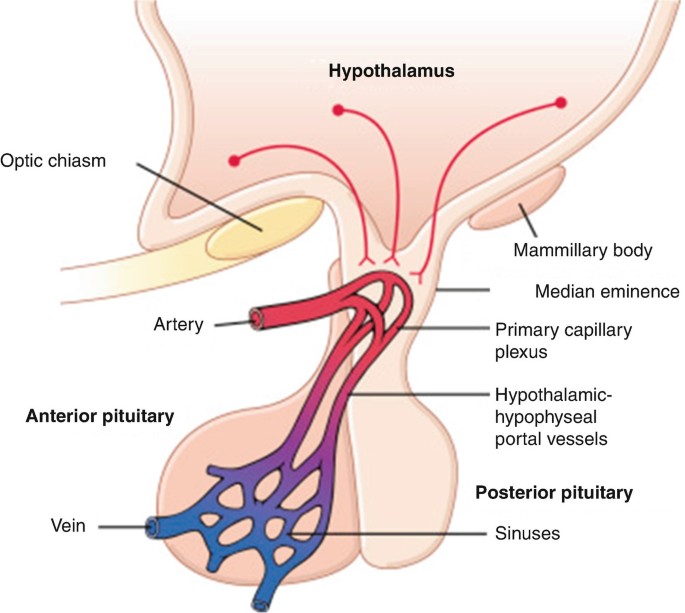

Hypothalamus releases a neurohormone.
That neurohormone travels to the anterior pituitary, which is a gland made of endocrine cells.
The neurohormone binds to receptors on those anterior pituitary gland cells.
Those gland cells then release a pituitary hormone into the blood.
That pituitary hormone may then travel to another endocrine gland such as the thyroid, adrenal gland, or gonads.
— MAYBE ASK QUESTION ABOUT IT
What does “tropic” or “trophic” mean
STIMULATES GROWTH OR PRODUCTION
Hypothalamus neurohormones that act on the anterior pituitary
GnRH
TRH
CRH
GHRH
Dopamine(inhibitory)/PRH

What does GnRH (Gonadotropin-Releasing Hormone) from the hypothalamus stimulate the anterior pituitary to release?
LH (Luteinizing Hormone) and FSH. (Follicle-Stimulating Hormone) which targets the gonads (ovaries and testies)
What does TRH (thyrotropin-Releasing Hormone) stimulate the anterior pituitary to release?
TSH - Thyroid stimulating hormone
which targets the thyroid gland
What does CRH (Corticotropin-Releasing Hormone )stimulate the anterior pituitary to release?
ACTH (Adrenocorticotropic Hormone) which targets the adrenal glands, especially the adrenal cortex
What does GHRH (Growth Hormone-Releasing Hormone) stimulate the anterior pituitary to release?
Growth hormone (GH)
which targets the bone, muscle, liver, and adipose tissue.
What effect does hypothalamic dopamine have on prolactin?
Dopamine inhibits prolactin release from the anterior pituitary.
so dopamine in this case is a neurohormone released into the blood that then acts on the anterior pituitary - which will stop milk production which happens because of prolactin.
What does PRH (Prolactin-Releasing Hormone) stimulate the anterior pituitary to release?
Prolactin releasing hormone causes the release of prolactin which targets the mammary glands to produce milk.
What happens when the hypothalamic neurohormone reaches the anterior pituitary?
It binds receptors on anterior pituitary endocrine cells and stimulates or inhibits hormone release.
What happens after the anterior pituitary releases its hormone?
The hormone enters the general bloodstream and travels to its target tissue or endocrine gland.
Sometimes the final destination is another endocrine gland and the hormone released by anterior pituitary will stimulate that one to release another hormone. example)
TRH → TSH → thyroid gland → thyroid hormone
The hypothalamus releases TRH.
TRH tells the anterior pituitary to release TSH.
TSH travels in the blood to the thyroid gland.
The thyroid gland responds by releasing thyroid hormones (T3/T4) into the blood.
T3/T4 then act on tissues throughout the body.
Where is the thyroid gland located?
In the neck, in front of the trachea and just below the thyroid cartilage.

What is the main overall effect of thyroid hormones in the body?
They help increase and maintain metabolic activity in many tissues.

its all connected
Increasing our heart rate - will help our metabolism - our circulation will dilate making blood easily to go to each tissue - it increases blood flow.
It increases respiration rate - it increases hemoglobin production allowing more oxygen. All support your metabolism.
How do thyroid hormones affect basal metabolic rate?
They increase BMR, causing cells to use more oxygen and glucose and produce more heat.
How do thyroid hormones affect the heart?
They increase resting heart rate and cardiac output.
: Why does increasing heart rate help support metabolism?
It increases blood flow, helping deliver more oxygen and nutrients to tissues.
How do thyroid hormones affect circulation?
They can increase blood flow to tissues, including skin and muscles.
How do thyroid hormones affect respiration?
They increase resting respiratory activity and help support greater oxygen delivery.
How do thyroid hormones affect the kidneys?
affect the clearance of medications and other substances.
by increasing metaobilism
What is featured in this image
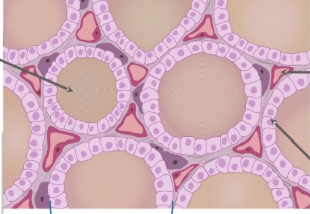

The inside is an oily substance called the colloid
the follicular cell +colloid = follicle
Why are capillaries important around thyroid follicles?
They allow thyroid hormones to enter the bloodstream and travel throughout the body.
How much thyroid hormone can be stored in the thyroid?
Roughly 2–5 months’ worth can be stored in the colloid. Thyroid hormones are lipophilic so they like to live in the oily substance.
What amino acid are thyroid hormones made from?
Tyrosine
Why is thyroid hormone special?
its derived from amino acids but its an exception in that it doesnt loe its carboxyl group.
The two thyroid hormones
T4 (thyroxine/tetraiodothyronine) - has 4 iodines
T3 (triiodothyronine) - has 3 iodines
Where does the iodine used to make thyroid hormones come from?
From the diet.
____ is more stable in circulation, but not active
T4
stable meanign it lasts a week in circulation.
____ is not stable in circulation, but active
T3
not stable meaning it lasts a day in circulation
What are the steps of thyroid hormone production?
Follicular cells trap iodide from the blood.
Iodide is moved into the colloid.
Thyroglobulin in the colloid provides tyrosine residues.
Iodine attaches to tyrosine on thyroglobulin.
Iodinated tyrosines combine to form T3 and T4.
T3 and T4 are stored in the colloid.
When TSH stimulates the thyroid, T3 and T4 are released into the blood.
Thyroglobulin
a bunch of tyrosines stuck together, it takes the iodine and jams it with a tyrosine. It can combine to form t3 or t4 - but 90% of the time it makes T4.
TRH and TSH
TRH: Thyrotropin-releasing hormone from the hypothalamus that stimulates TSH release.
TSH: Thyroid-stimulating hormone from the anterior pituitary that stimulates thyroid follicular cells.
Iodide Trapping
Uptake of iodide from the blood by thyroid follicular cells
What is the HPT axis?
The hypothalamus–pituitary–thyroid axis, which regulates thyroid hormone levels through negative feedback.

What are the steps of the HPT negative feedback pathway?
Hypothalamus releases TRH.
TRH stimulates the anterior pituitary.
Anterior pituitary releases TSH.
TSH stimulates the thyroid gland.
Thyroid releases T3 and T4.
T3 and t4 will go everywhere like the heart and lungs to increase blood flow - they go to kidneys and bones and repro systems. They also go back to the hypothalamus and the anterior pituitary, they signal to them that there is enough t3 and t4 It acc shuts down trh and tsh. It looks like this negative feedback loop. If they are shut down than eventually levels of t3 and t4 go down too.
When T3/T4 fall again, TRH and TSH increase.
Where are posterior pituitary hormones made?
In the cell bodies (soma) of neurons in the hypothalamus.
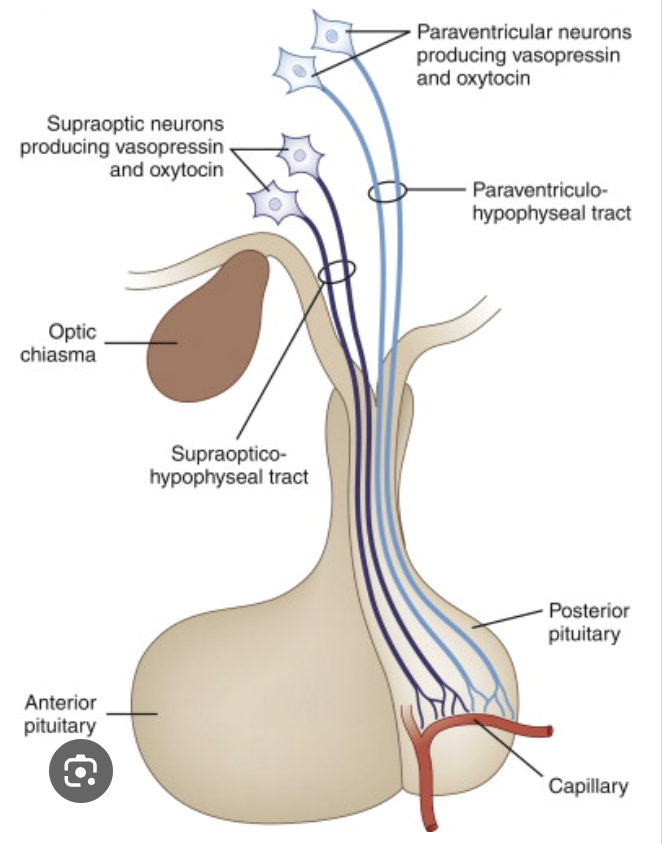
ADH and oxytocin re transported down the axons of hypothalamic neurons to their axon terminals in the posterior pituitary.
What causes ADH and oxytocin to be released from the posterior pituitary?
An action potential reaches the axon terminal and triggers their release into the bloodstream.
Are ADH and oxytocin hydrophilic or hydrophobic?
They are hydrophilic peptide hormones.Bc they are hydrophilic they can dissolev directly in the blood and dont need a carrier - but receptor is on cell membrane.

How does TRH reach the anterior pituitary?
TRH is released by hypothalamic neurons into the hypothalamic-hypophyseal portal blood vessels, which carry it to the anterior pituitary.
Bc its peptide hormone it doesnt need carrier, and its receptor on the glands are on the membrane.

What happens when TRH reaches the anterior pituitary?
It binds to receptors on anterior pituitary glands, TSH is already waiting inside the glands to be released - it goes into blood stream and and travels all the way to the thyroid. Bc TSH is a peptide hormone as well it doesnt need carrier nad its receptor is on thyroid follicular cell membrane.
What does TSH cause the thyroid gland to do?
It stimulates the thyroid to produce and release T3 and T4.
Once released, do T3 and T4 need carrier proteins in the blood?
Yes. They are lipophilic or hydrophobic, T3 and T4 travel bound to carrier proteins. Which means they can go directly though plasma membrane
Where do T3 and T4 travel?
Their target organs and hypothalamus and anterior pituitary where they provide negatiev feedback.
What happens when T3 and T4 levels fall again after negatiev feedback?
Negative feedback decreases, so TRH and TSH increase, stimulating the thyroid to release more T3 and T4.
main jobs of thyroid follicular cells
They trap iodide from the blood,
help synthesize T3/T4 - gets it ready for release through endocytosis - and they chop off the thyroglobulin
release thyroid hormones into the bloodstream.

Where are T3 and T4 stored before release?
In the colloid inside the thyroid follicle.
steps of thyroid hormone secretion
TSH binds to receptors on thyroid follicular cells.
Follicular cells endocytose a bit of colloid containing thyroglobulin-bound T3/T4.
Thyroglobulin is broken down, freeing T3 and T4.
T3 and T4 are released into the bloodstream.
Most released hormone is T4 (90%), which travels in blood bound to carrier proteins.
Target tissues take up thyroid hormone and can convert T4 → active T3 as needed.
Why doesn’t the thyroid release only the active form, T3, right away?
Because T4 is more stable and lasts longer in the blood, acting as a reservoir. Target tissues can then convert T4 → active T3 as needed, giving tissues more control over how much active thyroid hormone they use. the thyroid now doesn’t have to spend time estimating how much our organs each need.
Hypothyroidism
Too little T3/T4, leading to a slower/lower metabolic state.
sensitive to cold room temp
weight gain due to decreased fat breakdown and increased fat storage
low blood pressure
depression
easily fatigued
slow reflexes, apathy, and lethargy.
Example— autoimmune disease called Hashimoto Thyroiditis
HYPO = everything slows DOWN
Hyperthyroidism
Too much T3/T4, leading to a faster basal metabolic state.
sensitive to warm room temp
weight loss due to increased fat breakdown and decreased fat storage.
rapid heart rate
hyperactivity or nervousness
Example) autoimmune disease called Grave’s
HYPER = everything speeds UP
Iodine Deficiency
Iodine is required to make T3 and T4, so low iodine can reduce thyroid hormone production.
so T3 and T4 levels decrease bc there isnt enough iodine to make them.
Negative feedback on the hypothalamus and anterior pituitary decreases.
The hypothalamus releases more TRH.
The anterior pituitary releases more TSH.
bc there is so much TSH it stimulates the thyroid too much causing a goiter on the neck
this leads to hypothyroidism cause there isnt enough t3 and t4
and TSH and TRH are unregulated due to the lack of inhibition from T3 and T4
Iodine deficiency treatment
Improve diet but you can also take a thryoid hormone replacement pill called thyroxin (T4)
Are goiters onyl seen in iodine deficiency?
no its seen in graves, Tumour, and Hashimotos as well.
What happens if there is a tumour in the hypothalamus?
It will produce excess excess TRH bc its pressing on hypothalamus neurons causing them to have action potentials over and over again. Nothing can override that message - meaning TRH can no longer hear the inhibition messages that there is too much t3 and T4.
TRH is then produced in large amounts, causing a large amount of TSH. and you end up with a huge goiter.
Treatment for tumour on hypothalamus
surgery but sometimes radiation
Hashimoto’s thyroiditis (hypothyroidism) treatment - same as iodine deficiency -
thyroid hormone replacement - thyroxin - synthetic T4
Graves’ disease hyperthyroidism (↑ T3/T4): treatment
Common options are methimazole (antithyroid medication), a beta-blocker for symptoms like rapid heart rate/tremor, radioactive iodine to destroy thyroid tissue, or thyroid surgery in some cases
not on test most likely
What are the three main chemical classes of hormones?
Steroid hormones
Protein/peptide hormones
Amine hormones.
What are steroid hormones made from?
Cholesterol.
What are protein/peptide hormones made from?
Amino acids.
What are amine hormones made from?
Tyrosine
Structure of steroid hormones
They all look similar because they all have restructured cholesterol

Ex) testosterone, progesterone, estrogen, cortisol
know that these are all steroid hormones