370 DNA replication (5.1)

0.0(0)
Studied by 0 people
call kaiCall Kai
learnLearn
examPractice Test
spaced repetitionSpaced Repetition
heart puzzleMatch
flashcardsFlashcards
GameKnowt Play
Card Sorting

1/14

encourage image

There's no tags or description

Looks like no tags are added yet.

15 Terms

1
New cards

Conservative, semiconservative, dispersive model

Conservative: Original is conserved

Semi-conservative: One parental strand conserved on each new DNA (current model)

Dispersive: Sections of parental strands in new DNA

<p>Conservative: Original is conserved</p><p>Semi-conservative: One parental strand conserved on each new DNA (current model)</p><p>Dispersive: Sections of parental strands in new DNA</p>
2
New cards

DNA replication step 1

—Helicase unwinds the double helix, splits the strands into a replication fork
——→Needs to continuously unwind (along with SSB attachments to strands), therefore ATP input is required

—Topoisomerase behind helicase to make the DNA straight (to produce fork) to avoid strain
——→Relax or supercoil DNA molecules by cleaving one strand or turning the other (or both) strand around cleavage site

<p>—<strong>Helicase</strong> unwinds the double helix, splits the strands into a replication fork<br>——→Needs to continuously unwind (along with SSB attachments to strands), therefore ATP input is required</p><p>—<strong>Topoisomerase</strong> behind helicase to make the DNA straight (to produce fork) to avoid strain<br>——→Relax or supercoil DNA molecules by cleaving one strand or turning the other (or both) strand around cleavage site</p>
3
New cards

DNA replicaiton step 2

—Primase will anneal (bond) an RNA primer at a specific location to start replication (5-10 nucleotides long)
——→RNA primers allow recognition and removal of the primers from newly synthesized strands and reduce error rate (compared to DNA primers)
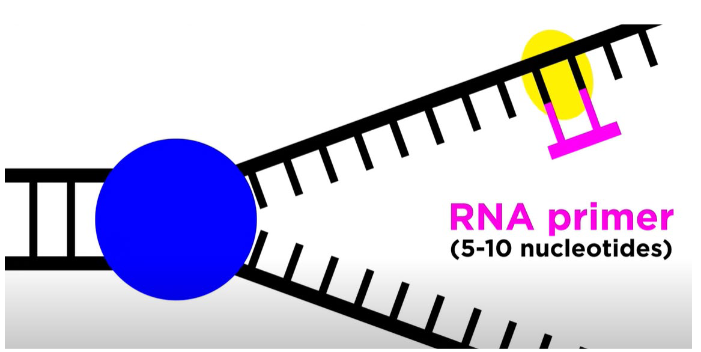
<p>—<strong>Primase</strong> will anneal (bond) an RNA primer at a specific location to start replication (5-10 nucleotides long)<br>——→RNA primers allow recognition and removal of the primers from newly synthesized strands and reduce error rate (compared to DNA primers)</p>
4
New cards

DNA replication step 3

—DNA polymerase 3 binds to primer and generates complementary strand

—Polymerase forms the phosphodiester bond of nucleotides in its active site
——→Active site shown to be complementary in shape to the base pairs
——→Visualized as a clamp that wraps around the DNA

—Always adds to 3’ end
——→DNA polymerase 3 is specific and designed to work from a 3’ OH group (building 5’ to 3’ direction)

—Has its own exonuclease activity (proofread for any wrong insertions and changes to the right one before moving on to adding new ones)

<p>—<strong>DNA polymerase 3</strong> binds to primer and generates complementary strand</p><p>—Polymerase forms the phosphodiester bond of nucleotides in its active site<br>——→Active site shown to be complementary in shape to the base pairs<br>——→Visualized as a clamp that wraps around the DNA</p><p>—<strong>Always adds to 3’ end</strong><br>——→DNA polymerase 3 is specific and designed to work from a 3’ OH group (building 5’ to 3’ direction)</p><p><strong>—Has its own exonuclease activity </strong>(proofread for any wrong insertions and changes to the right one before moving on to adding new ones)</p>
5
New cards

Leading strand

—Moves along fork continuously and it only needs the initial primer

<p>—Moves along fork continuously and it only needs the initial primer</p>
6
New cards

Lagging strand

—Polymerase has to go one chunk at a time as the replication fork extends from helicase

—Okazaki fragments, each one needs its own primer

<p>—Polymerase has to go one chunk at a time as the replication fork extends from helicase</p><p>—<strong>Okazaki fragments</strong>, each one needs its own primer</p>
7
New cards

Dual replication forks (bacteria)

—Opening at origin (ori)

<p>—Opening at origin (ori)</p>
8
New cards

DNA replication step 4

—DNA polymerase 1 will replace RNA nucleotides at primer with DNA nucleotides
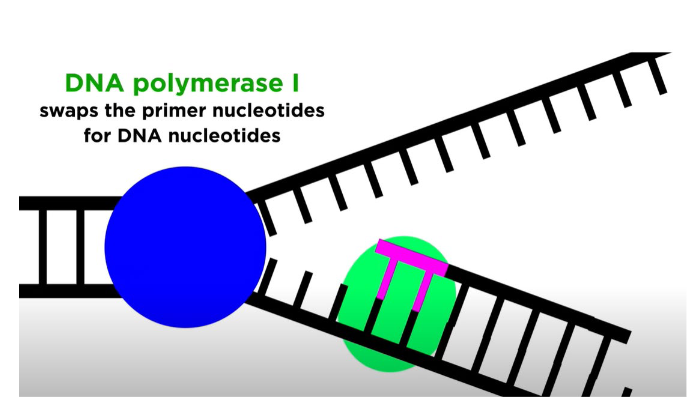
<p>—<strong>DNA polymerase 1</strong> will replace RNA nucleotides at primer with DNA nucleotides</p>
9
New cards

DNA replication step 5

—Ligase makes sure everything is connected
——→Connects the DNA added by DNA polymerase 1 to the rest of the strand
——→Also seals the lagging strand fragments

<p>—<strong>Ligase</strong> makes sure everything is connected<br>——→Connects the DNA added by DNA polymerase 1 to the rest of the strand<br>——→Also seals the lagging strand fragments</p>
10
New cards

Replisome

—Protein complex of everything involved in DNA replication
——→(Helicase, primase, DNA polymerase 3, DNA polymerase 1, ligase, single stranded DNA binding proteins [SSB] to stop seperated parent strands from sticking back together)

—Moves continuoulsy on leading strand, detaches periodically on lagging strand

<p>—Protein complex of everything involved in DNA replication<br>——→(Helicase, primase, DNA polymerase 3, DNA polymerase 1, ligase, single stranded DNA binding proteins <strong>[SSB]</strong> to stop seperated parent strands from sticking back together)</p><p>—Moves continuoulsy on leading strand, detaches periodically on lagging strand</p>
11
New cards

DNA replication: termination (prokaryotes)

—Occurs at termination sites (Ter), typically opposite from ori sites

—Ter sites bind to Tus protein that prevent helicase unwinding
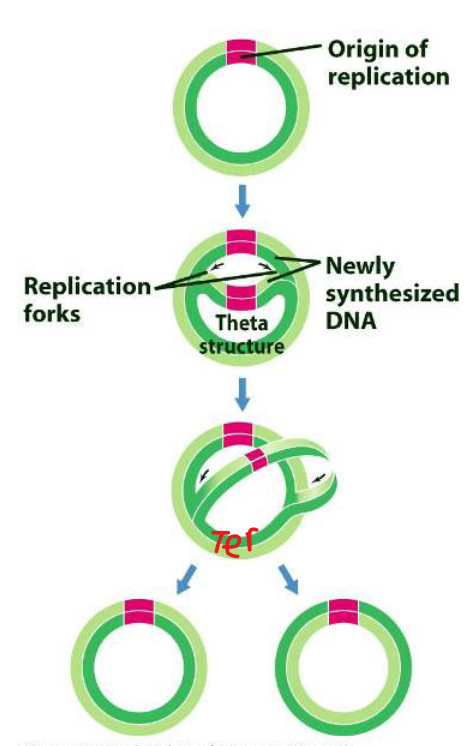
<p>—Occurs at <strong>termination sites (Ter)</strong>, typically opposite from ori sites</p><p>—Ter sites bind to <strong>Tus protein</strong> that prevent helicase unwinding</p>
12
New cards

DNA replication: termination (eukaryotes)

—Collision of replication forks (bubbles) leads to termination

—Eukaryotes don’t have Ter sites


—Leading strand terminates when end of strand is reached

—Lagging strand cannot be completed fully (final RNA primer at 5’ end cannot be replaced with DNA because there is no 3’ OH group)
——→50-100 nucleotides at 5’ end cannot be replicated (telomeres)

<p>—Collision of replication forks (bubbles) leads to termination</p><p>—Eukaryotes don’t have Ter sites</p><p></p><p>—Leading strand terminates when end of strand is reached</p><p>—Lagging strand cannot be completed fully (<strong>final RNA primer at 5’ end cannot be replaced with DNA</strong> because there is no 3’ OH group)<br>——→50-100 nucleotides at 5’ end cannot be replicated (<strong>telomeres</strong>)</p>
13
New cards

Termination: Telomere replication

—Telomerase binds to 3’ overhang of telomere (end of lagging strand)

—Adds random DNA from its own RNA template, extends telomere

—Add RNA primer on extension, and DNA polymerase can finish copying

—Prevents progressive shortening (telomeres not being replicated leads to the replicated DNA being shorter than the originals)

<p>—<strong>Telomerase</strong> binds to 3’ overhang of telomere (end of lagging strand)</p><p>—Adds random DNA from its own RNA template, extends telomere</p><p>—Add RNA primer on extension, and DNA polymerase can finish copying</p><p>—Prevents progressive shortening (telomeres not being replicated leads to the replicated DNA being shorter than the originals)</p>
14
New cards

DNA repair—Excision repair

—Identify damaged site

—Get rid of damaged nucleotide
——→DNA glycosylase removes the glycosidic bond between the base and the backbone
——→AP endonuclease cleaves one side of the deoxyribose bond on the backbone

—Get polymerase to repair

—Endonuclease cuts off the remaining original flap
——→Exonuclease cuts nucleotides off at a free end

—DNA ligase sticks the new stuff togetherC
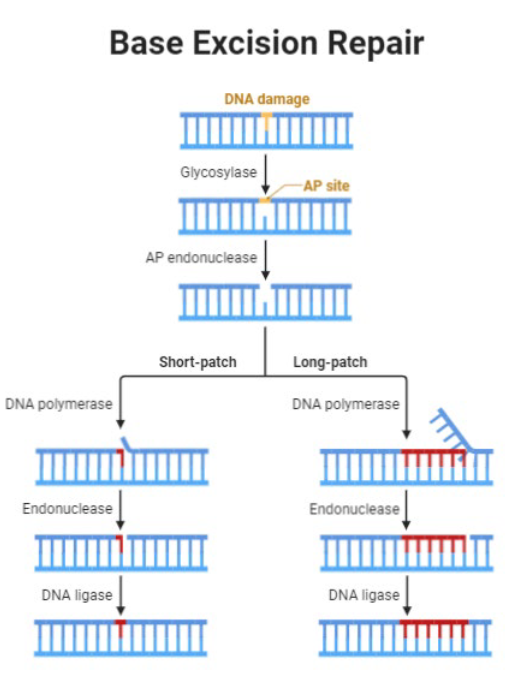
<p>—Identify damaged site</p><p>—Get rid of damaged nucleotide<br>——→<strong>DNA glycosylase</strong> removes the glycosidic bond between the base and the backbone<br>——→<strong>AP endonuclease</strong> cleaves one side of the deoxyribose bond on the backbone</p><p>—Get polymerase to repair</p><p>—<strong>Endonuclease</strong> cuts off the remaining original flap<br>——→<strong>Exonuclease</strong> cuts nucleotides off <strong>at a free end</strong></p><p>—<strong>DNA ligase</strong> sticks the new stuff togetherC</p>
15
New cards

Cell division (binary in prokaryotes)

—DNA replication beings at ori

—Replication continues as cell grows

—Daughter DNAs separate while cells begin to divide
——→Fts proteins form a ring in the center of elongating cell to help segregate the two cells
——→Forms divisome with other proteins, involved in synthesis of new membrane and cell wall to form the septum

—Form new cells

<p>—DNA replication beings at ori</p><p>—Replication continues as cell grows</p><p>—Daughter DNAs separate while cells begin to divide<br>——→<strong>Fts proteins</strong> form a ring in the center of elongating cell to help segregate the two cells<br>——→Forms <strong>divisome</strong> with other proteins, involved in synthesis of new membrane and cell wall to form the septum</p><p>—Form new cells</p>



