ECO-212 Midterm Exam #1
 Call Kai
 Learn
Learn Practice Test
 Spaced Repetition
 Match
Match Flashcards
 Knowt Play
1/199

There's no tags or description
Looks like no tags are added yet.
Name | Mastery | Learn | Test | Matching | Spaced | Call with Kai | Chat |
|---|
No analytics yet
Send a link to your students to track their progress
200 Terms
Scarcity exists when
a. there is less of a good or resource available than people wish to have
b. the government cannot meet the wants of every individual
c. there is less than an infinite amount of some resource or good
d. both b and c
there is less of a good or resource available than people wish to have
Which of the following goods best meets the textbook definition of scarcity?
a. drinkable water in a city
b. wood in a rainforest
c. air
d. water in a rainforest
drinkable water in a city
Which of the following falls within the study of economics?
a. the decision of a student in allocating his time
b. the decision of a consumer in allocating her income
c. the decision of a worker to take a particular job
d. all of the above
all of the above
In economics, the adage, "There is no such thing as a free lunch," means:
a. Food is a scarce good
b. The things we eat usually contain harmful substances that will hurt our health over time
c. To get something we like, we usually have to give up another thing we like
d. Even people on welfare have to pay for food these days
To get something we like, we usually have to give up another thing we like
If Susan works an additional hour to help pay her college expenses,
a. she gives up an hour that she could have spent studying, exercising, or doing something else of value
b. we would say she gives up something only if she could have spent her time doing something more important than working
c. she gives up something only if she is working overtime
d. she really doesn't give up anything, because without working she can't attend college
She gives up an hour that she could have spent studying, exercising, or doing something else of value
Paul decides to spend an hour playing basketball rather than studying or working at $15 per hour. His tradeoff (opportunity cost) is
a. nothing, because he enjoys playing basketball more than working or studying
b. the benefit to his grades from studying for an hour, or the $15 he could have earned from working
c. nothing, because he spent $6 for admission into the sports complex to play basketball
d. the increase in skill he obtains from playing basketball for that hour
the benefit to his grades from studying for an hour, or the $15 he could have earned from working
In economics, efficiency means
a. reduced dependence on energy sources
b. getting the most benefit from the use of scarce resources relative to their opportunity costs
c. conserving on resources in order to save them all for the future
d. goods and services are distributed fairly among society's members
getting the most benefit from the use of scarce resources relative to their opportunity costs
When government transfer and income redistribution policies are being designed,
a. equity can usually be achieved without an efficiency loss
b. increasing the size of the pie (efficiency) usually results in more equal shares of the pie (equity)
c. equity and efficiency goals are usually compatible
d. there is usually a tradeoff between equity and efficiency: forcing more equal shares of the pie (equity) usually results in decreasing the overall size of the pie (efficiency)
There is usually a tradeoff between equity and efficiency: forcing more equal shares of the pie (equity) usually results in decreasing the overall size of the pie (efficiency)
In economics, the cost of something is
a. what you must give up to get it
b. always higher than people think
c. always measured in dollars
d. only the out-of-pocket money expense of obtaining it
what you must give up to get it
The opportunity cost of an item is
a. greater during periods of inflation and lower during periods of deflation
b. what you must give up to get that item
c. always equal to the dollar value of the item
d. always less than the dollar value of the item
what you must give up to get that item
In economics, a "rational" decision maker takes an action only if
a. the marginal (additional) benefit is greater than the marginal (additional) cost
b. the marginal benefit is greater than both the average cost and the marginal cost
c. the average benefit is greater than the average cost
d. the average benefit is greater than the average cost, and the marginal benefit is greater than the marginal cost
the marginal (additional) benefit is greater than the marginal (additional) cost
Sometimes, public policies have unintended and costly side-effects because
a. individuals do not obey the policies
b. the courts do not enforce the policies
c. the policies may alter private incentives in ways often overlooked by policymakers
d. both a and b
the policies may alter private incentives in ways often overlooked by policymakers
Which is the most accurate statement about trade?
a. Trade can make every nation or person involved in the trade better off
b. Trading for a good can make a nation or a person better off only if the nation or the person cannot produce the traded good him or herself
c. Trade helps the rich and hurts the poor
d. Trade makes some nations better off and others worse off
Trade can make every nation or person involved in the trade better off
If Canada is better than the U.S. at producing beer, but the U.S. is better than Canada at producing hockey sticks, then
a. the U.S. should subsidize its beer industry so that it can compete with Canadian beer
b. the U.S. should export and sell hockey sticks to Canada, and should buy imported Canadian beer
c. the U.S. should put a quota on the amount of Canadian beer imported
d. the U.S. should impose a tariff on Canadian beer in order to protect jobs in the U.S. beer industry
the U.S. should export and sell hockey sticks to Canada, and should buy imported Canadian beer
In a market economy,
a. households voluntarily decide which firms to work for and what to buy with their incomes
b. firms voluntarily decide whom to hire and what to produce
c. market prices encourage profit-seeking and self-interest to guide the decisions of firms and households for the greater good of society
d. all of the above
all of the above
In his 1776 book The Wealth of Nations, Adam Smith made the most famous observation in all of economics:
a. No matter how much people earn, they tend to spend more than they earn
b. People buy more when prices are low than when prices are high, all else equal (in other words, the law of demand)
c. Households and firms interacting in markets are guided by an "invisible hand" that leads them to desirable market outcomes and an efficient use of scarce resources even though that was not their intention
d. The "invisible hand" of markets is never as effective as the "visible hand" of government in producing desirable outcomes for an economy because the government has good intentions
Households and firms interacting in markets are guided by an "invisible hand" that leads them to desirable market outcomes and an efficient use of scarce resources even though that was not their intention
The "invisible hand" directs economic activity through
a. mass media
b. prices and self-interest
c. subliminal messages
d. government regulations on market trade
prices and self-interest
When the government prevents prices from adjusting naturally to supply and demand,
a. it stabilizes the economy
b. society benefits from the reduced uncertainty associated with variable prices
c. it is only because the improvement in equity justifies the reduction in efficiency
d. it impedes the invisible hand's ability to coordinate the millions of households and firms that make up the economy, adversely affecting the allocation of scarce resources
it impedes the invisible hand's ability to coordinate the millions of households and firms that make up the economy, adversely affecting the allocation of scarce resources
What do rent control and socialist economic planning have in common?
a. They both rely on the invisible hand to direct resources
b. They both create a more equitable allocation of resources
c. They both directly control prices and adversely affect the allocation of resources
d. They both create an efficient allocation of resources
They both directly control prices and adversely affect the allocation of resources
A market economy rewards people according to
a. their ability to produce things of cultural importance
b. their needs
c. their ability to produce valued things that other people are willing and able to pay for
d. their ability to meet planned output targets set by the government
their ability to produce valued things that other people are willing and able to pay for
Taxing high incomes at a higher rate than low incomes is most likely to alter incentives and do which of the following?
a. promote equity and promote efficiency
b. hinder equity and hinder efficiency
c. promote equity and hinder efficiency
d. hinder equity and promote efficiency
promote equity and hinder efficiency
Upon what does a country's standard of living depend?
a. its ability to produce goods and services that people are willing and able to pay for
b. the amount of gold and silver the country has
c. the average amount of money individuals in the country have
d. its ability to protect its workers from foreign competition
its ability to produce goods and services that people are willing and able to pay for
A worker in China earns $20 per day making athletic shoes on a traditional assembly-line. A worker in the United States could earn $100 per day making athletic shoes using an AI-automated robotics production process. What accounts for the difference in wages?
a. There is no demand for athletic shoes in China and great demand in the U.S.
b. Labor is much more productive making athletic shoes using automation than on a traditional (manual) assembly line
c. U.S. textile (shoes and clothing) workers belong to a union
d. China has a low-wage policy to make its workers more competitive in world markets
Labor is much more productive making athletic shoes using automation than on a traditional (manual) assembly line
Which is the best statement about the way economists study the economy?
a. They use a purely probabilistic approach based on correlations between economic events
b. They use controlled experiments much the way a biologist or physicist does in a lab
c. They develop logical theories regarding human behavior, collect data, then analyze the data to test those theories
d. They collect data, analyze it, then devise theories regarding human behavior based on the data analysis after the fact
They develop logical theories regarding human behavior, collect data, then analyze the data to test those theories
What would be the best statement about a theory based on assumptions which are not always true?
a. The ideas may be good in theory, but not in practice
b. The theory is a good one if no logical mistakes were made in developing it
c. If the assumptions underlying the theory are not true, the theory must be false
d. The theory is nonetheless useful if it helps us to better understand how the world works
The theory is nonetheless useful if it helps us to better understand how the world works
Economists use models in order to
a. maintain all of the complexity of the real world
b. learn how the economy works through the simplifying assumptions of the model
c. make their profession appear more precise
d. make sure that all of the specific details of the economy are included in their analysis
learn how the economy works through the simplifying assumptions of the model

On the production possibilities graph shown, which point represents the maximum possible production of apples for this economy?
a. A
b. C
c. D
d. F
A

On the production possibilities graph shown, which point represents the maximum possible production of pizzas for this economy?
a. C
b. B
c. D
d. G
B
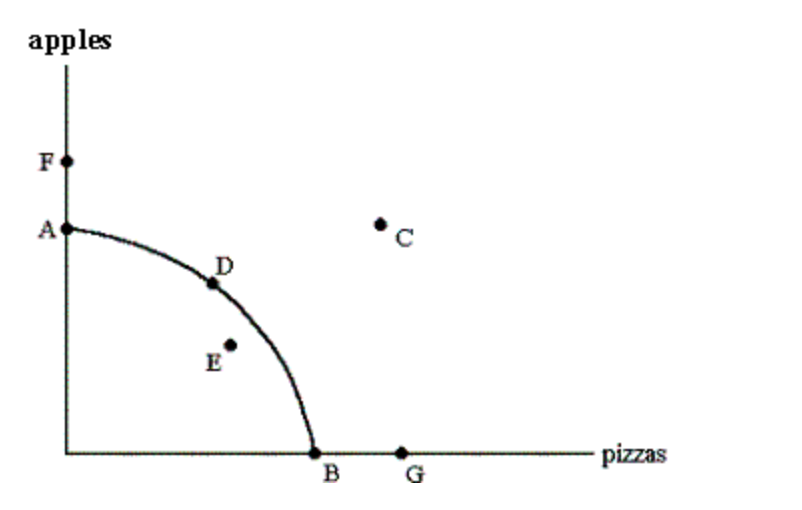
On the production possibilities graph shown, which point or points are efficient?
a. A, B and D
b. E
c. C, F and G
d. D
A, B, and D

On the production possibilities graph shown, which point or points are inefficient?
a. D
b. A, B, and D
c. C, F, and G
d. E
E

On the production possibilities graph shown below, the opportunity cost to the economy of getting the 10 additional gutters by moving from point A to point B is
a. It is impossible to know the opportunity cost without knowing the cost of the resources used to produce the additional gutters
b. 30 buns
c. 20 buns
d. 10 buns
10 buns

In the production possibilities graph shown below, the movement of the frontier from A to B can best be described as
a. a disaster for society
b. a misallocation of resources
c. an improvement in income distribution toward greater equity
d. economic growth
economic growth

In the production possibilities graph shown below, what is the opportunity cost to society of the movement from point C to point A?
a. 900 oranges
b. 500 bananas
c. 1000 bananas
d. 300 oranges
e. 600 oranges
500 bananas
Which of the following is a topic of study in microeconomics but not macroeconomics?
a. the effect of changes in saving rates on GDP
b. the effect of tax policy on the rate of economic growth
c. the impact of monetary policy on the rate of inflation
d. the impact of minimum-wage laws on employment in the fast-food industry
the impact of minimum-wage laws on employment in the fast-food industry
Positive statements are
a. prescriptive, making a claim about how the world ought to be
b. affirmative, justifying existing economic policy
c. descriptive, making a claim about how the world is
d. optimistic, putting the best possible interpretation on things
descriptive, making a claim about how the world is
Normative statements are
a. statements about the normal condition of the world
b. prescriptive, making a claim about how the world ought to be
c. descriptive, making a claim about how the world is
d. statements which establish production goals for the economy
prescriptive, making a claim about how the world ought to be
Economist Milton believes that macroeconomic policy cannot be used effectively to reduce fluctuations in the economy. Economist Paul disagrees. In their capacity as economists, their disagreement can best be described as
a. a disagreement about the validity of alternative positive economic theories
b. a disagreement about the desirability of smoothing out the business cycle
c. a disagreement about the degree of power that should be embodied in the Federal Reserve
d. a disagreement about the effects on economic welfare which result from reduced fluctuations in the economy
a disagreement about the validity of alternative positive economic theories
Fad or populist economic policies, such as trade protectionism or "free" health care or "free" college, often tempt politicians because
a. most politicians are trained economists and can make scientific judgments about the merits of these fads
b. politicians are, by nature, quite gullible
c. politicians in a democracy are eager to find easy solutions to hard and persistent problems, often with short-term visible benefits but long-term hidden costs
d. politicians always believe the public is quite gullible
politicians in a democracy are eager to find easy solutions to hard and persistent problems, often with short-term visible benefits but long-term hidden costs
Policies such as rent control, minimum wage laws, tariffs and import quotas persist in spite of the fact that economists are nearly united in their opposition to these policies. Which of the following is the best explanation for this situation?
a. Economists have entirely different values than do most people
b. Economists are usually of a different political party than are lawmakers
c. Economists are simply wrong about the economic impact of these policies
d. Economists have not yet educated and persuaded the general public (voters in a democracy) to the fact that these policies are undesirable
Economists have not yet educated and persuaded the general public (voters in a democracy) to the fact that these policies are undesirable
People who provide you with goods and services in a market economy
a. are required to do so by the government
b. are acting purely out of generosity
c. do so out of self interest because they get something in return
d. are acting exclusively out of concern for your welfare
e. all of the above
do so out of self interest because they get something in return
Which of the following is not correct?
a. Trade allows individuals or nations to consume outside of their own economy's production possibilities curve
b. Trade allows for specialization, which increases productivity
c. Trade is good for nations
d. Trade is always based on absolute advantage
Trade is always based on absolute advantage

For the following questions, use the graphs and figures below which illustrate the production possibilities available to George and Martha with 40 hours of labor.
The opportunity cost of 1 meal for George is
a. ½ book
b. 4 books
c. 4 meals
d. 2 books
½ book

The opportunity cost of 1 meal for Martha is
a. 1/8 book
b. 1/40 books
c. 8 books
d. 40 books
8 books

The opportunity cost of 1 book for Martha is
a. 1/8 meal
b. 5 labor hours
c. 40 meals
d. 5 meals
1/8 meal

The opportunity cost of 1 book for George is
a. 40 labor hours
b. 120 labor hours
c. ½ meal
d. 2 meals
2 meals
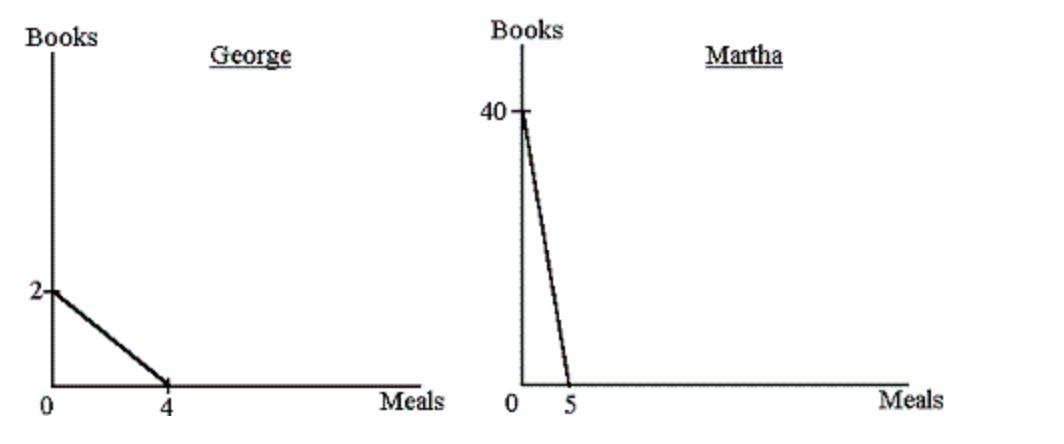
Martha has an absolute advantage in __________ and George has an absolute advantage in __________.
a. meals, books
b. books, meals
c. neither good, both goods
d. both goods, neither good
both goods, neither good

Martha has a comparative advantage in __________ and George has a comparative advantage in __________.
a. meals, books
b. books, meals
c. both goods, neither good
d. neither good, meals
books, meals

Martha should specialize in __________ and George should specialize in __________.
a. meals, books
b. books, neither good
c. books, meals
d. both goods, meals
books, meals

In the absence of trade, if both George and Martha devote 1/2 of their time (20 hours) to the production of each good, total consumption of books will be __________ and total consumption of meals will be __________.
a. 9, 42
b. 21, 4.5
c. 4.5, 21
d. 42, 9
21, 4.5

If both George and Martha specialize in the good in which they have a comparative advantage, total production of books will be __________ and total production of meals will be __________.
a. 40, 4
b. 42, 9
c. 4, 40
d. 9, 42
40, 4
Comparative advantage is based on
a. relative labor costs
b. relative opportunity costs
c. absolute labor productivity
d. dollar prices
relative opportunity costs
Trade is based on
a. relative dollar prices
b. relative opportunity costs
c. production costs
d. absolute advantage
relative opportunity costs
Trade can benefit society as a whole because it allows
a. people to specialize in activities in which that have a comparative advantage
b. for goods to be obtained at a lower opportunity cost
c. for a more efficient use of scarce resources
d. all of the above are true of trade
all of the above are true of trade
Adam Smith
a. first wrote about the benefits available from trade in the 18th Century
b. was one of the first scholars to write about the principle of the invisible hand
c. is considered the founder of modern economics
d. all the above are true of Adam Smith
all the above are true of Adam Smith
David Ricardo
a. wrote books opposing the ideas of Adam Smith
b. is considered the founder of modern economics
c. developed the concept of comparative advantage to argue in favor of Britain following a free-trade policy and abolishing trade barriers with Europe
d. all of the above are true of David Ricardo
developed the concept of comparative advantage to argue in favor of Britain following a free-trade policy and abolishing trade barriers with Europe
Adam Smith was the author of
a. Principles of Political Economy and Taxation
b. An Inquiry Into the Nature and Causes of the Wealth of Nations
c. The General Theory of Prices and Employment
d. Why Nations Trade
An Inquiry Into the Nature and Causes of the Wealth of Nations
Economists generally support
a. export subsidies
b. government management of trade
c. free international trade
d. trade restrictions
free international trade
If wages in the U.S. are higher than in Mexico,
a. the U.S. may still benefit from trade with Mexico due to comparative advantage
b. trade with Mexico will lower average wages in the U.S.
c. Mexico will not have a comparative advantage in any good
d. both b and c are correct
the U.S. may still benefit from trade with Mexico due to comparative advantage
In a free market, what ultimately determines how much of a good will be sold and the price at which it is sold?
a. the government
b. producer-suppliers alone
c. both producer-suppliers and consumer-demanders together
d. consumer-demanders alone
both producer-suppliers and consumer-demanders together
A market is
a. a place where only sellers meet
b. a place where only buyers come together
c. a group of demanders and suppliers of a particular good or service
d. a group of people with common desires
a group of demanders and suppliers of a particular good or service
If a good is a "normal good," then an increase in one's income will result in
a. no change in the demand for the good
b. an increase in the demand for the good
c. a lower market price
d. a decrease in the demand for the good
an increase in the demand for the good
If the price of a substitute to good X increases, then, all else equal,
a. the market price of good X will decrease
b. the demand for good X will decrease
c. the demand for good X will not change
d. the demand for good X will increase
the demand for good X will increase
Suppose that a decrease in the price of X results in less of good Y sold. This would likely mean that goods X and Y are
a. luxury goods
b. unrelated goods
c. substitute goods
d. normal goods
e. complementary goods
substitute goods
If a decrease in income increases the demand for a good, then, all else equal,
a. the good is an inferior good
b. the good is a luxury good
c. the good is a complement good
d. the good is a normal good
e. the good is a substitute
the good is an inferior good
The only determinant of quantity demanded or quantity supplied is
a. the price of a substitute good
b. the number of sellers in the market
c. the price of a complement good
d. the price of the good itself
the price of the good itself
All else equal, what will happen in the rice market if buyers (rice consumers) are expecting higher prices in the near future?
a. The demand for rice will intensify (increase) now
b. The demand for rice will be unaffected
c. The demand for rice will weaken (decrease) now
d. The supply of rice will intensify (increase) now
The demand for rice will intensify (increase) now
Whenever we talk of "movement along" a fixed or stable demand curve,
a. all determinants of quantity demanded are held constant
b. all non-price determinants of demand are assumed to be held constant
c. only price is held constant
d. income and the price of the good are held constant
all non-price determinants of demand are assumed to be held constant
Ceteris Paribus is a Latin phrase that literally means
a. "all other things being held equal"
b. "to respond slowly to a change in price"
c. "after this, therefore because of this"
d. "everything held constant"
"all other things being held equal"
Market demand, or the market demand curve for a particular good or service,
a. is the same thing as an individual's demand
b. represents how much of the good or service sellers are willing and able to produce and make available for sale
c. reflects a positive, or direct, relationship between price and quantity demanded in the market
d. is the (horizontal) sum of all the individual demands or demand curves for a particular good or service in the market
is the (horizontal) sum of all the individual demands or demand curves for a particular good or service in the market
All else equal, if the number of buyers in the market decreases,
a. the demand in the market will decrease
b. the demand and supply will decrease
c. the demand in the market will increase
d. the supply in the market will decrease
e. the supply in the market will increase
the demand in the market will decrease
Suppose that scientists find evidence that reveals a direct correlation between eating chocolate pudding and hair growth. It appears that the consumption of chocolate pudding increases hair growth in men who are balding. All else equal, and assuming men generally prefer hair to being bald, we would expect to see
a. no change in the demand for chocolate pudding among balding men
b. a decrease in the supply of chocolate pudding
c. an increase in the demand for chocolate pudding among balding men
d. a decrease in the demand for chocolate pudding among balding men
an increase in the demand for chocolate pudding among balding men
All else equal, when the price of a good or service changes,
a. there is a movement along a stable demand curve
b. demand shifts in the opposite direction
c. demand shifts in the same direction
d. there is a change in quantity demanded in the same direction as the change in price
there is a movement along a stable demand curve
Suppose that John receives a pay increase. All else equal, we would expect
a. John's demand for normal goods to decrease
b. John's demand for inferior goods to decrease
c. John's demand for luxury goods to decrease
d. John's demand for normal goods to remain unchanged
John's demand for inferior goods to decrease
The downward-sloping demand curve reflects which of the following?
a. There is a direct relationship between price and quantity demanded
b. There is an inverse relationship between price and quantity demanded
c. The price is positively related to quantity supplied
d. When the price falls, buyers willingly buy less, all else equal
There is an inverse relationship between price and quantity demanded
What is the law of demand?
a. When buyer tastes for the good increase, they purchase more of the good
b. When the price of a good or service falls, buyers respond by purchasing more, all else equal
c. When the price of a good or service rises, buyers respond by purchasing more, all else equal
d. When income levels increase, buyers respond by purchasing more, all else equal
When the price of a good or service falls, buyers respond by purchasing more, all else equal
The relationship between price and quantity supplied is
a. the same as the relationship between price and quantity demanded
b. negative, or inverse
c. positive, or direct
d. There is no relationship between price and quantity supplied
positive, or direct
Price acts as
a. a signal for rationing a good or service to its highest and best use
b. a constraint (incentive) to buyers, limiting consumption
c. an incentive to sellers, encouraging or limiting production
d. a way of quantifying perceived value of a good or service in a market
e. all of the above answers are correct
all of the above answers are correct
Other things equal, when the price of a good falls, the quantity supplied of the good also falls. This is
a. the law of increasing costs
b. the law of nature
c. the law of demand
d. the law of supply
the law of supply
Technological advancement
a. enables a firm to produce more using the same resources
b. typically reduces the costs of production
c. enables a firm to produce the same amount using fewer resources
d. all of the above answers regarding technology are correct
all of the above answers regarding technology are correct
A supply curve slopes upward because
a. an increase in input prices increases supply
b. a decrease in input prices decreases supply
c. an increase in price gives producers an incentive to supply a larger quantity, all else equal
d. as more is produced, per unit costs of production fall
an increase in price gives producers an incentive to supply a larger quantity, all else equal
All else equal, an increase in the price of oranges would
a. lead to an increased demand for oranges
b. lead to an increased supply of oranges
c. lead to a movement upwards along the supply curve for oranges, increasing the quantity supplied
d. lead to a reduction in the prices of inputs used in orange production
lead to a movement upwards along the supply curve for oranges, increasing the quantity supplied
All else equal, at the equilibrium price for a good,
a. buyers have bought all they could ever wish to buy
b. the amount sellers are able and wish to sell equals the amount buyers are able and wish to buy at that price
c. sellers have sold all they could ever wish to sell
d. everyone in the market has been completely satisfied
e. all of the above are correct
the amount sellers are able and wish to sell equals the amount buyers are able and wish to buy at that price
All else equal, when there is excess supply in a market,
a. there is downward pressure on price
b. there are too many buyers chasing too few goods
c. the market could still be in equilibrium
d. there is upward pressure on price
there is downward pressure on price
In most free markets,
a. the laws of supply and demand are prevalent
b. equilibrium is established relatively quickly
c. surpluses and shortages are only temporary
d. excess demand or excess supply is cleared by the free movement of prices
e. all of the above are correct
all of the above are correct
All else equal, buyers generally buy more of a normal good when
a. the prices of substitutes for the good rise
b. the prices of complements of the good fall
c. their incomes are higher
d. all of the above
all of the above
In general, in economics, the definition of elasticity is
a. the friction that develops between buyer and seller in a market
b. a measure of the competitive nature of a market
c. a measure of how much government intervention is prevalent in a market
d. a measure of how much buyers and sellers respond to changes in market conditions, such as prices
a measure of how much buyers and sellers respond to changes in market conditions, such as prices
Economists use the concept of price elasticity of demand to
a. measure how much buyers respond to changes in their incomes
b. measure how much buyers respond to changes in the price of the good
c. measure how much sellers respond to changes in the price of the good
d. measure how much worse off consumers are when the price of the good changes
measure how much buyers respond to changes in the price of the good
Demand is said to be price elastic
a. if the quantity demanded responds substantially to changes in the price of the good
b. if the demand shifts substantially when the price of the good changes
c. if the price of the good responds substantially to changes in the quantity demanded
d. if buyers don't respond much to changes in the price of the good
if the quantity demanded responds substantially to changes in the price of the good
Demand is said to be price inelastic
a. if the price of the good responds only slightly to changes in the quantity demanded
b. if buyers respond substantially to changes in the price of the good
c. if the quantity demanded changes only slightly when the price of the good changes substantially
d. if the demand shifts only slightly when the price of the good changes
if the quantity demanded changes only slightly when the price of the good changes substantially
If a good is considered a necessity by the consumer, their price elasticity of demand for the good would tend to be
a. horizontal
b. inelastic
c. elastic
d. unit elastic
inelastic
All else equal, price elasticity of demand for a good would tend to be more price sensitive, or more price elastic,
a. the broader the definition of the market
b. the greater the availability of complements for the good
c. the longer the period of time there is at hand in which to make a buying decision
d. the fewer the availability of close substitutes there are for the good
the longer the period of time there is at hand in which to make a buying decision
The demand for a good tends to be more price sensitive, or more price elastic,
a. the narrower the definition of the market
b. the longer the period of time in which to make a buying decision
c. the greater the availability of close substitutes for the good
d. all of the above are correct
all of the above are correct
Economists compute the standard (or "arc") price elasticity of demand as
a. the percentage change in the quantity demanded divided by the percentage change in price
b. the percentage change in the price divided by the percentage change in quantity demanded
c. the change in quantity demanded divided by the change in the price
d. the percentage change in the quantity demanded divided by the percentage change in income
the percentage change in the quantity demanded divided by the percentage change in price
Suppose that the price of product X is reduced from $1.45 to $1.25 and, as a result, the quantity of X demanded increases from 2,000 to 2,200 units. Using the midpoint method to calculate the price elasticity of demand, the demand for X in the given price range
a. is elastic
b. is inelastic
c. has decreased
d. is unit elastic
e. has increased
in inelastic
If the price elasticity of demand for a good is 1.22, then using the standard "arc" (not midpoint) method of computing price elasticity, a 10 percent increase in price would be expected to result in a
a. 122 percent decrease in the quantity demanded
b. 1.22 percent decrease in the quantity demanded
c. 1.22 percent increase in the quantity demanded
d. 12.2 percent decrease in the quantity demanded
e. 10 percent increase in the quantity demanded
12.2 percent decrease in the quantity demanded
The main reason for using the midpoint method to compute the coefficient of elasticity is
a. that it uses fewer numbers
b. that is gives the same answer regardless of the direction of change in price and quantity
c. that it rounds price to the nearest dollar
d. that it rounds quantities to the nearest whole unit
that is gives the same answer regardless of the direction of change in price and quantity
A perfectly elastic demand curve implies that
a. any rise in price above that represented by the demand curve will result in no output demanded
b. the demand is necessarily on top of the horizontal axis
c. price will rise by an infinite amount when there is a change in quantity demanded
d. buyers will not respond to a change in price
any rise in price above that represented by the demand curve will result in no output demanded
In any market, total revenue (TR) is
a. the price of the good multiplied by the quantity of the good sold
b. the price of the good multiplied by the quantity of the good sold less the costs of production
c. the price of the good divided by the price elasticity of demand of the good
d. the price of the good plus the quantity of the good sold͔
the price of the good multiplied by the quantity of the good sold
Suppose that you own a business that makes and sells jewelry boxes. A business consultant tells you that she has determined that you face an elastic demand for your jewelry boxes due to so many close substitutes (competitors) in the market. Assuming all other forces remain unchanged, if you want to increase your total revenue, you would
a. sell one jewelry box for the price of two
b. increase the price of your jewelry boxes
c. not change the price of your jewelry boxes
d. decrease the price of your jewelry boxes
decrease the price of your jewelry boxes
When demand is price elastic in the current price range,
a. a decrease in price would decrease total revenue because less would be sold
b. an increase in price would decrease total revenue because the reduction in quantity demanded is so great that it more than offsets the increase in price
c. a decrease in price would not affect the total revenue
d. an increase in price would increase total revenue because the reduction in the quantity demanded is so great that it more than offsets the increase in price
an increase in price would decrease total revenue because the reduction in quantity demanded is so great that it more than offsets the increase in price