Unit 3: Imperialism
 Call Kai
 Learn
 Practice Test
 Spaced Repetition
 Match
 Flashcards
 Knowt Play
1/85

There's no tags or description
Looks like no tags are added yet.
86 Terms
When a country takes control of another country (usually by force) for economic or political gain. U.S. became this way in the late 1800s and early 1900s. What term is this?
Imperialism
What are the 3 reasons for American imperialism?
Economic Growth, American Exceptionalism and Military Power
The idea that America is different from other countries and has a special purpose. They also think that they are better than the other countries. What term is this?
American Exceptionalism

Reasons for American Imperialism/ Reason 1: Economic Growth
The U.S.A. doesn't have many raw materials left after the Industrial Revolution. So, they need other countries to supply raw materials to make items to sell. What did the U.S. need?
Need for Resources
Reasons for American Imperialism/ Reason 1: Economic Growth
The U.S wants to sell their items and make money. They can sell their items in other countries and make a lot more money/increase profits. What did the U.S. need?
Need Markets

How does this cartoon show economic reasons for imperialism?
Because the U.S. wanted to gain access to China's markets and sell American products. The Philippines served as a stepping-stone to reach China and expand trade, resources, and profits.

Reasons for American Imperialism/Reason 2: American Exceptionalism
The U.S.A. had a duty to bring the benefits of their "superior" civilization to other nations. The term comes from a poem by Rudyard Kipling. What is this idea?
White Man's Burden (carga)
Reasons for American Imperialism/ Reason 2: American Exceptionalism
The US had a right to spread democracy across the Western Hemisphere. What is this idea?
Manifest Destiny
Having more warships/ boats to protect American ships and trade routes. What term is this?
Navy
Reasons for American Imperialism/ Reason 3: Military Power
A naval officer who wrote The Influence of Sea Power. Says that in order for the USA to grow economically, we need a strong navy. Who is this person?
Alfred T. Mahan
What was the primary reason the U.S expanded its naval power during the Age of Imperialism?
To protect its growing overseas interest and increase its influence in international affairs.
People who opposed the U.S. taking control of other countries. They said that Imperialism might help the American economy but it hurts other countries. Said Imperialism goes against America's founding ideas of freedom, liberty, and self-determination. What is this idea?
Anti-Imperialists
USA has the right to attack any European country that's in the Western Hemisphere. It was a warning against European interference in the Americas. What term is this?
Monroe Doctrine
French occupy Mexico, but the U.S wants them out because they opposed European countries taking control of nations in the Americas.
The U.S used the Monroe Doctrine (USA has the right to attack any European country that's in the Western Hemisphere)
France leaves Mexico and the U.S feels powerful. What example of American imperialism is this?
Mexico 1865
Japan had limited trade with foreign countries and wanted to remain isolated, but Commodore Matthew Perry takes his ships to Japan to get them to trade with the USA.
USA forces Japan to open trade (shoots cannons to scare them). Eventually we become trading partners. What example of American imperialism is this?
Japan (1853-1854)
The U.S. bought Alaska from Russia for 7.2 million dollars. They called it "Seward's Folly" to make fun of the purchase because they saw no value in the land at first. U.S. becomes bigger and expands. What example of American imperialism is this?
Alaska (1867)
Mocking (burlón) name given to the 1867 purchase of Alaska by the U.S from Russia. They called this way because many saw no value in the land. What term is this?
Seward's Folly
Dole Company wants Hawaii to grow crops, especially pineapples. USA invades Hawaii and overthrows Hawaiian Queen Liliuokalani. What example of American imperialism is this?
Hawaii (1893)
Hawaii is annexed (taken over/took control), and becomes a territory in 1898 and a state in 1959.
USA becomes bigger and has a new market for goods and new resources. What example of American imperialism is this?
Hawaii
These were areas where foreign powers (European countries) had special economic and political privileges, especially control over trade and ports. What term is this?
Spheres of Influence
It proposed that all foreign countries should have equal trading opportunities in China. China was not given an equal role in creating the policy. Foreign powers were deciding how trade in China should work. What policy is this?
Open Door Policy
USA wanted the resources China had because they had a lot. Europe was going to take it for themselves (spheres of influence)
China had been divided into spheres of influence by European powers (european countries took control of Chinese land and ports) and the US wants that land.
USA creates the Open Door Policy (All countries, except China, would have equal trading privileges, USA gets to trade with China but these is against China's will). What example of American imperialism is this?
China (1899)
Started by Theodore Roosevelt. Shortens trade routes because ships no longer had to travel all the way around Latin America, saving time and money.
Thousands of workers died during construction because of diseases like yellow fever and malaria, spread by mosquitoes. What term is this?
The Panama Canal (1904-1914)
The US was there to help this country gain independence from Colombia, but also they saw an opportunity to build a canal through this country to make trade and transportation easier and faster. What country is this?
Panama
Explain the effects imperialism had on the countries that were taken over.
Countries under imperialism lost control of their land, resources, and decisions while foreign powers gained wealth and influence.

1) What reason for American Imperialism does this cartoon represent?
2) What is this cartoon saying about American Imperialism?
1) Military Power
2) America wanted to become a powerful world leader by building up its military and expanding its influence.

1) What reason for American Imperialism does this passage represent?
2) According to McKinley, why should the US take over the Philippines?
1) American Exceptionalism
2) He believed Filipinos were not ready to govern themselves, so the U.S. should educate, civilize, and Christianize them.
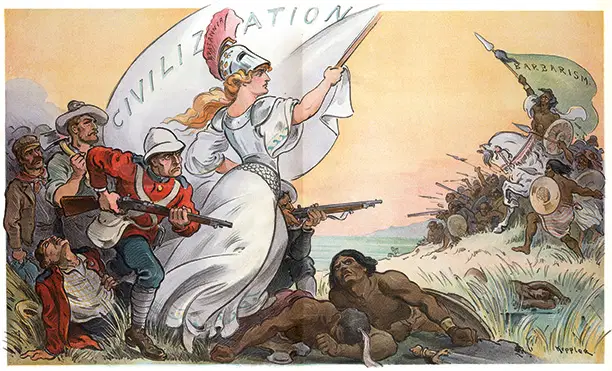
The cartoon portrays imperialism as a fight between "civilization" and "barbarism"
1) The artist is for or against imperialism and why?
1) For imperialism because the U.S. is shown representing civilization and fighting against barbarism.
"Americans used to believe that we were of a different clay from other nations... The country has once for all... joined the common pack of wolves... We are objects of fear to other lands." -William James
1) Why would the U.S. be "objects of fear to other lands"?
2) How could imperialism violate U.S. ideals?
1) Because the U.S. was taking control of other countries and using its military power to expand its influence.
2) Imperialism violated liberty and self-government because the U.S. controlled other countries instead of allowing their people to govern themselves.

1) According to Kipling's poem and cartoon, what was "the white man" obligated to do?
2) In the cartoon, where is Uncle Sam taking the people on his back?
3) How could this be a "burden" for Uncle Sam?
1) He was supposedly obligated to civilize, educate, and Christianize people in other countries.
2) He is carrying them toward civilization and progress.
3) It could cost the U.S. money, resources, and soldiers to control and govern other countries.

Taking Cuba from Spain was easy. Preserving it from overzealous Cuban patriots is another matter.' The question of how the U.S. seeks to insert itself into Cuban affairs still remains."
1) Why would Cuban patriots want to take Cuba back from the U.S.?
1) They wanted Cuba to be independent and govern itself without American control.
Spanish-American War/The Back Story
Before the Spanish-American War there was the…
These foreign policy warns European nations that the USA would not tolerate further colonization of Latin America.
Spain had colonies all over the world. Spanish colonies like Cuba and the Philippines started to fight for their freedom.
War starts and America stays out of it until 1898
Monroe Doctrine 1823 (Europe stays in the East and the U.S have the West)
Cuba is fighting for freedom against imperialist Spain.
Just like how the USA fought against Britain in the Revolutionary War, so they are basically twins.
"Butcher" Weyler was a Spanish leader sent to Cuba to stop the rebellion. He forces 300,000 Cuban rebels into Concentration Camps. Many Cubans die and Americans were upset by this. Reason that caused the U.S to get involved in the Spanish American war?
Reason 1: USA sympathy for Cuban Freedom Fighters

1) What is happening in this cartoon?
2) What is this cartoon trying to say about America and Cuba?
1) Uncle Sam is using a frying pan to remove Cuba from Spanish control and protect it from chaos.
2) America believed it had a responsibility to help Cuba become free from Spain and prevent further disorder.
Newspapers sensationalized events in hopes to sell papers. Used exaggerated, dramatic, or sometimes false stories to attract readers and sell more newspapers. What term is this?
Yellow Journalism
Newspapers with very little evidence for what they wrote and original fake news.
Made people angry and scared. US citizens ready to go to war and fight the Spanish because as public anger grew, more Americans supported going to war against Spain.
Famous writers: Joseph Pulitzer and William Hearst. Reason that caused the U.S to get involved in the Spanish American war?
Reason 2: Yellow Journalism
President McKinley wants to avoid war, tries diplomacy to avoid war.
Spanish Ambassador writes a letter talking very badly about McKinley and it is published in the NY Journal (a newspaper)
Yellow Journalists at it again because they made the letter a big story that cause anger in the U.S. Reason that caused the U.S to get involved in the Spanish American war?
Reason 3: De Lome Letter (Feb 9th, 1898)
USA ship is "blown up" in Havana, Cuba (major event)
Yellow Journalists Blame Spain, but there was very little evidence Spain did it. Probably a boiler exploded.
Sways public opinion and people demand revenge. Slogan: Remember the Maine, to HELL with Spain. Reason that caused the U.S to get involved in the Spanish American war?
Reason 4: U.S.S. Maine Explosion (Feb 15th, 1898)
Many thought that the war between Spain and the U.S would be over quickly with very little loss of American life.
They weren't entirely wrong because USA enters the war on April 21, 1898 and the war ends on December 10, 1898 (less than 9 months). 2061 soldiers die.
USA fought Spain in Cuba and the Philippines. United States won. What is the name of this war?
The "Splendid Little War"
Theodore Roosevelt helped lead a volunteer cavalry (caballería) unit called the Rough Riders that used the ports in Tampa to leave for Cuba.
Not super important battles BUT they made Roosevelt a war hero. Later, he used his fame to build his political career and became president. What are the names of these battles?
San Juan Hill and Kettle Hill
African-American regiment, fought at San Juan Hill and they were probably the reason Rough Riders won.
Name of these soldiers who fought alongside the Rough Riders during the Spanish-American War in Cuba?
The Buffalo Soldiers
A bloody conflict between the U.S. and Filipino nationalists who wanted independence from American control.
The war showed the challenges of controlling overseas territories and the moral problems associated with American expansionism. What type of insurrection is this?
The Philippine Insurrection
The Philippines
1) He was a Filipino leader who wanted the Philippines to become independent from Spain. Helped the USA to free the Philippines. Who is this person?
2) He was an American Navy commander. He defeated the Spanish Navy at the Battle of Manila Bay on May 1, 1898.
1) Emilio Aguinaldo
2) Admiral George Dewey
16 US battleships sail around the world. Show the world how strong the USA is. Victory lap (vuelta de la victoria) for winning the Spanish-American War.
What was the name of the fleet (flota) that sailed around the world?
The Great White Fleet
What countries the U.S. gain after defeating Spain?
Puerto Rico, Philippines, and Guam
What about Cuba?
Before the USA got involved in the war (1898), they promised NOT to take permanent control over Cuba and that they will get their independence. But the U.S. still had influence over the island. What amendment is this?
Teller Amendment
What about Cuba?
The USA could be involved in Cuba's international and domestic affairs to help protect Cuban independence.
Cuba had to lease Guantanamo Bay to the United States for a naval base. What amendment is this?
Platt Amendment (1901)
True or False
Did the Platt Amendment contradict the Teller Amendment by allowing the U.S. to interfere in Cuba's affairs?
True (The Teller Amendment promised Cuban independence, while the Platt Amendment gave the U.S. significant influence over Cuba)
Roosevelt: "Speak softly and carry a big stick" (the U.S. solve problems through peaceful negotiations, but have a strong military ready if diplomacy fails)
Start with negotiations and diplomacy, but have the military to back you up (U.S. would try talking first, but could use its military strength to pressure other countries) What is the name of this Roosevelt strategy?
Big Stick Diplomacy/ Policy
The U.S claimed the right to get involved in problems between European and Latin American countries (Monroe doctrine on steroids). Because the U.S. wanted to protect its influence in Latin America. What addition to the Monroe Doctrine is this?
Roosevelt Corollary
Starts to be built under Roosevelt's presidency. Shortened trade routes, but it was very difficult to build.
The Yellow Fever cause that people got very sick and died while building the canal. What canal is this?
The Panama Canal
Why did America want to build a canal through Panama?
To create a shortcut between the Atlantic and Pacific Oceans, making trade and military travel faster.
Panama wanted independence from Colombia, and the U.S. wanted to build a canal there. This is the reason why the U.S. supported the...
Panamanian revolt
The U.S. received the right to build the canal, and Panama received $10 million plus $250,000 in yearly rent after nine years. Who is involved in this treaty?
Panama and the U.S.
He took control of collecting import taxes/collection of Dominican imports to pay the Dominican Republic's foreign debts. With this action, what did President Theodore Roosevelt prevent?
He prevent European intervention in the Dominican Republic
The U.S. used diplomacy and military power to prevent European intervention in Latin America and protect its interests. What policy and strategy are these?
Big Stick Policy and Roosevelt Corollary
How did Taft's views differ from Roosevelt's?
Taft focused more on economic development and trade, while Roosevelt focused more on military power.
President Taft encouraged American bankers to invest in the Caribbean countries, which contributed to making foreign countries economically dependent on the U.S. and these increase American trade and influence.
Whenever Latin American countries became unable to repay loans to investors, the U.S sent troops to ensure the money was collected. What foreign policy is this?
Dollar Diplomacy
American bankers lent Nicaragua money to pay its debts. In return, they received control over its railroads, customs collection (collecting taxes on imported goods), and national bank.
When Nicaragua refused this, Taft sent in the U.S. Marines to enforce it. Between which countries was this deal?
U.S and Nicaragua
How did American investments in Mexico impact the Mexican people?
Most profits went to foreign companies and wealthy Mexicans, while most Mexican people became poorer.
A foreign policy by Woodrow Wilson that promoted democracy, peace, and opposed colonialism. What type of policy is this?
Moral Diplomacy
Big Stick Diplomacy / Roosevelt Corollary. Used diplomacy backed by military power to protect U.S. interests and prevent European intervention in Latin America. Which president is this?
Theodore Roosevelt
Dollar Diplomacy. Used American loans and investments to increase U.S. economic influence in other countries. Which president is this?
William Taft
Moral diplomacy. Promoted democracy, peace, and opposed colonialism. Which president is this?
Woodrow Wilson
True or False
While American expansionism brought economic and political gains for the U.S, it led to the exploitation of foreign populations and the perpetuation of racial and imperialistic ideologies.
True
Cuba could not make agreements with foreign countries that threatened its independence or allowed them to control Cuban land. What is the name of the amendment and article number?
Platt Amendment, article 1.
Cuba could not take on debts it could not afford to repay. What is the name of the amendment and article number?
Platt Amendment, article 2.
The U.S. had the right to intervene in Cuba to protect its independence and maintain order. What is the name of the amendment and article number?
Platt Amendment, article 3.
Cuba had to improve sanitation to prevent diseases and protect people and trade. What is the name of the amendment and article number?
Platt Amendment, article 5.
Cuba had to lease or sell land to the U.S. for naval bases, including Guantanamo Bay. What is the name of the amendment and article number?
Platt Amendment, article 7.
True or False
The goal of the Platt Amendment was to protect the U.S interests in Cuba and give the U.S.A control over Cuban affairs, including the right to intervene and maintain a naval base at Guantanamo Bay, even after Cuba became independent.
True
1)Why Cubans were hesitant to add this amendment to their constitution?
2) Why the U.S created this amendment?
1) Because it limited Cuba’s independence and gave the U.S. control over its affairs.
2) To protect its interests, prevent European intervention, and maintain control over Cuba.

1) How is Uncle Sam shown in this cartoon?
2) How is Cuba shown in this cartoon?
3) What is this cartoon saying about the Platt Amendment and how will it impact Cuba?
1) He is shown as a powerful figure controlling Cuba and taking its treasures.
2) Cuba is shown as weak, helpless, and controlled by the United States.
3) The Platt Amendment allowed the U.S. to interfere in Cuba's government and limited Cuba's independence.

What is the explanation of this cartoon?
Death is represented because building the Panama Canal was dangerous because workers faced diseases like yellow fever and malaria.

What is the explanation of this cartoon?
Theodore Roosevelt is digging through Panama to build the Panama Canal. It represents America's desire to expand its power and trade by controlling an important waterway.

What is the explanation of this cartoon?
Theodore Roosevelt is acting as the world's police officer. He uses Big Stick Diplomacy/ Roosevelt Corollary to control conflicts and keep order between countries.

What is the explanation of this cartoon?
Uncle Sam is stopping European countries from interfering in Latin America. It represents the Roosevelt Corollary ( the U.S. can intervene in Latin American countries to maintain order and protect its interests)

What is the explanation of this cartoon?
Yellow Journalism is creating war scares with exaggerated stories. This caused fear and anger.

What is the explanation of this cartoon?
Roosevelt is leading a the Great White Fleet. It represents how America used its military strength to show power and influence around the world.

What is the explanation of this cartoon?
Roosevelt is using U.S. military power and Roosevelt Corollary to keep European countries out of the Dominican Republic.
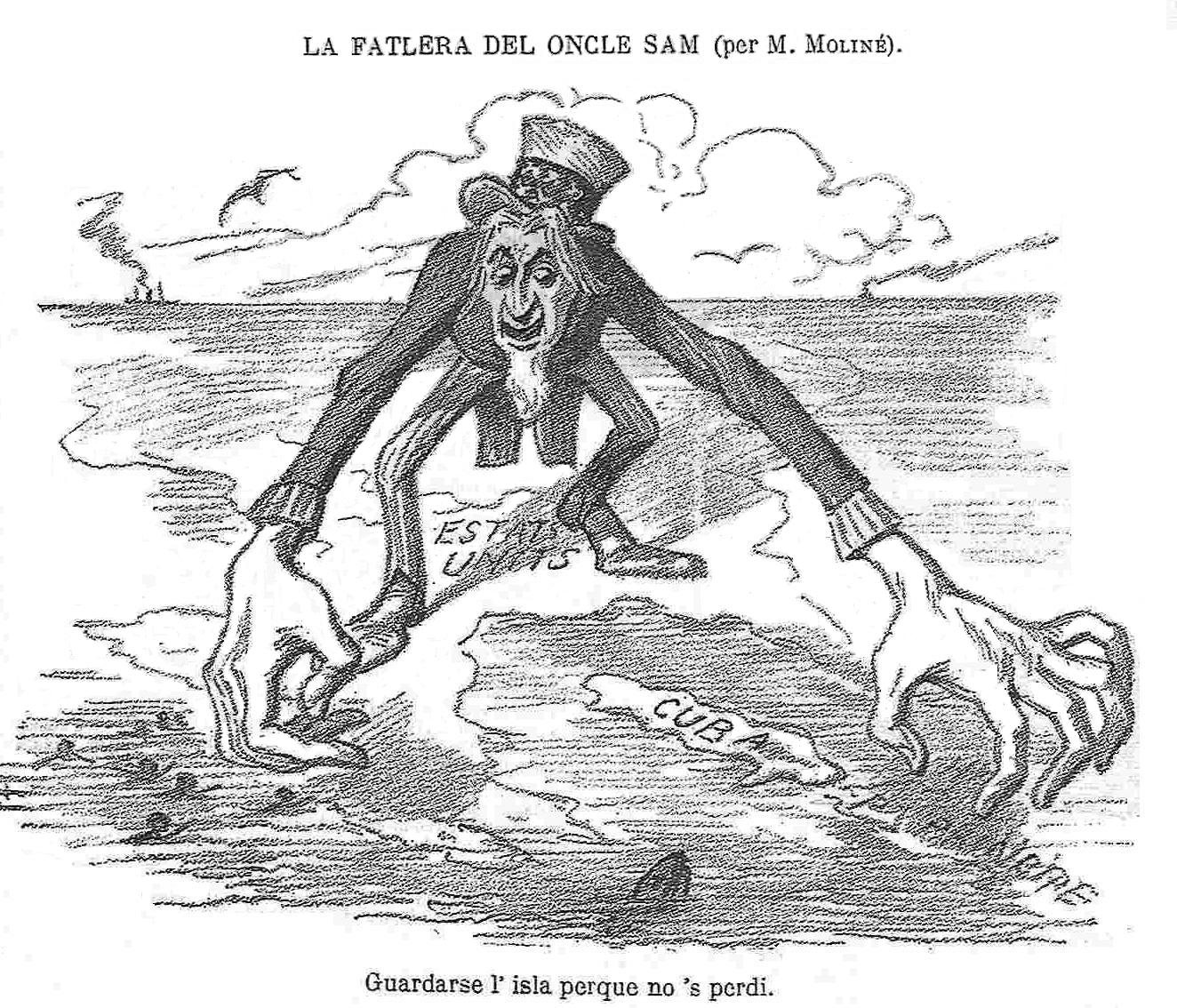
What is the explanation of this cartoon?
It suggests that the U.S wanted to keep control of Cuba territories and expand its power. It criticizes America's desire to control other countries.
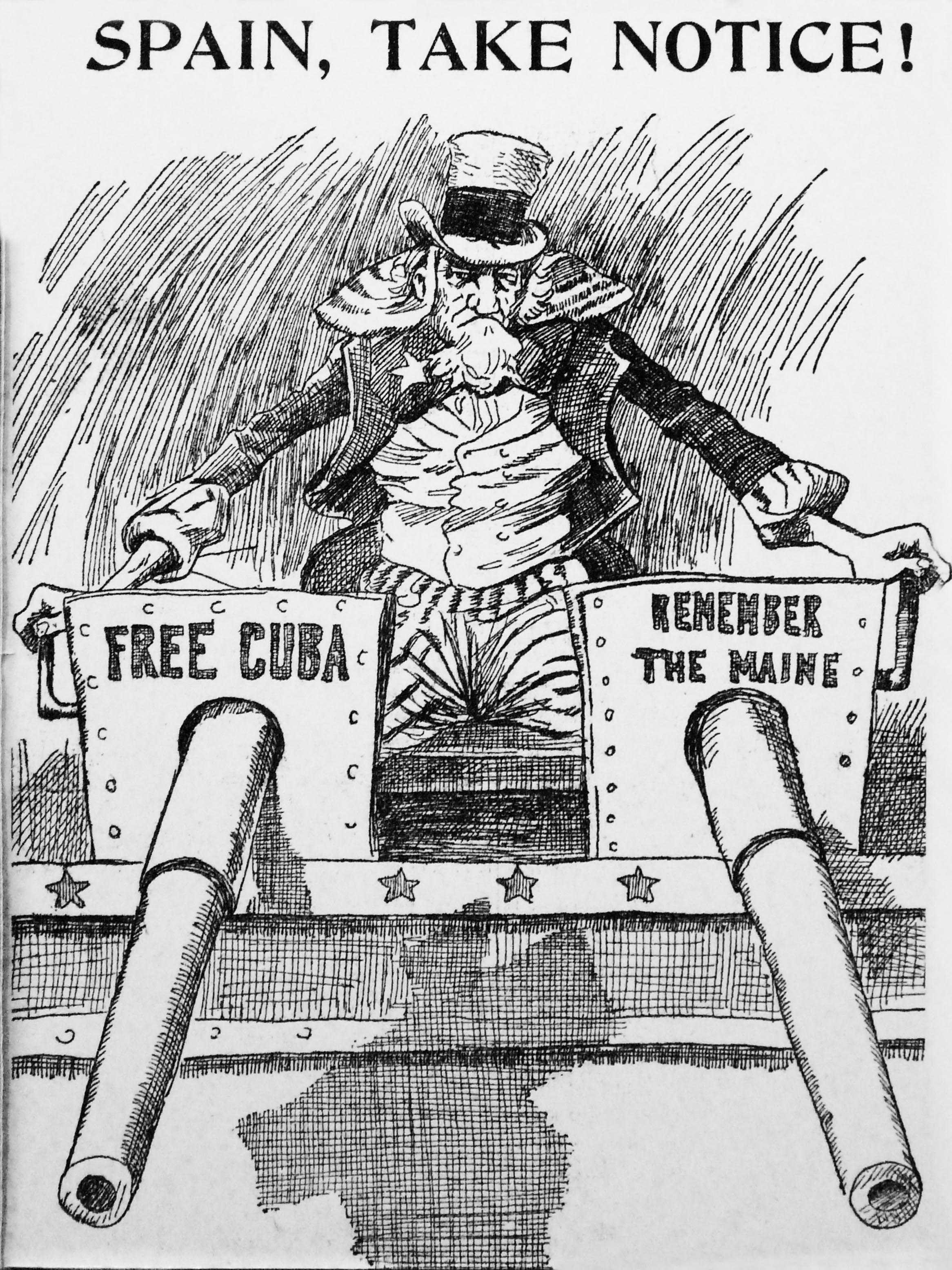
What is the explanation of this cartoon?
Uncle Sam is warning Spain to leave Cuba alone. This shows that the U.S. was ready to fight Spain to help Cuba gain independence and avenge the sinking of the USS Maine.

What is the explanation of this cartoon?
The cartoon shows how the U.S. wanted to control these territories and change their cultures by teaching them American values.

Which United States foreign policy was most often used to carry out the actions shown on the map?
A. Roosevelt Corollary to the Monroe Doctrine
B. Wilson's Fourteen Points
C. Kellogg-Briand Pact
D. Open Door
A. Roosevelt Corollary to the Monroe Doctrine

What was a major purpose of these 1898 newspaper headlines?
A. Rallying support for a declaration of war against Spain
B. Promoting peace between Spain and the United States
C. Supporting humanitarian aid for the suffering Cuban people
D. Punishing the citizens of Cuba
A. Rallying support for a declaration of war against Spain

What does this map show about the importance of completing the Panama Canal?
A. It made it easier for the U.S. Navy to patrol Latin America.
B. It shortened shipping routes between the Atlantic and the Pacific Oceans.
C. It created a security buffer between South America and the United States.
D. It prevented cheap Latin American goods from flooding the U.S. market.
B. It shortened shipping routes between the Atlantic and the Pacific Oceans.