BKE3 3 Energy Efficiency in Building and Transportation
 Call Kai
 Learn
 Practice Test
 Spaced Repetition
 Match
 Flashcards
 Knowt Play
1/16

There's no tags or description
Looks like no tags are added yet.
17 Terms
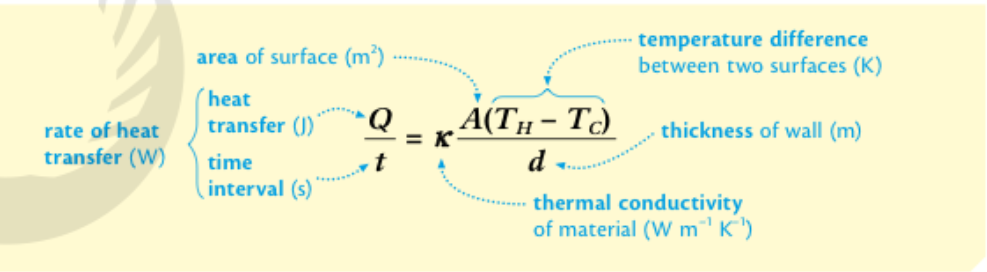
Rate of heat transfer by conduction (Equation)
This only accounts for heat transfer by conduction. [NOT IN DSE FORMULA SHEET - MUST MEMORIZE/DERIVE]
Thermal conductivity (k) vs Thermal transmittance (U-value)
Thermal conductivity (k) is an inherent property of a material.
Thermal transmittance (U-value) depends on BOTH the material and its thickness.
U = k / d. Lower U-value means a better thermal insulator.
[NOT IN DSE FORMULA SHEET - MUST MEMORIZE/DERIVE]

U-value of a composite wall (Multiple layers stacked in series)
1 / U_total = 1 / U_1 + 1 / U_2 + … (Derived because the rate of heat flow Q/t must be equal through all layers in a steady state). This ONLY applies to layers stacked in series (e.g., concrete + insulation layer). [NOT IN DSE FORMULA SHEET - MUST MEMORIZE/DERIVE]
Heat transfer of adjacent/parallel surfaces (e.g., wall with windows)
Do NOT use the 1/U formula. For adjacent parallel surfaces (Area 1 and Area 2), add the total rates of heat transfer directly: (Q/t)_total = U_1 * A_1 * delta T + U_2 * A_2 * delta T. [NOT IN DSE FORMULA SHEET - MUST MEMORIZE/DERIVE]

Overall Thermal Transfer Value (OTTV) Definition
The average rate of heat gain per unit area into a building through the building envelope by BOTH conduction and radiation. [NOT IN DSE FORMULA SHEET - MUST MEMORIZE/DERIVE]

Exam Trap: OTTV Equivalent Temperature Difference (delta T_eq)
Note that in Q_c/t = U * A * delta T_eq, the "equivalent temperature difference" is used instead of the instantaneous temperature difference. This is to account for seasonal variations, solar absorption (sun baking the wall), and wall orientation.
Exam Trap: Does OTTV account for convection or heat from the ground?
No. In calculating OTTV, the building envelope is assumed to be completely enclosed. Heat gain by convection and heat transfer through the ground are negligible/ignored.
Exam Trap: U-value vs Direct Sunlight (Radiation)
U-value only governs conduction. Under direct exposure to sunlight, heat is predominantly transferred through windows by RADIATION. Adding an air gap (double-glazing) lowers U-value to stop conduction but does not significantly block solar radiation.

Exam Trap: Heat transfer into a sunlit container office (HKDSE 2017)
Sunlight does not directly increase conduction. Instead, the exterior surface absorbs heat by radiation, raising the exterior surface temperature (T_hot) above the surrounding air temperature. This increases the temperature difference, driving a higher rate of heat transfer by CONDUCTION into the room.
Low-emissivity (low-e) glass & Solar control window films
They possess a thin metallic coating that reflects IR (infra-red) and UV (ultra-violet) radiation while allowing most visible light to pass through. This reduces solar heat gain without heavily sacrificing natural lighting.

Principle of Regenerative Braking in EVs / Hybrid vehicles
During braking, the electric motor acts as a generator. It converts the kinetic energy of the vehicle into electrical energy, which is then stored as chemical energy in the batteries for later use.

Exam Trap: When is Regenerative Braking most and least effective?
Most effective: Driving in a city with smooth traffic regulated by traffic lights, or going downhill (frequent braking from moderate speeds). Least effective: Highway (seldom brake) or heavy traffic congestion (speed is too low for effective kinetic energy conversion).
Exam Trap: Why Regenerative Braking Fails at Very Low Speeds
Based on Faraday's Law (E is proportional to v). As vehicle speed v approaches 0, the rate of magnetic flux cutting approaches zero, making the induced e.m.f. too small to charge the battery. Frictional brakes are required to bring the car to a complete stop.
End-use vs Overall Energy Efficiency for Electric Vehicles
End-use efficiency compares the motor's mechanical KE output to the battery's electrical energy input (very high, ~85%). Overall efficiency accounts for energy lost during electricity generation at the fossil-fuel power plant and transmission (e.g., Coal efficiency * Motor efficiency), making it much lower (~38%).
Exam Trap: "EVs are 100% zero-emission"
False. While EVs have no tailpipe emissions (improving roadside/urban air quality), the fossil-fuel power plants generating their electricity still emit greenhouse gases and air pollutants.
Exam Trap: Vehicle mass and power requirement (HKDSE 2021 Q28)
A more massive vehicle requires a larger force and peak power output for acceleration (F=ma) and deceleration. A common candidate mistake is thinking a larger force/power is required just to "maintain the speed" of a heavier vehicle.
Hybrid Vehicle Combustion Engines
They are often smaller and more efficient than those in standard fossil-fuel vehicles because the electric motor shares the propulsion load (especially during acceleration). The computer turns off the engine when the vehicle is stationary or at very low speeds.