6.2 Enzyme Kinetics: Kinetic Parameters Used to Compare Enzymes
 Call Kai
 Learn
 Practice Test
 Spaced Repetition
 Match
 Flashcards
 Knowt Play
1/4

There's no tags or description
Looks like no tags are added yet.
5 Terms
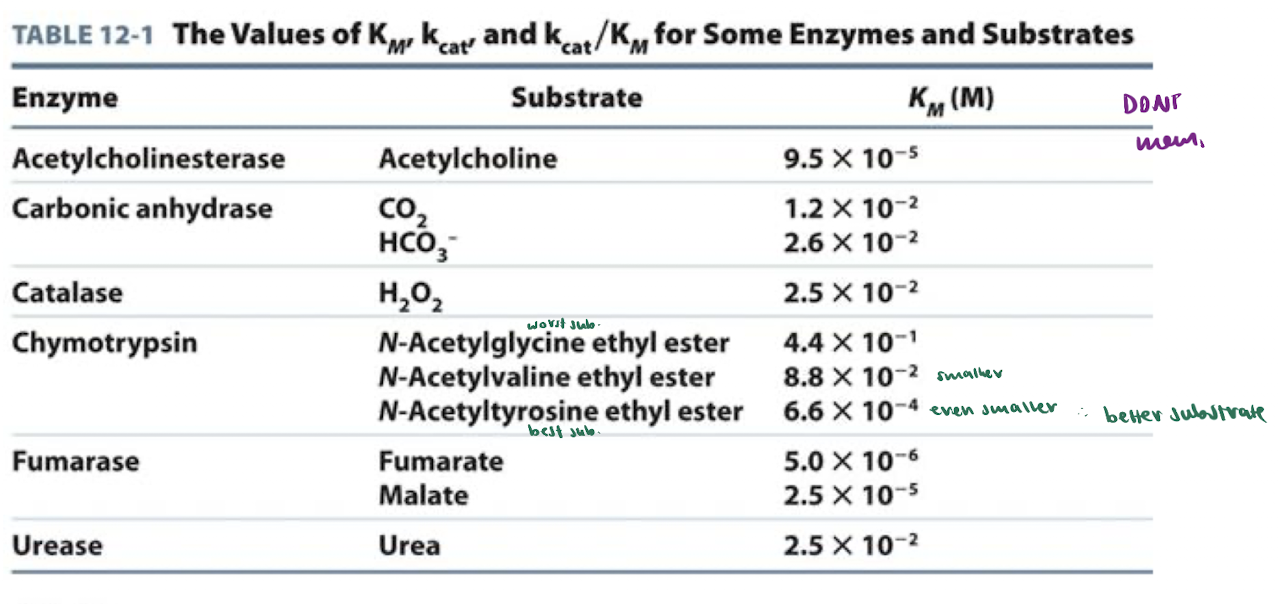
Michaelis Constant (Km)
Km : represents a relationship b/w various rate constants

= the [S] needed to get to 50% max velocity
units: M
affinity of enzyme for substrate
Km is a constant
often near physiological [substrate]
DOESNT tell us abt catalysis
lower Km = better substrate for that enzyme
means the enzyme has high affinity for that substrate & binds it easily, thus little is needed to hit half-speed
Turnover Number (kcat)
kcat = represents the ability of a single enzyme to catalyze product when its saturated with substrate
going from ES to P + E
kcat is a constant
units: s^-1
a normalized value of Vmax (max rate), which depends on [enzyme]
note: Vmax isn’t a constant, thus is influenced by kcat
units: per second

higher kcat = enzyme converts substrate to product faster, thus is better

→ THUS, the best enzyme would have a LOWER Km (higher affinity for substrate, thus less [s] is needed to be half-speed) & HIGHER kcat (faster conversion of substrate to product)
Specificity Constant
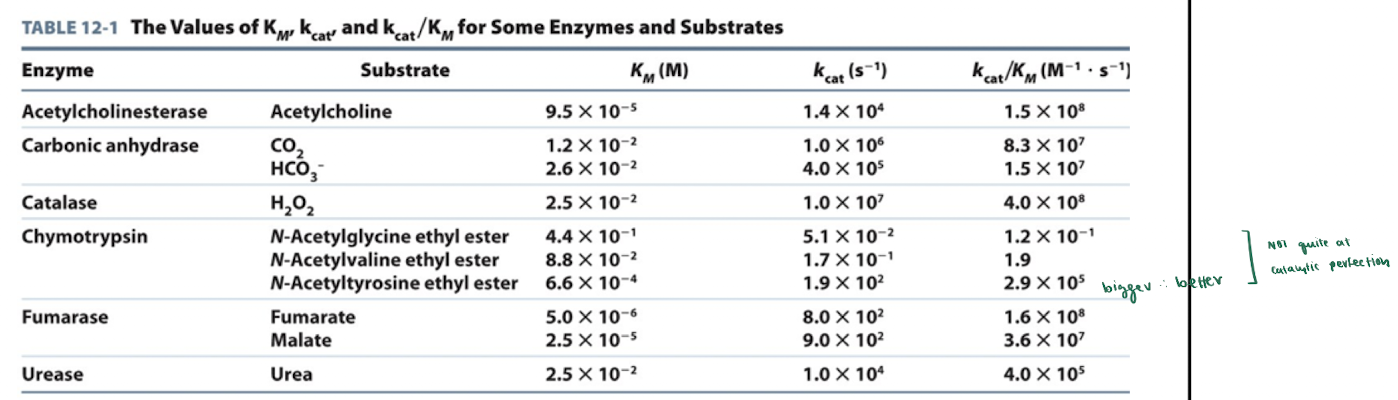
Specificity constant = a larger value can indicate catalytic perfection of an enzyme

used to determine how good an enzyme is at converting sub→ product & can be used to compare enzymes
a 2nd order rate constant
units: M^-1 s^-1
has a max limit: upper limit of diffusion
some enzymes reach this, so they’re rxn immediately occurs

larger specificity constant = a better enzyme, bc kcat is increasing & Km is decreasing → THUS approaching catalytic perfection
Specificity Constant: Derivation of the Equation
take M-M equation and replace Vmax with what it equals bc it contains kcat

if [S] « Km (meaning [S] is less than the [S] needed to reach 50% max velocity) then V0 equals:

bc if [S] is a lot less than Km, the denom is basically equal to Km → thus we can approximate it as equal to Km
this is a pseudo 2nd order rate equation: bc its constant x [ ] x [ ]
1st order would be constant x [ ]
final specificity constant equation

Q. The enzyme fumarase has a Km of 25.0µmol/L and a kcat of 900 s^-1 for malate. Is this close to catalytic perfection?
malate is the substrate, and its asking for the specificity constant
have to convert 25µmol/L → M (÷ by 1million or x by 10^-6)
calc specify constant

is the specific constant near the upper limit of diffusion ( ~10^8 to 10^9)
