Oxbow Lakes
 Call Kai
 Learn
Learn Practice Test
 Spaced Repetition
 Match
Match Flashcards
 Knowt Play
1/10

There's no tags or description
Looks like no tags are added yet.
Name | Mastery | Learn | Test | Matching | Spaced | Call with Kai | Chat |
|---|
No analytics yet
Send a link to your students to track their progress
11 Terms
Example
The River Moy
Meanders
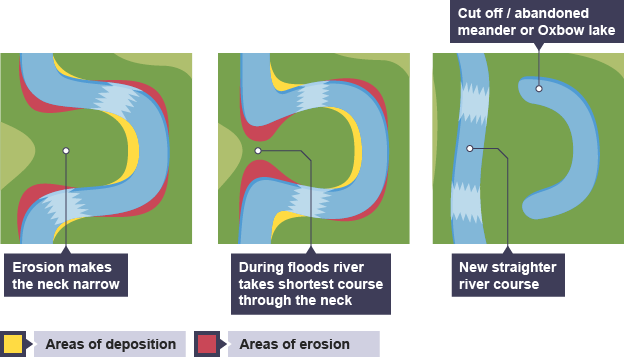
As a river flows through a landscape, it creates meanders, which are the large bends that develop over time.
Erode & settle
The faster water on the outside of a bend erodes the bank, while slower water on the inside allows sediments to settle.
Change shape
Over time, the meanders grow larger and the river starts to change shape.
Cut through
During heavy rain or flooding, the river can cut through the narrow part of a meander, creating a new, straighter channel.
Isolated bend
The isolated bend then becomes a crescent-shaped lake, known as an oxbow lake.
Deposition
An oxbow lake is formed by the deposition of sediment in a river, particularly in areas where the river has curves or bends.
Drop off
River depositon is the process where a river drops off sediments like sand and silt as it slows down.
Shallow
Oxbow lakes are often shallow and collect sediment over time, making them less deep.
Important habitats
These lakes provide important habitats for wildlife, including various fish, birds and plants.
Great example
Oxbow lakes are a great example of how rivers change their shape and the landscape around them over time.