Chapter 16 (Cell signaling)
 Call Kai
 Learn
 Practice Test
 Spaced Repetition
 Match
 Flashcards
 Knowt Play
1/84

There's no tags or description
Looks like no tags are added yet.
85 Terms
Cell signaling
Communication in which a cell detects a molecular signal and responds by changing its activity.
Target cell
A cell with the specific receptor needed to detect and respond to a signaling molecule.
Signaling molecule (ligand)
A molecule that binds to a receptor on a target cell and triggers a response. Can be proteins, peptides, amino acids, nucleic acids, nucleotides, steroid hormones and gas
Receptor
A protein that specifically binds a signaling molecule and initiates a cellular response.
Receptor affinity
The strength with which a receptor binds its signaling molecule; high affinity allows responses to very low ligand concentrations.
Signal specificity
The ability of a signaling molecule to affect only cells with the appropriate receptor.
Endocrine signaling
Long-distance signaling in which hormones which become very dilute travel through the bloodstream to reach target cells which have receptors that have high affinity.

Paracrine signaling
Localized signaling in which molecules diffuse through extracellular fluid to affect super nearby target cells binding to receptors. Relatively fast and receptors could have lower affinity. Can be seen in muscle cells.

Synaptic signaling
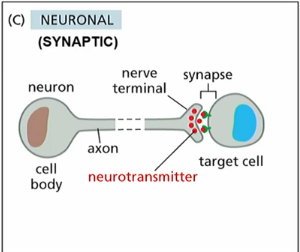
Signaling in which a neuron releases neurotransmitters into a synaptic cleft near a target cell. Signaled from electrical signal. Very small region to next cell. Very limiting diffusion because small space.
Contact-dependent signaling
Signaling requiring direct cell-to-cell contact because the signaling molecule remains attached to the signaling cell's surface.

Hormone
A signaling molecule released into the bloodstream to affect distant target cells.
Neurotransmitter
A signaling molecule released by a neuron into the synaptic cleft to communicate with a nearby target cell.
Synaptic cleft
The small extracellular space between a neuron and its target cell.
Second messenger
A small intracellular molecule or ion whose concentration changes in response to receptor activation and relays the signal inside the cell.

cAMP (cyclic AMP)
A second messenger produced from ATP by adenylyl cyclase that activates protein kinase A.
cAMP synthesis and breakdown pathway
ATP gets changed to cAMP by enzyme adenylyl cyclase.
Adenylyl cyclase produces alot of cAMP and cAMP phosphodiesterase converts cAMP into AMP.
ATP is not replenished from this.
Adenylyl cyclase (AC)
An enzyme that converts ATP into cAMP in response to activation by certain G proteins. Highly regulated enzyme

Calcium (Ca2+) as a second messenger
An intracellular signaling ion whose cytosolic concentration rises when calcium channels open or calcium is released from the ER. It is a good messenger as its positive charge allows it to flow into the cytosol from channels in passive transport.

Calcium Calmodulin (CaM)
A regulatory protein that binds Ca2+ and activates calcium-dependent proteins, including CaM kinase.

CaM kinase
A protein kinase activated when Ca2+ binds to calmodulin.

Protein kinase C (PKC)
A membrane-associated protein kinase activated by DAG and Ca2+ in certain signaling pathways.

Signal amplification
An increase in signal strength when one activated molecule activates many molecules of the next component in a pathway.

Signal diversification
The ability of one signaling pathway or second messenger to affect multiple target proteins and produce different cellular responses.

Kinase cascade
A sequence in which one activated protein kinase phosphorylates and activates another kinase. Most common form of signal amplification. Uses alot of ATP.

Serine/threonine kinase
A protein kinase that adds phosphate groups to serine or threonine residues on target proteins.
Tyrosine kinase
A protein kinase that adds phosphate groups to tyrosine residues on target proteins.
Signal termination
The process of turning off a signaling pathway and returning the cell to its resting state.
Cyclic AMP phosphodiesterase
An enzyme that converts (destroys) cAMP into AMP, lowering intracellular cAMP levels. Also highly regulated and is used as adenylyl cyclase makes alot of cAMP
Ca2+ ATPase
An ATP-powered pump that removes Ca2+ from the cytosol by moving it into the ER or out of the cell. Maintains Ca gradient

Protein phosphatase
An enzyme that removes phosphate groups from proteins, reversing the effects of protein kinases. Essentially dephosphorylation.
Receptor internalization
Removal of cell-surface receptors from the plasma membrane, reducing the cell's ability to respond to a signaling molecule. Sometimes the receptor can be degraded as well.
Energy use in cell signaling
Signaling pathways use ATP and GTP to produce second messengers, phosphorylate proteins, inactivate G proteins, and maintain ion gradients.
Ligand-gated ion channel
A receptor that opens or closes an ion channel when a signaling molecule binds, allowing ions to cross the membrane.

G-protein-linked receptor (GPCR)
A cell-surface receptor that activates an associated G protein when a signaling molecule binds.

Enzyme-coupled receptor
A cell-surface receptor that contains an intracellular enzyme domain or associates with an enzyme to trigger signaling.

G protein
A regulatory protein that binds and hydrolyzes GTP, relaying signals from GPCRs to intracellular effector proteins.

Trimeric G protein
A G protein composed of three subunits
Effector enzyme
An enzyme activated by a signaling pathway component, such as a G protein, that produces or regulates a second messenger.
G protein activation
The process in which an activated GPCR causes a G protein to release GDP and bind GTP.
G protein inactivation
The process in which a G protein hydrolyzes GTP into GDP and Pi, returning to its inactive state.
Guanine nucleotide exchange
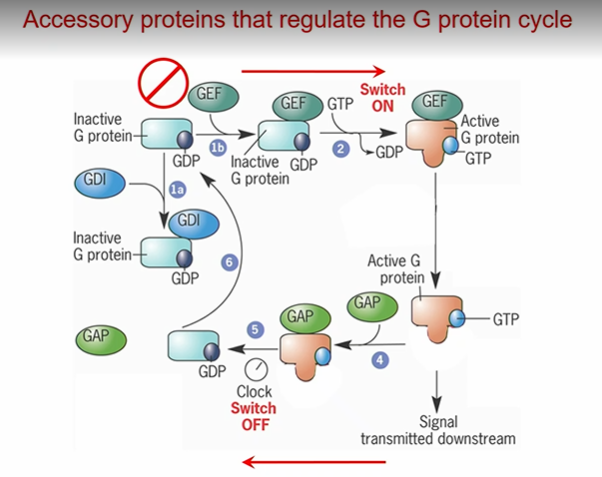
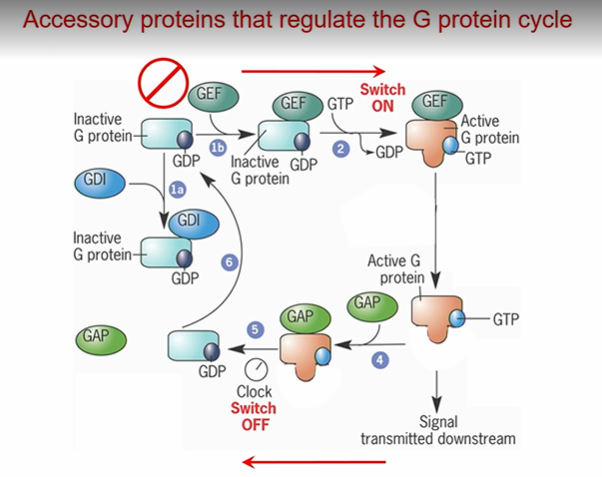
Replacement of GDP with GTP on a G protein, switching it from inactive to active.
GDI (guanine nucleotide dissociation inhibitor)
A regulatory protein that prevents GDP release from an inactive G protein, keeping it inactive.

GEF (guanine nucleotide exchange factor)
A regulatory protein that promotes GDP release and GTP binding, activating a G protein.
GAP (GTPase-activating protein)
A regulatory protein that stimulates GTP hydrolysis by an active G protein, turning it off.

Molecular switch
A protein that switches between active and inactive states, often depending on whether it is bound to GTP or GDP.
Beta-adrenergic receptor
A GPCR that binds epinephrine and activates a G protein to stimulate the cAMP signaling pathway.

Protein kinase A (PKA)
A kinase activated by cAMP that phosphorylates target proteins to regulate cellular processes.

PKA activation
cAMP binds PKA's regulatory subunits, releasing catalytic subunits that phosphorylate target proteins.
Protein kinase
An enzyme that modifies other proteins by adding a phosphate group to them known as phosphorylation. Usually leads to a change in conformation of protein which can lead to activation.
Phosphorylase kinase
A kinase activated by PKA phosphorylation that phosphorylates and activates glycogen phosphorylase.

Glycogen phosphorylase
An enzyme activated by phosphorylation that breaks down glycogen through phosphorolysis, releasing glucose-1-phosphate.

Glycogen synthase
An enzyme that builds glycogen; phosphorylation by PKA inhibits its activity.
Phospholipase C (PLC)
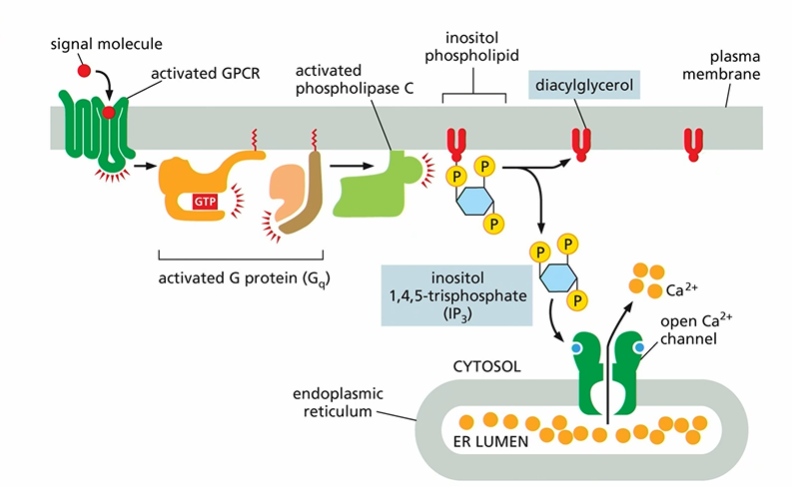
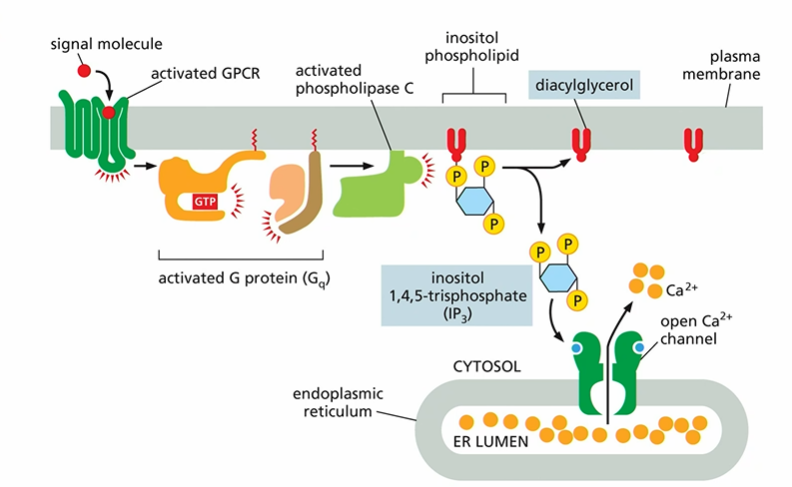
An enzyme activated by a G protein that cleaves PIP2 into IP3 and DAG.

PIP2 (phosphatidylinositol 4,5-bisphosphate)
A membrane phospholipid that phospholipase C splits into IP3 and DAG.
IP3 (inositol 1,4,5-trisphosphate)
A soluble second messenger that binds to and opens Ca2+ channels in the ER membrane.

DAG (diacylglycerol)
A membrane-associated second messenger produced by Phospholipase C cleavage of PIP2; it works with Ca2+ to activate PKC.
Calcium wave
A rapid increase and spread of cytosolic Ca2+ that triggers cellular responses, such as egg activation after fertilization.
Polyspermy
Fertilization of an egg by more than one sperm; the Ca2+ response after the first sperm helps prevent it.
Receptor tyrosine kinase (RTK)
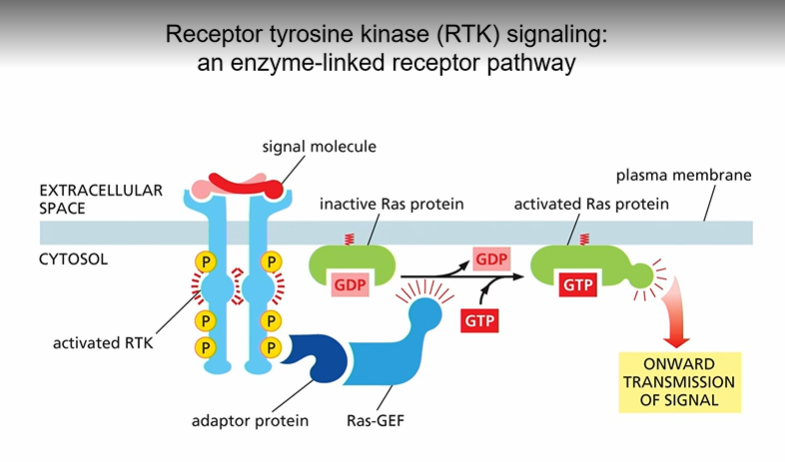
An enzyme-linked cell-surface receptor that binds growth factors and phosphorylates tyrosine residues.
Growth factor
An extracellular signaling molecule, such as PDGF or NGF, that stimulates cell growth, survival, or differentiation.
RTK dimerization
The joining of two ligand-bound receptor tyrosine kinases, allowing their intracellular kinase domains to activate one another.
RTK autophosphorylation
Phosphorylation of tyrosine residues on one RTK by the kinase domain of its partner receptor.
Adaptor protein
A protein that binds phosphorylated RTKs and helps assemble the proteins needed to transmit the signal.
Ras
A small, monomeric GTP-binding protein that becomes active when it exchanges GDP for GTP in the receptor tyrosine kinase signaling pathway.

Ras-activating protein
A signaling protein that promotes GDP release and GTP binding by Ras.
Monomeric G protein
A single-subunit GTP-binding protein, such as Ras, unlike a trimeric G protein.
MAP kinase cascade
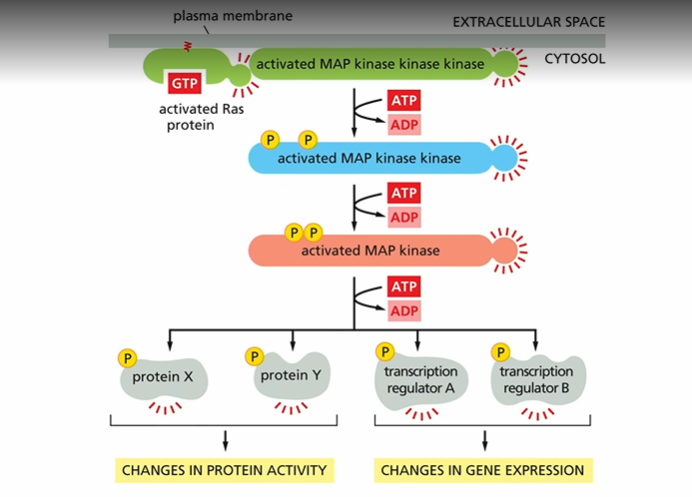
A three-kinase pathway in which MAPKKK activates MAPKK, which activates MAPK.

MAP kinase kinase kinase (MAPKKK)
The first kinase in the MAP kinase cascade; it phosphorylates and activates MAPKK after being recruited by the active Ras protein.
MAP kinase kinase (MAPKK)
The second kinase in the MAP kinase cascade; it phosphorylates and activates MAPK.

MAP kinase (MAPK)
The final kinase in the MAP kinase cascade; it phosphorylates target proteins to change protein activity and gene expression allowing for signal diversification and amplification.

Constitutively active G protein
A G protein that remains active without continued receptor stimulation, causing persistent downstream signaling.
Temperature-sensitive G protein mutation
A mutation that causes a G protein to function differently at different temperatures.
Pseudohypoparathyroidism
A condition involving impaired parathyroid hormone signaling; the lecture example involves a temperature-sensitive G protein mutation.
Precocious puberty
The unusually early onset of puberty; in the lecture example, persistent G protein signaling in the testes contributes to this condition.
McCune-Albright syndrome
A disorder caused by a Gs alpha mutation that reduces GTPase activity, resulting in prolonged G protein activation and elevated cAMP signaling. GTP protein always active and can’t shut itself off essentially.

Gs alpha subunit
The alpha subunit of a stimulatory trimeric G protein that activates adenylyl cyclase.
Reduced GTPase activity
Decreased ability to hydrolyze GTP, causing a G protein to remain active longer.
Somatic mutation
A mutation in a body cell rather than a germ cell; it affects that cell and its descendants but is not necessarily inherited.
Bacteria quorum sensing
A cell-to-cell communication process that bacteria use to coordinate group behaviors, such as biofilm formation, based on population density.
Cell Surface Receptor
A receptor protein embedded in the plasma membrane that binds to signaling molecules (ligands) located outside the cell and transmits a signal into the cell.

Intracellular Receptor
A receptor protein located inside the cell that binds to signaling molecules capable of crossing the plasma membrane.

General pattern of cell surface receptor signaling
Signal molecule binds to cell surface receptor
it is specific and has high affinity
Receptor transmits signal to inside of cell
It amplifies and diversifies signal
Increases number of effector molecules
After some time molecules go into rest state

What can limit cell signals lifetimes?
Signal molecule degraded
Receptors internalized and sometimes degraded
Regulatory proteins are inactivated
cAMP destroyed by phosphodiesterase into AMP
Ca2+ leaves cytosol
Phosphates are removed by protein phosphatases.
G-protein
A family of molecular switch proteins inside cells that transmit signals from external cell-surface receptors (such as G-protein-coupled receptors, or GPCRs) to internal target enzymes and ion channels. They bind and hydrolyze GTP

G-protein cycle
Receptor on G-protein binds to extracellular ligand signal phosphorylating the GDP on the G-protein to GTP and activating it as it changes protein shape.
Guanine nucleotide exchange factor promotes release of bound GDP on the G-protein.
Free GTP binds to G-protein
Signals are sent down to effector molecules to secondary signal proteins.
GTP hydrolyzed back into GDP and G-protein is inactivated.
