exam 2: chapters 12-18
 Call Kai
 Learn
 Practice Test
 Spaced Repetition
 Match
 Flashcards
 Knowt Play
1/67

There's no tags or description
Looks like no tags are added yet.
68 Terms
care management
making sure patients receive the right care, at the right time, at the right cost, while still achieving the best possible health outcomes
Coordination of a plan or process to bring health services together as a common whole in a cost-effective way.
Evaluate healthcare interventions, including the need and appropriateness of care and the actions taken to attain effective and efficient outcomes
Team based care and collaboration
case management
the process of coordinating a patient's healthcare services to make sure they receive the care, resources, and support they need.
Development and coordination of care for a selected client and family
Integrative collaborative process as assessment, planning, facilitation and advocacy options and services to meet a person's health needs through communication and available resources to promote quality, cost effective outcomes.
Involves disease management (secondary and tertiary prevention)
Disease management emphasizes prevention at the secondary and tertiary levels using EBP guidelines
w/o case management, care management would not be successful
case manager role
Advocacy and education
Clinical care coordination/facilitation
Continuity/transition management
Utilization/financial management
Performance and outcomes management
Psychosocial management
Research and practice development

telehealth
Form of electronic communication used to deliver healthcare information
Telehealth is a form of electronic communication used to deliver acute care and specialty consultations, home telenursing, and electronic referral to specialist in expert facilities
home care agencies and associated policies
People facing acute or chronic illness or a new health issue may be candidates
Re-evaluated every 60 days
home care agencies - Private/voluntary agency (not for profit)
A home health agency that is motivated by not-for-profit philosophy
Voluntary board of directors and community based advisory boards
Any profit margin that is acquired is reinvested in the operations of the home healthcare service instead of being distributed amount owners
EX: VNA (visiting nurses association)
home care agencies - hospital-based agency
home healthcare services that are owned or operated by a hospital
A home health care agency that is not freestanding in the community, one of many specialty services offered at a hospital setting
Designed to save money and maintain control of patient care costs
Hospital-based home healthcare agencies are governed by not only the same board that governs the hospital but also an advisory board like that of a VNA; this helps match their care initiatives to the realities of the populations they serve. Depending on the hospital, hospital-based agencies can be “for-profit” of “not-for-profit"
A key objective is to maintain levels of quality to increase collaboration by establishing home healthcare services as a part of continuum of care offered by the hospital
EX: Corewell Hospice
home care agencies - Proprietary (for profit) agency
A home health agency that exists at the bequest of local, state, or federal legislation
Private agencies that plan want to make profit
Their services are often paid for privately by families, and any profit margin is used to benefit the owner or chain of agencies
Proprietary agencies are privately owned, for-profit home healthcare businesses
home care agencies - official agencies
Supported by public monies that often come from taxes (monies come from local state or federal governments)
Mandate to serve all people w/o exception
Cares for patients who may not be admitted to private voluntary or proprietary home programs
Funded by government/taxpayer money (local, state, federal).
Focus on public health needs and serving underserved populations.
Generally have a mandate to serve all eligible individuals, regardless of ability to pay.
Examples: County health departments, TB treatment/follow-up, lead screening, well-child clinics, and home health services.
assisted living
Type of community based long term care that combines semi-independent living with the availability of nursing care onsite and through home care visits
For people who can't live on their own but are not ready for a nursing home
Many older community dwellers find assisted living or continuing care communities to be places where gradual changes in physical, cognitive and emotional abilities can be addressed with centralized services
This choice is made on the basis or financial ability to support such an option
Many people want to stay in their own homes to protect long term investments financially or emotionally
Home visits to people experiencing homelessness
Many facilities provide shelter to patients who are homeless, including shelters devoted to post hospitalization care
There are also groups of interprofessional caregivers who makes visits to patients throughout the streets of the community, especially at times when many people w/o homes are at great risk for injury and may need care
Facilities for serious and chronic illness
Home care nurses who specialize in palliative care may visit these areas especially because they offer the patient and staff expertise in comfort care as a patient's condition gets worse.
Hospice home care is one example of a “home visit” made to facilities that care for those who are seriously and chronically ill who are choosing to stop all curative interventions
Patients with serious or chronic illnesses may receive specialized palliative or hospice services in hospitals, long-term care facilities, or other settings.
Palliative care → Comfort and symptom management at any stage of serious illness.
Hospice care → Comfort-focused care for patients approaching the end of life.
parish/faith community nursing
Approach of holistic care for patients and families in the community
Seven key roles of the parish of faith community nurse:
Health educator, personal health counselor, referral agent, coordinator of volunteers, developer of supportive groups, integrator of faith and health, and health advocate.
The home visits are focused on care given in context of the seven roles and are often negotiated with a faith leader in a community parish, congregation of synagogue
In many cases, these roles are not reimbursed by insurance but serve as ways to coordinate care for families as needed.
financing of home care services
Services are reimbursed by local, state, and federal funds, private insurance, Medicare, Medicaid and TRICARE, and veterans administration
OASIS
Epic for home health
Standardized home health assessment tool used to guide care, measure outcomes, compare quality, and support Medicare reimbursement
The OASIS data are reported to the state where the home health agency exists to create a larger database that can be used for state comparisons across the US. The accuracy needed to complete this assessment is critical because each assessment item becomes the standard from which patient outcomes are measured. In addition, the OASIS data are used by Medicare with PDGM to help determine how home healthcare agencies are paid for their services.
Home visit #1 within 24 hours of home care being initiated
The 2nd visit is the actual visit
Comprehensive assessment/OASIS: within 5 calendar days of start of care.
OASIS recertification: every 60 days.
Medicare criteria for eligibility for home care services
Homebound → Difficult to leave home (e.g. requires walker and assistance to leave home)
Plan of care → Written treatment plan.
Skilled needs → Requires professional nursing or therapy services (e.g. wound care)
Intermittent care → Does not require continuous nursing (e.g. 3x/week)
Necessity → Care must be medically necessary (e.g. needs wound care)
plan of care
An agency-generated written document that is guided by the Outcome and Assessment Information set (OASIS)
This tool represents items that help home health care professional assess adult home care patients
Skilled needs
Intermittent care needs
Necessity
insurance companies and home health care
Insurance companies that pay for home healthcare can be independent (EX: State Farm Insurance) or can be part of health maintenance organization (HMO) or a case management organization
Insurance companies, HMOs, and case management organizations give coverage based on monies that are paid directly to them in monthly or annual increments for the purpose of giving home healthcare when and if needed. What is common in the latter type of insurance is that these organizations coordinate with home healthcare agencies from which the patients can obtain care
Home healthcare is regulated by the state and federal governments
genogram
A diagram of family relationships between blood and relatives that can span two or more generations
Life events like marriages, divorces, births and deaths are included in the diagram
Used to identify relationships as well as possible patterns of disease
Useful for identifying inherited conditions
EX: Cystic fibrosis
its like a family tree that shows family relationships and health history

ecomaps
A diagram used to identify the direction and intensity of family relationships between members and/or community institutions of importance to the family (schools, workplaces, places of worship)
Best displays support in family; visually displays a family's relationship with people, organizations, and community systems.

family interview process
15-minute family assessments
Based on CFAM and CFIM
Component | What it means | Example |
|---|---|---|
1. Manners | Be respectful, introduce yourself, and establish trust. | Address family members by name. |
2. Therapeutic conversation | Actively listen, show empathy, and validate concerns. | "It sounds like caring for your mother has been difficult." |
3. Genograms and ecomaps | Identify family relationships and outside support systems. | Determine who helps care for the patient. |
4. Therapeutic questions | Ask questions to identify concerns, expectations, and priorities. | "What is your biggest concern about your father's care?" |
5. Commendations | Recognize the family's strengths and resources. | "You've done a great job supporting each other." |
caregiver burden
Fatigue or frustration expressed by persons who care for convalescing or chronically ill persons
Caregiver burden is a significant issue for families because it can cause the development of physical or emotional illness in the caregiver over time
Caregivers might express feeling trapped, isolated, and overwhelmed with no possible help with care
Caring for a family member can lead to financial and work strain in some circumstances
community health nurse responsibilities
The responsibilities of community health nurses to families are to provide theory-guided and EB family assessment and intervention to promote family health and wellbeing
Family assessment requires flexibility to include key informants and for the location and timing of the interview
Family health practice, routines, and responses to difficult situations evolve from complex environmental interpersonal interactions
Significant even can put family health at risk
Theory guided and evidence-based community nursing
infectious diseases
Presence and replication of an infectious agent in the tissues of a host w/ manifestations of s/s; does not have to be contagious
The host: the human, animal, or insect that is harboring the infectious agent (“who” of the triad)
The agent: or microbe that causes the disease (“what” of the triad)
The environment: those intermediate factors that cause or allow the disease transmission (“where” of the triad) (EX: surface, water, soil, and biota aka plants)
An infectious disease in a human, animal, or insect is one caused by the growth of pathogenic microorganisms in the “host”. However, for an infectious disease to be communicable, or contagious, there also must be a portal of exit from the infected person, animal, or insect, a means of transmission, and a portal of entry to a susceptible host
infectious diseases - agent and host need _______ to be communicable
portals of entry and exit
agent and hosts have
incubation periods
incubation period
The time period between initial contact with the infectious agent and the appearance of the first signs or sx of the disease
pathogenicity
The ability of the agent to produce an infectious disease in a susceptible host
common source outbreak
one that has the same origin
multiple people become infected or ill after being exposed to the same contaminated source
propagated (continuous) outbreak
Transmitted over long periods of time that generates secondary infections
occurs when an infectious disease spreads from person to person over time, creating new groups of infected people
nosocomial infection
Infections acquired in the hospital or HC setting
food borne infections
Norovirus:
Transmission: Fecal–oral route through contaminated hands, food, water, and surfaces. primarily the most common fecal-oral
Symptoms: Sudden vomiting, diarrhea, nausea, and abdominal cramps.
Campylobacter:
Transmission: Undercooked poultry, unpasteurized dairy, contaminated water, produce, and contact with infected animals.
Symptoms: Diarrhea (often bloody), abdominal pain, fever, nausea, and vomiting.
Treatment: Usually resolves on its own; hydration is essential.
most common food borne
Listeria:
Transmission: Contaminated deli meats, soft cheeses, unpasteurized dairy products, and produce (if your preg. and want lunch meat → heat it up)
Symptoms: Fever, muscle aches, flu-like symptoms, and sometimes gastrointestinal symptoms.
High-risk groups: Pregnant patients, newborns, adults 65+, and immunocompromised individuals.
Nontyphoid salmonella:
Transmission: Fecal–oral route through contaminated food, water, or infected animals.
Sources: Poultry, eggs, produce, reptiles, and backyard chickens.
Symptoms: Diarrhea, fever, and abdominal cramps.
Treatment: Most recover without antibiotics; hydration is important.
Escherichia coli O157:H7:
Transmission: Contaminated food, water, infected animals, or person-to-person contact.
Sources: Undercooked ground beef, contaminated produce, and leafy greens.
Symptoms: Severe abdominal cramps, bloody diarrhea, vomiting, and sometimes mild fever.
Major complication: Hemolytic uremic syndrome (HUS), which can cause acute kidney injury.
Hep A:
Transmission: Primarily person-to-person fecal–oral contact in the United States; can also spread through contaminated food or water.
Sources: Contaminated produce, food handled by an infected person, and contaminated water.
Symptoms: Fatigue, nausea, abdominal pain, fever, dark urine, and jaundice.
Prevention: Hepatitis A vaccination, proper handwashing, and safe food handling.
water borne infections
Cholera
Typhoid
Polio
Giardia
Shygella
sexually transmitted infections
Chlamydia
Gonorrhea
Syphilis
Human papillomavirus
Human immunodeficiency virus
Herpes simplex virus
Hepatitis B
other infectious diseases
TB
RSV
Hep A, B, C
vaccine preventable infectious diseases
Measles
Mumps
Rubella
Pertussis
Varicella
Herpes zoster (shingles)
disease surveillance
A continual dynamic method for gathering data about the health of a public for the purpose of primary prevention of illness
Public health surveillance identifies person, place and time to determine how and why the health even occurred
reporting
At the state level, healthcare providers and healthcare facilities are required to report certain infectious diseases to the state health departments
State and public health departments that monitor disease incidence and identify possible outbreaks within their states and report this data to the CDC
outbreak investigation
Establishing existence of an outbreak
Contact tracing
Common source outbreak
Propagated outbreak
Secondary infections

Ebola virus disease
Scientists believe that fruit bats are natural Ebola virus hosts. The Ebola virus is transmitted to people through close contact with the blood, secretions, organs, or other body fluids of infected animals such as fruit bats, chimpanzees, gorillas, monkeys, forest antelope, or porcupines found ill or dead or in the rainforest. The virus spreads in the human population through human-to-human transmission by close contact with an acute case, including from patients to healthcare providers in healthcare settings such as hospitals and clinics when infection control precautions are not strictly practiced. The virus can also be transmitted from the body of a person who died from Ebola.
Incubation period 2-21 days
NOT SPREAD THROUGH VECTOR
Spread through direct contact with blood or other bodily fluids of infected people who are symptomatic
Lyme’s disease
Most common vector-borne disease in the US, is caused by the bacterium Borrelia burgdorferi and, rarely, Borrelia mayonii. It is transmitted to humans through the bite of infected black-legged ticks
Treated w/ abx
West Nile virus
bird → mosquito → human
Eastern equine encephalitis
bird → mosquito → human
has a much higher death rate among people who develop severe disease - can cause encephalitis
no vac.
prevent by preventing mosquito bites (repellant, protective clothing, etc.)
Zika virus disease
mosquito
mother to fetus
sexual transmission
blood transfusion
can remain in semen longer than blood
very dangerous in pregnancy - can lead to microcephaly
Mpox (monkeypox)
Transmission | Example |
|---|---|
Direct skin contact | Touching infectious sores or scabs |
Bodily fluids | Contact with infectious secretions |
Contaminated materials | Sharing bedding, clothing, or towels |
Close respiratory exposure | Prolonged face-to-face contact |
Intimate contact | Kissing, cuddling, or sexual contact |
Animal-to-human | Contact with an infected animal |
Mother-to-fetus | Transmission across the placenta |
lymphadenopathy
have vac. for prevention
poliomyelitis
spread fecal-oral
feces → hands/food → ingests virus
can cause paralysis
common in children
vac. for prevention
listeria
foodborne bacterial infection
deli meats, soft cheeses and dairy, packaged salads, fully cooked chicken (ready to eat chicken)
at risk → pregnant people, newborns, adults 65 years and older, immunocompromised
microorganisms transmission routes
Route | How it spreads | Example |
|---|---|---|
Direct contact | Physical contact with an infected person | Scabies, herpes |
Indirect contact | Contact with contaminated objects (fomites) | Norovirus from contaminated surfaces |
Droplet | Respiratory droplets spread over short distances | Pertussis, influenza |
Airborne | Small infectious particles remain suspended in the air | Tuberculosis, measles |
Fecal-oral | Contaminated food, water, blood, or other substances | Salmonella from contaminated food |
Vector-borne | Spread through insects or other arthropods | Lyme disease (ticks), malaria (mosquitoes) |
gender based violence
violence or abuse directed at someone because of their gender or because of unequal power and control related to gender.
A term used to distinguish violence that targets people, or groups of people on the bases of their gender from other forms of violence
It includes any act that results in, or is likely to result in, physical, sexual, or psychological harm, such as rape, torture mutilation, sexual slavery, forced impregnation and murder
Violence against women
gender based violence - IVP
IVP is a type of gender-based violence
abuse or controlling behavior by a current or former romantic partner that causes physical, sexual, or psychological harm.
can be physical, sexual, stalking or phycological aggression
Leaving an abusive relationship does NOT automatically make a woman safer - the period during and immediately after separation can be dangerous
intimate partner femicide
Term used to refer to a homicide of a female person that occurs in the context to IPV
Women are at higher risk of this if they leave a relationship
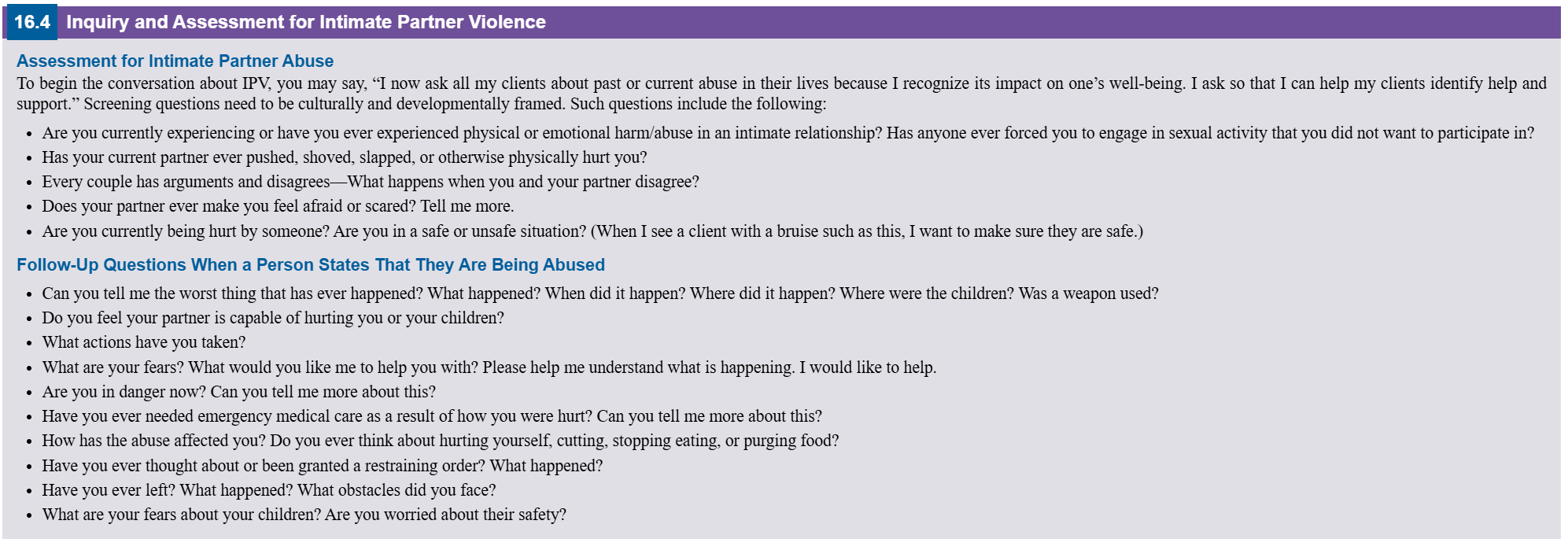
IVP prevention
primary prevention → stop violence from occurring in the first place.
EX: teaching high schoolers how to recognize controlling behaviors in a relationship
secondary prevention → identify IVP as early as possible and innerve before harm.
EX: screening privately w/o the partner present
tertiary prevention → prevent further harm and complications (patients who have already experienced IVP)
EX: treat injuries caused by IVP, develop safety plans, provide support for consequences of abuse
lethality assessment → helps ID risk factors associated with intimate partner homicide
safety planning → working with the patient to develop strategies that reduce the risk of injury or death

risk factors for IVP
Substance use disorder
traditional gender roles (specifically, rigid beliefs supporting male dominance, control, or unequal power can increase risk)
depression
Risk factors include age less than 45 years, low income, lack of employment, recent separation or divorce, education at the high school level or lower, and having young children. Certain populations face a higher risk of IVP, such as Native Americans, non-Hispanic Black women, women with mental and physical disabilities, adolescent girls (dating violence), and immigrant women.

alcohol use and associated mental disorders
Alcohol use accounts for approx. 3 million deaths per year
Associated mental disorders:
CIWA – alcohol w/d
N/V
Tactile disturbances
Tremor
Auditory disturbances
Anxiety
HA
Agitation
Orientation and clouding of sensorium
tx of alcohol dependency
Medication-assisted treatments of alcohol-dependent disorders
Naltrexone and acamprosate diminish craving
Disulfiram induces AE
motivational interviewing and completion of mental staus examinations
Goal-directed, client-centered counseling style for eliciting behavioral change by helping clients explore and resolve ambivalence. MI has been applied to a wide range of problem behaviors r/t alcohol and substance misuse, as well as health promotion, medical treatment adherence, and mental health issues
Establishing rapport with the client and listening reflectively
Asking open-ended questions to explore the clients' own motivations for change
Affirming the clients change-related statements and efforts
Eliciting recognition of the gap between current behavior and desired life goals
Asking permission before providing information or advise
Responding to resistance w/o direct confrontation
Encouraging the client’s self-efficacy for change
Developing an action plan to which the client is willing to commit.
adolescent drug screening
CRAFFT drug screen (2/6)
Have you ever ridden in a Car driven by someone (including yourself) who was “high” or had been using alcohol or drugs?
Do you ever use alcohol or drugs to Relax, feel better about yourself, or fit in?
Do you ever use alcohol or drugs while you are by yourself, Alone?
Do you ever Forget things you did while using alcohol or drugs?
Do your family or Friends ever tell you that you should cut down on your drinking or drug use?
Have you gotten into Trouble while you were using alcohol or drugs?
Scoring: A “Yes” answer to two or more questions indicates the need for active intervention
Men have a higher amount of fluids in their body
methods used to decrease opioid use
Recommendations for prescribing opioids for chronic pain outside palliative and end-of-life care
Determining when to initiate or continue opioids for chronic pain
Opioid selection, dosage, duration, f/u, and discontinuation
Assessing risk and addressing harms of opioid use
Substance use treatment need not be voluntary to help people achieve recovery. The most effective treatment involves a multimodal approach with interventions such as motivational interviewing, opioid substitution programs, family therapy or couples therapy, and 12-step self-help groups
Decreases in opioid dispending – increased guidelines
most illicit drug
Marijuana is the most illicit drug
50% of high schoolers have smoked
healthy people 2020/2030
SDOH domains for healthy people 2030:
Helping more people achieve economic and financial stability.
Providing high-quality educational opportunities for children and adolescents and helping them do well in school.
Improving health by helping people get timely, high-quality healthcare services.
Improving health and safety in the places where people live, work, learn, and play.
Helping people get the social support they need in the places where they live, work, learn, and play.

geonomics
Analyze all genes and their interrelationship on the growth and development of an organism
Genetics looks at single genes
the study of all of a person's genes (their genome), including how genes interact with each other and the environment to influence health and disease.
epigenetics
Study the changes in organisms are through human behaviors and the environment
DNA remains the same, but social determinants of health impact people differently
helps us understand that changes in organisms through modification of gene expressions are occurring through not only human behaviors but also the environment
Example
Two identical twins have the same DNA, but:
Twin A: Exercises regularly, eats a balanced diet, and experiences low stress.
Twin B: Smokes, has poor nutrition, and experiences chronic stress.
Over time, these different exposures may lead to different epigenetic changes, affecting how certain genes are expressed.
polygenic screening
Analysis of genetic variants that place a person at increased risk for a particular disease (i.e. BRCA1 and BRCA2 testing)
examines many genetic variants to estimate someone's inherited risk of developing a disease
medically undersearved area
Areas that are determined through the calculation of a ratio of primary medical care physicians per 1,000 population, infant mortality rate, and percentage of the population aged 65 and older
Geographic area
medically underserved population
US federal designation (the federal government officially identifies certain populations) for those populations that face economic barriers or cultural and/or linguistic access barriers to primary medical care services
Federally qualified health center for those areas and populations
A specific population group
levels of poverty within the US
Rural residents tend to be poorer
Rural Americans are more likely to live below the poverty level
older adults have incomes that can be up to 20% lower than those of their urban counterparts because of lower social security payments, smaller levels of assets in the bank or in property, less pension coverage, and less opportunity to make up the difference because of lack of part-time employment possibilities.
Nearly 24% of rural children live in poverty.
health inequity
Systemic, avoidable, and unjust disparities in health status and mortality rates across population groups that are rooted to underlying injustices and social and economic conditions
Unfair, avoidable differences in health outcomes between populations
systematic injustice
occurs when laws, policies, institutions, or social systems create unfair disadvantages for certain groups of people
Even through the gap in health outcomes between White population and communities of color has improved, major disparities still exist. People who experience racism, economic inequality, gender inequality and other systemic injustices often have worse health outcomes and face more barriers when trying to access healthcare.
Systemic racism refers to policies, institutional practices, and structures that produce unequal opportunities or outcomes across racial groups.
In healthcare, this may contribute to disparities in access, quality of care, and health outcomes.
EX: A community experiences longstanding housing discrimination, leading to greater exposure to pollution and fewer nearby healthcare resources.
Nursing role: Identify barriers, advocate for equitable access, provide culturally responsive care, and address social determinants of health.