BSC2011 Exam 2
 Call Kai
 Learn
Learn Practice Test
 Spaced Repetition
 Match
Match Flashcards
 Knowt Play
1/154

There's no tags or description
Looks like no tags are added yet.
Name | Mastery | Learn | Test | Matching | Spaced | Call with Kai | Chat |
|---|
No analytics yet
Send a link to your students to track their progress
155 Terms
general characteristics of animals
multicellularity
heterotrophic metabolism
internal digestion
true or false: all animals are monophyletic (have a common ancestor)
true
common ancestor development
flagellated protists similar to existing choanoflagellates and sponges
formation of colonies due to efficient pray capturing
cells in colonies began to specialize for different functions (movement, nutrition)
led to complex animals
do colonies of choanoflagellate protists count as animals
no because they do not have any specialized cells
single cells attached to stalk w flagella
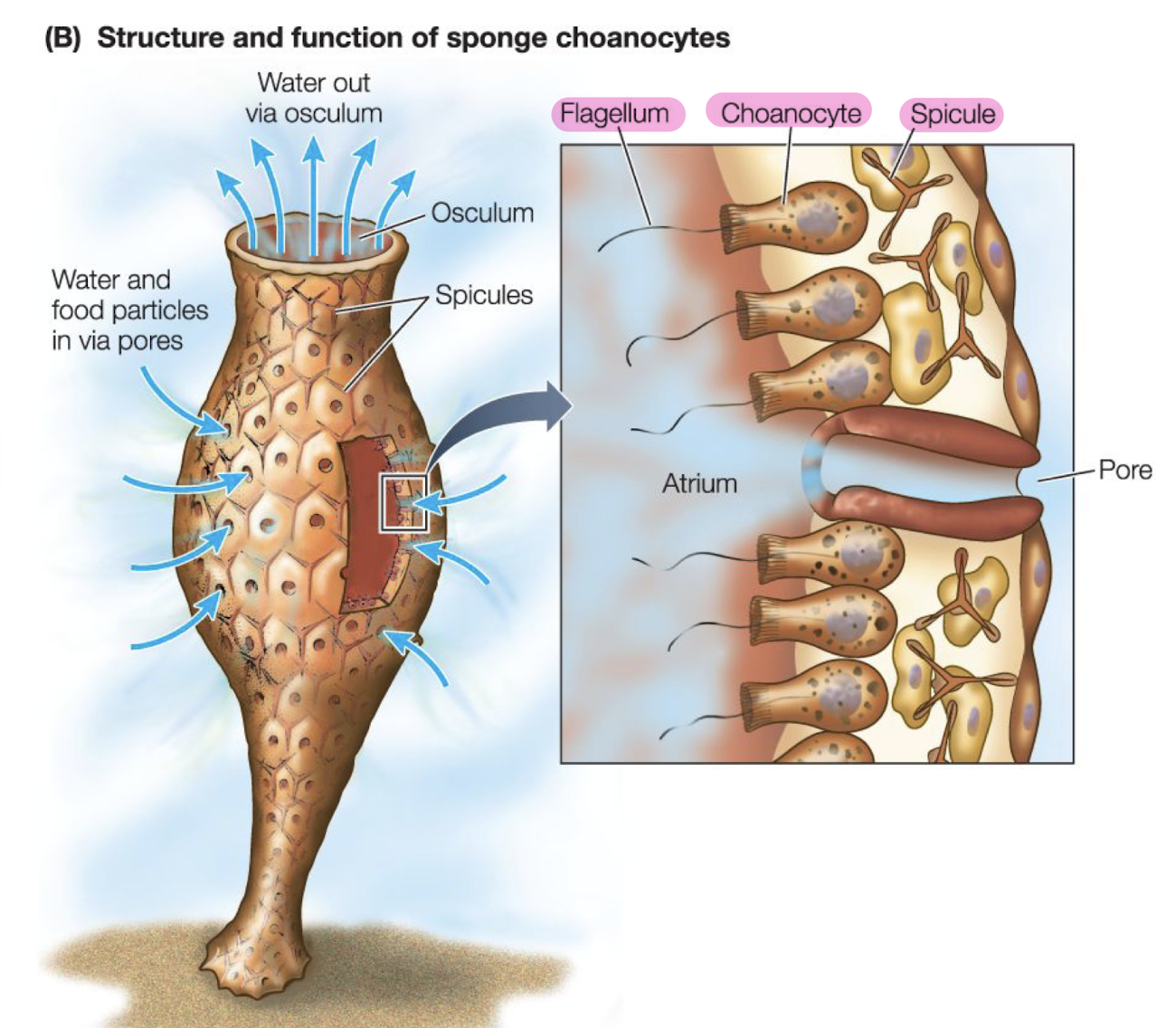
structure and function of sponge choanoccytes
narrow bottom, bulbous center, narrow top
opening of upper bulb: osculum, water exits here
water and food particles in via pores that are on spicules
choanocytes and their falgella facing toward inner cavity of bulb
cleavage
early cell divisions of an embryo
patterns of cleavage characterize different animal groups
examples of cleavage patterns
radial cleavage: yolk (energy for developing embryo) distributed through egg cytoplasm, zygote and descendent cells divide evenly
spiral cleavage: new cells at angles to existing ones, creates spiral
germ layers
first layers of cells that develop in early development
diploblastic animals
2 layers
ectoderm (outer), endoderm (inner)
triploblastic animals
3 cell layers
ectoderm, endoderm, mesoderm (middle)
when do germ layers form in development?
gastrulation (invagination)
blastula (hollow, fluid filled ball w cells on outside) invaginates creating a blastopore
forms layers on inside which create germ layers

ectoderm
outer layers
outer surface (epidermal cells of skin)
cns (neurons)
neural crest (pigment cell ex melanocyte)
mesoderm
middle layer
dorsal (notochord)
paraxial (bone tissue)
intermediate (tubule cell of kidney)
lateral (red blood cells)
head (facial muscle)
endoderm
inner layer
digestive tube (stomach cell)
pharynx (thyroid cell)
respiratory tube (lung/aveolar cell)q
bilaterians
bilateral symmetry (2 mirrored sides) during embryonic development
true of false: all diplobasts are bilaterians
false, all triplobasts are bilaterians
protostomes
blastopore develops into mouth
anus forms later
ex. insects, snails
deuterostomes
blastopore develops into anus
mouth develops later
ex. vertebrates, starfish
true or false: protostomes and deuterostomes are distinct clades
true
true or false: triplobalasts are a clade
true
body plan
general structure, arrangement of organ systems, integrated functioning of body parts
5 key features of the body plan
symmetry
body cavity structure
segmentation
external appendages
complexity of nervous system
symmetry
overall shape
symmetrical
can be divided along at least one plant into similar halves
radial symmetry
body parts arranged around central axis

bilateral symmetry
can be divided into mirror image halves only on one plane

asymmetrical
no plane of symmetry
ex. placozoans and sponges
bilaterial symmetry and cephalization
concentration of sensory organs and nerve tissues at anterior end (head)
cephalizatoin
having a head
more advanced trait = more advanced animal
allows for communication, sensory reception, etc
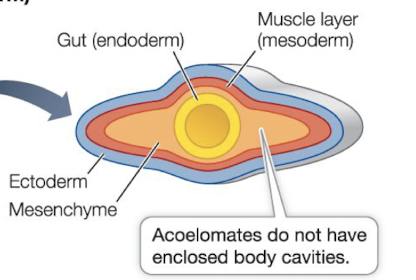
acoelomate
no fluid filled body cavity
whole body filled with loosely connected ciliated cells (mesenchyme)
creates flexible body
psuedocoelomate
body cavity is fluid-filled space where internal organs are suspended
no mesoderm surrounding internal organs

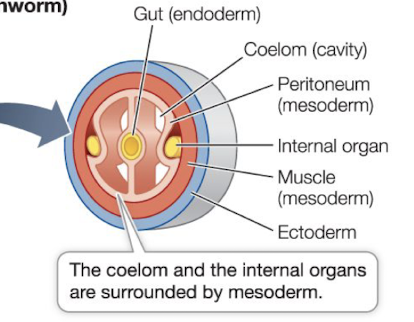
coelomate
body cavity is coelom (housed w/in mesoderm)
lined with layer of muscular tissue (peritoneum)
enclosed on both inside and outside by mesoderm
hydrostatic skeletons
when muscles contract, fluid is pushed to another part of cavity, causes region to expand
ex. earthworm movement through hydrostatic skeleton
segmentation
facilitates specialization of body regions
allows animal to alter body shape and control precise movements
true of false: radiation of anthropods was not based on segmented body plans
false, was based
appendages
can enhance animals ability to move around among other functions
ex. antennae, claws, mouthparts, reproductive organs
nerve nets
simple collection of nerves that functions as nervous system
not brain or nervous system
in ctenophores and cnidarians
bilaterian nervous system
well coordinated CNS due to cephalization
muscle action coordinated to allow movement of appendages and body parts
sensory info gathered and processed
nerve nets on cladogram
evolved independently twice in cnidarians and cnetophores
four animal groups that are not bilaterians
sponges, cnetophores, placozoans, cnidarians
which 2 out of the 4 animal groups that are not bilaterians split first
sponges and cnetophores
sponges
monoblastic
no distinct embryonic (germ) cell layers and no true organs
spicules: skeletal elements made of silicon dioxide or calcium carbonate
spicules in glass sponges and demosponges are made of…
silicon dioxide
spicules in calcareous sponges are made of…
calcium carbonate (good in salt water)
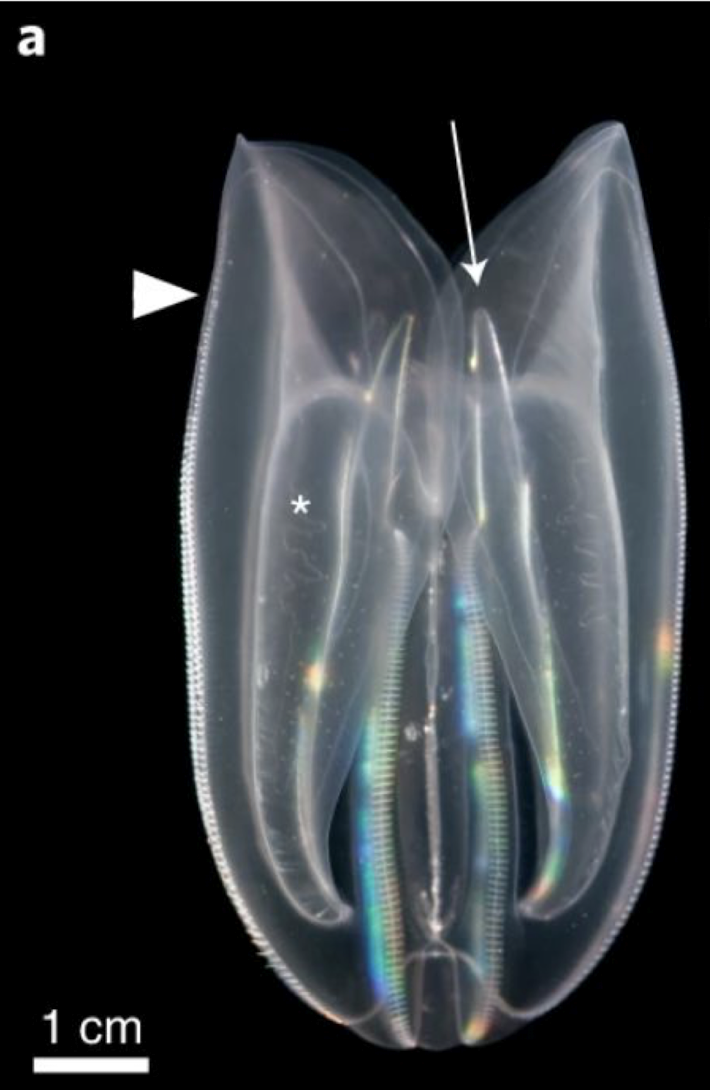
cnetophores
“comb jellies”
radial symmetry, diploblastic
move by beating cillia arranges on 8 comblike plates called ctenes
placozoans
very simple, only 4 cell types
diplobasltic
two life stages: pelagic swimming stage (free swimming/drifting) and stage that adheres to surfaces
cnidarians
diploblastic
jellyfishes, sea anemones, corals, hydrozoans
gastrovascular cavity: functions in digestion, circulation, gas exchange, hydrostatic skeleton
life cycle: sessile polyp (like coral) and motile medusa stages
nematocysts
nematocysts
feature of cnidarians
specialized harpoon-like structures w toxins (reason why tentacles get stuck to you)
used to capture large pray
causes stinging
life cycle of cnidarian
polyp (2n) → mature polyp (2n) → young medusa (2n) → mature medusa/jellyfish (2n) → fertilization of egg and sperm (n+n) → fertilized egg (2n) → planula larva (2n)
heterotrophs
organisms that require preformed organic molecules as sources of energy and chemical building blocks
obtain energy through breaking chemical bonds of organic compounds obtained by other organisms
build their tissues (growth and cell replacement) w matter present in preexisting organic compounds
organization
most essential attribute of life
second law of thermodynamics
any organized system, left alone, tends to lose organization and become more random
animals and second law of thermodynamics connection
animals need to obtain energy so they can work to maintain their organization
how is energy needed to maintain a charge gradient across a cell membrane
energy is needed for the ion channel pumps that maintain the charge distribution of the cell
how is energy needed to maintain the retina
photoreceptors in the eyes receive light energy
neurons needs energy to maintain organization and process information received by photoreceptiors
three types of feeding
predation
suspension feeding
symbiosis
suspension feeding
animal filters tiny food particles suspended in water rather than hunting or eating large pieces of food.
nutrition
study of how animals meet their needs for chemical substances and energy
interconversion of molecules in animals
lipid molecules → carbohydrates
not complete, some molecules must be fully formed and obtained from food
essential nutrients
required but cannot be synthesized by animal
standard amino acids
20 amino acids animals need to build proteins
animals can synthesize some of these
essential amino acids
amino acids that cannot be synthesized and must come from food
essential fatty acids
omgea-3 and omega-6
3 and 6 refer to # of carbon position of the last double bond
PVT. TIM HALL
8 essential amino acids for adult humans
phenylalanine
valine
tryptophan
threonine
isoleucine
methionine
histidine (only required in infants)
arginine*
lysine
leucine
essential vitamins
A (vision)
K (blood clotting)
essential minerals
chemical elements that animals require in addition to C, O, H, N
ex. Ca, P (bone strength), I (thyroid horomes), Fe (hemoglobin)
energy content of food
measured by amount of heat food produces when burned in presence of O2 forcing CO2 and H2O
calorie
amount of heat needed to raise 1g of H2O 1 degree Celcius
food labels
kilocalories (1000 calories)
1 Joule
0.239 calories
metabolic rate
amount of chemical bond energy consumed and converted to heat per day
three types of food molecules
lipids (fats and oils)
carbohydrates
proteins
what happens when an animal consumes more chemical-bond energy than it needs
some can be stored as energy dense lipids
true or false: animals with lower metabolic rates have lower food needs
true, the opposite is also true
animals with high metabolic rates need to find and eat a lot of food per unit of time to replace energy being consumed
true or false: physical activity increases metabolic rate
true
humans: linear increase
fish: exponential increase due to resistance in water
birds: high and low speeds metabolic rate is high
basal metabolic rate (BMR)
measured when an animal is in a comfortable thermal environment and has not eaten recently
scaling relationships
animals characteristics as functions of body size
BMR per gram body weight decreases as animal size increases
small mammals need more food per gram of body weight than large mammals do
intersitial fluids
cells in an animals body that are bathed with body fluids
regulation
occurs when internal environment stays constant even when external environment changes
provides stability but energetically expensive
regulators
animals that can maintain constant internal conditions like temperature
conformers
animals with internal environments that vary to match the external environment
energetically cheap but animals cells must be able to cope with changes in their environment
intracellular vs extracellular fluid
intra = fluid inside cells
extra = rest of the body fluid in the body including plasma and interssital fluid
epithelia
sheet of epithelial cells that covers a body surface, organ, or lines a body cavity
functions: pumps ions between fluids on either side, secretes hormones, mucous, digestive enzymes, milk, sweat, absorbs nutrients from gut, serves sensory functions like smell and taste, separates fluid compartments
simple epithelium
single layer of cells on nonliving basement membrane
lines blood vessels, intestines, other tubules
roles of cell membranes
pumps ions between intra and extracellular fluid
receiving and producing physiological signals (cells receptors)
control diffusion of ions/molecules
tissue
assemblage of cells of similar type
organ
2+ types of tissue w defined structural relationship to each other
multi-organ system
multiple organs working together
levels of organization in midgut (small intenstine)
small intestine organ in digestive organ system
small intestine composed of connective tissue, smooth muscle tissue, and nervous tissue
intestine lined w simple epithelium, digestive enzymes, absorption of nutrients, secretion of hormones and mucous
homeostasis
refers to the stability of the internal environment and the mechanisms that maintain it
con of regulation of homeostasis
energetically expensive
homeotherms
animals that maintain a constant internal body temperature (thermoregualtion)
thermoneutral zone (TNZ)
range of external temperatures in which metabolic rate is minimal and does not change with external temperature
not much energy has to be expended to keep body temp w/in homeostatic range
true or false: outside of the TNZ, metabolic rate lowers
false, metabolic rate rises
pokilotherms or ectotheerms
body temperatures are variable and are determined by the external temperature
no internal body temp regulation
vary widely in body temperature limits
how do poikilotherms and ectotherms regulate their body temperatuer
behavioral thermoregulation ex. physical positioning of body in shade or sun
true or false: in general poikilotherm metabolic rate is higher than homeotherm body temperature when external temperatures are low
false, when external temperatures are low, metabolic rates of homeotherms are higher than poikilotherms
homeothermy relationship between external temperature and metabolic rate
metabolic rate rises as the temperature falls below the TNZ (body requires energy to keep the body warm)
TNZ
metabolic rate rises as the temperature increases above the TNZ (body requires energy to keep it cool)
food needs additional to this
poikiliothermy relationship between external temperature and metabolic rate
metabolic rate rises because as the external temperature rises, the animal’s internal temperature also rises
homeotherm mechanisms that can increase metabolic rate in cold environemnts
shivering: skeletal muscles contract and energy is converted from ATP to heat
nonshivering thermogenesis