hand/wrist osteology
 Call Kai
 Learn
Learn Practice Test
 Spaced Repetition
 Match
Match Flashcards
 Knowt Play
1/75

There's no tags or description
Looks like no tags are added yet.
Name | Mastery | Learn | Test | Matching | Spaced | Call with Kai | Chat |
|---|
No analytics yet
Send a link to your students to track their progress
76 Terms
radius angulation
slightly volarly 10 degrees, and ulnarly 25 degrees
proximal row of carpals
scaphoid, lunate, triquetrum, pisiform
distal row of carpals
trapezium, trapezoid, capitate, hamate
scaphoid
proximal surface: convex
responsible for placing the first digit anterior to the plane of the palm
most commonly fractured bone in the hand, with problems healing
lunate
most frequently dislocated carpal
proximally convex, distally concave
pisiform
sits on triquetrum
FCU tendon encases this before inserting on hook of hamate
trapezium
forms CMC joint with 1st MC
capitate
axis for ulnar and radial deviation
stable bone
hamate
FCU tendon insertion
creates tunnel of guyon between pisiform and hook of hamate
ulnar n. compression here- “bikers palsy”
metacarpals
concave base, convex head
contain tubercles for collateral ligaments (ECU attachment on thumb)
phalanges
concave base, convex head
proximal/distal phalanx concave- assists in “longitudinal arch”
wrist joint consists of
radiocarpal and midcarpal
wrist joint DoF
2 DoF- flexion/extension, RD/UD
wrist joint flexion/extension
sagittal plane, ML axis
flexion: 0-80, extension: 0-70
* volar/ulnar angulation of articular surfaces allows greater ROM in flexion
wrist joint UD/RD
frontal plane, AP axis
RD: 0-20, UD: 0-35
* volar/ulnar angulation of articular surfaces allows greater ROM in UD
CMC joint 1
trapezium to first MC
2 DoF- flexion/extension, abduction/adduction
CMC flexion/extension
frontal plane, AP axis
flexion: 0-45, extension: 0
CMC abduction/adduction
sagittal plane, ML axis *and opposition, reposition (non-volitional)
abd: 0-80, add: 0
opposition involves __ degrees of thumb rotation
45-60
CMC joint 2-5
no volitional motion, minimal between hamate, capitate, and trapezoid.
allow shape of transverse arch of the hand to change
thumb MCP joint
condyloid
1 DoF- flexion/extension BUT abd/add can occur
thumb MCP flexion/extension plane and norms
frontal plane, AP axis
flexion: 0-60, extension: 0
MCP joints 2-5
2 DoF- flexion/extension, abduction/adduction
passive long axis rotation available due to ligamentous laxity
mcp joint flexion/extension
sagittal plane, ML axis
flexion: 0-90, extension: 45 (passive 90)
* MCP range of flexion increases moving towards digit 5
digit __ has the greated abduction/adduction
2
in MCP joints 2-5, passive extension
greatly exceeds active
IP joints
hinge joint
1 DoF- flexion/extension
IP joint flexion/extension
sagittal plane, ML axis
DIP flexion: 0-70-90, extension: 0-30 active
PIP flexion: 0-100, extension: 0?
thumb IP joint flexion/extension
frontal plane, AP axis
flexion: 0-80
RC joint arthro
scaphoid and lunate with radius and disc
convex carpal bones moving on concave radius
flexion: volar roll, dorsal glide
extension: dorsal roll, volar glide
MC joint arthro flexion/extension
proximal carpal bones with distal carpal bones
convex distal carpal bones moving on concave proximal carpal bones
flexion: volar roll, dorsal glide
extension: dorsal roll, volar glide
RCL
radial styloid- scaphoid, trapezium, transverse carpal ligament
resists UD (like APL, EPL, EPB)
UCL
ulnar styloid- pisiform/triquetrum
resists RD (with ECU)
part of ulnocarpal complex
palmar ligamentous complex
distal radius- scaphoid, lunate, triquetrum, capitate.
important for wrist joint stability
limit wrist EXTENSION
dorsal ligamentous complex
posterior distal radius- scaphoid, lunate, triquetrum
restricts FLEXION
properties of intercarpal bones
all possess synovial cavities
have joint capsules
linked by interosseous ligaments
less vascular, slower to heal
scapholunate ligament
stabilizes scaphoid
lunotriquetral ligament
stabilizes lunate and triquetrum
functional motion of wrist joint
10 degrees flexion, 35 degrees extension
RC/MC arthro UD/RD
convex proximal carpal row on concave radius
convex capitate moving on concave proximal row
RD: radial roll
UD: ulnar roll
glide not typically referenced
close pack position for wrist
full extension
CMC joint 2-5 arthro
will not describe arthro, but they are important for transverse arch of hand
increased mobility of 4/5- may assist in opposition (5)
small motion helps form palmar arches that allow cupping
intercarpal motion
translatory motion between bases of MCs 2-5
palm proper
distal and middle palmar crease
digito palmar crease
crease at MCP
interdigital cleft
webbing between fingers
thenar eminence
flexor retinaculum, palmaris longus, radial pulse
anatomical snuffbox
EPL, EPB, APL
base: CMC joint thumb, radial artery, radial styloid
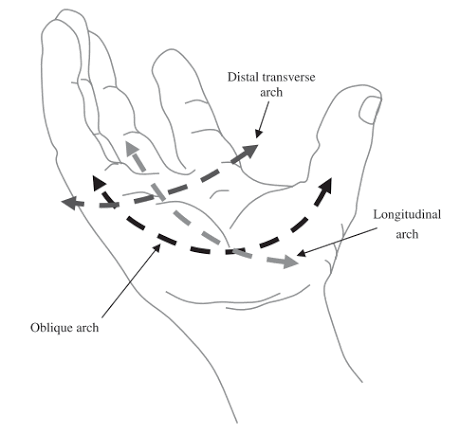
transverse arch
formed by concavity anteriorly of carpal bones. continuous with transverse arch at MC heads

longitudinal arches
arch of middle finger, concave anteriorly with keystone at MCP joint
arch of index used with opposition

oblique arches
arches formed by thumb with opposition. includes
thumb to index
thumb to pinky
carpal tunnel
carpal bones form anterior, concave gutter. transverse carpal ligament spans gutter. medial border= pisiform, hook of hamate, lateral border= tubercle of trapezium/scaphoid
holds finger flexor tendons, median nerve, FPL
MCP joint 2-5 arthro flexion/extension
concave base moving on a convex head
concave base is much smaller, volar plate acts like a hinge to increase contact
flexion: volar roll, volar glide
extension: dorsal roll, dorsal glide
volar plate functions
increase contact between joint surfaces
prevent premature bone on bone contact in flexion
MCP flexion is limited by
dorsal muscles, extensor mechanism, collateral ligaments
MCP extension is limited by
palmar muscles, joint capsule
MCP adduction is limited by
contact with adjacent digit
extended MCP joint abd/add are limited by
interossei
flexed MCP joint abd/add are limited by
collateral ligaments
close pack position for MCP joint
70-90 degrees flexion
loose pack position for MCP joint
30 degrees flexion
IP volar plate
serves to enhance contact of small base with large head
IP collateral ligaments
restrict VALGUS and VARUS strain at IP
IP anterior capsular ligament
stabilizes volar surface
at PIP- check rein ligament, limits EXTENSION
IP joint arthro
concave base moving on convex head
flexion: volar roll, volar glide
extension: dorsal roll, dorsal glide
thumb IP function
same manner as 2-5; 1 DoF. slight medial rotation with IP flexion due to medial condyle being slightly more distal
close pack position for IP joints
25 degrees of flexion
thumb MCP arthro
concave proximal base of phalanx moving on convex distal head of 1st MC
flexion: ulnar roll, ulnar glide
extension: radial roll, radial glide
close pack position for thumb MCP joint
full flexion (active to 60)
ligaments of 1st CMC joint
anterior oblique
UCL
first intermetacarpal
posterior oblique
RCL
1st CMC abduction/adduction arthro
convex MC moves on concave trapezium
axis: MC
abduction: volar roll, dorsal glide
adduction: dorsal roll, volar glide
1st CMC flexion/extension arthro
concave MC moving on convex trapezium
axis: trapezium
flexion: ulnar roll, ulnar glide
extension: radial roll, radial glide
close pack position for 1st CMC joint
opposition, end range abduction
loose pack position for 1st CMC joint
mid range abduction
opposition involves
abduction, flexion, internal rotation
reposition involves
extension, adduction, external rotation