criminal law = Introducing the criminal law of scotland.
 Call Kai
 Learn
Learn Practice Test
 Spaced Repetition
 Match
Match Flashcards
 Knowt Play
1/71

There's no tags or description
Looks like no tags are added yet.
Name | Mastery | Learn | Test | Matching | Spaced | Call with Kai | Chat |
|---|
No analytics yet
Send a link to your students to track their progress
72 Terms
What is harm principle?
An act or omission which causes harm
What is a crime?
A situation forbidden by the law under threat of punishment
What are the 2 types of conduct in crimes of commission?
Positive conduct
Result conduct
What is the meaning of positive conduct (crimes of commission)?
A public wrong ie assault or murder
What is the meaning of result conduct (crime of commission)?
An act or conduct that has a later effect
ie selling knives to a minor
What are the 2 types of conduct in crimes of omission?
Negative conduct
Negative conduct that has a result
What is the meaning of negative conduct within the crime of omission?
Failure to comply with the law when faced with a legal duty
ie failure to provide a breath specimen
What is the meaning of gof negative conduct with a result in crime of omission?
a crime that happens when someone fails to do something they have a legal duty to do, and that failure causes harm or breaks the law
ie starving a child to death.
What is a state of affairs?
A state of affairs is a situation or condition
It exists when a person is in a particular situation that is unlawful
ie drunk in charge of a motor vehicle
When does the state of affairs apply?
In statutory offences
Breach of the peace of common law
What is the ‘Good Samaritan rule’ and is it in Scotland?
The Good Samaritan rule is when you find someone in danger and are legally bound to help them
Scotland does not have any legal binding to this rule with he exception with some situations
When does the commission follow a prior dangerous act and example?
When the previous positive act may be criminal or not criminal
example is : HMA v McPhee
When does the accused status contractual obligation result in a duty to act?
Applies to those in public office or positions with responsibility
When the accused has a duty to prevent the occurrence of harm and fails to do so
Example is ; Bonnar and Hogg v Macleod (Police officer who assaulted and supervisor did not intervene)
When does prior special relationships between parties hold a legal obligation? And example
An example is a parent and a minor
But the obligation is not absolute personal characteristics are considered
Bone vs HMA (Homocide against daughter)
What are the 5 statements that makeup the definition of a criminal act?
A public wrong
An action with a result
negative conduct
negative conduct with a result
state of affairs
What acts are seen to be a crime?
Involving harm
causing offence to others
conflicting with morality
Harm to the offender
How is the law defines in criminal law?
Through
common law
legislation
Human rights law
Legal writing
Why is Scotland considered to be a mixed legal system?
As common law is developed and applied through judges
Written by institutional writers who are prominent lawyers
Uses both uk and Scottish parliament and legislation
Follows the European convention of Human Rights
How has common law developed in Scotland?
Evolved by cases heard in court and decisions taken by judges and creating precedents
What is the definition of Scottish common law?
The decision of previous higher court is used to guide a decision on a particular offence
What is the declamatory power of the high court?
Its the higher court power to declare the common law which is of obvious criminal nature e
What is legislation?
Act or omission can be declared crimes by statue because society demands that these actions are treated as crimes
Both Uk(Westminster acts) or Scottish acts
How does the European convention on Human Rights known as the ECHR affect Scottish criminal law?
Its only enforced to the extent that is compatible with the rights set out in the human right act of 1998
What are the principles of law?
No one is above the law
The law must be understandable and accessible
Legal rights and responsibilities are decided through rules of law
Governments should exercise their power in good faith and responsibly
Justice should not be excessively delayed or costly
State should comply with obligations of national law
The law must protect fundamental human rights
How many jurisdictions does the Uk have?
3
What are the names of the UK Jurisdiction?
England
Wales and Northen Ireland
Scotland
How does the Scottish criminal justice system differ from other Jurisdictions?
Scotland has its own separate criminal justice system
The union with Scotland Act 1707 ratified the Treaty of Union
Scotland retained its own legal system that developed separately from Wales and England
Even before devolution they SJS had its won police force,prosecution service and prisons.
How has Scottish values reflected in policy making compared to England and Wales?
Scotland has often been described as having a different penal philosophy with less harsh and disciplinary criminal justice system.
What is the meaning of civil law?
Right of obligations of individuals and organisations
What is the meaning of criminal law/public law?
it concerns the structure of government
The power, duties and obligations from officials
It includes both statutory and common law offences.
How is the Scottish legal framework?

How does common law differ between England and Scottish criminal systems?
Sentencers in Scotland have discretion when considering sentencing options available to them.
Its evolved over time by cases heard in court and decisions taken by judges creating precedents
Sentences are not fixed by nature of the offence but the authority of the court hearing the case.
What is the meaning of proctor Fiscal?
In where the court decide which court the prosecution should take place in. Which is also considered by the seriousness of the crime.
What is the order of Scottish criminal courts?
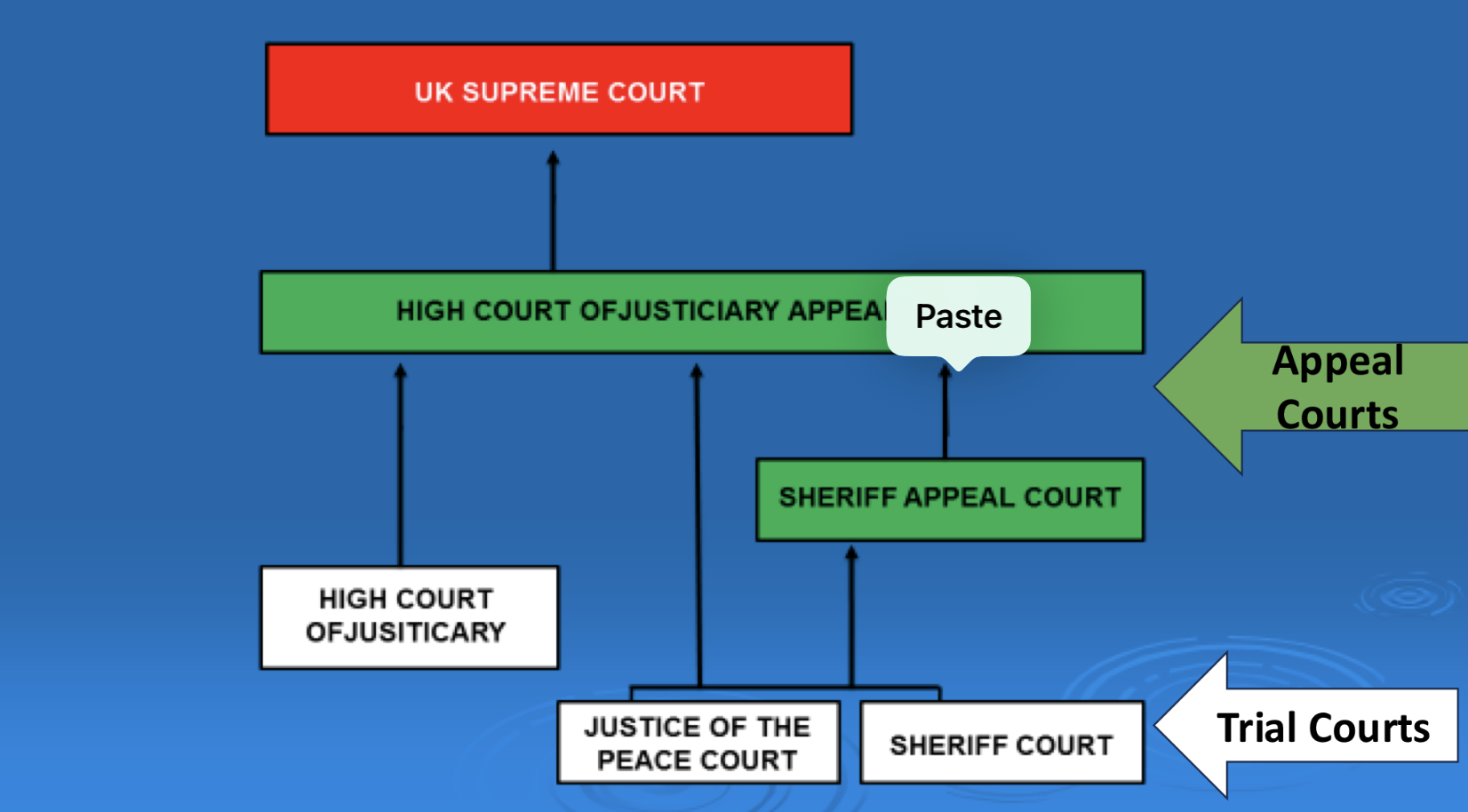
What occurs at the Justice of the peace courts?
Its the lowest level of the criminal court system
Deals with minot offences
The judges are known as ‘lay judges’
Can impose custodial sentences of up to 60 days and fines of £2,500
What occurs at the Sherrif Courts?
Majority of cases in Scotland
Deal with crime that are too serious for a Justice of the Peace court but not serious enough or the high court
There are 2 types of proceedings summary and solemn procedure.
What is the meaning of summary procedure?
Used for less serious offences and may ultimately lead to trial before Sheriff or a JoP
Trails under summary are conducted without a Jury
What is the meaning of solemn procedure?
Involves the most serious of criminal cases
May to lead to trial on indictment before a judge in the HC or before a sheriff in the SC
Conducted of a jury of 15 people.
What is the procedure of the summary?
The Sheriff determines if the accused is guilty or not
And if found guilty imposes the sentencing
The maximum sentence hears before a sheriff is 12 months in prison or a £10,000 fine
What is the structure of the jury and verdict requirements in Scottish solemn procedure?
Used only under solemn procedure in Scotland.
Jury consists of 15 people.
The jury are the finders of fact, not arbiters of the law.
A simple majority (at least 8 out of 15 / over 1/2) is required for a guilty verdict (Note: In Scotland, a minimum of 8 jury members out of 15 must agree to convict).
The jury decides whether the accused is guilty or not.
What are the main procedural steps during a solemn trial in Scotland?
No opening statements (standard Scottish procedure).
Begins directly with the Crown and defense calling their witnesses.
No requirement for the accused to give evidence.
Closing speeches are made.
The trial judge/sheriff gives their charge to the jury.
The jury returns their verdict.
What are the roles of the sheriff and the limits on sentencing in solemn procedure?
Role of Sheriff: Determines the sentence if the accused is convicted.
Sentence limits (Sheriff Court):
Maximum prison sentence of 5 years.
No limit on the fine the sheriff can impose.
What is the high court of Justiciary?
The highest criminal court
Covers the whole of Scotland in respect of all crimes
Aberdeen, Edinburgh, Glasgow have permanent HC buildings
Deal with the most serious crimes like murder.
How is the High Court of Justiciary structured for trials and appeals?
A single judge hears cases with a jury of 15 people.
Sitting as a court of appeal is only in Edinburgh.
3 judges are mandatory when hearing appeals against conviction.
Appeals against sentence are generally heard by a bench of 2 judges.
Who undertakes prosecutions in the High Court and Sheriff Court?
Prosecutions in the High Court are brought in the name of the Lord Advocate and handled by advocate deputes.
Prosecutions in the Sheriff Court are undertaken by the Procurator Fiscal for a sheriffdom.
What is and occurs in the UK Supreme Court?
It is the final court of appeal for all Uk civil and criminal cases
Hears appeals on arguable points of law of general public importance
Concentrates on cases of the greatest public and constitutional importance
Maintans and develops the role of the highest court in the UK
What are the rules of appealing cases?
The name of the Paris are reversed
Law reports to include an appellants first name in Brackets
Only exception is when the Crown is the appellant.
What has changed to the rule of verdicts?
3 verdict system has been abolished from 2026 onwards
Only 2 options available guilty / non guilty
Jury size has to be 15 members
conviction requires 2/3 majority (10 out of the 15)
What is the new rule on the doctrine of Judicial precedent?
The decision of the higher courts create a precedence which the lower courts must follow.
Stare decisis
What is the meaning of ‘Stare Decisis’?
To stand by things decided
What is the position of Lord advocate ?
His Majesty’s Advocate is alternatively called
Principal legal adviser of both Scottish government and the crown in Scotland for civil and criminal matters
They are able to refer to a point of law which has arisen during course of solemn proceedings for determination
THE HCOJ considers the case and arguments and gives an opinion and interpretation of how the law should be applied
then the case is sent back for to the court origin.
How does legislation define crime ?
There are acts or omissions declared to be crimes by statue
Can be UK acts or Scottish acts which only apply in Scotland
How does a person’s state of mind affect whether their conduct constitutes a crime?
Conduct generally amounts to a crime only if carried out with a blameworthy state of mind (criminal intent)
What is the 2 part general rule that crime consists of?
Conduct + mental element
⬇Act + Intention
What is the meaning of conduct in anatomy of crime?
Doing something wrong
An omission
A state of affairs
What is the meaning of mental element in anatomy of a crime?
Criminal intention
Acting recklessly
Blameworthy state of mind
Can a defence challenge what constitutes a crime?
Yes. Some defences prevent the establishment of the actus reus or mens rea, meaning one or both elements of the crime is ultimately missing.
What does there need to be for it to be considered a crime?
Act
Intention
No defence
What is the meaning of Actus Reus?
Conduct element of an offence
ie doing the criminal offence
What is the meaning of Mens Rea?
Guilty purpose or criminal intent —→
Dole —→ evil intent
When is someone seen as being guilty of a crime?
If without justification or excuse they carry out the actus reus of that crime and has the required Mens Rea
What if they don't happen at exactly the same time?
No. Although they normally coincide, an accused may still be criminally liable where the acts and mental state form part of the same sequence of events/one transaction.
What is an example of coincidence in time under autonomy of crime