Renal Filtration
 Call Kai
 Learn
 Practice Test
 Spaced Repetition
 Match
 Flashcards
 Knowt Play
1/36

There's no tags or description
Looks like no tags are added yet.
37 Terms
Kidney functions
Homeostasis of ECF - volume (water and Na balance, electrolyte composition, osmolarity)
Waste disposal, hormone production, acid-base balance

Kidney anatomy

Nephron

Vascular componenet of nephron

What are the two types of nephrons?
Cortical nephrons: 80%, short loop of Henle, mostly in cortex
Juxtamedullary nephrons: 20%, long loop of Henle, dips deep into medulla
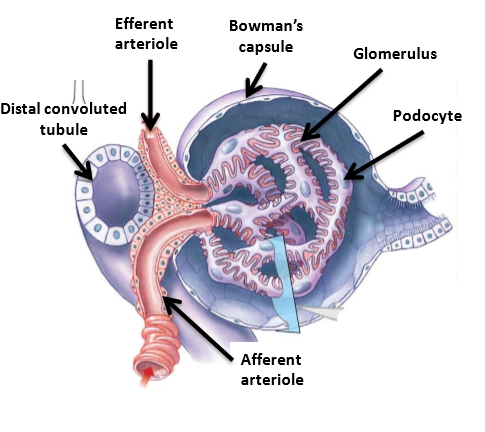
What does the renal corpuscle consist of?
A glomerulus surrounded by podocytes
Bowman’s capsule - for filtration
& plasma enters and exits via afferent and efferent arteriole

What are the layers of the glomerular membrane?
Glomerular capillary wall
Basement membrane
Podocyte filtration slits

What are the components of the glomerular capillary wall?
Has fenestrations
Allows passage of most plasma components aside from large proteins and cells
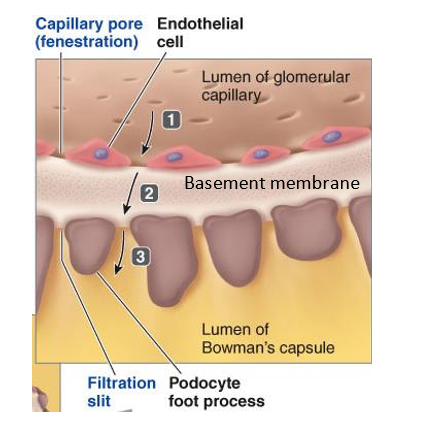
Basement membrane components?
Gel-like zone
Physical barrier: proteins can’t fit through
Electrical barrier: negative charge repels proteins
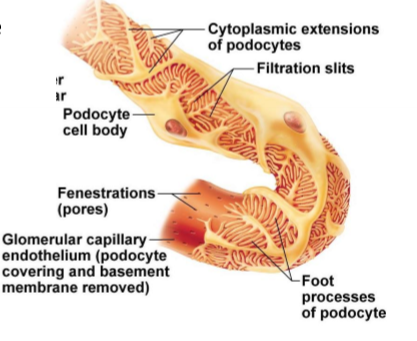
Podocyte filtration slit components
The capillaries are lined with podocytes
Adjacent podocytes interlace
Spaces between foot processes are called filtration slits
What are the forces involved in glomerular filtration?
Hydrostatic (pushing) force - glomerular blood capillary pressure (favours filtration) & Bowman’s capsule hydrostatic pressure (opposes filtration)
Osmotic (pulling) force - plama colloid osmotic pressure (opposes filtration)
Net filtration pressure - forces favouring filtration minus forces favouring reabsorption
What is GFR (glomerular filtration rate)
The amount of filtrate kidneys produce each minute
It is controlled by adjusting the glomerular capillary blood pressure from increasing or decreasing afferent arteriole
What % of reabsorption occurs where?
60-70% in the proximal convuluted tubule
25% loop of Henle
Distal convuluted tubule and collecting duct (hormonally controlled reabsorption of Na+ and water)
What barriers must be crossed for reabsorption?
Luminal membrane of tubular cell
Cytosol of tubular cell
Basolateral membrane of tubular cell
Interstitial fluid
Capillary wall

Transepithelial transport

What are the ways water reabsoprtion occurs?
Water reabsorption is osmotically linked to Na+ reabsorption
Except in the distal tubule and collecting duct where it is hormonally controlled
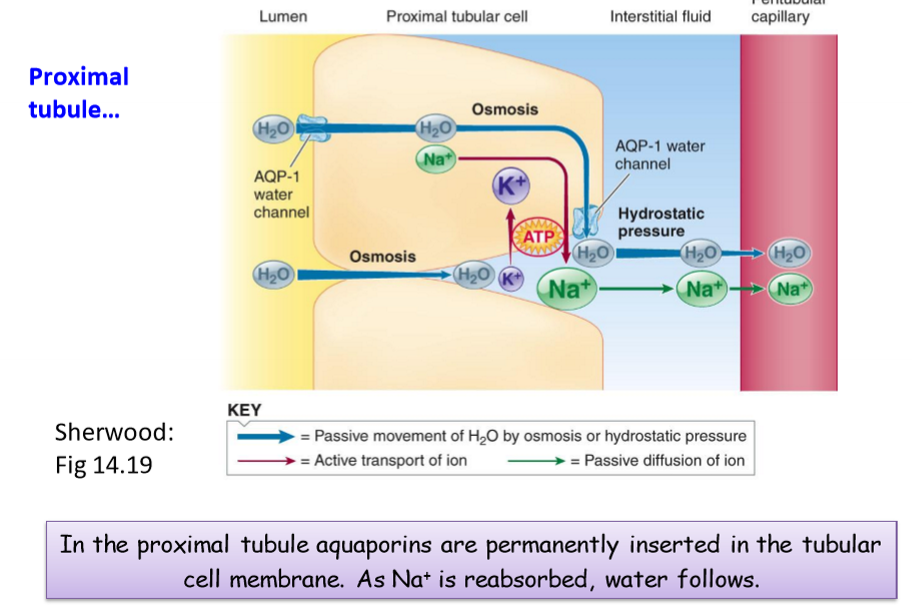
How is water in the proximal tubule reabsorped?
Through permanent aquaporins

How is water reabsorped in distal tubule and collecting ducts?
Through vasopressin-dependent insertion of aquaporins into the luminal membrane
Vasopressin facts
A hormone also called anti-diuretic hormone
Produced by hypothalamic neurons
Stored and released from the posterior pituitary
Released when ECF osmolarity is too high or blood pressure is too low

Vasopressin pathway

How do we make urine which is more concentrated when water movement is always passive (down it’s concentration gradient)?
The osmotic gradient established in the renal medulla - interstitial fluid in medulla becomes more concentreated towards the renal pelvis.
This gradient allows selective reabsorption in the distal tubule and collecting duct

How does the loop of Henle contribute to reabsorption of water?
The descending limb has lots of aquaporins and does not reabsorb Na+
Ascending limb actively reabsorbs NaCl with no aquaporins
This allows the gradient to be formed

What happens in over-hydration?
No further reabsorption of water occurs in the distal tubule or collecting duct if vasopressin is absent
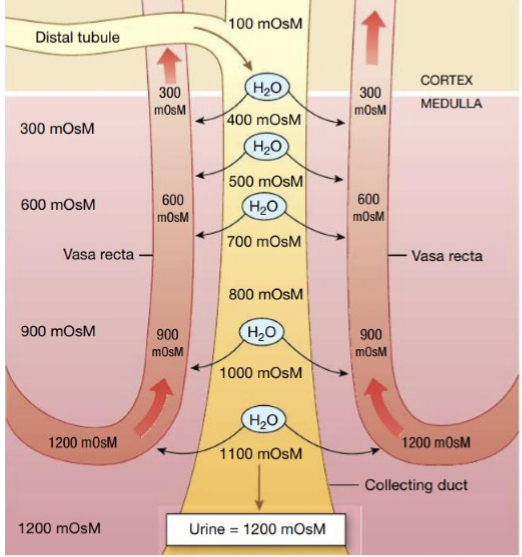
What happens with dehydration in the collecting duct & distal tubule?
Vasopressin is released and causes the insertion of aquaporins and reabsorption occurs
What are the main functions of the different parts of the nephron?
Renal corpuscle (glomerulus and Bowman’s capsule): Filtration
Proximal tubule: Majority of reabsorption
Loop of Henle: allows urine to be concentrated or diluted
Distal tubule/collecting duct: hormonally controlled reabsorption and secretion
Where is Na+ reabsorbed along the nephron?
Proximal tubule: 67%
Loop of Henle: 25%
Distal tubule and collecting duct: 8%
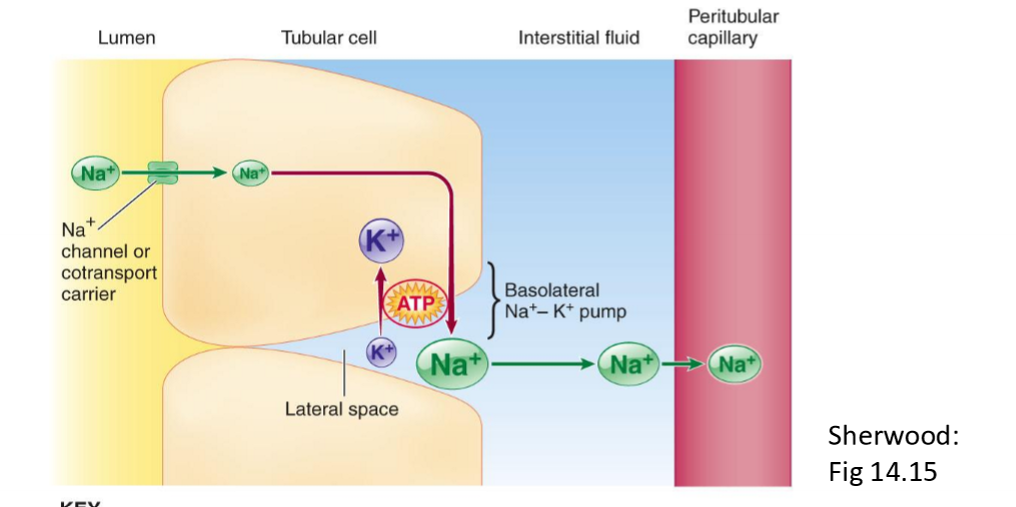
How is Na+ reabsorped in the proximal tubule?
Na+ transport across the basolateral membrane is active and produces a Na+ concentration gradient (low in cell, high in interstitial fluid)
Transport across the luminal membrane is passive and down the concentration gradient

The Na+ concentration gradient aids the reabsorption of other essential molecules: glucose
How is Na+ reabsorped in the distal tubule and collecting duct?
Hormonally via the RAAS, trigerred by:
Low NaCl
Low blood pressure/volume
Reabsorption of Na+ through RAAS = reabsorption of water (osmosis) = increase in blood pressure/volume
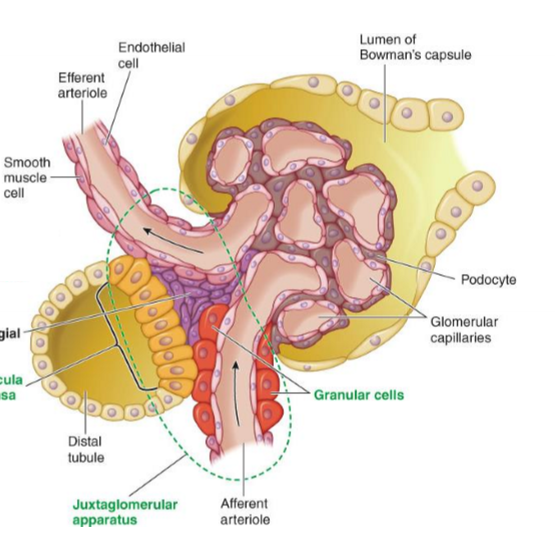
Where does activation of the RAAS begin?
At the juxtaglomerular apparatus
Specialised region of distal tubule + afferent & efferent arteriole
Contains Granular (smooth) cells in afferent arteriole
Macula densa (specialised cells sensing what’s in the filtrate)
How does RAAS begin?
Granular cells release renin in response to a drop in NACl, plasma volume or blood pressure
Granular cells are baroreceptors (detecting drop in blood pressure in afferent arteriole)
Macula densa detect a fall in NaCl in distal tubule (stimulating granular cells)
Sympathetic activation of granular cells (drop in blood pressure stimulates baroreceptor reflex)
What are the steps of the RAAS hormonal pathway?
Drop in NaCl, or blood pressure detected
Granular cells secrete renin
Renin activates angiotensinogen into angiotensin I (angiotensin is a plasma protein in the blood but inactive)
In lungs: angiotensin I converted into angiotensin II by angiotensin converting enzyme (ACE)
Angiotensin II activates adrenal cortex which releases aldosterone into the blood
Aldosterone stimulates Na+ reabsorption from distal tubule and collecting duct
Na+ reabsorption ‘pulls’ more water into the ECF (more salt and water in blood)
What does angiotensin II do?
Activates adrenal cortex to release aldosterone
Increases thirst and fluid intake
Increases vasopressin which increases H2O reabsorption
Arteriolar vasoconstriction which increases blood pressure
How does aldosterone increase Na+ reabsorption
Aldosterone promotes the insertion of Na+ channels and pumps in the tubular cell membrane
What is tubular secretion?
Transfer of substances from the capillaries into the tubule
Allows the kidney to selectively transfer substances that are too concentrated in the blood
H+ - important for regulating acid-base balance
K+ - Keeps plasma K+ concentration at appropriate level to maintain normal membrane excitability in muscles and nerves
Organic ions - accomplish more efficient eliminatino of foreign organic compounds from the body (drugs)

How do the kidneys help regulate blood pH
By excreting more hydrogen and conserving bicarbonate (HCO3)

Haemorrhage steps renal system