Milk and Dairy Products
 Call Kai
 Learn
 Practice Test
 Spaced Repetition
 Match
 Flashcards
 Knowt Play
1/40

There's no tags or description
Looks like no tags are added yet.
41 Terms
What are the variations of milk?
Organic Milk
From cows grazed on pasture without chemical fertilisers, pesticides or agrochemicals
Jersey and Guernsey milk:
produced from Jersey or Guernsey breeds of cow
Higher fat content and fat-soluble vitamins than regular whole milk
Homogenised milk:
forcing the milk at high pressure through small holes, breaking of fat globules to spread it evenly and prevent a creamy layer
Most frequently available
Standardized milk:
milk with the fat content adjusted to a specified value. e.g. Full fat milk
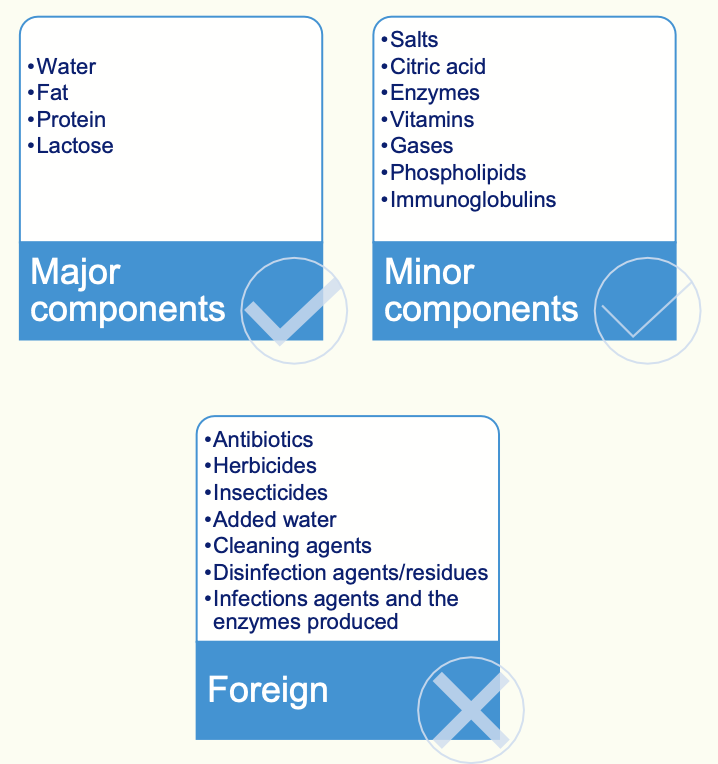
List the major, minor and foreign components of animal milk
What are the differences between skimmed, 1% fat, semi skimmed and whole milk?
lower levels of vitamins A and E in lower fat milks as they are fat soluble

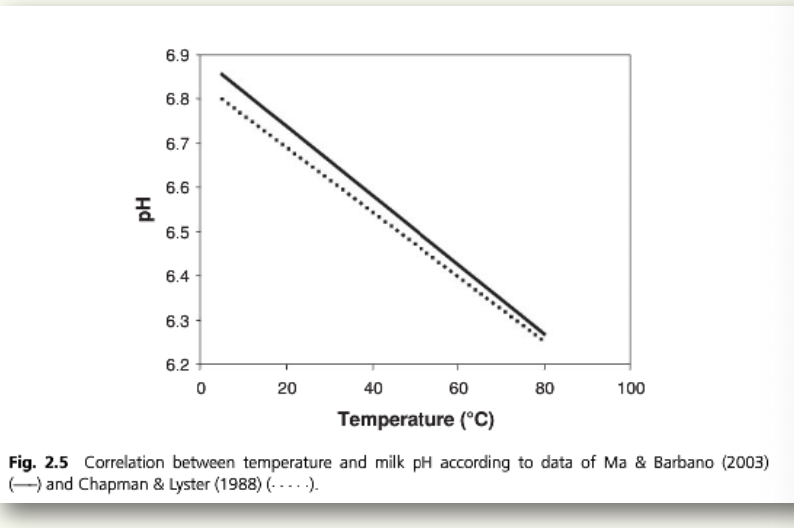
What is the pH of milk, butter and cheese?
Milk: 6.4-6.8
Butter 6.1-6.4
Cheese (big variation): 4.8 (cottage) -7.4 (camembert)
What are the consequences of decrease in pH and increase in pH of fresh milk?
Decrease in pH:
Microorganisms if lactose fermenting
Extensive lipolysis
Increasing temperature
Increase in pH :
Physiological stress
Decreasing temperature
What is the water activity (Aw) of whole milk?
aw> 0.9
incr with incr temp + pressure
(This means that yeasts and moulds are most likely to grow)
What can happen in processing of milk that will increase likelihood of a high load of bacteria?
Milk with high load of bacteria (from cow, high SCC)
Contamination of product (at parlour, transport and processing)
Inadquate storage temperatures throughout
Inefficient/ deficient treatments (during processing)
What bacteria associated with mastitis can cause infectious agents in dairy products?
Contagious –spread during milking
Staphylococcus aureus
Streptococcus dysgalactiae/agalactiae
Corynebacterium bovis
Mycoplasma sp.
Environmental (generally > Bactoscan)
Streptococcus uberis
Escherichia coli
Klebsiella sp.
Associated with Summer:
e.g. Hydrotaea irritans & Trueperella pyogenes
Fungi
What bacteria associated with systemic infections can cause infectious agents in dairy products?
Tubercullosis
Q-fever
Leptospirosis
Salmonellosis
zoonotic
List the important food safety pathogens associated with dairy products?
Campylobacter jejuni
Listeria monocytogenes
Mycobacterium paratuberculosis
Salmonella spp.
Staphylococcus aureus
List the important spoilage organisms associated with dairy products?
Bacillus sporothermodurans
Butyric acid bacteria
Pseudomonas spp.
Streptococcus thermophilus
(potentially environemntal contam problems)
Which pathogens exhibit a dual role of pathogenic and spoilage organisms in dairy products?
Bacillus cereus
Escherichia coli
Pseudomonas aeruginosa
(spoilage organism that are harmful if consumed)
What is the required temperature for storage of milk?
<8°C if collected daily
<6°C if not daily collection
During transport <10°C
No refrigeration if collection within 2 hrs of milking
Yersinia + Listeria monocytogenes can grow in cold temperatures
What are the organisations behind the regulation of milk production?
Local authorities
Hygiene and enforcement on dairy plants and retailers
EHOs: environmental health officers
FSA (hygiene and enforcement on farm), VMD (residues), APHA (eradication programs)
EU
International dairy federation
What standards must raw cow's milk intended for human consumption meet?
Plate count (Total Viable Count TVC) at 30°C ≤100 000 cfu/ml
Average over a period of two months with at least two samples / month
SCC ≤400 000 cfu/ml
Average over a period of three months with at least one sample/ month unless authority specifies otherwise
if intended for direct human consumption
Plate count (TVC) at 30 °C: cfu/ml ≤ 20 000
Coliforms: <100cfu/ml
At the manufacture of dairy products and before processing is initiated what should the plate count be for raw vs processed milk?
If milk raw:
Plate count (TVC) at 30 °C: < 300 000 cfu/ml
If milk processed:
Plate count (TVC) at 30 °C: < 100 000cfu/ml
raw milk for human consumption used to prod cheese
Can raw milk be sold to the consumer?
Not in Scotland and Northern Ireland
In England and Wales:
Yes but TB and brucellosis free herd
Health warning on the label
Comply with hygiene rules
Inspections and samples (inspect 2x/yr + sample quarterly for TVC + coliforms for cows milk)
Recall what the D value is?
heat resistance of an organism - time at given temperature required to reduce population by 1 log10 (90%)
Recall what the Z value is?
Temperature change required to alter D value by factor of 10
What bacteria is pastereurisation currently set against?
Coxiella burnetti
What are the different methods of pasteurisation?
Low Temperature Long Time - LTLT ”holding method”
63.5°C for 30 min
High Temperature Short Time (HTST)
at least 71.7°C for min of 15 sec
Regulatory requirement since 2006
72°C for min of 15 sec
Flash pasteurisation
88°C for 1 sec
What are the different heat treatments for milk?
Sterilisation
UHT
What are the features of sterilisation of milk?
Not legally defined process
Efficient against most heat resistant spores, pre heat followed by homogenisation
Air tight bottles filled through steam chamber
110-130° for 10-30 mins
Keeps for 6 months without refrigeration
When opened lasts 5 days
Sweeter taste
What are the features of UHT of milk?
>135 °C for 1 sec
plus, appropriate holding time to produce ‘commercial sterility’
Opaque containers
Spoilage mainly from heat-stable proteases and lipases produced by psychrotrophic bacteria in the raw milk:
Pseudomonas spp.,
Alcaligens spp.
Flavobacterium spp.
Residual activity after UHT sterilisation can be as high as 40%
What is the difference between evaporated and condensed milk?
Condensed has added sugar (preserved by sugar content)
What is the difference between filtered and dried milk powder?
Filtered milk= filtered extending shelf life
Dried milk powder= spray dried or roller dried
What is the minimum fat in cream?
10%
What bacteria is produced by fermentation in the production of yoghurt?
Fermentation of milk by lactic acid forming
Lactobacillus
Streptococcus
What are the features of butter? Minimum water and fat content?
Water-in-fat emulsion (from fat-in water emulsion which is milk)
Min water content: 16%
Min fat content: 80%
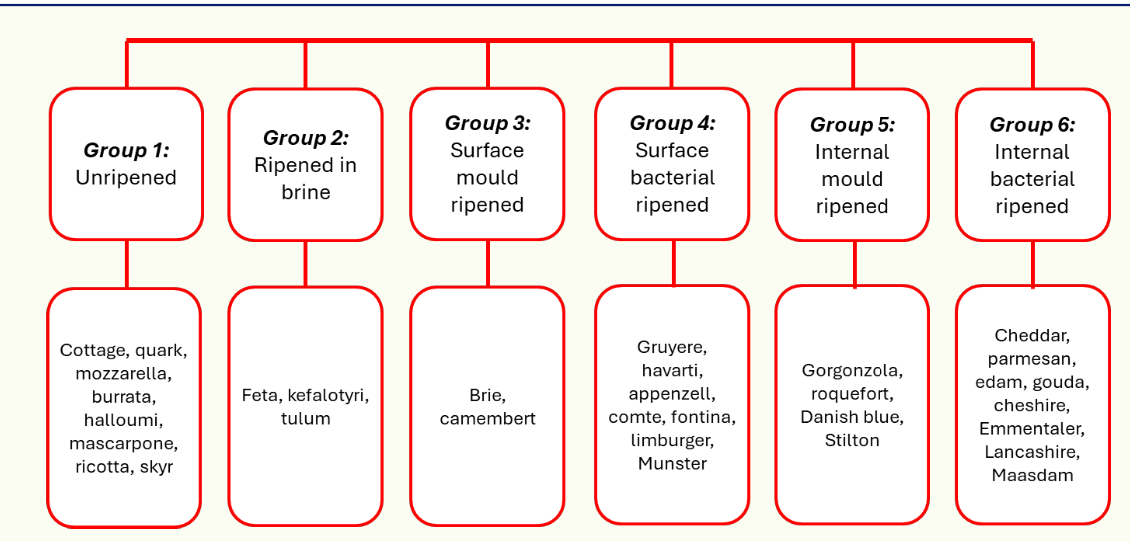
List the different groups of cheeses
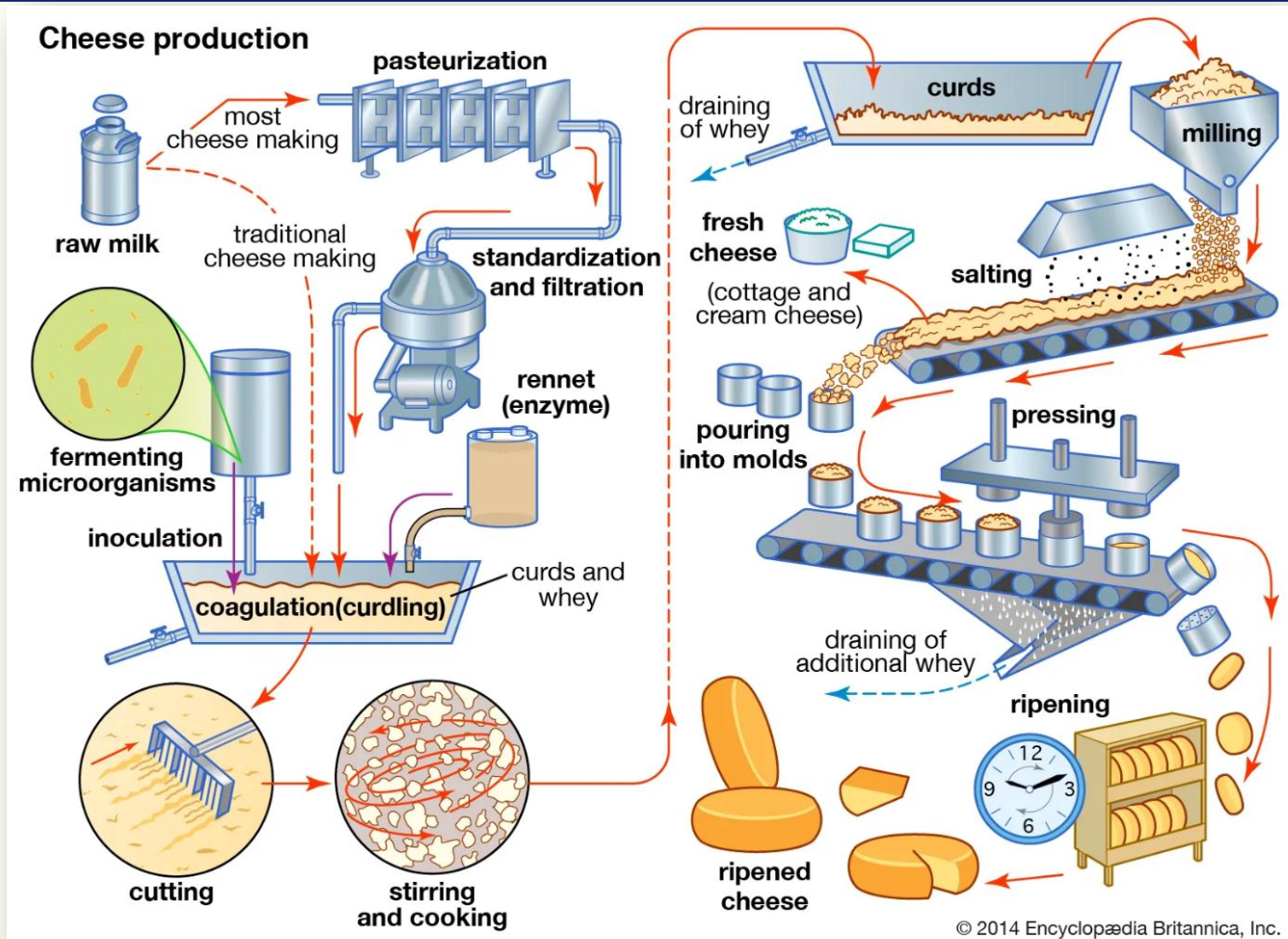
Schematic of cheese production
What temperature is milk heated to, in order to produce cheese?
>85°C
Explain the molecular production of cheese?
Casein reaction with B lacto globulin
Micelle becomes coarser and open spongy gel that absorbs liquid
-vely charged casein tails sticking out prevents clumping
casein looses its -ve charge and clumps
Fat incorpoated into mesh
Separation from water soluble substances (whey)
What are the different types of curd formation? What is the optimal temp?
Sour curd: fermentative bacteria
Also achieved by addition of acid e.g. citric acid
Sweet curd: addition of rennin*/rennet
Optimal temp: 30/40°C
What are the steps of curd processing?
Salted, seasoned
Coloured
Mixed secondary bacteria/fungus
Condensing and squeezing to form dense curd
How are cheese ripened? (Hard vs Soft ripened cheese)
Hard ripened cheeses (e.g. Cheddar):
Further compression & wrapped in wax/plastic
Prevent contamination, loss of moisture
Incubated (~10oC) to allow the bacteria to do its work
Soft ripened cheeses (e.g. Camembert and Limburger),
A microbe (e.g. mould) on surface
Protein-digesting enzyme: creamier
List the schemes of geographical indications and traditional specialities of cheese
PDO: protected designation of origin
PGI: protected geographical indication
TSG: traditional speciality guarantee
What are the three main hazards to public health of dairy products?
'Sterility' of raw product
Hygiene during processing
Heat treatment
What are the tests that can be done on milk products to ensure their safety?
Resazurin tests
pH and alcohol test
Singlepath test
What are the steps of pasteurised cheese manufacturing?
Ingredient: Milk pre pasteurised
Add pastuerised milk
Heating
Add vinegar 3%
Ripening and coagulation
Texturing (curd turned and piled)
Draining
Salt 2%
Seasoning and salting
Moulding
Pressing
Storage and maturation
Which bacterium is more likely to grow in chilled milk?
Listeria monocytogenes