Limbic system flashcards
 Call Kai
 Learn
 Practice Test
 Spaced Repetition
 Match
 Flashcards
 Knowt Play
1/22

There's no tags or description
Looks like no tags are added yet.
23 Terms
Cortical structures of the limbic system
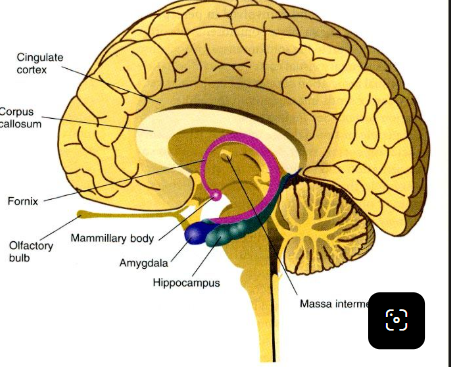
Parahippocampal gyrus, cingulate gyrus, dentate gyrus, hippocampus, subiculum, entorhinal cortex, and orbitofrontal cortex.
Major limbic nuclei
Amygdala, hypothalamus (including the mammillary bodies), and anterior nucleus of the thalamus.
Major limbic fibre tracts
Fornix, fimbria of the hippocampus, hippocampal (fornical) commissure, cingulum, and uncinate fascicle.
Cingulate gyrus (anatomical location)
Located on the medial surface of the cerebral hemisphere, arching directly superior to the corpus callosum.
Hippocampus (anatomical location)
Located deep within the medial temporal lobe.
Amygdala (anatomical location)
Located in the anterior region of the medial temporal lobe, immediately anterior and superior to the hippocampus.
Mammillary bodies (anatomical location)
Prominences located on the inferior surface (underside) of the hypothalamus.
Entorhinal cortex (anatomical location)
Located in the medial temporal lobe adjacent to the hippocampus, positioning it as an interface with the rest of the cortex.
Fimbria of the hippocampus (structural pathway)
A band of white matter extending from the hippocampus that continues as the crus of the fornix.
Fornix (connections)
Carries efferent projection fibres from the hippocampus primarily to the mammillary bodies and other subcortical structures.
Hippocampal commissure (connections)
Transverse white matter tract that connects homologous regions of the hippocampal formation between the left and right hemispheres.
Cingulum (connections)
A white matter tract running along the cingulate gyrus that interconnects medial frontal and medial temporal regions.

Uncinate fascicle (connections)
An association bundle connecting the anterior temporal lobe (including the amygdala) with the orbitofrontal cortex.
Hippocampus (primary function)
Crucial for forming and consolidating new long-term explicit memories, specifically episodic events and spatial mapping.
Amygdala (primary function)
Processes emotional stimuli (especially fear) and attributes emotional significance and valence to memories.
Hypothalamus (primary functions)
Regulates autonomic and endocrine homeostatic functions, generating physical and physiological manifestations of emotion.
Mammillary bodies (functional role)
Relays hippocampal signals received via the fornix onward to the anterior thalamic nucleus as part of memory circuits.
Entorhinal cortex (functional role)
Serves as the primary bidirectional gateway and relay station mediating information flow between neocortex and hippocampus.

Orbitofrontal cortex (functional role)
Evaluates reward expectations, risks, and consequences to guide adaptive decision-making and goal-directed behaviour.

Cingulate gyrus (functional role)
Participates in emotional processing, motivational drive, and the executive control of attention.
Two broad classifications of long-term memory
Explicit (conscious/declarative) memory and implicit (unconscious/non-declarative) memory.
Two subtypes of explicit memory
Episodic memory (autobiographical recollections of events) and semantic memory (general factual knowledge and concepts).
Procedural memory
A subtype of implicit memory governing motor skills, automated habits, and practical 'how-to' execution.