pharm part 3
 Call Kai
 Learn
 Practice Test
 Spaced Repetition
 Match
 Flashcards
 Knowt Play
1/11

There's no tags or description
Looks like no tags are added yet.
12 Terms
cholinergic
refers to neurons or axons that release acetylcholine (ACh) as primary neurotransmitter
system:
entire parasympathetic ns
preganglionic neurons of sympathetic nervous system
post ganglionic sympathetic neurons innvervating sweat glands
somatic motor neurons
CNS
adrenergic
neurons that use noradrenaline (NA) as neurotransmitter, as well as adrenal medullar that releases adrenaline as hormone
system:
most post ganglionic neurons of sympathetic nervous system
adrenal medullar
CNS
neurotransmission sites of drug action

nicotinic receptors
ligand-gated ion channels
pentameric proteins made up of combinations of alpha, beta, gamma, delta, epsilon
Neuronal types (Nn) formed with alpha or alpha and beta
muscle types (Nm) formed with all

neuromulscular junction non-depolarizing blocking agent
act to block Nm nicotinic receptors at NMJs
competitive antagonists
can block pre- and post-synaptic nicotinic receptors
AChE inhibitors can reverse the effect by increasing ACh
majority of clinically used NMJ blocking agents are non-deploarizing

neuromuscular junction depolarizing blocking agents
agonsists at nicotinic receptors
cause muscle twitching initially
sustained depolarization prevents further responding to ACh, resulting in muscle paralysis
non-depolarizing NMJ blocking agents examples
antagonists
curare
tubocurarine
pancuronium, vecuronium
pure synthetic Nm blockers
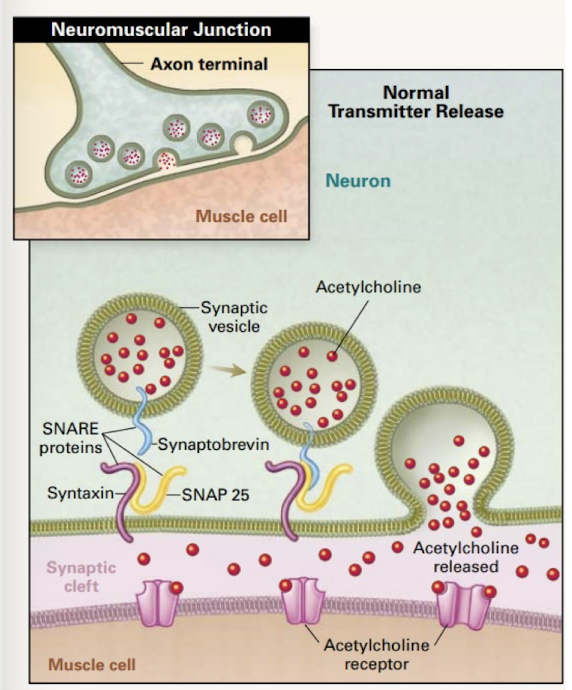
ACh containing vesicle exocytosis
SNARE proteins include SNAP-25, syntaxin and synaptobrevin (VAMP)
proteins located on synaptic vesicles and the inner surface of nerve terminal membrane
SNARE proteins help bring synaptic vesicles close to nerve terminal membrane and promote membrane fusion
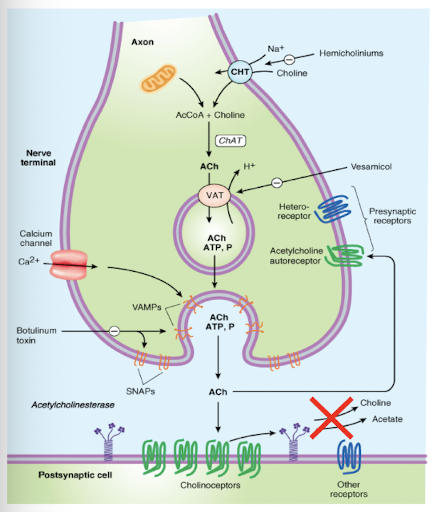
when action potential reaches nerve terminal, voltage-gated Ca2+ channels open, allowing Ca2+ to enter
Ca2+ binds to synaptotagmin, calcium-sensing protein, triggering SNARE-mediated vesicle fusion
ACh is then released into synaptic cleft by exocytosis
botox MOA
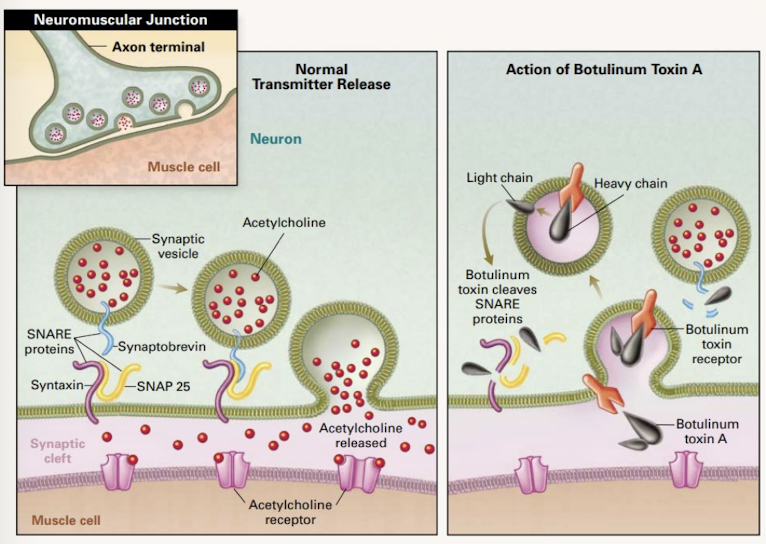
inhibits exocytosis of ACh containing vesicles
taken up into vesicles, cleaves the SNARE proteins, preventing assembly of fusion complex and preventing release of ACh
botox clinical applications
paralyzes muscles by blocking release of ACh at cholinergic nerves
indications:
overactive bladder
dystonia and other eye issues
hyperhidrosis
acetylcholinesterase inhibitors
increase ACh
AChE terminates actions of ACh
effects after inhibition
enhance actions of ACh and have actions similar to ACh agonists
autonomic actions: enhancement of ACh activity at parasympathetic synapses (bradycardia, increased saliva secretion, increased smooth muscle contractility)
neuromuscular junction: repeated firing of muscle fiber leading to twitching and increased muscle contraction
can cause profound CNS effects if cross BBB
clinical uses
myasthenia gravis, urinary retnetion, reversing neuromuscular blocking agents
antidote for CNS effects of atropine and other anticholinergic overdoses
myasthenia gravis
complex autoimmune disorder in which antibodies destroy neuromuscular connections
drooping eyelid most frquent early sign
can progress to produce exessive muscle weakness - myasthenic crisis
