Week 10 - Hand
 Call Kai
 Learn
 Practice Test
 Spaced Repetition
 Match
 Flashcards
 Knowt Play
1/62

Earn XP
Description and Tags
Muscles and Extensor Hood
63 Terms
Extrinsic Muscles of the Thumb
Flexor Pollicis Longus
Extensor Pollicis Longus
Extensor Pollicis Brevis
Abductor Pollicis Longus
Flexor Pollicis Longus (FPL) Function
Flexes all 3 joints of the thumb (IP, MCP, CMC)
Can contribute to flexion component of opposition if IP is flexed
What is the prime mover of thumb IP, MCP, CMC joints and the only muscle responsible for IP flexion? (Flexes all thumb joints)
Flexor Pollicis Longus
Snuff Box Muscles
Extensor Pollicis Longus
Extensor Pollicis Brevis
Abductor Pollicis Longus
Extensor Pollicis Longus (EPL) Function
Extension of all thumb joints
Adduction of thumb CMC
Extensor Pollicis Brevis (EPB) Function
Prime mover for extension of CMC & MCP joints of thumb
Assists with CMC abduction
Abductor Pollicis Longus (AbPL) Function
CMC Abduction and extension
Thumb Intrinsics/Thenar Group
Opponens Pollicis (OP)
Flexor Pollicis Brevis (FPB)
Abductor Pollicis Brevis (AbPB)
Adductor Pollicis (AdP)
Opponens Pollicis (OP) Function
Opposition of thumb at CMC joint
Responsible for the rotational component of opposition
Abductor Pollicis Brevis (AbPB)
Abduction of thumb at both CMC and MCP joints
Responsible for the abduction component of opposition
Flexor Pollicis Brevis (FPB) Function
Prime mover for flexion of thumb at CMC and MCP
Responsible for the flexion component of opposition
Adductor Pollicis (AdP) Function
Prime mover for adduction of thumb at CMC and MCP
Prime mover for flexion of thumb at CMC and MCP
Contributes to opposition with increased pressure
What muscles make up the thenar group?
Flexor Pollicis Brevis
Abductor Pollicis Brevis
Opponens Pollicis
What moves the thumb out of the palm?
Thumb extrinsics (snuffbox) muscles
Extensor Pollicis Longus
Extensor Pollicis Brevis
Abductor Pollicis Longus
Opposition is the simultaneous movement of….
abduction, flexion, and rotation of the thumb at the CMC
What abducts the CMC joint to open the “jaws of the pincher wider”?
Abductor Pollicis Brevis
What further flexes the CMC, bringing the thumb closer into the palm?
Flexor Pollicis Brevis
What squeezes the “jaws of the pincher” together?
Adductor Pollicis
If force is required in thumb movement then the Adductor Pollicis…
Strengthens the grip on an object
If force is required in thumb movement then the Flexor Pollicis Longus…
will assist for power needed at thumb tip
or
it will stabilize the thumb along with Extensor Pollicis Longus (both prime movers for adduction of CMC)
Finger Intrinsics
Lumbricals
Dorsal Interossei
Palmar Interossei
Hypothenar Muscles
Opponens digiti minimi
Flexor digiti minimi
Abductor digit minimi
What makes up the hypothenar eminence?
Abductor Digiti Minimi
Flexor Digiti Minimi
Opponens Digiti Mini
Function of the Hypothenar Eminence
Help to bring 5th digit into opposition and stabilize the 5th digit for grasping
Abductor Digiti Minimi (AbDM) Function
Prime mover for MCP abduction (5th digit)
Flexor Digiti Minimi (FDM) Function
Prime mover to MCP flexion (5th digit)
Opponens Digiti Minimi (ODM) Function
Prime mover for CMC flexion and rotation (5th digit)
Intrinsic Muscles of the Hand
Lumbricals and Interossi
Lumbricals and Interossi Function
Present in digits 2-5
Significantly impact grip strength and hand opening
What are lumbricals?
Only muscles in the body the link two other muscle groups together (both proximally and distally)
They “float” between FDP (tendon) and extensor hood
Lumbricals Action
Prime movers for simultaneous flexion of MCP joint and extension of IP joint
How many lumbricals are in each hand?
4
One at each finger on the radial side
How many dorsal interossei in each hand?
4 DI
Sit between metacarpal bones
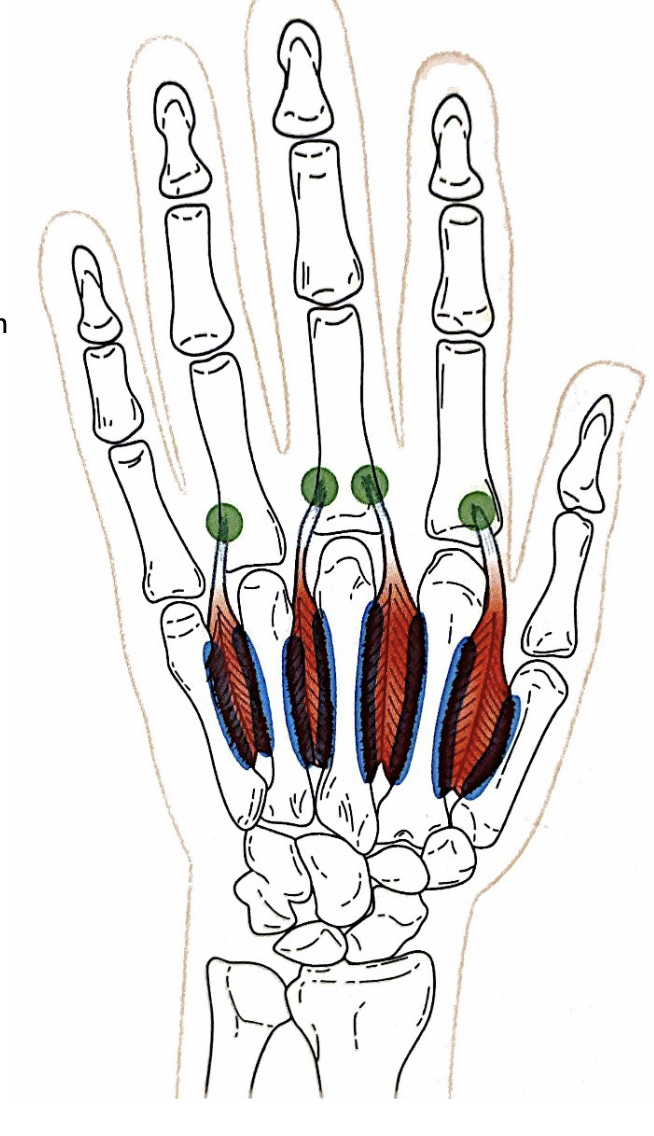
How many DIs does the 3rd digit have?
2 one on each side
Dorsal Interossei Action
DABs
MCP Abduction
3rd digit is the reference point for abduction and has 2 DIs
Important assist for MCP flexion (due to volar attachments) and IP extension (due to attachments on extensor hood)
What can be functionally considered a 5th DI?
The Abductor Digiti Minimi
How many Palmar Interossei in each hand?
3 PIs
Palmar Interossei Action
PADs
MCP Adduction
3rd Digit has no PIs
Important for MCP flexion (due to volar attachments) and IP extension (due to attachments in the extensor hood)
Actions of the Dorsal Interossei
aBduction
DABs
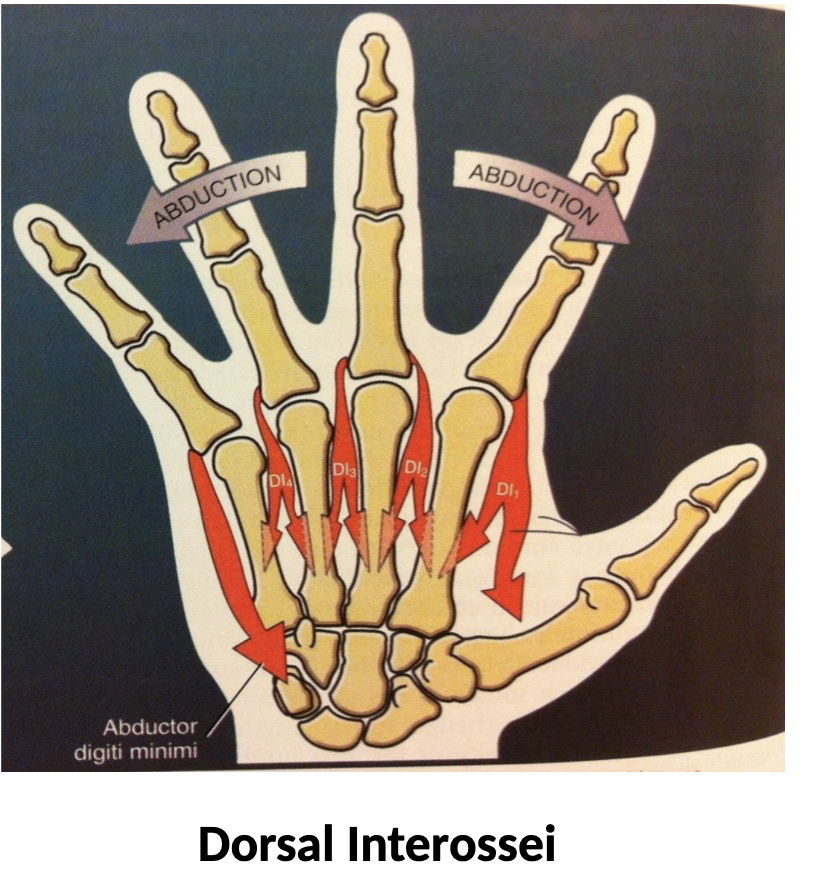
Actions of the Palmar Interossei
PADs
Adduction

The combined action of the lumbricals and interossei are shown as…
Flexion at the MCP
Extension at the IPs
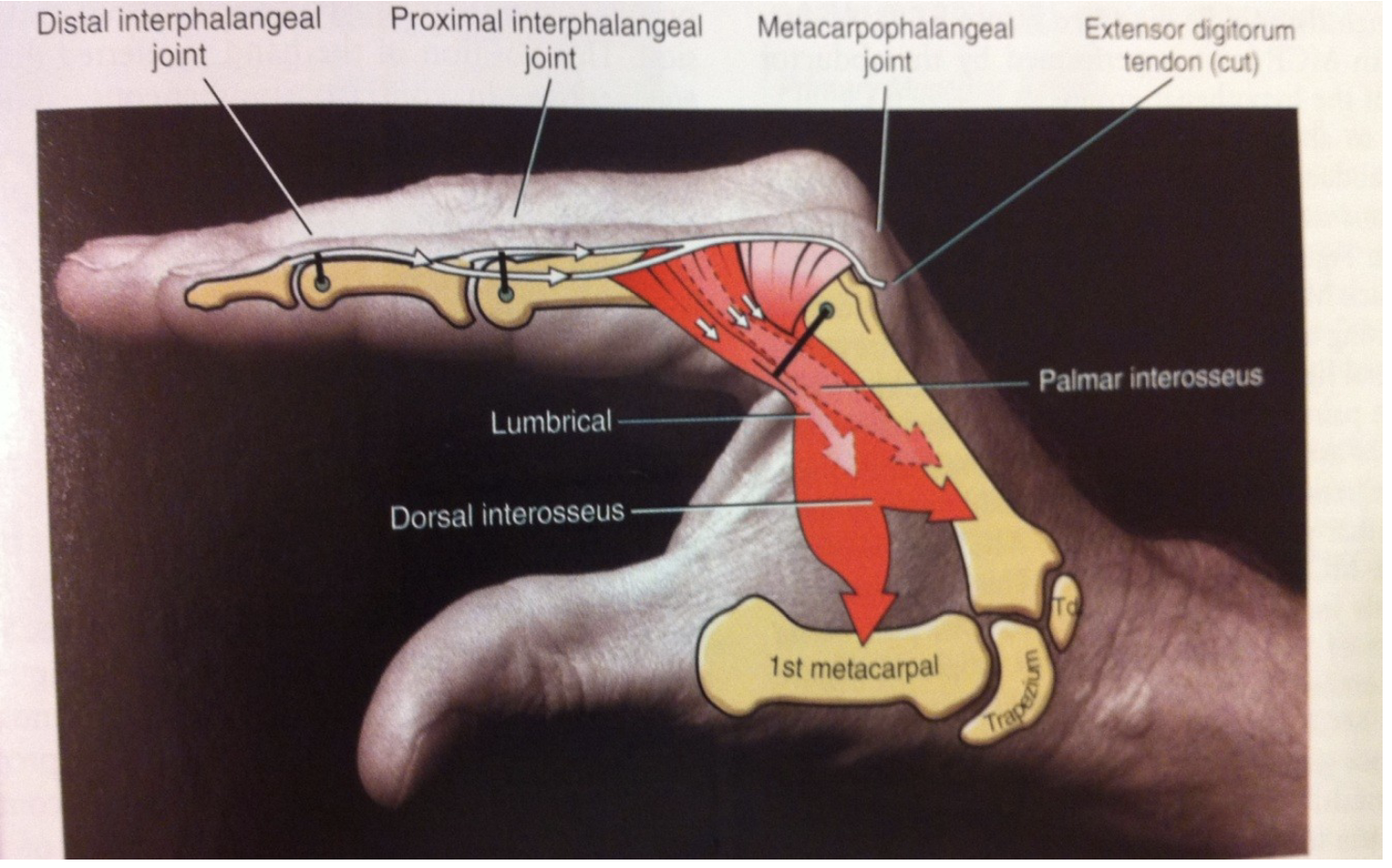
Digits 2-5 have an extra accessory structure which allow for full extension at the IP joints
Extensor Hood Mechanism
What makes up the extensor hood mechanism?
EDC
Lumbricals
DI
PI
Triangular Ligament
Oblique Retinacular Ligament
What does the EHM allow for?
Full hand opening and highly coordinated movements of the hand
Other names for the extensor hood mechanism?
Dorsal Hood Mechanism
Extensor Assembly
Extensor Expansion
Extensor Hood Mechanism
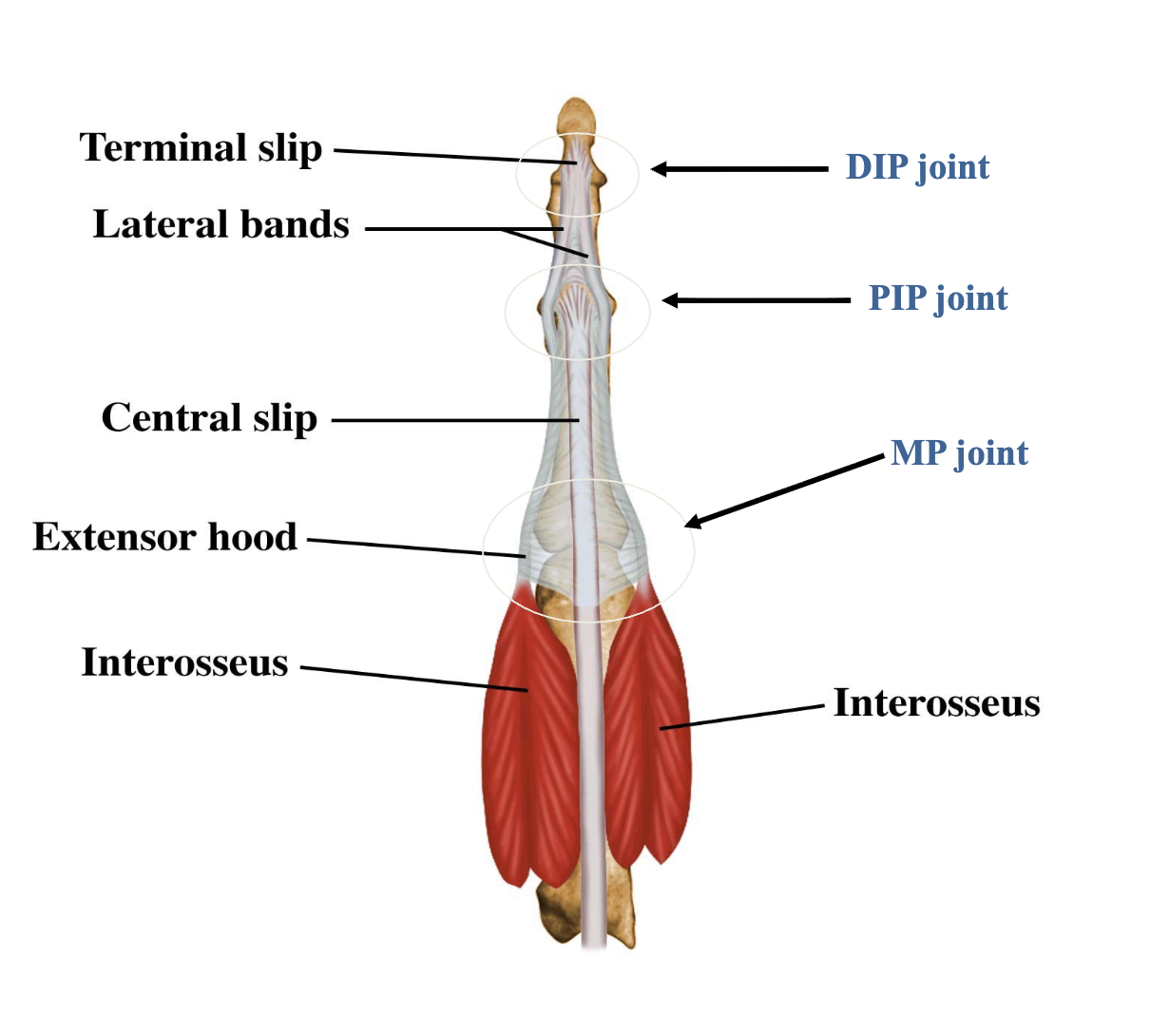
Actions of the Lumbricals with the EHM
The lumbricals pull proximally on the extensor hood and relax the passive tension of the Flexor Digitorum Profundus by pulling distally
Causing the FDP to become LAX
Causing the IP to extend
The Oblique Retinacular Ligament is also called
“Link Ligament”
Oblique Retinacular Ligament runs from what to what
The Flexor Digitorum Profundus to EHM
The extensor digitorum communis (EDC) tendon sprouts into the…
Extensor hood
What is the extensor hood?
Covers/wraps around proximal phalanx and the EDC splits as it exits the hood (extends MP joint)
The extensor hood emergers and trifurcates into…
Central Slip/tendon
Lateral Bands
Terminal Slip/Tendon
Central Slip/tendon
Attaches to the base of the middle phalanx. Extends the PIP joints
Lateral Bands
Directly responsible for extending DIP
Terminal Slip/Tendon
Inserts on distal phalanges; rejoining of the lateral bands
Triangular Ligament
Connects the two lateral bands dorsally at the middle phalanx (just proximal to the DIP joint)
Oblique Retinaculum Ligament
Runs from volar to dorsal sides of hand; links the actions of the DIP and PIP
All extrinsic extensors go into the…
Hood (EDC, EDM, EI)
EDC, EI, EDM are the primary muscles responsible for…
extending the MP joints of the fingers
The exrtinsic extensors can produce MP extension but not PIP and DIP extension so they need…
The interossei and lumbricals via the attachments into the EHM to assist in extension
PI and DI stabilize MCP joints and prevent what of the MCP joints?
Hyperextension
The PI and DI are active during MCP flexion with IP extension but they are not prime movers for ________ but they assist because they cross dorsally at the MCP joints!
flexion
The PI and DI are active during MCP extension, they _____-_________ and stabilize the MCP joints in extension
co-contract
The lumbricals are active at the IPs for extension, regardless of ____ __________ as are the DIs and PIs muscles (due to their attachments)
MCP position