L39 - Central Nervous System
 Call Kai
 Learn
Learn Practice Test
 Spaced Repetition
 Match
Match Flashcards
 Knowt Play
1/92

There's no tags or description
Looks like no tags are added yet.
Name | Mastery | Learn | Test | Matching | Spaced | Call with Kai | Chat |
|---|
No analytics yet
Send a link to your students to track their progress
93 Terms
What are the Two Functional Divisions of the Vertebrate Nervous System?
Central nervous system (CNS)
Peripheral nervous system (PNS)
What is a Major Feature of the Vertebrate Brain?
It is highly organized and specialized, and evolved from the spinal cord

Why is the vertebrate CNS considered highly protected?
It is protected by:
Bone
Meninges
Cerebrospinal fluid (CSF)
Blood-brain barrier
What is the basic hierarchical flow of information through the nervous system?
Sensory input → Association → Decision → Motor output

What occurs in an Ascending Pathway?
Stimulus → Sensory fibers → CNS → filtering → cerebral interpretation/association

What occurs in a Descending Pathway?
Decision/behavior → Motor pathways → lower motor neurons → Effector

What is Gray matter primarily composed of?
Neuronal cell bodies (somata)
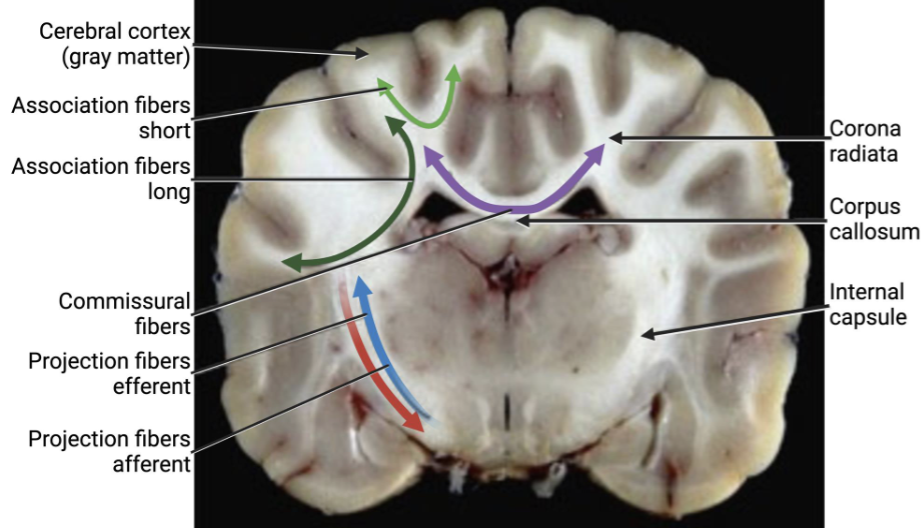
What is a Cortex?
Gray matter in which neuronal cell bodies are organized into layers/laminae

What are Examples of Cortical organization?
Cerebral cortex
Cerebellar cortex
Hippocampus

What is a CNS nucleus?
A cluster of neuronal cell bodies located deep within the cerebral hemispheres or brainstem
What is White matter primarily composed of?
Axons/fibers
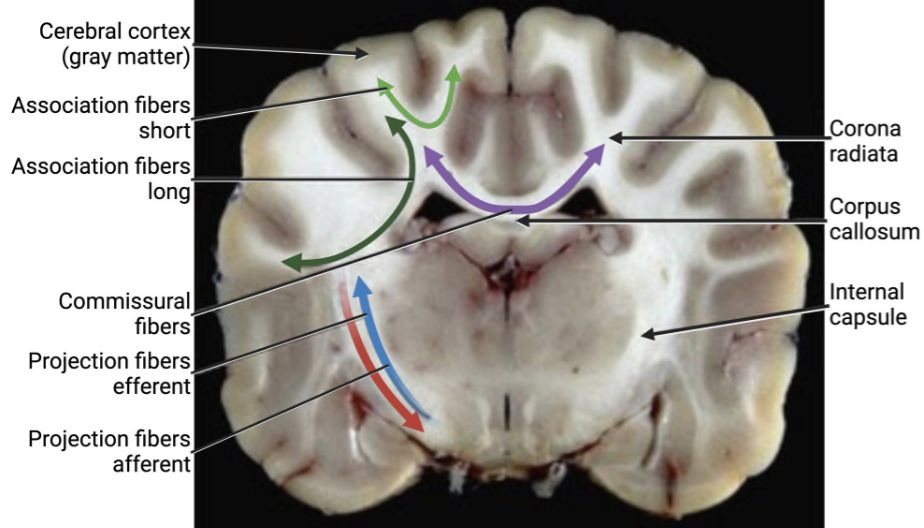
What is a Tract?
A bundle of axons within the CNS

Why does White matter appear white?
Many axons are surrounded by lipid-rich myelin
What are the Major Functions of the Cerebral cortex?
Sensory interpretation
Voluntary/skilled movement
Intellectual/emotional processing

What does the Cerebral cortex do with sensory information?
Localizes and interprets sensory input
What does Gyrencephalic mean?
A folded/convoluted cerebral cortex

What is a Gyrus?
A fold of the cerebral cortex.
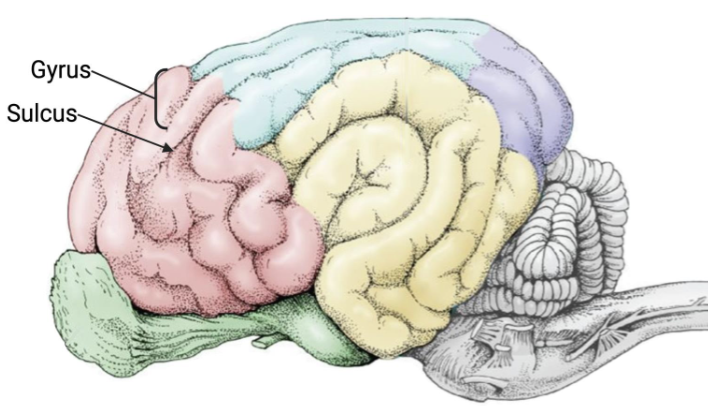
What is a Sulcus?
A groove between folds

What is a Fissure?
A deeper groove
What does Lissencephalic mean?
A smooth, non-convoluted cerebral cortex
What are the Three Types of Cerebral White matter Fibers?
Association
Commissural
Projection fibers

What do Association fibers connect?
Areas within the same cerebral hemisphere
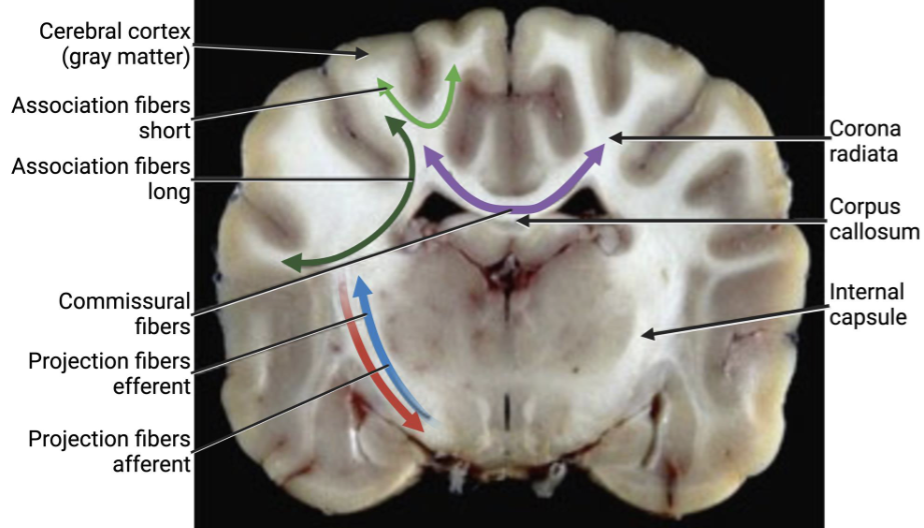
What do Commissural fibers connect?
The two opposite cerebral hemispheres

What do Projection fibers connect?
The cerebrum with lower CNS regions, including the brainstem and spinal cord.

What is the Major Function of the Basal nuclei?
Refine and regulate voluntary skeletal muscle movement
Eye movement
Habit formation
Procedural learning
Conditional learning

What is the Major Function of the Thalamus?
Acts as a relay station for sensory impulses to the cerebral cortex
Relays information between the cerebral motor cortex and motor centers and participates in memory processing

What is the Hypothalamus?
The chief integration center of the autonomic nervous system

What Functions does the Hypothalamus regulate?
Temperature
Food intake
Water balance
Thirst
Biological rhythms
Drives,
Hormonal output
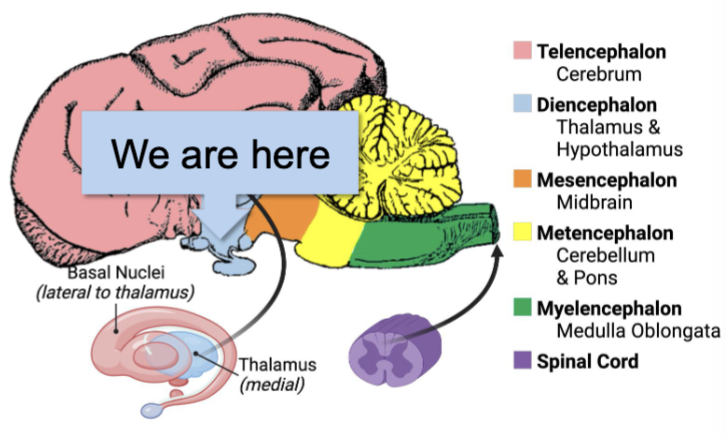
How does the Hypothalamus Function as an Endocrine organ?
It produces posterior pituitary hormones and regulates anterior pituitary output

What Three Structures form the Brainstem?
Midbrain
Pons
Medulla oblongata
What are Major Functions of the Midbrain?
Visual/auditory reflexes
Subcortical motor control
Projection pathways

What is a Major Functions of the Pons?
Relays information from the cerebrum → cerebellum
Cooperates with medullary respiratory centers

What are Major Functions of the Medulla oblongata?
Relays ascending sensory information
Contains visceral nuclei
Relays information to the cerebellum
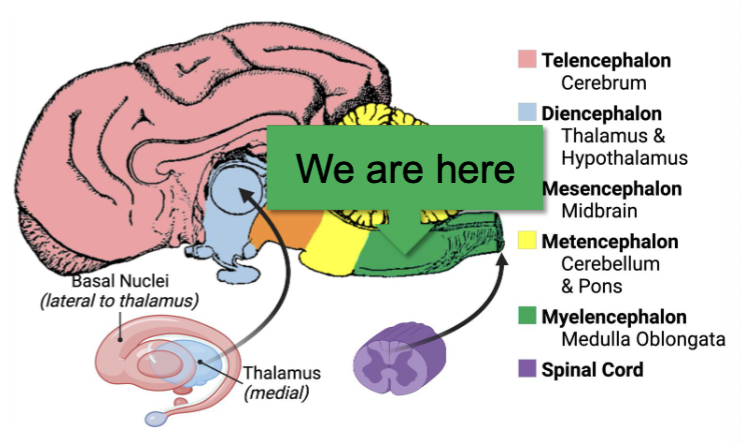
What important crossing occurs in the Medulla?
Pyramidal decussation
What information does the Cerebellum process?
Input from the:
Motor cortex
Proprioceptors
Equilibrium
Visual pathways
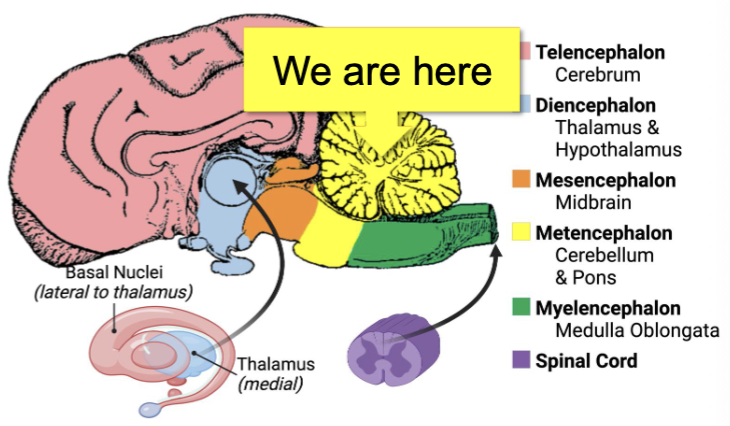
What is the Major Functional Role of the Cerebellum?
Coordination of:
Movement
Balance
Posture

What are the Two Major Functions of the Spinal cord?
Links the brain and PNS and acts as an integration center for spinal reflexes

What do Ascending Spinal cord Pathways carry?
Sensory information → brain

What do Descending Spinal cord Pathways carry?
Motor information → body

What three functional brain systems are emphasized in the lecture?
Reticular activating system (RAS)
Limbic system
Neocortex

What is the general Role of the RAS?
Integrates and relays information needed for vital survival functions
Sleep
Arousal
Consciousness

What neurotransmitters are associated with the RAS?
Norepinephrine from locus coeruleus
Serotonin from raphe nuclei

What Major Structures are included in the Limbic system?
Cingulate region
Hippocampus
Amygdala
Associated structures

What is the general Function of the Limbic system?
Emotion, memory, learning, social processing, motivation, and reward

What other body systems does the Limbic system influence?
The endocrine and autonomic nervous systems
What is the Mammalian Neocortex?
A six-layered neuronal cortex involved in higher-order brain functions

What Functions are associated with the Neocortex?
Sensory perception, motor commands, attention, spatial reasoning, complex behavior, and cognition
Do birds have the same six-layer neocortex as mammals?
No
Birds have a differently organized pallium but can still perform complex cognitive behaviors.

What are the Four Major forms of CNS protection?
Bone
Meninges
CSF
Brain barriers
What bone protects the Brain?
The cranium, specifically the cranial vault

What protects the Spinal cord?
The vertebrae

What are the Three Meninges from Outermost → Innermost?
Dura mater
Arachnoid mater
Pia mater

What is the Dura mater?
The outermost, fibroelastic meningeal layer
Permeable to fluid
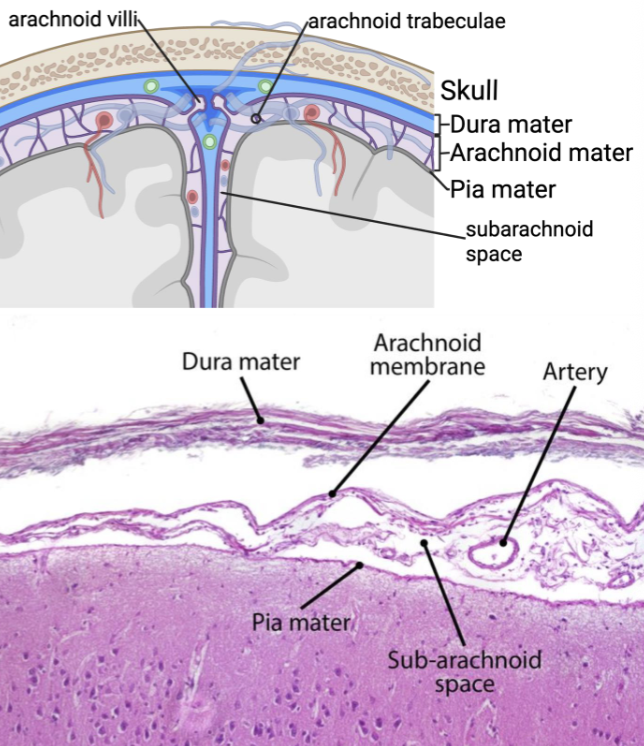
What is the Arachnoid mater?
The middle, fluid-impermeable meningeal layer

What is the Subarachnoid space?
Space between arachnoid and pia mater containing CSF

What are Arachnoid villi?
Protrusions into dural venous sinuses involved in CSF reabsorption
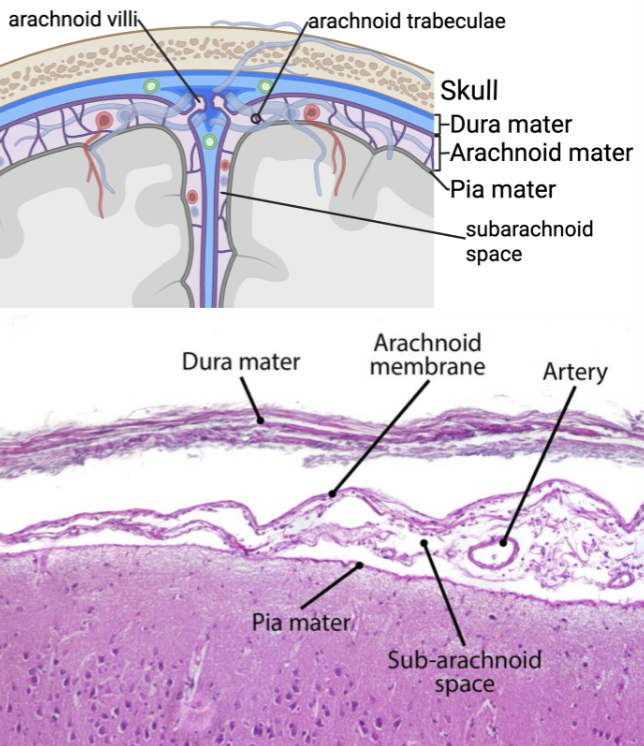
What is the Pia mater?
The innermost meningeal layer that closely follows the CNS contour

What is CSF?
A clear, colorless, low-protein fluid that protects and nourishes the CNS
Where is CSF produced?
Choroid plexus

Where does CSF circulate?
Through the Ventricular system and Subarachnoid space

Where is CSF reabsorbed?
Into Dural venous sinuses via Arachnoid villi

How does CSF compare with plasma?
CSF has…
Very little protein
Less glucose
Lower K⁺/Ca²⁺
Similar osmolarity and Na⁺
Slightly lower pH
What Cells line the Ventricles and Central canal?
Ependymocytes

What are Tanycytes?
Specialized ependymocytes located at the third ventricle

What are Choroid Epithelial cells?
Specialized ependymocytes forming the choroid plexus epithelium

What percentage of CSF is produced by the choroid plexus according to the lecture?
About 80%

What is the Pathway of CSF Circulation?
Lateral ventricles
3rd ventricle
Cerebral aqueduct
4th ventricle
Central canal/subarachnoid space
Arachnoid drainage
Dural venous sinuses
Venous circulation

What is Internal hydrocephalus?
CSF accumulation within the ventricular system

What is External hydrocephalus?
CSF accumulation primarily within the subarachnoid space

How does an Obstruction produce Hydrocephalus?
Blocked CSF circulation →
CSF accumulation →
Ventricular enlargement
What commonly causes Congenital Obstructive Hydrocephalus?
Stenosis of the mesencephalic/cerebral aqueduct
Internal hydrocephalus

What can cause Acquired Obstructive Hydrocephalus?
Internal hydrocephalus
Tumor
Injury
Inflammation/disease
Dural fibrosis
Occipital bone hypoplasia

Congenital obstructive hydrocephalus vs. Acquired obstructive hydrocephalus SUMMARY
Type | When does obstruction develop? | Examples from your lecture | Result |
Congenital obstructive hydrocephalus | During early development | Most commonly mesencephalic aqueduct stenosis | CSF blocked → accumulates in ventricles → internal hydrocephalus |
Acquired obstructive hydrocephalus | After development due to disease/injury | Neoplasia, ependymal inflammation (FIP/bacterial meningoencephalitis), dural fibrosis, occipital bone hypoplasia | CSF flow obstructed → ventricular expansion → internal hydrocephalus |
What are the Three Brain Barriers?
Blood-CSF
Arachnoid-CSF
Blood-brain barriers

Where is the blood-CSF barrier located and what does it do?
Choroid plexus
Selective transport/filtration

What can occur if the blood-CSF barrier is damaged?
↑ protein in CSF
Where is the arachnoid-CSF barrier and what does it do?
Arachnoid region
Controls CSF movement/drainage

What can occur if the arachnoid-CSF barrier is damaged?
External hydrocephalus
Where is the blood-brain barrier (BBB)?
At the neurovascular unit

What is the major property of the BBB?
Restrictive permeability
Why is restrictive BBB permeability clinically important?
Some drugs, antibiotics, and other substances may have difficulty reaching CNS tissue
What happens when inflammation or disease damages the BBB?
↑ permeability → abnormal leakage into CNS tissue
Gray Matter vs. White Matter SUMMARY
Feature | Gray Matter | White Matter |
Primarily contains | Neuronal cell bodies (somata) | Axons/fibers |
Main organization | Cortex or nuclei | Tracts/fibers |
Cortex | Somata arranged in layers/laminae | — |
Nucleus | Cluster of neurons deep in CNS | — |
Tract | — | Bundle of axons |
Why white? | — | Lipid-rich myelin around many axons |
Cerebral White Matter Fibers SUMMARY
Fiber Type | Connects | Easy Reminder |
Association fibers | Areas within the SAME hemisphere | Associate within one side |
Commissural fibers | OPPOSITE hemispheres | Cross hemispheres |
Projection fibers | Cerebrum ↕ brainstem/spinal cord | Project up/down |
Major CNS Regions SUMMARY
CNS Region | Main Function |
Cerebrum | Sensation, interpretation, association, motor planning |
Brainstem | Reflexes, relay pathways, visceral functions |
Cerebellum | Proprioception, balance, coordinated movement |
Spinal cord | Ascending sensory + descending motor pathways; spinal reflexes |
Brainstem Regions SUMMARY
Region | Key Functions |
Midbrain | Visual/auditory reflex centers; subcortical motor centers; projection fibers |
Pons | Cerebrum → cerebellum relay; assists respiratory centers |
Medulla oblongata | Sensory relay; visceral control; cerebellar relay; pyramidal decussation |
Thalamus vs. Hypothalamus vs. Basal Nuclei SUMMARY
Structure | Main Function | Think... |
Thalamus | Relay station for sensory impulses to cortex | Sensory relay |
Hypothalamus | Chief ANS integration center; homeostasis + endocrine regulation | Homeostasis |
Basal nuclei | Refines/regulates voluntary skeletal muscle movement | Refine movement |
Functional Brain Systems SUMMARY
System | Major Role | Important Functions |
Reticular Activating System (RAS) | Instinct/survival | Sleep, arousal, consciousness; vital functions |
Limbic system | Emotion + motivation | Emotion, memory, learning, social processing, motivation, reward |
Neocortex | Higher-order processing | Sensory perception, motor commands, attention, spatial reasoning, cognition |
Meninges SUMMARY
Layer | Position | Key Feature |
Dura mater | Outermost | Fibroelastic; permeable to fluid |
Arachnoid mater | Middle | Impermeable to fluid |
Pia mater | Innermost | Closely follows CNS contour |
Subarachnoid space | Between arachnoid + pia | Contains CSF |
Arachnoid villi | Extend into dural venous sinuses | CSF reabsorption |
CSF — Production, Circulation & Reabsorption SUMMARY
Step | Location |
Production | Choroid plexus |
↓ | Lateral ventricles |
↓ | Third ventricle |
↓ | Cerebral/mesencephalic aqueduct |
↓ | Fourth ventricle |
Circulation | Central canal + subarachnoid space |
Reabsorption | Arachnoid-associated drainage |
↓ | Dural venous sinuses |
Return | Venous circulation |
Ependymal-Related Cells SUMMRY
Cell | Location/Role | Key Feature |
Ependymocytes | Line ventricles + central canal | Microvilli + cilia |
Tanycytes | Third ventricle | Contact blood vessels + hypothalamic neurons |
Choroid epithelial cells | Choroid plexus | Specialized ependymocytes; CSF production |
CNS Barriers SUMMARY
Barrier | Location | Main Function | If Damaged |
Blood-CSF | Choroid plexus | Selective transport/filtration | ↑ Protein in CSF |
Arachnoid-CSF | Arachnoid region | Controls CSF movement/drainage | External hydrocephalus |
Blood-brain (BBB) | Neurovascular unit | Restrictive permeability | Abnormal leakage into brain |
Internal vs. External Hydrocephalus SUMMARY
Type | Where Does CSF Accumulate? |
Internal hydrocephalus | Inside ventricular system |
External hydrocephalus | Primarily within subarachnoid space |