Pedigree Risk Assessment
 Call Kai
 Learn
 Practice Test
 Spaced Repetition
 Match
 Flashcards
 Knowt Play
1/34

There's no tags or description
Looks like no tags are added yet.
35 Terms
What are the functions of a pedigree?
First step risk assessment – visualisation
Efficient manner to document family history
Rapport building
Can reveal psychosocial issues
What are the features of tree symbols?
Provides consistency
What can the challenges with pedigree trees be?
Require biological relationships
Depends on biological sex, sperm donor etc
What are the features of autosomal dominant inheritance?
Vertical inheritance pattern with multiple generations affected
Each affected person normally has one affected parent
Each child has an affected person has ½ chance of inheriting variant
Males and females are equally likely to be affected
Can be dominant and de novo rather than inherited

What inheritance is this?
Autosomal dominance
What are the features of autosomal recessive inheritance?
Horizontal pattern of inheritance, one or more siblings affected, usually no family history
Parents and children of affected individuals are usually unaffected
Each subsequent sibling of an affected child has a ¼ chance of being affected
Males and females are equally likely to be affected
May see affected individuals in multiple generations

What type of inheritance is this?
Autosomal recessive
What are the features of X-linked inheritance?
Recessive X linked has knights move pattern
Affected males may have affected uncles
Parents and children of affected individuals are normally unaffected
No father to son transmission but all daughters of affected males will be heterozygous carriers
Affects mainly males if recessive but females' carriers may present with milder symptoms
Can be de novo or dominant X linked condition
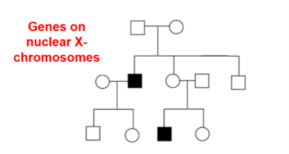
What type of inheritance is this?
X-Linked Recessive
What is penetrance?
TWhahe proportion of individuals with a genetic variant who show features of the condition
What can penetrance depend on?
Age
What is expressivity?
The variation of phenotypic features seen between individuals
What is an example of expressivity with BRCA1/2?
Can cause breast, ovarian, both or neither types of cancer
What are the features of mitochondrial inheritance?
Vertical inheritance pattern
Children of affected males are never affected
All children of an affected woman will be affected but extremely variable
Heteroplasmy – depends on the degree of mitochondria that carry the change

What type of inheritance is this?
Mitochondrial

What type of inheritance is this?
Autosomal dominant

What is the risk?
A has a low population risk as neither parents have the copy
B and C both have a 50% chance that they have affected child
What is the risk?
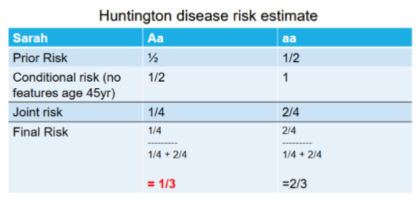
Sarah has 50% inheritance chance of developing it as wouldn’t be expected to show symptoms at that stage

What are the features of Huntington’s?
Huntington’s is a neurodegenerative condition that demonstrates anticipation
The repeat gets larger as passed between generations and important when it borders
Doesn't always gets larger by the same amount
Has age related penetrance

What is the risk?
Sarah had a 50% chance of developing it and died before presentation so don’t know if she has it
Means that you half the chance for the offspring so Rob has 25% chance
What are the features of Friedreich Ataxia?
Ataxia is loss of balance, difficulty walking, unsteady
Nerve dysfunction loss of muscle coordination, weakness in legs, loss of sensations
Speech and swallowing changes
Systemic complications, diabetes, hearing loss etc
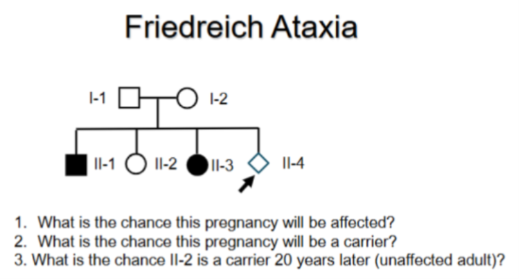
What is the risk?
Has a ¼ chance of being affected as each parent is a carrier but needs two copies
Has ½ chance of being a carrier
2/3 chance as you know she doesn’t have both copies so only 3 possible options and 2 are carriers
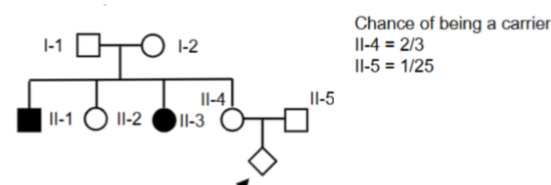
What is the risk of the baby being affected?
1/150

Which of these people would be carriers?
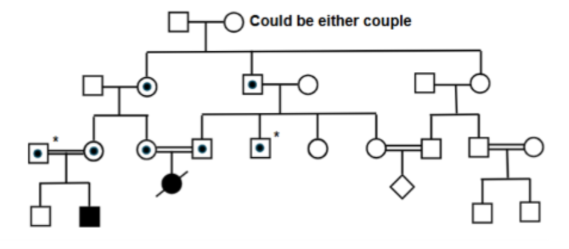
What are the features of consanguineous marriages?
Consanguinity may not be noted
Both parents of unaffected child could be carriers
More common in families from a small region

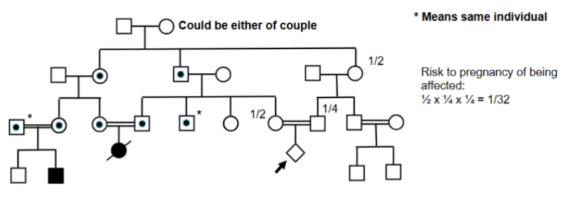
What is the risk to the pregnancy?
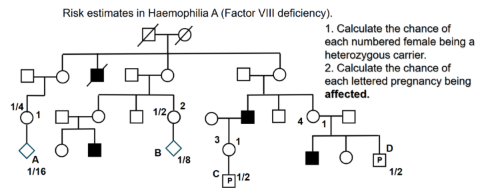
How are X-linked disorders inherited?
Affected females will have affected sons, healthy sons and daughters or carrier daughters
Affected males will have female carriers and unaffected sons

What is the risk?
What are the features of the Hardy-Weinberg Principle?
Used for carrier frequencies
Used for recessive conditions
The allele frequency in a population will remain constant in the absence of evolutionary influences
A is affected and a is recessive
What are the Hardy-Weinberg equations?


What is the risk?

How is HW used with consanguinity?
Can not be assumed to work with consanguinity
If most cases of rare recessive conditions occur in consanguineous families the Hardy-Weinberg equation can’t be applied
Will badly over-estimate the frequency of carriers in the general population
What are the features of Bayes theory?
Combines risk information from different sources
Modifies the probability of an outcome based on conditional probabilities
Works out a prior risk
Ask what additional information is available
Test results
Penetrance
Unaffected children / siblings
Works out the conditional probability

How does Bayes work?
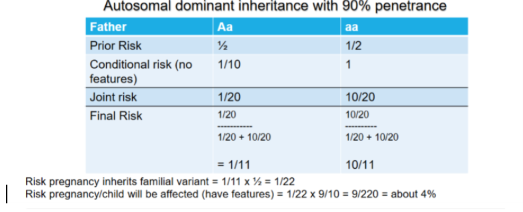

What is the risk?