EXSI 420 ch 2 Biomech of Resistence
 Call Kai
 Learn
Learn Practice Test
 Spaced Repetition
 Match
Match Flashcards
 Knowt Play
1/35

There's no tags or description
Looks like no tags are added yet.
Name | Mastery | Learn | Test | Matching | Spaced | Call with Kai | Chat |
|---|
No analytics yet
Send a link to your students to track their progress
36 Terms
Biomechanics
mechanisms through which components interact to create movement
Origin
proximal
Insertion
distal
Agonist
muscle most directly involved; prime mover
antagonist
muscle slow down or stop movement
synergist
muscle asisst indirectly in a movement
Levers
rigid or semi-rigid body that, when subjected to a force whose line of action does not pass through its pivot point, exerts force on any object impeding its tendency to rotate.
Fa
force applied to lever
Maf
moment arm of the applied force
Fr
force resisting the lever’s rotation
Mrf
moment arm of resistetive force; equal force in mag but oppisite direction
Mechanical advantage
ratio of moment arm through force is applied acts to resistive force; if resistive moment arm is shorter —> less, if longer —→ greater
Greater than 1 = less muscle force than resistive force for equal amount of torque
Less than 1 person must apply greater muscle force than the amount of resitve force
first-class lever
muscle force and resistive force act on oppisite sides
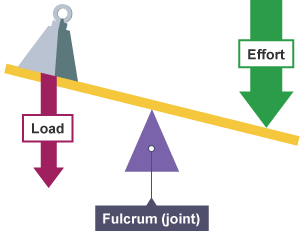
second-class lever
muscle force and resistive force act on the same side of the fulcrum, with the muscle force acting through a moment arm longer
required muscle force is smaller than the resistive force

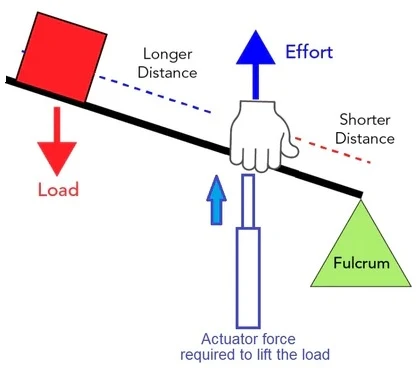
Third-class lever
A lever for which the muscle force and resistive force act on the same side
of the fulcrum, with the muscle force acting through a moment arm shorter
MA less than 1 so muscle force greater
Patella mechanical advantage
The patella increases the mechanical advantage
of the quadriceps muscle group by maintaining the
quadriceps tendon’s distance from the knee’s axis of
rotation.Absence of the patella allows the tendon to fall
closer to the knee’s center of rotation, shortening the
moment arm through which the muscle force acts
and thereby reducing the muscle’s mechanical
advantage.
Are forces in the muscles and tendons higher than hands or feet on external objects?
yes
Tendon insertion variation
further away from the joint center = ability to llift heavier weights
results in loss of max speed and force capibility during faster movements
Strength
capacity to exert force at any given speed
Accleration
change in velcocity per unit of time (force= mass x accleration)
Power
explosive strength
rate of time doing work (power= work/time)
Work
product of force exerted on an object and the distance the object moves in the direction the force is exerted (work = force x displacement)
Negative work
work performed on, rather than by a muscle
eccentric muscle contractions
Angular work and power
angle which an object rotates
rotational work = torque x angular displacement
Commonality between strenth and power
reflect the ability to exert force at a given velocity
Biomechanical factors in human strength
Neural control-which and how many motor units (rate coding)'
muscle cross-sectional area
arrangement of muscle fibers- pennate (align obliquely)
muscle length (resting)- muscle can generate greatest force
muscle length (contracted)- decreased force generation capability
joint angle-force v muscle length (torque)
muscle contraction velocity- force dec as velocity inc
joint angular velocity (3 type)
body size- body size inc, body mass inc more rapidly than muscle strength; smaller athlete has high strength to mass ratio
Concentric action
muscle shortens bc contractile force greater than resitive force. Forces generated within muscle and acting to shorten it are greater than external forces acting at tendons to stretch it
eccentric action
muscle lengthens bc the contractile force is less than the resistive force. Forces generated within muscle to shorten are less than the external forces to stretch it
Isometric acton
muscle length does not change. Contraction equal to the resitive force
Force-velocity curve
inverse relationship between speed and the amount of external force or resistence a muscle can produce
Eccentric flexors and extensors more torque with - joint angle
Strength to mass ratio
Directly reflects an athlete’s ability to acclerate his or her body when dealing with sprinting or jumping
Gravity application to resistence training
When weight is horizontally closer to a joint, less resitive torque
weight horizontally farther, more resistive torque
exercise tech can affect resistive torque pattern and shift stress among muscle groups
Back injury
resistence training, the back should be in a moderately arched position
fluid ball aids in support (lifting belt)
Valsalva maneuver
The glottis is closed, thus keeping air from escaping the lungs, and the muscles of the abdomen and rib cage contract, creating rigid compartments of liquid in the lower torso and air in the upper torso.
Shoulder injury
warm up w light weights
exercise shoulders in a balanced way
exercise at controlled speed
prone to injury during weight training
Knee injury
prone to injury because of location between two levers
minimize use of wraps