8- Trauma informed care
 Call Kai
 Learn
 Practice Test
 Spaced Repetition
 Match
 Flashcards
 Knowt Play
1/55

There's no tags or description
Looks like no tags are added yet.
56 Terms
Psychosocial Health
Caring for the whole person
Psychological
Social
Spiritual / Cultural
Beyond the illness/disorder/disease/condition/injury/symptoms
About the human, the human experience, and the human response
Person-centered care
Deeper than exchange of information –story / narrative
Opportunity to build therapeutic relationship
Human response
Physical
Cognitive
Behavioural
Affective
Spiritual
Psychosocial Assessment
Engagement and collaboration
Dialogue
Opportunity for patient to express self and ask questions
Deeper understanding
Therapeutic benefits
Experiential and narrative
Health benefits
want to use open ended questions: gather more info and have them open up to you
allows for patient to ask questions
Guiding questions
How are they responding to their health condition or problem? What is the impact and how are they processing this?
2What are their sources of distress? What is most concerning to them?
What are their current social circumstances? How are those around them affected by the health issues
How is their mental health, coping resources? Are there other factors affecting how they are managing?
What gives them personal meaning? From where / who do they draw strength? What gives them comfort?
Narrative truth
The coherent story a person builds around events to make sense of their meaning and lived experience
Objective truth
What actually happened or exists independently of personal feelings or beliefs
Narrative truth vs objective truth
Everyone constructs their own narrative
Objective information is interpreted and reinterpreted
People can use coping mechanisms to help with what they’re going through
Incorporate both into care
Pain is a good example
Things to consider before doing a psychosocial assesment
How much time do you have?
What is the setting?
Is there privacy?
What are the clinical priorities? Are they acute?
What is the current physical / mental condition?
What is your rapport? Stage of therapeutic relationship?
Use critical thinking and clinical judgment to decide when and where to go deeper into the narrative.
Psychosocial assessment- Observation
Posture
Position
Eye contact
Facial expression
Hand gestures
Behaviour
Engagement
Understanding
Psychosocial assessment- Asking questions
Listening, validating, clarifying, responding
Checking for understanding
Inviting questions
Summarizing
Psychosocial assessment- current, change, functioning and abilities in performing acitivities
Current
Change
Same or different from before
How?
Functioning and abilities in performing activities
Have you noticed any changes or limitations because of this condition
Are there things you want to do but can’t have you found yourself frustrated and by what?
Have you needed to adjust? have those adjustments allowed you to do what you wanted to do?
Is there anything you need support to do now that you are hoping to reduce how much help is needed?
Psychosocial assessment- sleep
Falling asleep, staying asleep, frequent periods of waking up
Tired during the day
How satisfying is your sleep?
Psychosocial assessment- Appetite and diet
Any changes in appetite, eating habits or patterns?
Any specifics of your diet that are important to you?
Any changes in diet related to health condition?
Psychosocial assessment- GI function
Any symptoms or concerns about bowel or bladder function?
Any changes?
Psychosocial assessment- fatigue
Any changes in energy levels
Rest and activity – can you accomplish what you want / need to accomplish?
Effects of fatigue on your life
Exercise and activity levels
Psychosocial assessment- pain
What does it feel like? What words to describe it?
What helps you cope with it?
Impact on daily functioning?
Psychosocial assessment- MH
Thoughts and feelings
Mood
Behaviour
Cognitive functioning
How are you feeling today?
Are you having any thoughts that are troubling you?
Have you noticed any changes in how you think or feel or act?
What is on your mind?
MH care
Everyone has mental health ; there is no health without mental health . Every nurse is a mental health nurse .
Emotional, psychological and social well -being . How we handle stress, relate to others, and make choices . Mental health is a spectrum .
Many factors contribute to mental health including :
Biological factors : such as genes or brain chemistry
Life experiences : such as trauma or abuse
Lifestyle or life circumstances: such as diet and exercise, social support availability, opportunities for relaxation
Mental health vs Mental illness
Mental Health | Mental health |
• Sleep | • Generalized Anxiety Disorder |
• Nutrition | • Depression |
• Sleep | • Eating Disorder |
• Exercise | • Post-traumatic Stress Disorder (PTSD) |
• Stress | • Obsessive Compulsive Disorder |
• Coping | • Schizophrenia |
• Grief/Loss | • Bipolar Disorder |
• Adaptation / Adjustment | • Severe Depression |
• Resilience | • Severe Obsessive Compulsive Disorder |
• Negative / Positive emotions | |
• Response to life events | |
• Conflicts | |
• Interpersonal relationship dynamics | |
• Identity |
Mental health
A mental, behavioral, or emotional disorder resulting in serious functional impairment, which substantially interferes with or limits one or more major life activities
Communicating with people with MH conditions
When working with people with mental health conditions, you may face difficulties in trying to establish a relationship .
They may rarely initiate contact and their answers are likely to be brief . It is important to keep trying to connect .
Treat as though the patient can understand
Orient patient frequently
Provide familiar objects
Explain noises, procedures, and equipment
Encourage family to interact
Utilize technologies to enhance communication
If the person is hallucinating or using delusions, don't challenge their validity directly nor engage into a prolonged discussion of illogical thinking .
Psychosocial Assessment- coping
Emotion focused coping
Problem focused coping
Solution focused coping
Avoidant
How do you usually cope with difficult situations
What would be helpful to you in coping with this condition
Psychosocial Assessment- Identity, social identity, and relationships
Body image and sense of self
How do you feel about the changes in your physical appearance?
Are there things you have started / stopped doing
Are there times you feel uncomfortable around people
Psychosocial Assessment- sexual well-being
Any changes in sexual desire or arousal?
Give permission: It is common for people to experience changes in their sexual function. If you have any concerns or questions, you can ask them anytime.
Psychosocial Assessment- occuptation and finances
Any impact on day-to-day activities, ability to do daily work (job, childcare, gardening etc.)
Any concerns related to employment (time off work) or finances?
Any effects on changing family roles / responsibilities?
Any financial stress?
Psychosocial Assessment- relationships and support system
How has condition impacted relationship or dynamics within family?
Response of family to health condition
How are they coping?
Has support system rallied or fallen away?
How do you feel about your relationships?
Do you feel adequately supported?
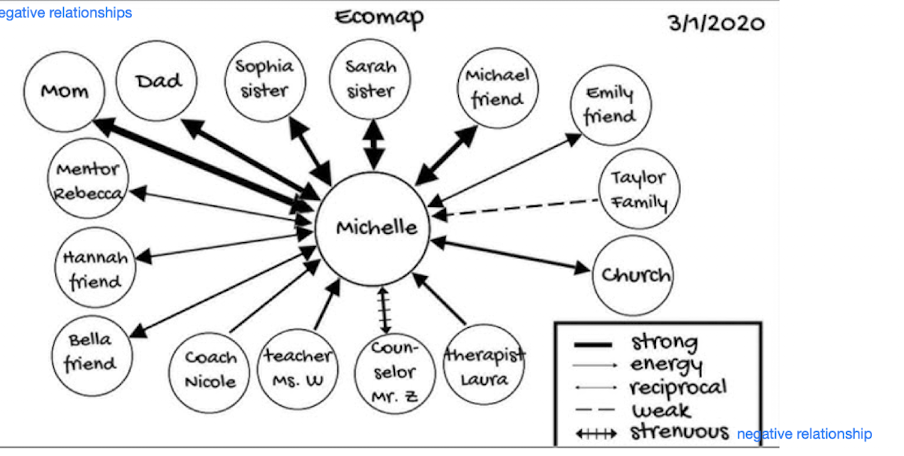
Psychosocial Assessment- ecomaps
Any people involved in your life
Positive or negative relationship
Spiritual Assessment
Meaning / Purpose
Connection
Peace and comfort
What gives you meaning and purpose in life
Are you connected to a spiritual or faith-based community
How important is spiritual health or well-being to you
Do you have any spiritual beliefs that you consider when it comes to your health or managing your health condition
Are there any specific practices that I should know about as your nurse or that I can help you access while in hospital
What are your sources of hope, strength, comfort?
What gets you through difficult times?
Spiritual Assessment importance
Spirituality and religion are recognized as important factors in coping with disease and life events and in maintaining quality of life.
When health fails or circumstances seem beyond control, it is often the person's spiritual self-concept that sustains a sense of self and helps to maintain a more balanced equilibrium.
Spirituality and religion are often used interchangeably, but there are differences:
Religion can be defined as "an organized system, or set of beliefs, that provides answers to questions about life through sacred texts, rituals and practices"
Spirituality can be experienced within or outside a formalized religion and community, or individually. Spirituality is iwhatever or whoever gives ultimate meaning and purpose in one's life"
Spiritual Assessment communication
Open and non-judgmental communication: Create a safe environment where patients feel comfortable sharing their spiritual beliefs and experiences.
Asking open-ended questions: Prompt patients to reflect on their beliefs, values, and sources of strength to gain insight into their spiritual needs.
Active listening: Pay attention to verbal and non-verbal cues, demonstrating respect and empathy towards patients' spiritual concerns.
Cultural sensitivity: Recognize and respect diverse spiritual beliefs and practices, ensuring care aligns with patients' cultural backgrounds.
Incorporating spiritual helath
Collaborative approach: Involve the interdisciplinary team, including spiritual care providers, chaplains, and pastoral services, to address patients' spiritual needs.
Respect individual choices: Ensure patient autonomy and respect for diverse spiritual beliefs, allowing patients to guide their care.
Provide resources and support: Offer information on religious or spiritual resources available in the healthcare setting, such as prayer rooms or support groups.
Reflective practice: Engage in self-reflection to understand personal biases, beliefs, and limitations, ensuring non-judgmental and respectful care.
Trauma informed care
Is a patient centered approach to healthcare that calls on health professionals to provide care in a way that prevents re -traumatization of patients and staff.
Definition of trauma informed care
When every part of service is assessed and potentially modified to include a basic understanding of how trauma impacts the life of an individual seeking services
What is trauma?
Traumatic events are those associated with actual or threatened risk of serious injury, death, or sexual violence that are experienced directly or indirectly (by witnessing them, or vicariously (through the experiences of a close friend or loved one).
Responses to traumatic events vary widely, as they are influenced by a person's sociocultural history, a person's interpretation of events, the meaning a person ascribes to the events, and the associated physical and psychological effects of the events.
Although the stress that follows a traumatic event effects each person individually, it often produces lasting emotional, physical, mental, spiritual, and social upheaval.
Barrier tha impact treatment
It is common for trauma survivors to face systemic discrimination or live infsocial contexts that are full of inequities.
This can lead to difficulty accessing services, limited engagement and poorretention in treatment programs.
The Trauma Informed Approach
Guides health care providers in understanding the sequelae of trauma and in accepting and supporting victims of trauma through positive adaptation and healing.
It recognizes the signs and symptoms of traumatic stress and acknowledges the role that trauma may play in a patient's life.
Trauma triggers
Are rarely clear
Are often unnoticed, even by the individual
Can be invisible (sensory oriented)
Can seem trivial/minor
Are often uncontrolled factors
Don't always make sense
Revert us to less functional versions of ourselves
The 6 Principles of Trauma Informed Care
Safety
Trustworthiness and transparency
Peer Support
Collaboration and Mutual Support
Cultural and Historical Sensitivity
Empowerment (voice and choice)
Creating a Safe Environment
People with histories of trauma may feel unsafe in unfamiliar environments, creating stress and anxiety. Health care providers are to ensure that accommodations are safe and welcoming for all patients without judgment regarding age, sex, sexual orientation, gender identity, race, socioeconomic status, or social determinants of health.
Ask Patients directly what they need to feel safe
Keep Consistent schedules and offer sufficient notice and preparation when changes are necessary
Send medical forms that require patients to disclose sensitive information ahead of time
Greet patients in a warm and welcoming manner
Ask patients how they would like to be addressed
Ask patients whether they are comfortable with having door shut during exams
Trustworthiness and Transparency
Trustworthiness is built through our communication with patients that emphasizes person - centered care which focuses on diversity, equity and inclusion. As well as practicing ethically, understanding patient confidentiality and rights.
Transparency, which fosters trust, is founded on anticipatory guidance and use of educational pedagogy to determineunderstanding. Use of the teach back method.
Peer support
The peer role is deeply rooted in the idea of not trying to “fix” people but rather to help them find inner strength by connecting them to supportive peer services in communities that mirror their culture, religion, beliefs, practices, and experiences.
Collaboration and Mutual Support
View patients as active partners:
Patients are experts on their lived experience.
Recognize patients as active participants in their care.
Shared goals and prioritization:
Nurses and healthcare team members support the goals identified by the patient.
Collaboratively prioritize goals based on patient input .
Creating a plan of care and discharge:
Collaboratively develop a comprehensive plan of care.
Involve the patient in decision- making for their healthcare.
Recommendations and patient decision- making:
Healthcare team provides recommendations based on expertise.
Patient makes final decisions about healthcare avenues, considering limitations and preferences.
Cultural and Historical Sensitivity
Cultural and historical sensitivity:
Encompasses allaspects ofa person's identity.
Includes race, ethnicity, sexualorientation, age, religion, gender identity, geography, and life experiences.
Impact on healthcare relationships:
Patients bring personalexperiences, traumas, and historical narratives to healthcare interactions.
Understanding cultural and historical context is crucial for effective care.
Historical trauma:
Traumatic events shared by a group that affect parenting, physical health, and mentalhealth across generations.
Stress can lead to sleep loss, anxiety, depression, unhealthy behaviors, and epigenetic changes.
Importance ofsensitivity:
Acknowledge and respect diverse beliefs, values, and experiences.
Create a safe and inclusive environment for patients.
Empowerment (Voice and Choice)
Empowerment of patient voice and choice :
Foundation ofTIC and reflected in all core principles.
Central focus on empowering patients throughout the care process.
A Offering a voice:
TIC ensures patients have opportunities to express their thoughts, concerns, and preferences.
Actively listen to patients and value their input.
B.Respecting choices:
TIC acknowledges and respects patients' autonomy and decision-making abilities.
Involve patients in decisions regarding their care and treatment options.
C. Developing health literacy:
TIC promotes patient education and understanding of healthcare information.
Build on patients' existing strengths and address their weaknesses to enhance health literacy.
Crisis
occurs when a stressful life event overwhelms an individual’s ability to cope effectively in the face of a perceived challenge or threat.
Crisis state
An acute but normal human response to severely abnormal circumstances.
Types of crisis
developmental
situational
behvioural
Developmental crisis
a predictable turning point or period of emotional upheaval that happens during normal growth and life transitions
it stems from expected milestones like puberty, starting a career, parenthood, midlife, or retirement
Situational crisis
a sudden, unexpected stressful event that overwhelms a person's usual coping abilities and disrupts their emotional balance
happen with little advance warning
Behavioural crisis
happens when someone's actions or emotional distress escalate to a point where they can't be managed safely in the moment, creating a risk of harm to themselves or others.
It can stem from mental health conditions, neurodevelopmental differences (like autism or intellectual/developmental disabilities), substance use, medical issues, or overwhelming stress and triggers
Crisis intervention
an immediate and short -term emergency response to mental, emotional, physical and behavioral distress
help to restore an individual's equilibrium to their biopsychosocial functioning and minimize the potential for long -term trauma or distress
As a nurse, you cannot always change the nature of a crisis situation, but you can help defuse a person's emotional reaction to it with compassionate, professional support and guidance
Nursing model
The nursing model developed by Aguilera (1998) approaches crisis intervention from a balancing perspective, between a crisis situation and a person's capacity to resolve it
The model proposes that a crisis state develops because of a distorted perception of a situation or because the person lacks the resources to cope successfully with it
Balancing factors include a realistic perception of the event, the person's external (environmental) support and the person's internal resources (beliefs or attitudes)
Absence of adequate situational support, lack of coping skills, and a distorted perception of the crisis event can result in a crisis state, leaving individuals and families overwhelmed and unable to cope
Structuring Crisis Intervention Strategies
Assess lethality and mental status
Establish rapport and engage the patient
Identify major problems
Explore alternative options and partial solutions
Develop a realistic action plan
Implement the plan
Develop a termination and follow -up protocol
Mental health emergencies
Present significant challenges for nurses. Whether encountered in the community or the emergency department, often present as a danger to themselves or others.
They present with chaotic distress behaviours that are not under the person's control.
Require an immediate coordinated response designed to alleviate the potential for harm and restore basic stability.
Triage assessment system (TAS) for mental health crises that can help nurses understand a patient's responses across three domains: affective, behavioural, and cognitive.
Types of mental health emergencies
violence
sexual assault
psychosis
suicide
De-Escalation Tips for Mental Health Emergencies
De-escalate people's responsive behaviours
Implement person -preferred interventions to assist person in coping
Tips include :
Identify yourself; talk calmly; respond calmly
Provide additional personal space
Respect needs to communicate in different ways
Reassure people but set professional boundaries
Allow quiet time for people to respond - silent pauses are important
Acknowledge the significance of the situation for the person