Chapter 9 - Light and the Aquatic Ecosystem
 Call Kai
 Learn
Learn Practice Test
 Spaced Repetition
 Match
Match Flashcards
 Knowt Play
1/32

There's no tags or description
Looks like no tags are added yet.
Name | Mastery | Learn | Test | Matching | Spaced | Call with Kai | Chat |
|---|
No analytics yet
Send a link to your students to track their progress
33 Terms
What are the other sources of energy on Earth?
Manmade
Uranium fission such as nuclear reactors
Hydrogen fission (rare)
Natural
Moon-pulled tides
Earth’s internal heat from radioactive decay
Lord Kelvin: Calculated the age of Earth based on temp of Earth’s surface
Seismic activity
What is the solar constant?
1.94 cal/cm2
Not anywhere near this; it even reaches the surface
Measured at the Earth’s mean distance from the sun
Functionally lost at many points
Scattered
Reflected
Absorbed
What is the speed of light and what does it actually mean?
299,792 km/s
the measurement of light traveling thru diff materials
hard speed limit of the universe
What is the speed of light composed in?
Composed of quanta of energy traveling in waves with different frequencies and wavelength
Wavelengths measured in nanometers
ex) would take 8 minuted to realize the sun was out if it ever happened bc of the amt of light years (299,792 km/s)
What is Planck’s Quantum theory?
Direct relationship of frequency to energy
TLDR: regarding visible light, there is almost twice as much energy in short wave light as long wave light
What are the two sources of radiation on Earth?
Direct
Diffuse
How is color seen on earth?
PAR: photosynthetically active range
Chlorophyll absorbs reds and violets, reflecting greens and yellows
why plants look green and yellow
Photosynthetic activity highest in violet blue and orange red lights
what is the solar constant in langley?
1.94 ly (langley) per minute
How is light reflected at the surface of a lake?
thru light bouncing= intensity is lost
Reflectance (R): expressed as a percentage is R X 100
Complicated by wind
Complicated by cloud cover
Why is it harder to tan in January than in the summer?
There is less directy light, so more atmopshere is going thru an angle
How is light seen below a lake’s surface?
light loses intensity (quickly) with increasing depth
What is Beer’s Law?
A beam of monochromatic light passing through a given distance of a solution is absorbed exponentially according to concentration of solute
why it is easier to tan when swimming than when outside
beer law what makes spectrophotometry possible (how much shit in the way)

What is Beer-Bouguer’s Law?
light absorbed exponentially with distance
combines two laws
Three terms give you the total coefficient of Absorbtion

How much light rlly goes thru?
It depends on things such as water, dissolved solids, undissolved solides, and absorbtion, transmittance, attenuation, and scattering
TLDR:
Red penetrates farther than expected
Clear lakes transmit green and yellow well
Orange goes farthest in stained water
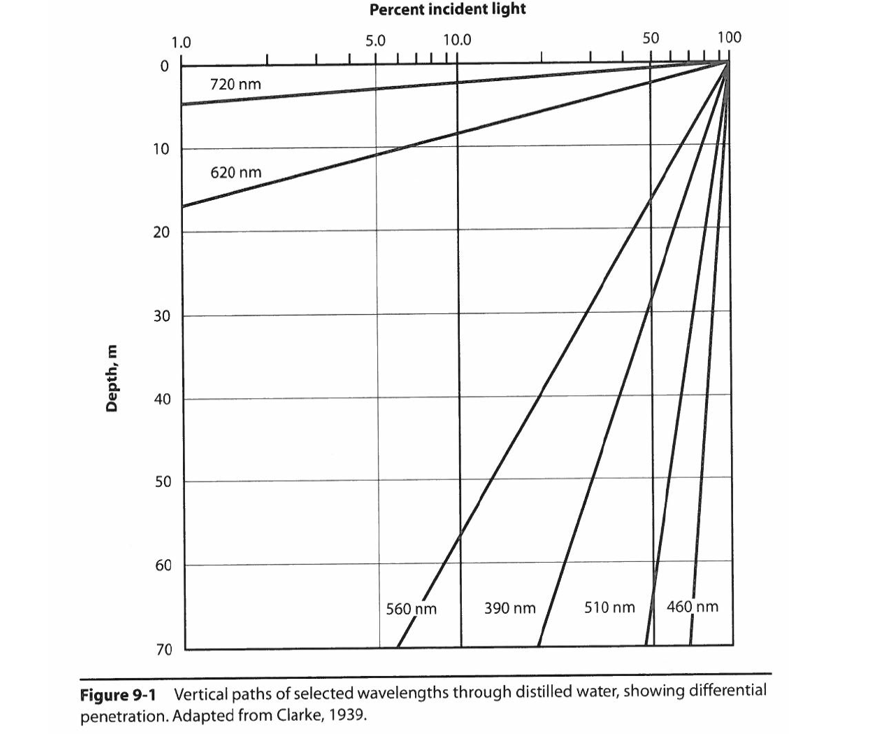
Explain what the fuckkk is going on in this graph
Lines are the wavelengths of light
720nm being red
620nm being orange
Bottom wavelengths are blue, indigo, and violets
At 5m of depth, all red is gone
Everything eventually turns blue as you increase in depth
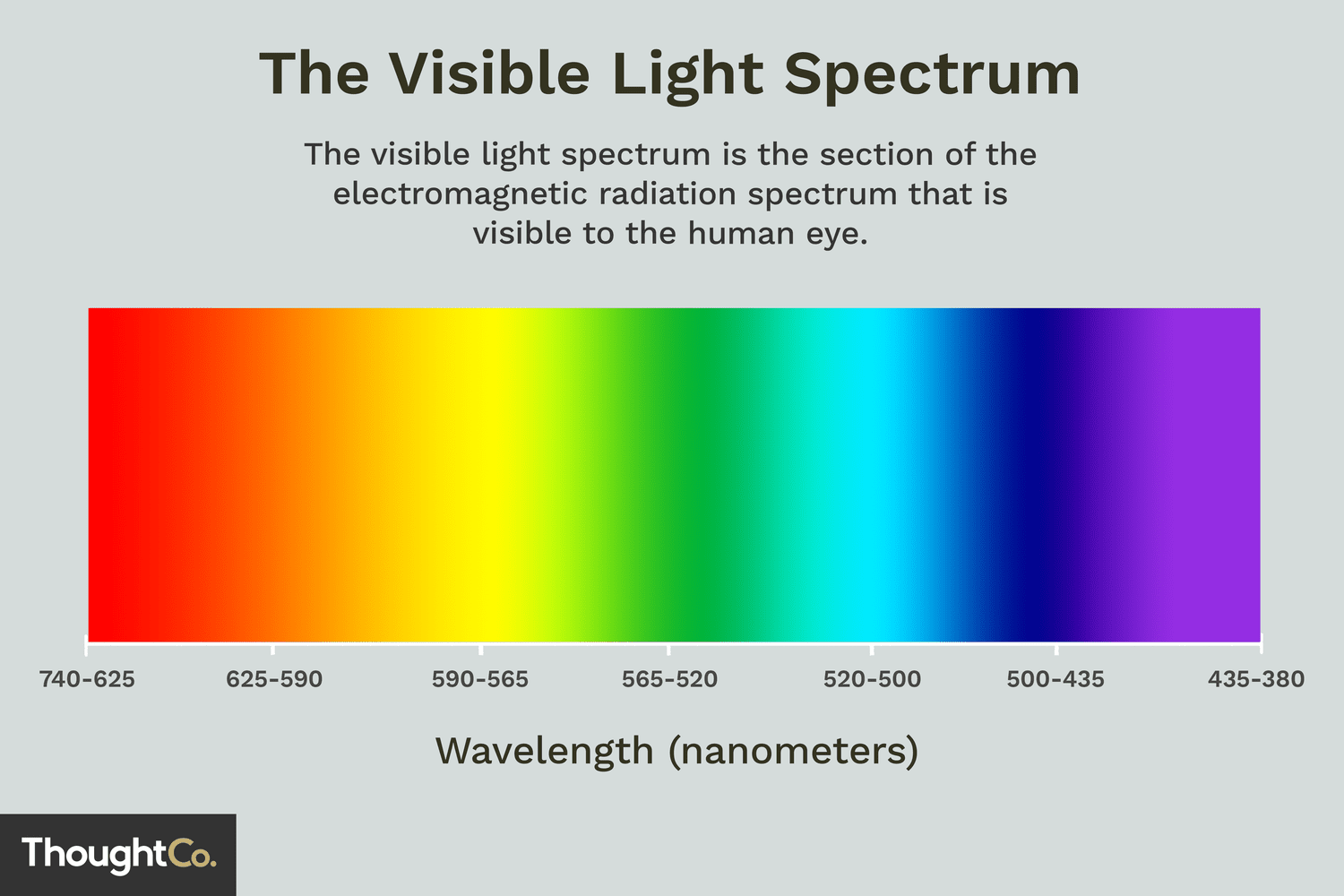
What are the wavelengths of visible light?
ROY G. BIV

Explain the graph of vertical penetration and bodies of water
Depths of 0-2 meters have water color of brown dookie color
light gets lost at 5ft of water due to turbudity
Take note of Lake Itasca, Minnesota
Lake Tahoe has some light at aorund 20% light at 6m depth

Which lake is the clearest and which is the least clear?
At around 4m of depths, there’s a thermocline present where it disbands from not being a linear relationship
lake Erie: Least clear lake
Lake Huron: Most clear lake

Explain the transmission curves occuring in the graph
The graph illustrates a shift increasing transmittance (lsomething coming thru) of long waves as absorption of coefficient increases
0.25 on graph is absorption of coefficient
What is the secchi disk?
Flat disk is lowered, measure where you can’t see it anymore
measures water transparency
can be inconsistasnt since everyone has diff eyesight and reflectance of water can vary
ex) Crater Lake so clear that secchi disk can be seen at 40m depth
most lakes less than 1m due to biotic and abiotic factors

What is the euphotic/photic zone?
Region where at least 99% of surface light has disappeared
How do you find the bottom of the photic zone?
Vertical Absorption Coefficient:
1.7 divided by ZSD
Multiply 3 times the ZSD
What are the effects of ice and snow cover?
Clear ice transmits light better than water beneath it
With snow, albedo increases by an incredible amount
In a lake with low amounts of oxygen, can lead to winterkill

What is black ice/ congelation ice?
Congelation ice forms when there is no wind and a lake freezes fast
lake looks so clear

Why do lakes and any natural system usually not meet the Beer-Bouguer law?
they are not homogenous
there’s biotic interactions such as
cyanobacteria
sulfur using bacteria
eukaryoptic algae
temeprature and density effects

Wtf is happening here
Linear line present in the solid line is due to bacteria being absorbed in
at 100m of depth is where purple sulfur forms (where the linear line forms)

What is seen in the graph where optical density is shown?
At between 4-5m of depth, there is a lot of light being transmitted
between the depths of 7-10m, the lake is clear
remember: OD is how much light material (lake) is absorbed
Low OD: No light goes thru
High OD: light absorbed and scattered a lot
How are colors usually seen in a lake?
Ultraoligotrophic- bluest water
like Lake Tahoe and Crater lake
Usually from one of two sources
Inorganic edaphic materials
Biotic sources
Usually bacteria or algae

What is the science behind red and pink colored lakes?
Pink or red lakes form due to excessive salt and salt loving bacteria being present

What is the Forel-Ule scale?
Color matching board that matches the color of the water with what’s on the board
Classifies the color/type of lake based on the color of the water
Light penetration and aquatic plant zonation
Aquatic plants usually make water more clear and increase photosynthetic ability.
Usually disappears before the 1% zone
Many other factors influence distribution

What can you interpret from this table?
Deepest plant growth usually means that the secchi disk depth will also be high in value, meaning clear water
Light and aquatic animals
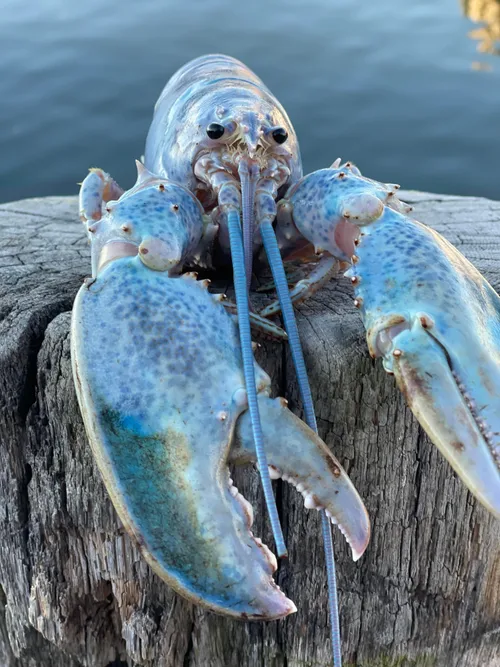
blue is a rare color within nature due light absorption
Many surface dwelling species in the neuston have blue carotenoproteins or white sheens to protect themselves from UV radiation