Upper Resp. Tract Disease in Small Animals
 Call Kai
 Learn
 Practice Test
 Spaced Repetition
 Match
 Flashcards
 Knowt Play
1/29

There's no tags or description
Looks like no tags are added yet.
30 Terms
Upper airway anatomy review:

Be able to recognize and differentiate between stertor and stridor… what is STERTOR supposed to sound like?
Pitch → low pitched, snore / gurgle
Primary area of origin → pharynx / nasopharynx
What it is described as “sounding like” → SNORE
Is a classic BOAS noise… happens more in the UPPER airways
What is STRIDOR supposed to sound like?
Pitch → HIGH pitched
Primary area of origin → Larynx / trachea
What it is described as “sounding like” → SQUEAK, HONK
What exactly is BOAS?
Brachycephalic Obstructive Airway Syndrome
Happens in ALL brachycephalic breeds; have an abnormal breathing apparatus that increases air turbulence / flow
Is a PRIMARY CONDITION… THEY’RE BORN THIS WAY

What features (that brachycephalic dogs are born with) contribute to primary BOAS?
Hypoplastic trachea → “collapsing trachea”
Stenotic nares
Elongated (and thickened) soft palate
Macroglossia (long tongue)
Aberrant nasal turbinates
Rostral / caudal excess tissue in nasal cavity
Nasal septum deviation
Excessive pharyngeal mucosa
Tonsilar hypertrophy
**** keep in mind ****
Not all dogs will have every bit of this… the exact cause of an individual’s BOAS is based on what variation they’re born with
What does primary BOAS eventually result in?
SECONDARY BOAS, which leads to LARYNGEAL COLLAPSE
Due to increased and continuous pressure to the larynx from struggling breaths over time
Arytenoid cartilage weakens over time
What are the 3 stages of laryngeal collapse?
Stage 1
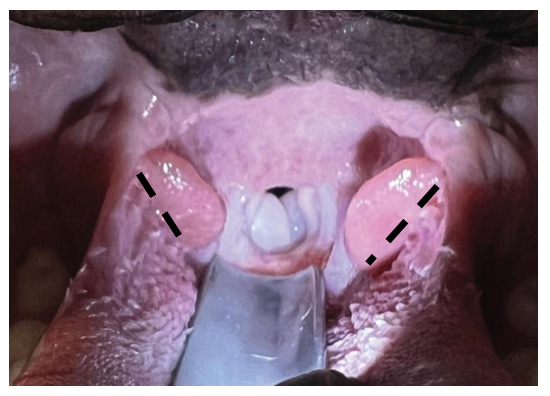
Eversion of the laryngeal saccules
Look like pink balloons; aren’t supposed to be visible, are usually tucked in like a bowl (see image)
Stage 2
Partial collapse of the cartilage folds
Causes narrowing of the laryngeal opening
Stage 3
Entire collapse of cartilage folds
Leads to CLOSURE of the laryngeal opening

What are the CHRONIC symptoms of BOAS?
Stertor
Exercise intolerance
Dyspnea / cyanotic episodes
Heat intolerance
Regurgitation
Sleep apnea / snoring
What are the ACUTE symptoms of BOAS?
NEED TO UNDERSTAND: acute presentation is essentially a sudden WORSENING of chronic symptoms in the cases of BOAS
Doesn’t just come out of nowhere in brachycephalics
SEVERE stertor
Dyspnea / cyanosis
Aspiration pneumonia
Coughing / nasal discharge
Collapse
obstruction of airway
Death
What should you be assessig during your clinical examination with a dog with BOAS?
Get a COMPREHENSIVE HISTORY
All of the previous chronic signs listed should be asked about; will tell you how much the dog is struggling
Then physical exam:
Chest auscultation
Laryngeal auscultation
NARES ASSESSMENT
Open vs. mild - moderate stenosis vs. severe stenosis
Airway exam
Functional grading
CT scan

What is “functional grading” of a dog with BOAS?
Is basically an exercise tolerance test (ETT)
Patients are examined and auscultated over the lateral larynx first
Dogs are then exercised for 3 min at a trot
Breathing is reassessed
What are the different grades of a Functional Grading BOAS exam, and what do they mean?
Grade 0 - BOAS free for now
Grade I - clinically unaffected but with mild respiratory signs
Annual health check suggested if dog is under 3 yrs old
Grade II - BOAS affected, moderate respiratory signs
Dog has clinically relevent disease that requires management
Weight loss
Surgical intervention
Grade III - BOAS affected, SEVERE respiratory signs
Dog should have thorough veterinary examination w/ surgical intervention
What factors of BOAS can be managed surgically?
These are done in a “FIRST LINE MULTI-LEVEL AIRWAY SURGERY”
Everything that NEEDS to be addressed is all done at the same time
Also first-line surgical treatment; if they can make the dog’s QOL better, then they should be done
STENOTIC NARES
Elongated soft palate
Everted laryngeal saccules
Tonsillar eversion
Turbinectomy
What procedure is used to correct stenotic nares?
Nares = Rhinoplasty (or nareplasty)
“Wedge rhinoplasty” is the most common technique (see image)

What procedure is used to correct an elongated soft palate?
Soft palate = Staphylectomy (or folded flap palatoplasty)
Soft palate is literally stuck behind the epiglottis
Cut at the level of the tonsillar crypts (pockets where tonsils sit)
“Cut and sew” technique… literally cut the excess and sew it up

What procedure is used to correct a grade 1 laryngeal collapse?
Grade 1 laryngeal collapse = Sacculectomy
Is also a “first line” surgical approach
Is the surgical removal of everted laryngeal saccules

What procedure is used to correct tonsillar eversion?
Tonsils = Tonsillectomy
Removal of the tonsils
What are some conservative management strategies for BOAS?
Weight loss
Harness not lead
Keep cool, avoid stress
Manage exercise
Early surgery to prevent further secondary changes
Can be done before or in tandem with surgery as well
What happens to cause a BOAS crisis? How do you treat for the crisis?
Acute crisis = obstruction = NO AIR FLOW
Usually due to excessive excitement or exercise in hot weather
Makes soft tissues swell
Can also be due to acute regurgitation and inhalation
When these come in to the clinic:
ACT FAST
Treatment regimen:
O2 (flow by)
Cooling
Steroids (bring swelling down)
Sedation
GA / intubation
OR tracheostomy (TT) potentially
How does BOAS cause GERD and hiatal hernias in brachycephalics?
Due to the increased upper respiratory tract pressure and “sucking” effect from stomach
This makes them more prone to aspiration pneumonia
Acute episodes can cause death
Symptoms:
Cough
Pyrexia
Tachypnea
Dyspnea

How are hiatal hernias treated?
Treatment =
Reduce negative airway pressure with airway surgery
Medical = antacids, prokinetics
Finally -> Herniorraphy
What is laryngeal paralysis? What is responsible for it?
Laryngeal paralysis → failure of the recurrent laryngeal nerve to activate the cricoarytenoid dorsalis (CAD) muscle
Can no longer abduct on inspiration
Arytenoid cartilages remain in para-median position, narrowing the airway and causing an airway obstruction
What are the 3 most common causes of laryngeal paralysis?
1) Idiopathic is the MOST COMMON CAUSE
Geriatric Onset Laryngela Paralysis and Polyneuropathy (GOLPP)
2) Secondary / acquired - very uncommon
Surgical nerve injury
Neoplasia
Trauma
Endocrine disease / hypothyroidism
3) Congenital - RARE
Huskies / sled dogs
Describe GOLPP… how does it present? What are the symptoms?
Typical of middle-aged / older, large breed dogs
Labs, goldens, setters
Signs:
PROGRESSIVE
Brachycephalics can present acutely
Inspiratory stridor ± dysphonia
Exercise intolerance
Gagging / coughing can be seen
When eating / drinking / swimming
Can be exacerbated by heat, stress, and exercise
Can also have WEAKENESS / ATROPHY of the hindlimbs; is a neurodegenerative condition that can affect other parts of the body
Coco had this
How is laryngeal paralysis diagnosed?
Airway (laryngeal) exam
Failure of the arytenoid to ABduct when taking breaths
LEFT side more commonly affected
(nerve here is longer so most likely to be damaged; can be bilateral)
False positives common due to influence of anaesthesia/sedative drugs
Check for current aspiration pneumonia
How can laryngeal paralysis be treated?
SURGERY
Cricoarytenoid lateralization or “tie back'“ surgery
WILL ONLY TIE BACK ONE SIDE
Likely the left
Don’t want to make them lose the ability to keep themselves from aspirating
Conservative treatment = same as BOAS
Acute crisis = same as BOAS
Switching abruptly
What are nasopharyngeal polyps, and who are they most common in? What are the causes?
Bobbles of tissue that originate from the tympanic bullae and either:
Grow out of the ear canal - aural polyp
Grow down the eustatian tube into the nasopharynx - nasopharyngeal polyp
Happen MOST COMMONLY in younger cats (< 2yrs)
Causes:
Unsure
? Respiratory Virus related
? Inflammatory MOST LIKELY

What are the clinical signs of nasopharyngeal polyps?
Clinical signs relate to location
Aural polyp – otitis media, aural discharge, head shaking, scratching etc
Nasopharyngeal polyp – stertor, swallowing issues **
How are nasopharyngeal polyps treated?
Traction & avulsion = recurrence HIGH
Approach through oral cavity and retract soft palate rostrally or via external ear canal
Grasp and apply steady traction to the polyp until it avulses; will see stalk come with it
Ventral Bulla Osteotomy = long term solution
Referral surgery usually

When it comes to BOAS in cats… what is their main problem?
STENOTIC NARES… everything else fairly normal, no overgrown palates or anything