Ecology: Climate, Populations, Communities & Ecosystems Exam Review 2
 Call Kai
 Learn
 Practice Test
 Spaced Repetition
 Match
 Flashcards
 Knowt Play
1/49

There's no tags or description
Looks like no tags are added yet.
50 Terms
What is the primary reason for the occurrence of seasons on Earth?
the tilt of Earth’s axis relative to the Sun, combined with its orbit around the Sun
Which of the following is the main driving force behind the other factors that shape global climate patterns?
uneven heating of Earth’s surface by the Sun
Subtropical plants are commonplace in Land’s End, England, however, at the equivalent latitude of Labrador in coastal Canada, the local flora is instead, subarctic. Which statement best explains why this apparent contrast exists between North America and Europe?
Warm ocean currents interact with England, whereas cold ocean currents interact with Labrador.
In the region of the Rocky Mountains, one local variety of Ponderosa pine (Pinus ponderosa) predominantly occurs between 5,000 and 8,500 feet in elevation, where it can best tolerate temperatures and precipitation. Which of the following changes in pine tree range is most likely to result if future climate change in this region causes the temperature to increase and rainfall to decrease?
that Ponderosa pine variety will occur at higher elevations and/or higher latitudes
Which of the following investigations would provide the most informative data to use for predicting the future distribution of organisms in temperate regions that are faced with climate change?
Look at the climatic changes that occurred since the last ice age and how species redistributed as glaciers melted.
Which of the following sources of information allows us to most accurately predict and draw the boundaries of Earth’s biomes?
the precipitation and temperature constraints on vegetation within the biome
If global warming continues at its present rate, which biomes will most likely replace portions of the coniferous forest (taiga)?
temperate broadleaf forest and grassland
Which statement best describes the relationship between fire and ecosystems?
Some plant species and ecosystems have adapted to withstand and even benefit from frequent fires.

The eight panels below show average climatic values across the year on a monthly basis, as represented by first letter of each month depicted on the x-axis. Temperature values are depicted as a line graph and represented by the left vertical axis, while precipitation values are depicted as a bar graph and represented by the right vertical axis.
Which panel (A-H) most likely depicts the climate for location 3 as shown on the map in the center panel?
panel letter D
Which of the following lakes is most likely to have a relatively simple community structure and clear water?
an oligotrophic lake
Which statement about dispersal is the most accurate?
Dispersal is a common component of the life cycles of plants and animals.
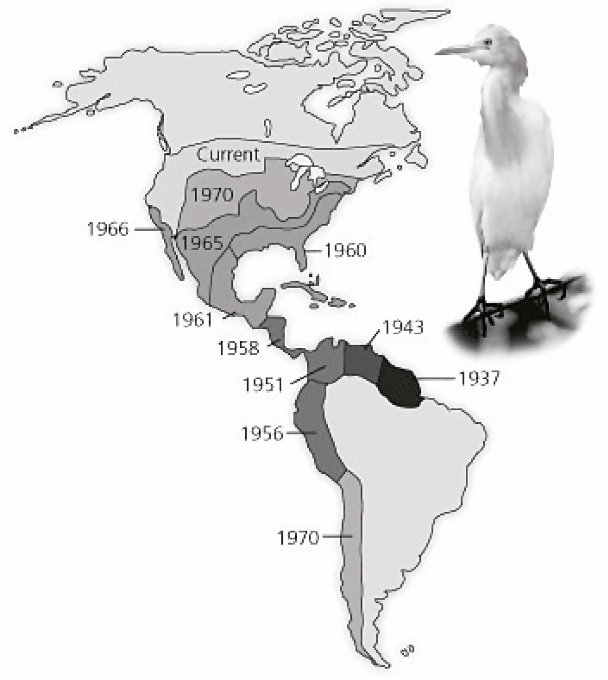
Use the diagram showing the spread of the cattle egret, Bubulcus ibis, since its arrival in the New World, to answer the question. The range of cattle egrets has expanded between 1937 (dark region in South America) and today, as depicted in the map with lighter shades indicating more recent advancements of the egret over time.
Which of the following claims best explains the expansion of the cattle egret range?
The abundant area and little competition with other birds occupying similar habitats met the biotic and abiotic requirements of the cattle egret expansion.
Which of the following is a mechanism by which ocean ecosystems affect the biosphere?
producing a substantial amount of the biosphere’s oxygen and being the source of most of Earth’s rainfall
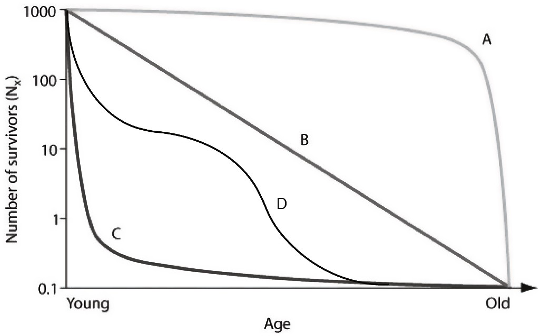
Analyze the provided graphical representation of survivorship trends and determine which curve best corresponds to a population characterized by high resource availability (e.g., stable access to nutrition, medical care, and infrastructure).
curve A
Evaluate the fundamental assumptions underlying the mark-recapture method used to estimate wildlife populations. Which of the following represents the most critical assumption that must be met for this method to produce an accurate population estimate? Justify your choice by considering how violations of different assumptions affect the reliability of the data.
The probability of recapturing a previously marked individual is equal to that of capturing an unmarked individual.
Long-term studies of Belding’s ground squirrels show that individuals are known to emigrate up to 2 kilometers from where they are born. Over time, immigrants comprise up to 8% of individuals in the new population. Which of the following answers describes an evolutionary benefit from immigration among populations?
These immigrants provide a source of genetic diversity for the receiving populations.
In 2025, the United States Census Bureau reported the various components of population change as estimated below.
One birth every 9 seconds
One death every 9.4 seconds
One international migrant (net of immigrants versus emigrants) every 23 seconds
Net gain of one person every 21 seconds
During that year, which of the components was having the smallest effect on population growth?
the net immigration rate
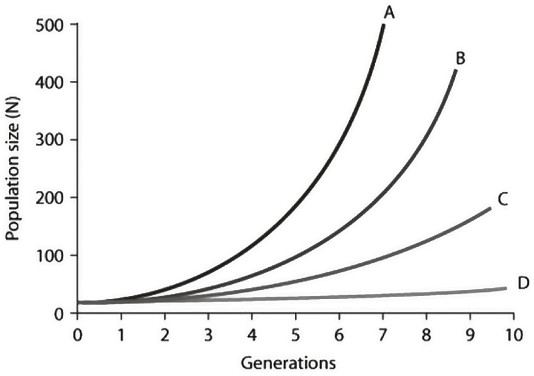
Based on the provided graph, which illustrates different population growth rates over multiple generations, which of the following factors is the most plausible explanation for the differences in growth trajectories among populations A, B, C, and D?
differences in per capita birth and death rates, with higher net reproduction leading to steeper growth curves
A biologist is monitoring two coral reef ecosystems off the coast of Australia: one remains largely undisturbed, while the other has been impacted by a recent cyclone, causing significant coral breakage and habitat disruption. Based on ecological principles, in which reef are more species likely to exhibit exponential population growth, and why?
disturbed reef, because the loss of competition and increased resource availability allow certain opportunistic species to expand rapidly
Based on the population growth model shown in the figure, which of the labeled points most accurately represents the point at which population growth stabilizes due to environmental constraints?
point C, where the population size levels off as it reaches environmental carrying capacity
Which of the following graphs best illustrates the growth curve of a small population of rodents that has increased to a static carrying capacity?

In which of the following situations would you expect to find the largest number of
r-selected individuals?
a recently abandoned agricultural field in Colorado
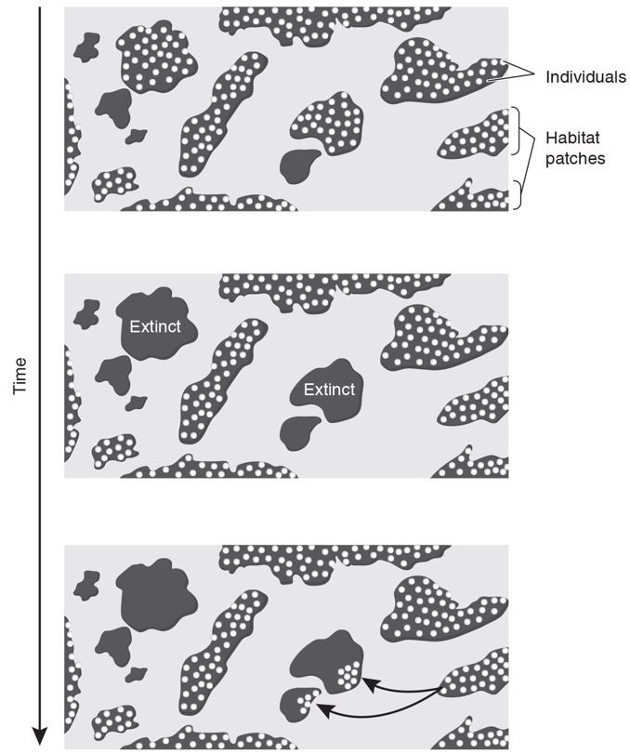
Which of the following topics is represented by the figures showing the fate of individuals in distinct habitat patches over time?
metapopulations
Which of the following statements regarding the future of populations in developing, less industrialized countries are correct?
Survivorship will increase, overall population size will increase dramatically, and the fertility rate is predicted to remain high, especially in some regions.

Infant mortality and life expectancy at birth in developed and developing countries (data as of 2005).
What is a logical conclusion that can be drawn from the graphs about developed countries?
lower infant mortality rates and higher life expectancy than developing countries
Which of the following is consistent with a recent study of ecological footprints?
The ecological footprint of the United States, Canada, and Australia are large because per capita resource use is high.
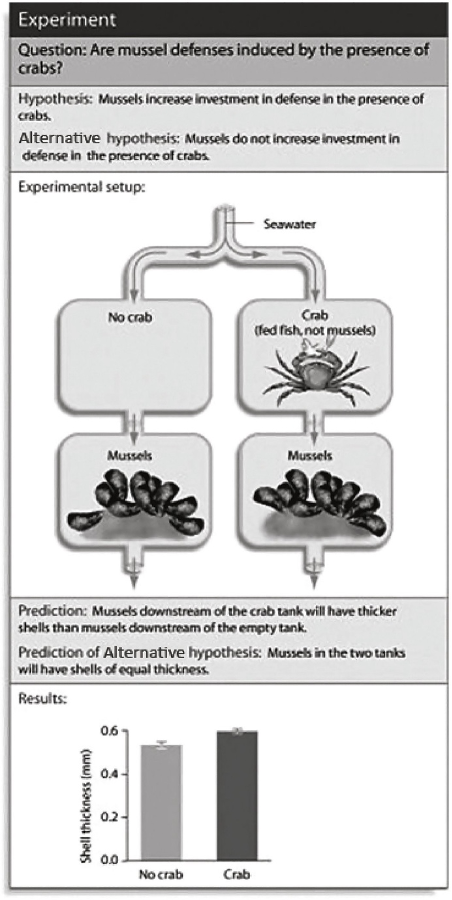
Which of the following conclusions is best supported from the experimental evidence in the figure?
Without direct contact, mussels can sense the presence of crabs.
A field biologist studying two closely related predatory beetle species, the ember-striped beetle and the dusk-forager beetle, observes that in regions where the species’ ranges do not overlap, both are nocturnal hunters. However, in areas where both species coexist, the ember-striped beetle hunts at night, while the dusk-forager beetle shifts its activity to the morning. To further investigate, the biologist isolates individuals from each species in a controlled lab setting and finds that their offspring are naturally nocturnal, regardless of whether they come from an overlapping or non-overlapping habitat. The observations above indicated that the two species likely demonstrate which of the following ecological principles?
resource partitioning, where species alter behavior to utilize different resources and reduce niche overlap

In this experiment, Balanus balanoids was removed from the habitat shown on the left, obtaining the results shown on the right. Which of the following statements is supported by the results of this experiment?
Competition with B. balanoids prevented C. stellatus from occupying the lower tide region of its fundamental niche.
Using the symbols +, −, and 0 to indicate interspecific species interactions, where the first symbol refers to the first organism mentioned, which of the following claims/statements is correct?
A +/− interaction could shift to +/0 or +/+ over time, depending on other factors such as competition, population density, or environmental changes.
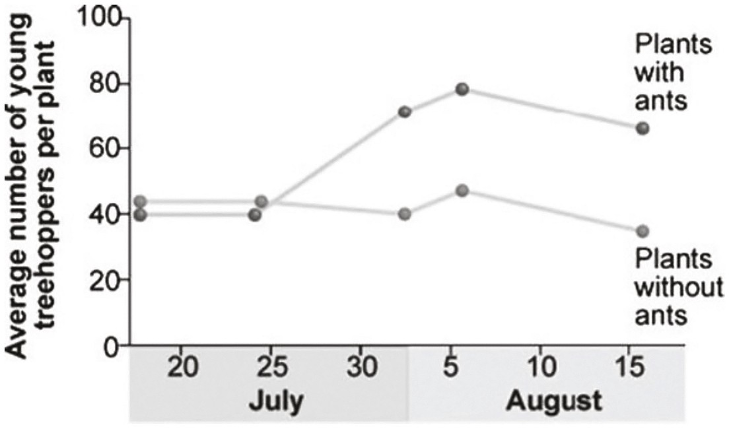
Treehoppers (a type of insect) produce honeydew, which ants use for food. Treehoppers have a major predator, the jumping spider. Researchers hypothesized that the ants would protect the treehoppers from the spiders. In an experiment, researchers followed study plots with ants removed from the system and compared them to a control plot. Which of the following conclusions is best supported by the data provided in the figure?
Ants do somehow protect the treehoppers from spiders.
Bouchard and Brooks studied the effect of insect flight on dispersal and speciation in rain forest insects. They sampled all of the insects in the study area and found that 60 insect species are flightless and 19 are able to fly. These results indicate which of the following?
Flightless insects have a higher species richness in the study area.
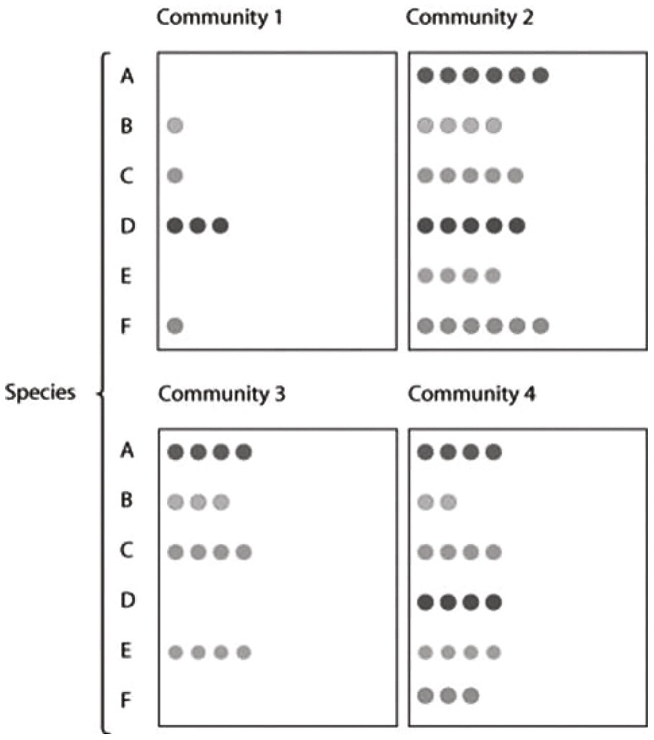
In the figure, species A through F are found among four communities, with the number of circles representing their abundance. Which species has the highest abundance across all of the communities shown?
Species A
Approximately how many kilograms (kg) of carnivore (secondary consumer) biomass can be supported by an area of a field containing 2,000 kg of plant material (assuming 10% efficiency in energy transfer)?
20
Elephants are not the most abundant species in African grasslands, yet they influence community structure. The grasslands contain scattered woody plants, but these woody plants remain relatively uncommon because of the uprooting activities of the elephants. If elephants were removed, the grasslands eventually are converted to forests or to shrublands. These newly growing forests support fewer species than the previous, more biodiverse grasslands. Which of the following statements best supports the elephants’ role as a keystone species in this scenario?
Elephants exhibit a disproportionate influence on the structure of the community relative to their abundance.
Which of the following best explains why moderate levels of disturbance result in an increase in community diversity?
Habitat is opened up for less competitive species.
Which of the following is a correct statement about MacArthur and Wilson’s island equilibrium model?
Larger islands receive more new immigrant species.
Use the following diagram of five islands formed at around the same time near a particular mainland, as well as the principles of MacArthur and Wilson’s island equilibrium model, to answer the question.
Which region would likely have the greatest species diversity?
the mainland
In terms of community ecology, which of the following best explains why pathogens are often more virulent now than in the past?
Human activities are transporting pathogens into new habitats (or communities) at an unprecedented rate.
A scientist who is studying a tropical rainforest ecosystem identifies two fundamental ecological processes that sustain life across multiple trophic levels. These processes ensure the continuous transfer of essential resources and energy within the system. Which of the following best describes these key emergent properties of an ecosystem?
the circulation of essential chemical elements within the environment and the one-way transfer of energy from producers to higher trophic levels
Which of the following are the main forms of energy inputs and outputs that move through an ecosystem?
sunlight and heat
In a grassland ecosystem in Colorado, scientists measure the movement of essential elements and energy through plants, herbivores, predators, and decomposers. They observe that while certain materials are recycled and reused, others follow a one-way path and cannot be reclaimed by the ecosystem. Which of the following is not continuously cycled within the ecosystem and instead follows a linear flow?
thermal energy released by organisms as a byproduct of metabolism?
Which of the following best represents the actions of photoautotrophs?
produce, and use, both oxygen and carbon dioxide?

Which of the following best explains why no arrows lead directly from “Detritus” to secondary consumers?
few primary consumers directly eat detritus, and so it is mostly broken down into inorganic compounds by decomposers such as earthworms, fungi, and prokaryotes
The amount of energy from light (or chemicals, in chemoautotrophic systems) converted to the chemical energy of organic molecules per unit time is defined as which of the following?
gross primary production

Which habitat type in the figure covers the largest area?
open ocean
Which of the following best explains why terrestrial productivity is higher in equatorial climates than in temperate climates?
Productivity increases with temperature and water availability
Which of the following ecosystems would likely have the largest net primary productivity per hectare and why?
grassland, because of rapid growth, the small standing crop biomass that results from consumption by herbivores, and rapid decomposition
Which of the following is primarily responsible for limiting the number of trophic levels in most ecosystems?
Energy transfer between trophic levels is usually less than 20% efficient.

Based on the information provided, which of the following contains the largest source or pool of nitrogen?
internal nitrogen cycling in the oceans