Ch. 6 Pt 2 CNS
 Call Kai
 Learn
 Practice Test
 Spaced Repetition
 Match
 Flashcards
 Knowt Play
1/46

There's no tags or description
Looks like no tags are added yet.
47 Terms
What are the 4 functions of the spinal cord?
Conduction, integration, locomotion, reflexes
How are the 31 pairs of spinal nerves divided?
Based on where they emerge from:
C1-L1 = spinal cord
L2-S5 = cauda equina
what are the 4 functional regions of the spine in order from top to bottom?
Cervical (neck/upper limbs)
Thoracic (chest)
Lumbar (abdomen/lower limbs)
Sacral (genitalia)
What are the 3 meninges of the spine?
Dura mater (tough stuff)
Arachnoid mater (spidery stuff)
Pia mater (delicate stuff)
What is the epidural space?
Space between vertebrae and dural sheath (covering dura mater). Usually filled with fat
What is the subarachnoid space?
Space between arachnoid mater and pia mater. Contains cerebrospinal fluid (CSF)

1. epidural space
2. Subarachnoid space
3. Dura mater
4. Arachnoid mater
5. Pia mater
Matter with little or no myelin. Association neurons (interneurons). Synapses between peripheral nerves and interneurons
Gray matter
Lot of myelin (mostly membrane→ rich in lipid content). Axons of ascending and descending neurons
White matter
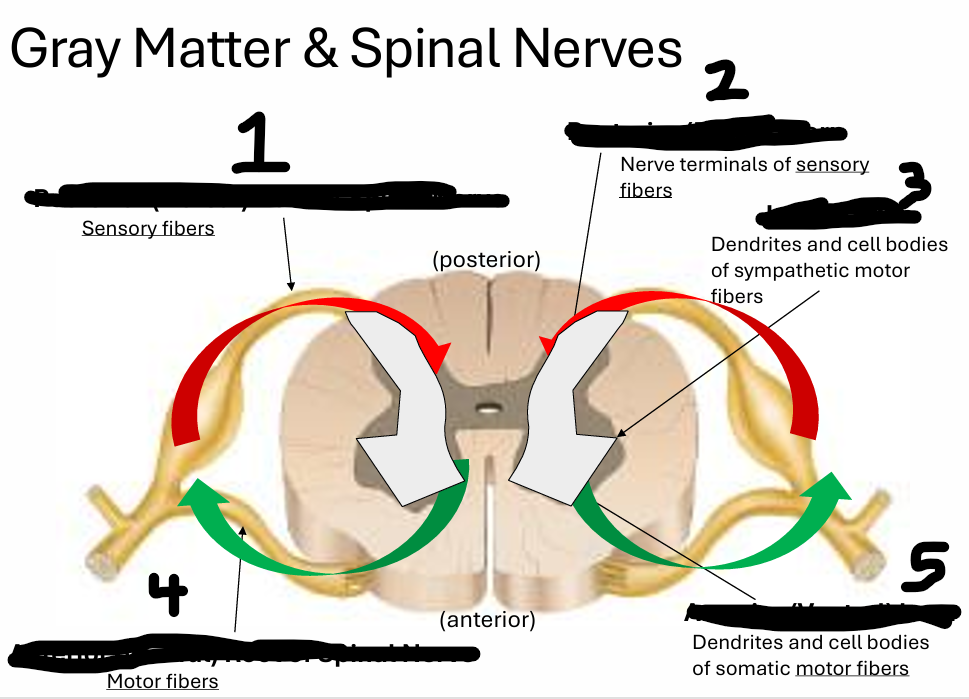
Posterior (dorsal) root of spinal nerve
Posterior (dorsal) horn
Lateral horn
Anterior (ventral) root of spinal nerve
Anterior (ventral) horn
What are the areas of white matter running up and down the spinal cord and what kind of fibers do they contain?
Posterior column (top; all sensory fibers)
Lateral columns (left & right; mixed fibers)
Anterior column (bottom; mostly motor fibers)
Motor =
descending
sensory =
ascending
Clusters of nerves in parallel arrangements in the CNS. Ascending & descending
Nerve tracts
What is the naming rule for sensory tracts?
spino - [destination to brain]
What are the 3 neurons involved with sensory pathways?
3rd order neuron: From thalamus to postcentral gyrus of cerebral cortex (sensory region of brain)
2nd order: From brainstem or spinal cord to the thalamus (“gateway”) in brain
1st order: Detects a stimulus and sends it to the brainstem or posterior horn of spinal cord
What is the naming rule for motor tracts?
[origin in the brain] - spinal
What are the 3 neurons involved with motor pathways?
Upper motor neuron: From precentral gyrus of cerebral cortex to brain stem or spinal cord (motor region of the brain)
Lower motor neuron: Synapses with upper motor neuron and terminates at target organs
What is a nerve?
cord-like organs composed of nerve fibers (axons)
sheath that wraps around single nerve fibers and their myelin sheaths
endoneurium
sheath that wraps around groups of nerve fibers (nerve fascicle)
Perineurium
wrapping that covers the entire nerve
Epineurium
What are the 4 ways nerves are classified as?
By location of soma, by function, by innervation, and by range of organs innervated
What are the two locations for nerve somas?
cranial (innervate head)
spinal (innervate rest of body)
What are the 3 functions of nerves?
afferent/sensory nerves
efferent/motor nerves
mixed nerves
What are the two types of nerve innervations?
somatic & visceral fibers
What are the two ranges of organs innervated by nerves?
General fibers (innervate widespread organs: muscles, skin, viscera)
Special fibers (innervate more localized organs: eyes, ears, taste)
What 2 diseases cause destruction of motor neurons and production of skeletal muscle atrophy from lack of innervation?
Poliomyelitis and ALS
Caused by the poliovirus
Destroys motor neurons in brainstem and anterior horn of spinal cord
Causes muscle pain, weakness, and loss of some reflexes, followed by paralysis, muscular atrophy, and respiratory arrest
Virus spreads by fecal contamination of water (outbreaks in first half of 1900s)
Poliomyelitis
Destruction of motor neurons and muscular atrophy
Scarring of lateral regions of the spinal cord
The neurotransmitter glutamate accumulates to toxic levels
Causes muscular weakness, difficulty speaking, swallowing, and use of hands
Sensory and intellectual functions remain unaffected
Amyotrophic lateral sclerosis (ALS)
cluster of neurosomas outside the CNS
ganglion
contains somas of unipolar sensory neurons
posterior root ganglion

Posterior (dorsal) root ganglion
Gray commissure
Posterior (dorsal) root nerve
Spinal nerve
Anterior (ventral) root of spinal nerve
Central canal
What are the 4 nerve plexuses?
Cervical, brachial, lumbar, sacral
What are the key spinal nerves for each plexus?
cervical - phrenic nerve (diaphragm)
brachial - radial & ulnar nerve
lumbar - femoral nerve (quads)
sacral - sciatic nerve (hamstrings)
Each zone of the skin ( _____________) is innervated by sensory branches of the spinal nerves
dermatomes
Common disease of early childhood. Caused by varicella virus. Produces itchy rash that clears up (usually without complications). Virus remains for life in the posterior (dorsal) root ganglia (sensory neuron somas)
Chickenpox
Localized disease caused by the virus from chickenpox traveling along sensory nerves (when immune system is compromised). Painful trail of skin discoloration and fluid-filled vesicles along path of nerve (usually along one dermatome)
Shingles
Quick, involuntary, stereotyped (predictable) reactions to glands and muscles to stimulation. Automatic responses to sensory input that occur without our intent or often even our awareness. Can include glands and all 3 types of muscle
Reflexes
unlearned skeletal muscle reflexes mediated by brainstem/spinal cord
Somatic reflexes
What is the fastest/simplest reflex arc that goes from Somatic Sensor → afferent nerve fiber → efferent nerve fiber → effector?
Monosynaptic
Which reflex arc is most common that allows for integration that goes from Somatic receptor → afferent nerve fiber → interneuron(s) → efferent nerve fiber → effector?
Polysynaptic
What is the stretch reflex?
The tendency to cause a muscle to contract when it is rapidly stretched. Almost always involves reciprocal inhibition (Antagonists are inhibited during a reflex)
What is an example of reciprocal inhibition where there’s suppressed contraction of hamstrings when the quadriceps are contracting?
patellar tendon reflex
How do muscles know they are rapidly stretched?
Muscle spindles: stretch receptors that feed back info to the CNS about muscle tone/movement
The process of moving a body part away from a noxious stimulus. Requires a prolonged stimulation of flexor muscle
Flexor (withdrawl) reflex or ipsilateral reflex
The contraction of extensor muscles (and relaxation of flexor muscles) in limb opposite of the one that is withdrawn. Maintains balance by extending other leg
Crossed extension reflex