Temperature and Heat
 Call Kai
 Learn
Learn Practice Test
 Spaced Repetition
 Match
Match Flashcards
 Knowt Play
1/139

There's no tags or description
Looks like no tags are added yet.
Name | Mastery | Learn | Test | Matching | Spaced | Call with Kai | Chat |
|---|
No analytics yet
Send a link to your students to track their progress
140 Terms
What is temperature?
A measure of the average kinetic energy of the particles in a substance.
How is temperature different from heat?
Temperature measures average particle kinetic energy; heat is energy transferred because of a temperature difference.
What is internal energy?
The total kinetic and potential energies of all atoms and molecules in a substance.
- How do thermometers measure temperature?
By expanding when heated or contracting when cooled.
What are the three temperature scales?
Fahrenheit, Celsius, and Kelvin.
What is absolute zero?
The coldest possible temperature: 0 K, −273.15°C, or −459.67°F.
- Why is Kelvin called an absolute temperature scale?
It starts at absolute zero.
How does temperature affect particle motion?
Higher temperature means greater average kinetic energy and faster particle motion.
- How do particles move in solids and liquids?
They vibrate; gas particles move randomly at high speeds.
Can absolute zero be reached?
According to the notes, no; particles cannot be completely stopped.
- What happens to some materials at very low temperatures?
They may become brittle, become superconductors, or exhibit superfluidity.
What happens to matter at extremely high temperatures?
Atoms cannot remain bound together; at sufficiently high temperatures, electrons separate from atoms and plasma forms.
What is escape velocity?
The minimum speed needed to overcome a planet's gravitational pull.
- What determines whether a planet can retain a gas?
The gas's average molecular speed compared with the planet's escape velocity.
- What is thermal expansion?
The expansion of a substance as its temperature increases.
- Why do substances expand when heated?
Their particles move or vibrate more and spread farther apart.
What happens if a substance is prevented from expanding?
Forces and pressures develop.
What is linear expansion?
A change in an object's length due to temperature change.
- What does the coefficient of linear expansion (α) describe?
How much a solid expands or contracts with temperature changes.
- Is thermal expansion reversible?
Yes; objects generally contract when cooled.
- What is a bimetallic strip?
Two different metals bonded together that bend because they expand at different rates.
- What happens to a bimetallic strip when heated?
It bends because the two metals expand by different amounts.
- How does thermal expansion affect solids in three dimensions?
Their length, width, thickness, surface area, and volume can increase.
- How do liquids respond to heating?
They generally expand in volume.
- How does water behave between 0°C and 4°C?
It contracts when heated and expands when cooled.
- Why do lakes and ponds freeze from the top first?
Water near 4°C is denser and sinks, while colder water and ice remain near the surface.
- Why does ice float on water?
Ice is less dense than liquid water.
- What is Charles' law?
At constant pressure, a gas's volume is proportional to its absolute temperature.
- What happens to a gas's volume if its Kelvin temperature increases by 10% at constant pressure?
Its volume increases by 10%.
- What is the ideal gas law relationship in your notes?
(pV = (\text{constant})T).
- What does the ideal gas law relate?
Pressure, volume, and temperature.
- What happens to gas pressure when temperature increases at constant volume?
Pressure increases proportionally to Kelvin temperature.
- Does heating change an object's mass or weight?
No.
- How does thermal expansion affect density?
Density decreases when volume increases but mass stays the same.
- What are two ways to increase a substance's temperature?
Expose it to something hotter or do work on it.
- How can friction increase temperature?
Friction does work, converting mechanical energy into internal energy.
- How can compressing a gas increase its temperature?
Work is done on the gas, increasing its internal energy.
What does the symbol (U) represent?
Internal energy.
- What contributes to the internal energy of a gas, according to your notes?
The kinetic energies of its particles.
- What contributes to the internal energy of solids and liquids?
Both kinetic and potential energies of their particles.
- What is heat?
Energy transferred between substances because of a temperature difference.
What is the symbol for heat?
(Q).
- In which direction does heat naturally flow?
From a hotter substance to a cooler substance.
- What is the difference between heat and internal energy?
Heat is energy in transfer; internal energy is energy stored within a substance.
- State the First Law of Thermodynamics.
Change in internal energy = work done on the substance + heat transferred to it.
What is the equation for the First Law of Thermodynamics?
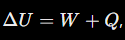
- When is (Q) positive?
When heat flows into a substance.
- When is (Q) negative?
When heat flows out of a substance.
What is thermal equilibrium?
When two substances have the same temperature and there is no net heat transfer between them.
- Why can temperature stay constant during a phase change even when heat is added?
The added energy changes particle potential energy rather than average kinetic energy.
- What are the three methods of heat transfer?
Conduction, convection, and radiation.
- What is conduction?
Heat transfer through direct contact between particles.
- How does heat travel through a metal pan?
Faster-moving particles transfer energy to neighboring particles.
- What is a thermal insulator?
A material through which heat flows slowly.
- Give examples of thermal insulators.
Wool, Styrofoam, and fiberglass.
- What is a thermal conductor?
A material through which heat flows readily.
- Give examples of thermal conductors.
Diamond and metals such as iron and copper.
- Why are metals good thermal conductors?
Mobile electrons transfer internal energy through the metal.
- Why does a vacuum prevent conduction?
It contains no particles to transfer energy through direct contact.
- What four factors affect the rate of conduction?
Temperature difference, distance, cross-sectional area, and thermal conductivity.
- Why does a rug feel warmer than a tile floor?
It conducts heat away from your feet more slowly.
- What is convection?
Heat transfer through the buoyant movement and mixing of a fluid.
- Why does warm air rise?
Heating lowers its density, and the surrounding denser air pushes it upward.
- What is forced convection?
Heat transfer caused by mechanically mixing a fluid.
- Give an example of forced convection.
Stirring cream into hot coffee or blowing air through a room.
How does convection help form cumulus clouds?
Warm air rises, cools, and its water vapor condenses into droplets.
- What causes a sea breeze during the day?
Land heats faster than water, causing air over land to rise and cooler air from the sea to move inland.
- What causes a land breeze at night?
Land cools faster than water, causing air to move from land toward the sea.
- What is radiation?
Heat transfer by electromagnetic waves.
- Can radiation transfer energy through a vacuum?
Yes.
- What happens when an object absorbs more radiation than it emits?
It gains internal energy and warms up.
- What kind of radiation do relatively cool objects mainly emit?
Infrared radiation.
- How does the Sun heat Earth?
By radiation.
- How do thermals form?
The Sun heats the ground by radiation, the ground heats nearby air by conduction, and the warm air rises by convection.
- How does building insulation reduce energy costs?
It reduces heat transfer, especially by conduction.
- How does a thermos reduce heat transfer?
A near-vacuum reduces conduction, and reflective inner surfaces reduce radiation.
- What is specific heat capacity?
The heat required to raise the temperature of a unit mass of a substance by one degree.
What symbol represents specific heat capacity?
(C).
- What three factors determine the heat needed to change temperature?
Specific heat capacity, mass, and temperature change.
What is the specific heat equation?


(Q) = heat transferred; (C) = specific heat capacity; (m) = mass; (\Delta T) = temperature change.
- What is the SI unit for specific heat capacity?
J/(kg·°C), or equivalently J/(kg·K).
- How does mass affect the heat required?
Doubling the mass doubles the heat needed for the same temperature change.
- How does specific heat capacity affect temperature change?
A higher specific heat capacity means more heat is needed for the same temperature change.
- Why is water useful for cooling?
Its high specific heat capacity allows it to absorb large amounts of heat with a relatively small temperature increase.
- Does all mechanical work produce a large temperature increase?
No; typical amounts of work often produce only small temperature changes.
- What is a phase transition?
A change from one state of matter to another.
- What is boiling?
Liquid changing into gas.
- What is melting?
Solid changing into liquid.
- What is condensation?
Gas changing into liquid.
- What is freezing?
Liquid changing into solid.
- What happens to water's temperature while it boils at sea level?
It remains at 100°C (212°F) while boiling continues.
- Why does temperature stay constant during boiling?
Added energy increases potential energy by separating molecules rather than increasing average kinetic energy.
- How does pressure affect water's boiling point?
Higher pressure raises it; lower pressure lowers it.
- Why does food take longer to cook at high elevations?
Lower atmospheric pressure lowers water's boiling point.
- What happens to temperature while ice melts?
It remains at 0°C (32°F) until melting is complete.
- What happens to particle potential energy during melting?
It increases.
- What happens to particle potential energy during freezing or condensation?
It decreases.
- What is latent heat?
Energy absorbed or released during a phase change at constant temperature.
- What is latent heat of fusion?
Energy required to change a solid into a liquid, or released during freezing.