MS - Neuromuscular Junction + Excitation-Contraction Coupling
 Call Kai
 Learn
 Practice Test
 Spaced Repetition
 Match
 Flashcards
 Knowt Play
1/15

There's no tags or description
Looks like no tags are added yet.
16 Terms
sarcolemma: definition, what it does
cell membrane, wraps around a myofiber (basically the outer border of a myofiber)
sarcoplasm: definition + what it does
cytoplasm, inside each myofiber and surrounds the bundles of myofibrils
what is a t tubule
penetrates cytoplasm of cell

what is a terminal cisternae
modified smooth ER that stores calcium

what makes up a triad and where are the components of the triad?
a triad is made of a t tubule and 2 terminal cisternaes
t tubule - associated with sarcolemma
terminal cisternae - associated with sarcoplasmic reticulum (SR)
what system activates a skeletal muscle?
voluntary motor system
what is excitation contraction coupling?
when a neuron sends an electrical signal to a muscle fiber, thus exciting it and releasing Ca, causing contraction to happen
1st Step of the Neuromuscular Junction (NJM)
calcium channels on the axon terminal of the neuron open up, allowing calcium to flow into the neuron and bind to the neurotransmtiter vesicles

2nd Step of the Neuromuscular Junction (NJM)
The calcium binded to the neurotransmitter vesicles allow the vesicles to exocytosis out of neuron and go into the synaptic cleft (neuromuscular junction)
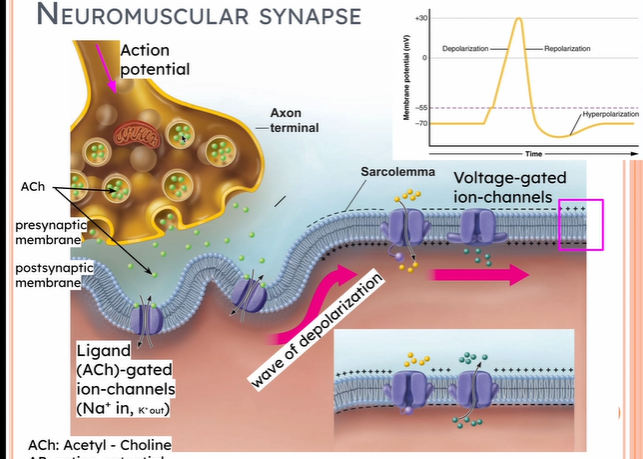
3rd Step of NJM
Neuron releases ACh (acetylcholine) to communicate with the skeletal muscle cells

4th Step of NJM
ACh in synaptic cleft bind to ACh ligand-gated channels, letting Na in and K out
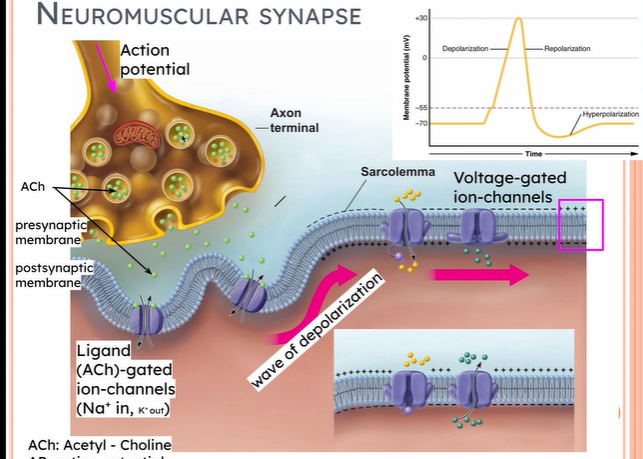
5th Step of NJM
The ligand gated channels allow for depolarization (changing of the electrical current in and out of a membrane), activating the voltage gated na channel and letting an influx on Na into cell

6th Step of NJM
voltage gated k channel is going to open: K is going to flow out of the cell, allowing for repolarization and slowly closing the K voltage-gated ion channels
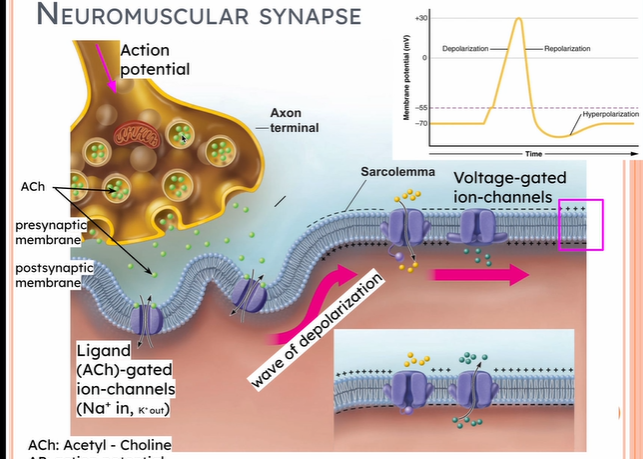
how do the neurotransmitters actually make the muscle move? (steps)
action potential travels along sarcolemma, going into T tubule area and changing the voltage-sensitive receptor on T tubule
voltage-sensitive receptor will open, opening the mechanically-gated Ca channels on the surface of the terminal cisternae
Ca trapped inside the cisternae flow out into the cytoplasm of the skeletal muscle cells, binding to troponin in thin filaments

what needs to happen for the muscle to return to resting length?
stop the contraction
gravity
contraction of agonist muscle
what are the steps of muscle relaxation?
stop axon release of ACh
degrade ACh with Achesterase
close ligand-gated ion channels on post-synaptic membrane (the sarcolemma)
Put the Ca back into SR
Tropomyosin, actin, troponin, and myosin go back to its resting state
titin proteins of sarcomere reshape