Cognition
 Call Kai
 Learn
 Practice Test
 Spaced Repetition
 Match
 Flashcards
 Knowt Play
1/29

There's no tags or description
Looks like no tags are added yet.
30 Terms
Cognition
Mental processes used to acquire, use and generate knowledge: attention, memory, language, reasoning, judgment, planning, etc
· Cannot be observed directly - infer it from measurable behaviour on cognitive tasks
6 common domains
1. Executive function
2. Attention/working memory
3. Memory
4. Language
5. Visuospatial function
6. Social cognition
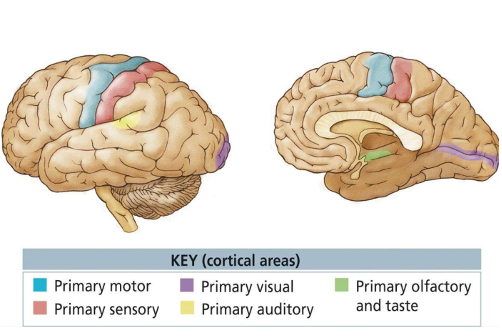
Association cortex
Lies across all 4 cortical lobes and integrates incoming sensory info with stored knowledge, creating meaningful perception, supporting effective interaction, abstract thought and language
Association cortex - inputs
Primary/secondary sensory and motor cortices, thalamus and brainstem
Association cortex - outputs
Hippocampus, basal ganglia, cerebellum, thalamus and other association areas
Posterior association cortex
Area of grey matter that synthesises sensory info and memory and frontal association cortex supports complex behaviour
· Parietal, temporal and occipital lobes
Dorsolateral prefrontal cortex (DLPFC)
Important for planning, temporal sequencing, speech and logical reasoning
Binding problem
How separate visual, auditory, tactile and motor signals become one coherent perception or action
Multimodal association
Neurons respond to more than one sensory modality so integration across modalities offers a solution to the binding problem
· E.g. matching a person’s voice with their face
Attention
Selectively prioritising one stimulus or thought among competing inputs
· Frontal lobes help control and disengage attention
- Frontal injury can cause difficulty shifting away from irrelevant or environmental stimuli
· Frontal and parietal systems help direct attention to contralateral space (e.g. orienting the eyes/head and reaching)
Letter-Number sequencing test
Assesses attention and working memory - part of the WAIS-IV
· Procedure: participants hear mixed letters and numbers, then repeat them with numbers in ascending order followed by letters in alphabetical order
· Higher scores indicate better attention and working memory
· Those with frontal lobe deficits (e.g. Parkinson's disease or dementia) perform poorly
ADHD
· Cortical thinning in attention/executive networks and atypical regulation of large-scale networks
- Dorsal attention networks contribute goal-directed top-down control and interact with ventral networks during attentional tasks
Left hemispatial neglect vs visual extinction
· Extinction can occur across multiple senses

Left neglect assessments to identify
1. Copying/drawing (omit left details)
2. Cancellation (miss left targets)
3. Line bisection (mark midpoint too far right)
Planning
Formulating, evaluating and ordering thoughts/actions to achieve a goal
· An executive function
Prefrontal cortex
Identify goals, prioritise, time and sequence actions
Temporal/occipital cortex
Recognise objects and surroundings
Parietal cortex
Guide movement through space
Frontal lobe
· Coordinate all the cortex’s
· What you need to do, when you need to do it, prioritise tasks, organize in sequence
WCST
· Probes cognitive flexibility, rule shifting and perseveration
· Frontal/DLPFC injury can increase perseverative errors
· Scores include categories achieved, trials, errors and perseverative errors
· 12-20 mins
WCST - procedure
· Match cards by an unstated rule (e.g. colour) and feedback indicates correct/incorrect
· Rule changes to shape or number and the participant must discover and switch to the new rule
Mirror neurons
Discharge when an animal performs an action and when it observes another performing that action
· Rizzolatti discovered they’re found in macaque premotor area F5
· Human inferior frontal cortex and superior parietal lobe are active
Mirror-neuron theory
Shared action representations help us recognise others’ actions, imitate behaviour and possibly understand communication
· Observing actions activates brain regions involved in action processing: inferior frontal and parietal regions, alongside visual areas in the occipital and temporal lobes.
· Evidence limitations: direct evidence of individual mirror neurons in humans is limited, so their proposed functions are not fully established and therefore theoretical
Functional lateralization
Some functions are processed more efficiently in one hemisphere - but neither hemisphere performs only one type of task
· Visual info from each visual hemifield reaches the opposite hemisphere
Left vs right hemisphere tendency

Split-brain experiments
· Showed corpus callosum connects hemispheres
· Surgical disconnection has been used as a last-resort treatment for refractory epilepsy as it prevents normal interhemispheric sharing of info
Split-brain experiments - experiment 1
· Spoon in RIGHT visual field → LEFT hemisphere → person can verbally name “spoon”
· Spoon in LEFT visual field → RIGHT hemisphere → person may be unable to name it aloud
· Doesn’t mean the object was not perceived
Split-brain experiments - experiment 2
· Spoon in LEFT visual field → RIGHT hemisphere → LEFT hand can reach for the spoon despite inability to name it
Split-brain experiments - experiment 3
· Hands may select different objects or interfere with each other
· Interhemispheric competition
Sex differences in cognition
· Women higher on some verbal-fluency tasks, greater volume prefrontal and medial paralimbic systems and increased cortical grey matter concentration
· Men higher on some mental-rotation tasks, greater volume medial/orbital frontal and angular gyrus and more uniform grey matter concentration and more aggressive
· Rat findings: male rats had larger dendritic fields in medial frontal cortex and female rats in orbitofrontal cortex
- Sex hormones impact cortical organisation and cognition
- Cannot be assumed to generalise to human cognition
· Evolutionary explanations involving historical spatial navigation and caregiving/language roles